
Refund abuse has become one of the most expensive challenges facing ecommerce businesses. Unlike payment fraud, refund abuse usually occurs after a legitimate purchase has been completed. Customers receive the product, then exploit return policies to request refunds that may not be justified.
Whether you sell through Shopify, WooCommerce, Amazon, Flipkart, Etsy, AJIO, Meesho, Myntra, or your own D2C website, refund abuse can quietly reduce profitability through unnecessary refunds, inventory losses, shipping costs, and increased operational workload.
Many businesses rely on fraud detection software to identify suspicious buyers. While these tools are valuable, they cannot prove what actually happened during order fulfillment.
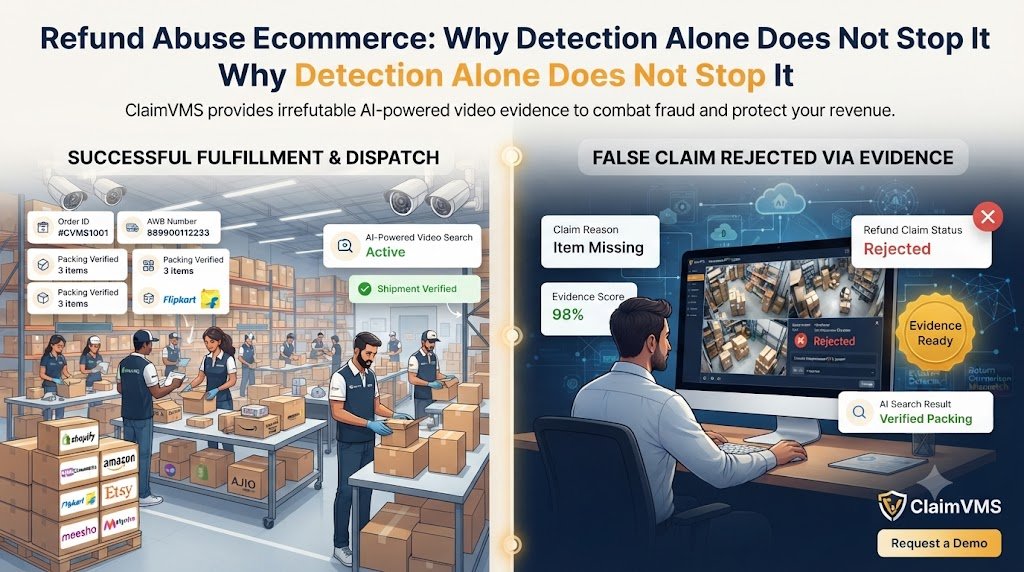
ClaimVMS fills this gap by creating order-linked packing videos, searchable warehouse CCTV evidence, and intelligent shipment records that help sellers respond confidently to refund disputes.
Why Refund Abuse Is Different from Payment Fraud
Payment fraud usually happens before an order is shipped.
Refund abuse happens after delivery.
The customer:
- Places a genuine order.
- Makes a successful payment.
- Receives the shipment.
- Later requests a refund using a disputed claim.
Because the transaction itself was legitimate, traditional checkout fraud tools cannot identify the abuse.
The problem shifts from payment verification to fulfillment verification.
Why Detection Alone Cannot Stop Refund Abuse
Many ecommerce businesses invest in software that detects suspicious customer behaviour.
These systems can identify:
- High return rates
- Repeat refund requests
- Multiple customer accounts
- Frequent chargebacks
- Unusual buying patterns
While these insights are useful, they do not answer the most important question:
What exactly was dispatched for this order?
Without shipment-specific evidence, merchants often struggle to challenge disputed refund requests.
The Three Most Common Types of Refund Abuse
Refund abuse can take several forms.
Understanding the differences helps businesses build stronger prevention strategies.
Wardrobing
Wardrobing occurs when customers purchase products for temporary use before returning them.
Common examples include:
- Fashion apparel
- Jewellery
- Electronics
- Seasonal products
- Event accessories
Products may appear suitable for return while showing signs of prior use that reduce their resale value.
Bracketing
Bracketing involves purchasing multiple versions of the same product with the intention of returning most of them.
Examples include:
- Multiple clothing sizes
- Different colours
- Several product variations
Although some returns are genuine, repeated large-volume returns can significantly increase operational costs.
Serial Return Abuse
Some customers repeatedly exploit return policies.
Typical behaviours include:
- Frequent “wrong item” claims
- Repeated damage complaints
- Empty parcel allegations
- Late refund requests
- Multiple disputes across different orders
Monitoring these patterns helps businesses identify accounts that require closer review.
How ClaimVMS Helps Reduce Refund Abuse
ClaimVMS transforms ordinary warehouse CCTV into an intelligent shipment verification platform.
Every packing session is automatically linked with:
- Order ID
- AWB Number
- Invoice Number
- Barcode
- QR Code
- Dispatch Date
- Shipment Status
Instead of manually searching through warehouse recordings, teams can retrieve shipment evidence within seconds.
A Practical Example
Imagine a skincare brand receives a refund request stating that the customer received the wrong product.
The operations team gathers:
- Invoice
- Order confirmation
- Courier tracking
- Customer communication
These documents confirm the transaction but cannot independently verify what was packed.
Using ClaimVMS, the warehouse team searches the Order ID.
The packing video clearly shows:
- Correct product selection
- SKU verification
- Barcode scanning
- Product inspection
- Packaging process
- Parcel sealing
- Shipping label attachment
The business now has shipment-specific evidence that supports the fulfillment process.
Why Traditional CCTV Systems Are Not Enough
Most warehouses already record packing areas.
However, standard CCTV systems are designed for security—not ecommerce dispute management.
Common challenges include:
- Videos organised only by date and time
- Manual timeline searches
- Multiple camera feeds
- Slow evidence retrieval
- Limited shipment indexing
- Difficult exports
ClaimVMS automatically indexes every recording using shipment information rather than timestamps, allowing businesses to retrieve evidence almost instantly.
Why Order-Linked Packing Videos Strengthen Seller Protection
Winning refund disputes requires more than invoices and courier tracking.
Order-linked packing videos provide:
- Shipment-specific verification
- Faster investigations
- Improved warehouse accountability
- Better operational transparency
- Reduced manual CCTV searches
- Stronger dispute responses
- Greater customer confidence
By documenting every fulfillment process and linking it directly to the order, ClaimVMS helps ecommerce businesses reduce refund abuse while improving warehouse accuracy and operational efficiency.
Why Documentation Is More Powerful Than Detection
Many ecommerce businesses focus on identifying suspicious customers.
Detection tools can reveal:
High return frequency
Repeat refund requests
Unusual buying patterns
Multiple customer accounts
High-risk transactions
While this information is valuable, it does not prove what happened during a specific order.
When a customer claims they received the wrong product or a damaged item, investigators require order-specific evidence—not behavioural analysis.
This is where ClaimVMS provides a significant advantage by documenting every shipment at the point of dispatch.
Building a Complete Refund Abuse Evidence Package
A successful refund dispute response relies on organized, shipment-specific documentation.
A complete evidence package should include:
Order-linked packing video
Order confirmation
Invoice
Courier tracking details
Shipping label verification
Barcode or QR code scan records
Product inspection records
Return inspection photographs (if applicable)
Customer communication
Presenting evidence in a structured format helps marketplaces and payment providers review the case more efficiently.
Why Order-Level Evidence Matters
General warehouse procedures demonstrate how your business normally operates.
Order-level documentation proves what happened for one specific customer.
Packing videos can verify:
Correct product selection
SKU confirmation
Product condition before dispatch
Accessories included
Packaging process
Parcel sealing
Shipping label attachment
This creates independent evidence that complements invoices and delivery records.
Best Practices for Managing Refund Abuse
Reducing refund abuse starts with consistent warehouse operations.
Recommended practices include:
Verify every SKU before packing.
Scan products using barcodes or QR codes.
Record every packing station.
Seal parcels under camera coverage.
Preserve courier documentation.
Archive packing videos securely.
Photograph returned products immediately.
Review repeat refund requests.
Audit warehouse processes regularly.
Train staff on fulfillment accuracy.
These procedures improve both operational quality and dispute readiness.
Common Mistakes That Increase Refund Losses
Many businesses unknowingly weaken their own dispute responses.
Common mistakes include:
Relying only on invoices.
Depending only on courier tracking.
Missing dispute deadlines.
Not recording the packing process.
Using poor-quality CCTV footage.
Failing to organize shipment records.
Ignoring return inspection documentation.
Correcting these issues significantly improves evidence quality.
How ClaimVMS Simplifies Evidence Retrieval
Searching manually through warehouse CCTV recordings can take hours.
ClaimVMS automatically indexes every recording using:
Order ID
AWB Number
Invoice Number
Barcode
QR Code
Dispatch Date
Shipment Status
Warehouse teams simply enter the shipment details and retrieve the required video within seconds.
This reduces investigation time while improving the speed of dispute resolution.
Supporting Multi-Channel Ecommerce Businesses
Many businesses sell across several marketplaces simultaneously.
ClaimVMS centralizes shipment evidence for:
Shopify
WooCommerce
Amazon
Flipkart
Etsy
AJIO
Meesho
Myntra
Magento
Other ecommerce platforms
Instead of managing separate systems, businesses can retrieve shipment evidence for every order from a single searchable dashboard.
How ClaimVMS Changes the Economics of Refund Abuse
Refund abuse is profitable for fraudsters when merchants cannot produce strong evidence.
ClaimVMS changes this by making every shipment traceable and every packing process verifiable.
Businesses can:
Retrieve evidence instantly.
Compare dispatch and return conditions.
Export dispute-ready documentation.
Improve warehouse transparency.
Reduce manual CCTV searches.
Strengthen refund investigations.
Build confidence during marketplace disputes.
By reducing the uncertainty around what was dispatched, ClaimVMS helps make fraudulent refund claims far more difficult to support.
Final Thoughts
Refund abuse is no longer just a customer service issue—it has become a significant operational and financial challenge for ecommerce businesses.
While fraud detection software remains important, detection alone cannot prove what was packed, shipped, or dispatched for a specific order.
By combining warehouse CCTV, order-linked packing videos, shipment verification, and searchable evidence management, ClaimVMS gives businesses the tools they need to investigate disputes more effectively and respond with confidence.
As refund abuse continues to evolve, businesses that invest in structured dispatch documentation will be better positioned to reduce losses, improve operational efficiency, and protect long-term profitability.
Frequently Asked Questions
What is refund abuse in ecommerce?
Refund abuse occurs when customers exploit return or refund policies by making false or misleading claims to receive refunds while keeping or misusing the product.
Can fraud detection software stop refund abuse?
Fraud detection software can identify suspicious behaviour, but it cannot verify what was packed or shipped. Shipment-specific evidence is needed to challenge many refund disputes.
Why are packing videos useful for refund disputes?
Packing videos document product inspection, SKU verification, packaging, parcel sealing, and shipping label attachment, providing independent evidence of the dispatch process.
Can ClaimVMS work with existing warehouse CCTV systems?
Yes. ClaimVMS integrates with compatible warehouse CCTV systems and converts standard recordings into searchable, order-linked shipment evidence.
Which ecommerce platforms are supported by ClaimVMS?
ClaimVMS supports Shopify, WooCommerce, Amazon, Flipkart, Etsy, AJIO, Meesho, Myntra, Magento, and other ecommerce platforms.
How quickly can shipment evidence be retrieved?
Because recordings are indexed using Order IDs, AWB numbers, invoice details, and shipment information, warehouse teams can typically retrieve the required evidence within seconds.