
A customer-friendly return policy is essential for building trust and increasing conversions. However, as ecommerce continues to grow, many businesses are discovering that generous return policies can also create opportunities for abuse.
Whether you sell through Shopify, WooCommerce, Amazon, Flipkart, Etsy, AJIO, Meesho, Myntra, or your own D2C website, return policy abuse can quietly reduce profits through false damage claims, wrong-item allegations, product swapping, and repeated refund requests.
While tightening your return policy may reduce genuine returns, it does not necessarily prevent customers from making false claims after receiving an order.
ClaimVMS helps ecommerce businesses strengthen their post-purchase protection by combining warehouse CCTV, order-linked packing videos, and AI-powered shipment evidence that supports faster and more effective dispute resolution.
Why Return Policy Abuse Is Becoming a Bigger Challenge
Many businesses assume return policy abuse happens because their return window is too long.
In reality, the biggest problem is often the lack of shipment-specific evidence.
Customers may claim:
- The item arrived damaged.
- The wrong product was delivered.
- Accessories were missing.
- The parcel contained a different item.
- The product was not as described.
Without documentation showing what actually left the warehouse, businesses often struggle to challenge these claims.
Return Policy Abuse vs Return Fraud
Although these terms are often used interchangeably, they are not always the same.
Return fraud usually involves deliberate deception, such as:
- Returning a different product
- Empty parcel returns
- Product swapping
- Fake damage claims
- False delivery disputes
Return policy abuse often involves exploiting legitimate policies, including:
- Wearing products before returning them
- Ordering multiple variations with the intention of returning most of them
- Repeatedly using free return policies
- Filing claims at the end of the return period
Both situations increase operational costs and reduce profitability.
The Most Common Types of Return Policy Abuse
Understanding how customers misuse return policies helps businesses improve both warehouse operations and dispute preparedness.
Return Window Exploitation
Some customers intentionally use products throughout the allowed return period before requesting a refund.
Common examples include:
- Occasion wear
- Seasonal clothing
- Travel accessories
- Consumer electronics
- Home décor
Shortening the return window may reduce some cases, but it does not eliminate false damage or wrong-item claims.
Condition Claim Abuse
One of the most expensive forms of return policy abuse involves condition-related complaints.
Customers may claim that:
- The item arrived damaged.
- The packaging was defective.
- Parts were missing.
- The product appeared used.
Without visual dispatch evidence, it can be difficult to determine whether the damage occurred before shipping, during transit, or after delivery.
Wrong Product Claims
Some customers claim they received a different product from the one they ordered.
To investigate these disputes effectively, businesses need evidence showing exactly what was packed.
ClaimVMS records:
- SKU verification
- Barcode scanning
- Product inspection
- Packaging process
- Parcel sealing
- Shipping label attachment
This creates shipment-specific documentation linked directly to the order.
How ClaimVMS Strengthens Return Policy Protection
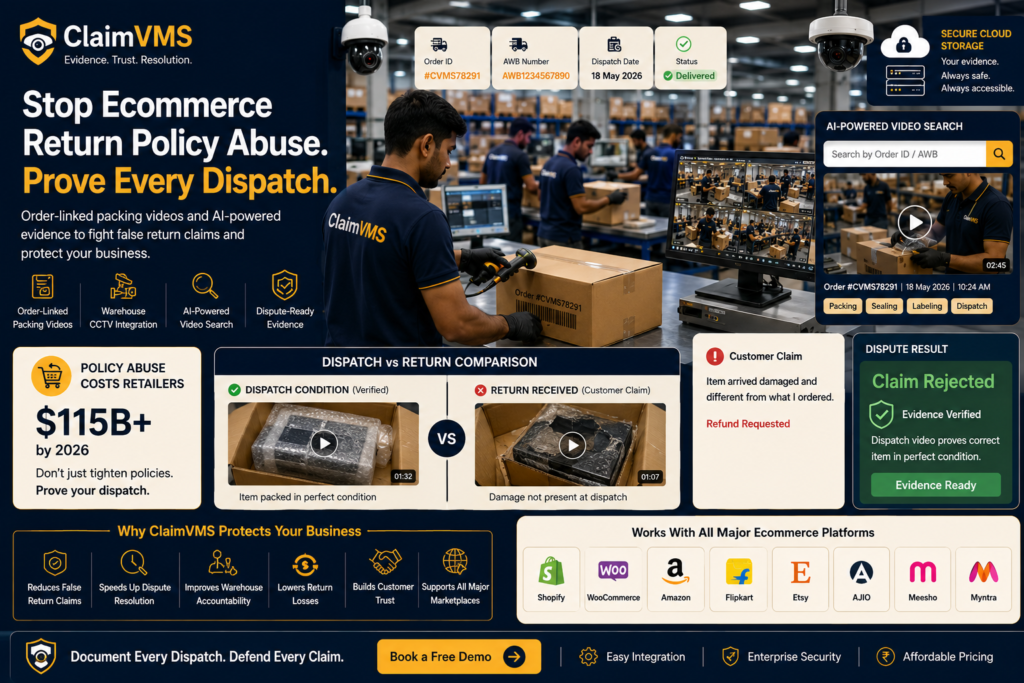
ClaimVMS transforms ordinary warehouse CCTV into an intelligent evidence management platform.
Every packing session is automatically linked with:
- Order ID
- AWB Number
- Invoice Number
- Barcode
- QR Code
- Dispatch Date
- Shipment Status
Instead of searching manually through hours of surveillance footage, warehouse teams can retrieve the correct packing video within seconds.
A Practical Example
Imagine a home décor brand receives a return request claiming that the customer received the wrong decorative lamp.
The operations team gathers:
- Order confirmation
- Invoice
- Courier tracking
- Product listing
Although these documents verify the transaction, they cannot independently prove which product was packed.
Using ClaimVMS, the warehouse team searches the Order ID and retrieves the corresponding packing video.
The recording clearly shows:
- Correct SKU selection
- Barcode verification
- Product inspection
- Packaging process
- Parcel sealing
- Shipping label confirmation
Instead of relying solely on paperwork, the business now has visual shipment evidence that supports the fulfillment process.
Why Traditional CCTV Systems Cannot Solve Return Policy Abuse
Most warehouses already use CCTV cameras.
However, conventional surveillance systems are designed for security rather than ecommerce investigations.
Typical limitations include:
- Videos organised only by date and time
- Manual timeline searches
- Multiple camera feeds
- Slow evidence retrieval
- Limited shipment indexing
- Difficult exports
ClaimVMS automatically indexes recordings using shipment information rather than timestamps, enabling warehouse teams to locate evidence in seconds.
Why Order-Linked Packing Videos Improve Seller Protection
Winning return-related disputes requires evidence that clearly demonstrates what happened before dispatch.
Order-linked packing videos help businesses:
- Verify shipment contents
- Confirm product condition
- Improve warehouse accountability
- Reduce manual CCTV searches
- Strengthen dispute responses
- Improve operational transparency
- Build long-term customer confidence
By documenting every shipment and linking each recording to its Order ID, ClaimVMS helps ecommerce businesses reduce return policy abuse while improving warehouse efficiency and protecting valuable inventory.
Why Strong Documentation Is More Effective Than Stricter Return Policies
Many ecommerce businesses respond to increasing return abuse by introducing stricter return policies.
Common changes include:
Shorter return windows
Higher restocking fees
Mandatory original packaging
More restrictive return conditions
While these measures may reduce genuine return requests, they often do little to stop customers who intentionally submit false damage claims or wrong-item complaints.
The real solution is not simply making returns harder—it is creating reliable evidence that verifies exactly what was dispatched.
Building a Complete Return Evidence Package
When a return dispute occurs, businesses should submit a structured evidence package rather than relying on a single document.
An effective evidence package should include:
Order-linked packing video
Order confirmation
Invoice
Courier tracking details
Shipping label verification
Barcode or QR code scan records
Product inspection records
Return inspection photographs
Customer communication (where applicable)
Combining these records provides a complete view of the order lifecycle and strengthens the dispute response.
Why Dispatch Documentation Matters
Many businesses can prove that an order was shipped.
Far fewer can prove the exact condition and contents of the parcel before dispatch.
Order-linked packing videos help verify:
Correct SKU selection
Product condition before packing
Accessories included
Packaging process
Parcel sealing
Shipping label attachment
Final dispatch verification
This shipment-specific documentation helps businesses compare what left the warehouse with what was returned.
Best Practices to Reduce Return Policy Abuse
Reducing abuse begins with disciplined warehouse processes.
Recommended best practices include:
Verify every SKU before packing.
Scan products using barcodes or QR codes.
Record every packing station.
Seal parcels under camera coverage.
Preserve shipment documentation.
Archive packing videos securely.
Inspect returned products immediately.
Photograph return condition.
Review repeat return patterns.
Audit fulfillment accuracy regularly.
These practices improve warehouse accountability while creating stronger evidence for future disputes.
Common Mistakes That Increase Return Losses
Many businesses unknowingly weaken their own position during investigations.
Common mistakes include:
Depending only on invoices.
Relying solely on courier tracking.
Not recording the packing process.
Missing response deadlines.
Using poor-quality CCTV footage.
Failing to organize evidence.
Ignoring return inspection documentation.
Correcting these issues helps improve both operational efficiency and dispute outcomes.
How ClaimVMS Simplifies Evidence Retrieval
Traditional CCTV systems require manual searches through hours of recorded footage.
ClaimVMS automatically indexes every recording using:
Order ID
AWB Number
Invoice Number
Barcode
QR Code
Dispatch Date
Shipment Status
Warehouse teams simply search using the shipment information and retrieve the required recording within seconds.
This significantly reduces investigation time and improves evidence quality.
Supporting Multi-Channel Ecommerce Businesses
Modern ecommerce sellers rarely operate on a single platform.
ClaimVMS provides centralized shipment evidence management for:
Shopify
WooCommerce
Amazon
Flipkart
Etsy
AJIO
Meesho
Myntra
Magento
Other ecommerce platforms
One dashboard allows businesses to retrieve shipment evidence regardless of where the order originated.
How ClaimVMS Reduces Return Policy Abuse
ClaimVMS helps ecommerce businesses move from reactive dispute handling to proactive evidence management.
The platform enables businesses to:
Record every packing process.
Link videos with Order IDs.
Retrieve shipment evidence instantly.
Compare dispatch and return conditions.
Export dispute-ready documentation.
Improve warehouse transparency.
Reduce manual CCTV searches.
Strengthen return investigations.
Instead of relying on assumptions, businesses can make decisions based on verified shipment evidence.
Final Thoughts
Return policy abuse continues to evolve as ecommerce grows, making traditional policy restrictions less effective against sophisticated false claims.
Although return policies remain important, the strongest protection comes from documenting every shipment before it leaves the warehouse.
By combining warehouse CCTV, order-linked packing videos, AI-powered evidence retrieval, and structured shipment documentation, ClaimVMS helps businesses reduce return-related losses while improving warehouse efficiency and customer confidence.
Businesses that invest in evidence management today will be better prepared to handle future disputes, reduce operational costs, and protect long-term profitability.
Frequently Asked Questions
What is return policy abuse?
Return policy abuse occurs when customers exploit legitimate return policies through excessive returns, false damage claims, wrong-item allegations, or repeated use of refund benefits.
How is return policy abuse different from return fraud?
Return fraud usually involves deliberate deception, while return policy abuse often exploits legitimate policy rules without technically breaking them. Both can lead to significant financial losses.
Why are packing videos important for return disputes?
Packing videos verify SKU selection, product condition, packaging, parcel sealing, and shipping label attachment, creating shipment-specific evidence for investigations.
Can ClaimVMS work with existing warehouse CCTV systems?
Yes. ClaimVMS integrates with compatible warehouse CCTV infrastructure and converts standard recordings into searchable, order-linked shipment evidence.
Which ecommerce platforms are supported by ClaimVMS?
ClaimVMS supports Shopify, WooCommerce, Amazon, Flipkart, Etsy, AJIO, Meesho, Myntra, Magento, and other ecommerce platforms.
How quickly can shipment evidence be retrieved?
Because every recording is indexed using Order IDs, AWB numbers, invoice details, and shipment information, warehouse teams can typically retrieve the required evidence within seconds.