
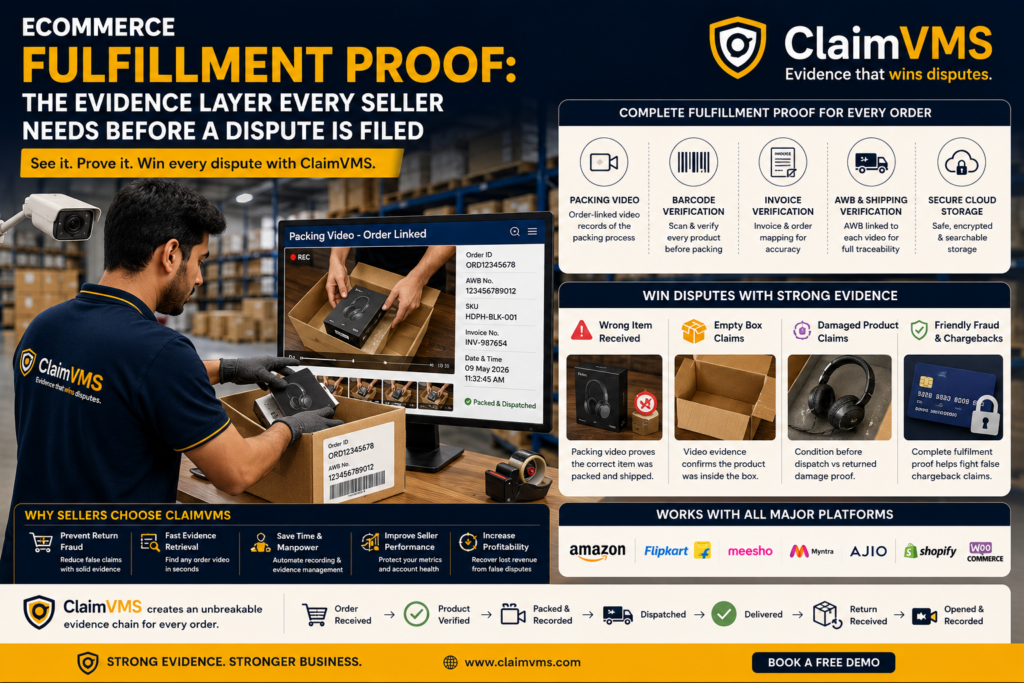
Why Ecommerce Fulfillment Proof Matters More Than Ever
Every ecommerce seller focuses on receiving orders, packing products, and shipping them on time.
But what happens when a customer claims:
- The box was empty.
- The wrong product was delivered.
- The item arrived damaged.
- A different item was received.
- The order was never packed correctly.
In these situations, traditional order records and courier tracking often fail to prove what actually happened.
That’s where ecommerce fulfillment proof becomes essential.
Fulfillment proof is the missing evidence layer that shows exactly what happened during packing—before any dispute or return request is ever raised.
Whether you sell on Amazon, Flipkart, Meesho, Myntra, AJIO, Shopify, WooCommerce, Magento, or your own D2C website, having reliable fulfillment proof can significantly improve dispute resolution and reduce losses caused by friendly fraud.
What Is Ecommerce Fulfillment Proof?
Ecommerce fulfillment proof is a complete, searchable, and verifiable record of what was packed and shipped for every customer order.
Unlike standard warehouse records, fulfillment proof provides visual evidence that can be independently verified.
Rather than relying on written notes or staff explanations, fulfillment proof documents the actual packing process.
A complete fulfillment record may include:
- Packing video
- Order ID
- AWB Number
- Invoice
- Product SKU
- Barcode verification
- Date & Time
- Operator details
- Camera recording
This evidence creates a trustworthy record that can be retrieved whenever a customer dispute occurs.
Why Independent Verification Is Important
When handling return disputes, chargebacks, or marketplace investigations, reviewers need evidence they can trust.
Statements like:
“Our team packed the correct product.”
are difficult to verify.
However, a time-stamped packing video linked to the exact Order ID allows anyone to independently confirm:
- Which product was packed
- The quantity shipped
- The parcel condition
- The shipping label
- The sealing process
This type of visual verification is significantly more reliable than handwritten warehouse records.
Why Standard Fulfillment Records Are Not Enough
Every ecommerce business already maintains operational records such as:
- Order management system
- Picking lists
- Dispatch logs
- Courier handover records
- Shipping confirmation
- Delivery tracking
While these records help manage daily operations, they usually do not answer the most important question during a dispute:
“What exactly was inside the parcel when it left the warehouse?”
For example:
An invoice proves what should have been shipped.
A courier tracking number proves a parcel was delivered.
Neither proves what was actually packed.
This evidence gap is one of the biggest reasons ecommerce sellers lose disputes.
Common Fulfillment Records vs. Actual Fulfillment Proof
Let’s understand the difference.
Order Management Records
These confirm that an order was processed.
They do not prove the correct product was physically packed.
Picking Lists
Picking lists show which product should be collected from inventory.
They cannot verify what actually entered the parcel.
Courier Pickup Records
Courier records confirm that a package was collected.
They do not identify the contents of that package.
Delivery Confirmation
Delivery confirmation proves that the parcel reached the customer.
It cannot verify:
- Product accuracy
- Product quantity
- Product condition
- Packaging quality
As a result, these documents alone often fail to resolve disputes involving wrong items, empty boxes, or damaged products.
The Three Components of Strong Ecommerce Fulfillment Proof
A strong fulfillment verification system combines multiple types of evidence.
Together, they create a complete chain of proof.
Component 1: Order-Linked Packing Video
This is the most valuable piece of fulfillment evidence.
ClaimVMS automatically records every packing process while linking the video with:
- Order ID
- AWB Number
- Product SKU
- Invoice
- Barcode
- Date & Time
The recording clearly shows:
- Product selection
- Product condition
- Quantity packed
- Parcel sealing
- Shipping label verification
This creates visual proof that can be retrieved instantly whenever required.
Component 2: Product Condition Verification
Photographs and visual inspection before packing help document the product’s condition.
Useful records include:
- Product photographs
- SKU verification
- Barcode scans
- Invoice verification
- Packaging inspection
These records strengthen the packing video by demonstrating that the product was in good condition before dispatch.
Component 3: Return Receiving Evidence
The fulfillment process shouldn’t end after shipping.
When returned parcels arrive, businesses should also document the return process.
A structured return verification process may include:
- Recording the unopened parcel
- Capturing the shipping label
- Weighing the package
- Recording the unboxing process
- Photographing returned contents
- Matching the return with the original Order ID
This creates a complete “before and after” evidence trail that helps resolve disputes involving empty box returns, product substitution, or damaged return claims.
Why Most Sellers Still Lack Fulfillment Proof
Many ecommerce businesses already have CCTV cameras installed inside their warehouses.
However, general warehouse surveillance is rarely enough during a dispute.
Finding one specific order among several hours of CCTV footage is difficult and time-consuming.
In many cases, the required footage cannot be located before the dispute deadline expires.
This is where ClaimVMS simplifies the entire process by automatically recording, organizing, and linking every packing video with its corresponding order details.
How to Automate Ecommerce Fulfillment Proof
Creating fulfillment proof manually for every shipment is nearly impossible for growing ecommerce businesses.
Whether you process 50 orders or 5,000 orders daily, manual documentation consumes valuable time and increases the chances of missing important evidence.
Automation solves this challenge.
Instead of depending on warehouse staff to manually record videos or capture photographs, ClaimVMS automatically creates fulfillment evidence during the packing process.
Every order is documented without interrupting warehouse operations.
Automatic Packing Video Recording
ClaimVMS starts recording the packing process automatically when an order is being prepared.
Every recording is linked with:
- Order ID
- AWB Number
- Invoice Number
- Product SKU
- Barcode
- Date & Time
- Packing Operator
- Camera ID
This creates a complete visual record of every shipment before it leaves the warehouse.
No manual file naming.
No searching through CCTV footage.
No missing recordings.
Secure Cloud Storage and Instant Search
One of the biggest problems with traditional CCTV systems is finding the correct footage.
ClaimVMS automatically organizes every packing video inside a searchable database.
Users can locate evidence using:
- Order ID
- AWB Number
- Invoice Number
- Customer Name
- Product SKU
- Dispatch Date
Instead of reviewing hours of warehouse recordings, the required evidence can be retrieved within seconds.
Return Verification Workflow
Fulfillment proof should continue even after the shipment reaches the customer.
Returned products should also be documented.
A standardized return process may include:
- Recording the unopened parcel
- Capturing the courier label
- Weighing the package
- Recording the complete unboxing
- Verifying returned products
- Matching the return with the original Order ID
This creates a complete before-and-after evidence chain that helps resolve return fraud and product substitution cases.
How ClaimVMS Creates a Complete Fulfillment Proof System
ClaimVMS is designed specifically for ecommerce businesses that need reliable proof for every shipment.
Unlike traditional CCTV systems, ClaimVMS automatically connects warehouse activity with order information.
For every shipment, ClaimVMS records:
- Order-linked packing videos
- AWB-linked verification
- Invoice mapping
- Barcode verification
- Product SKU mapping
- Timestamped recordings
- Searchable fulfillment records
- Secure cloud storage
- Instant video retrieval
Everything is connected to a single order, making dispute management faster and more efficient.
Disputes That Fulfillment Proof Helps Resolve
Strong fulfillment evidence helps ecommerce sellers respond confidently to several common dispute types.
Wrong Item Received
Customers may claim they received a different product.
ClaimVMS packing videos clearly show the correct item being packed and sealed before dispatch.
Empty Box Claims
Some buyers allege that the parcel arrived empty.
Order-linked packing videos demonstrate that the correct product was inside the parcel before it left the warehouse.
Product Damage Claims
Customers may report that products arrived damaged.
Packing videos and product condition verification help demonstrate the product’s condition before shipment.
Item Not Received (INR)
While courier tracking confirms delivery, ClaimVMS provides additional evidence showing that the shipment was packed correctly before dispatch.
Together, these records create a stronger fulfillment trail.
Friendly Fraud
Friendly fraud occurs when customers receive the correct order but later submit false claims to obtain refunds or replacements.
Packing videos, AWB verification, delivery confirmation, and return verification work together to strengthen dispute responses.
Why Fulfillment Proof Improves Dispute Success
Every successful dispute response answers three important questions:
Was the correct product packed?
Was the shipment dispatched correctly?
Was the parcel delivered successfully?
ClaimVMS provides evidence for every stage of this journey.
Instead of relying on assumptions, sellers can submit visual proof supported by order records.
The Business Benefits of Fulfillment Proof
Implementing fulfillment proof offers benefits beyond dispute management.
Businesses often experience:
- Reduced fraudulent claims
- Faster dispute resolution
- Lower operational losses
- Improved warehouse accountability
- Better customer confidence
- Faster evidence retrieval
- Improved seller performance metrics
- Reduced manual investigation time
These improvements contribute to more efficient warehouse operations and stronger customer trust.
Why ClaimVMS Is Built for Modern Ecommerce Sellers
ClaimVMS combines warehouse monitoring with intelligent order verification.
Key features include:
- Automatic packing video recording
- Order ID integration
- AWB-linked videos
- Barcode scanning
- Invoice verification
- Secure cloud storage
- Fast evidence search
- Multi-camera support
- Marketplace-ready dispute evidence
- Exportable video reports
Whether you sell on Amazon, Flipkart, Meesho, Myntra, AJIO, Shopify, WooCommerce, Magento, or your own ecommerce website, ClaimVMS helps create reliable fulfillment evidence for every order.
Build Evidence Before a Dispute Happens
The best time to create evidence is during fulfillment—not after a dispute has already been raised.
A complete fulfillment record should include:
- Product verification
- Barcode scanning
- Packing video
- Invoice validation
- AWB verification
- Parcel sealing
- Courier handover
- Delivery confirmation
- Return verification
When these records work together, businesses create a strong evidence chain that helps reduce fraud and improve dispute outcomes.
Final Thoughts
Ecommerce fulfillment proof is no longer optional for businesses handling large numbers of online orders.
Invoices, courier tracking, and warehouse records provide useful operational information, but they often cannot prove what was actually packed inside a shipment.
ClaimVMS fills this gap by automatically recording every packing process and linking each video with Order IDs, AWB numbers, invoices, and barcode scans.
With searchable fulfillment records and instant evidence retrieval, ecommerce sellers can respond to disputes more quickly, reduce friendly fraud, and improve customer confidence.
For sellers operating on Amazon, Flipkart, Meesho, Myntra, AJIO, Shopify, WooCommerce, Magento, and D2C platforms, ClaimVMS provides a smarter way to protect every shipment before a dispute ever occurs.
Frequently Asked Questions (FAQs)
What is ecommerce fulfillment proof?
Ecommerce fulfillment proof is a complete record of the packing and shipping process, including packing videos, Order IDs, AWB numbers, invoices, barcode verification, and delivery records that help sellers respond to disputes.
Why is fulfillment proof important?
Fulfillment proof helps businesses defend against false claims involving empty boxes, wrong products, damaged items, and friendly fraud by providing independently verifiable evidence.
How does ClaimVMS create fulfillment proof?
ClaimVMS automatically records the packing process, links videos to Order IDs and AWB numbers, stores evidence securely, and enables instant retrieval whenever a dispute occurs.
Can fulfillment proof reduce return fraud?
Yes. Visual packing evidence combined with delivery verification and return documentation significantly improves a seller’s ability to respond to fraudulent return claims.
Which ecommerce platforms can use ClaimVMS?
ClaimVMS supports sellers on Amazon, Flipkart, Meesho, Myntra, AJIO, Shopify, WooCommerce, Magento, and custom ecommerce websites, helping businesses create reliable fulfillment proof for every shipment.