
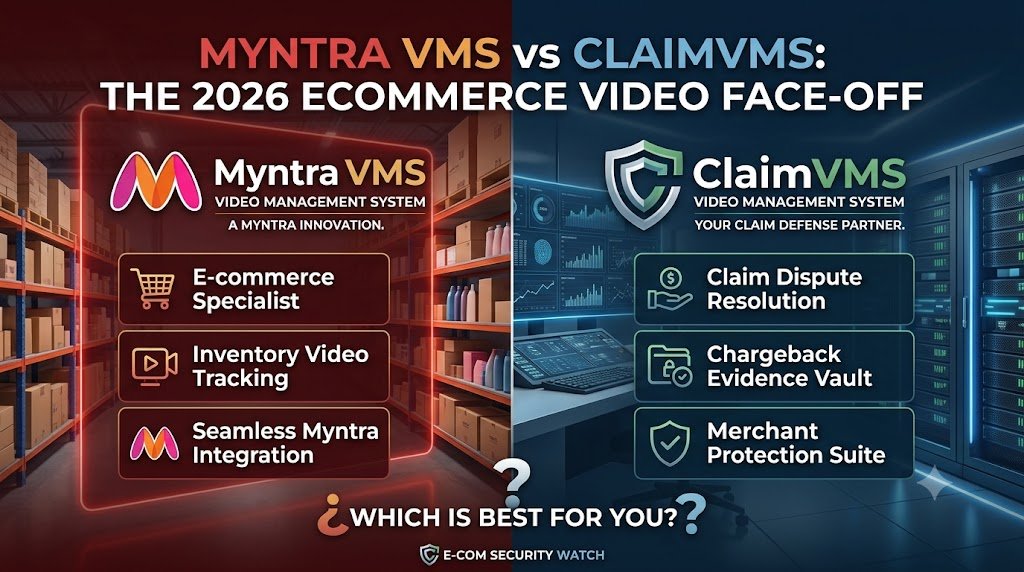
As ecommerce continues to expand across India, sellers are no longer limited to a single marketplace. Most businesses now sell simultaneously on Myntra, Amazon, Flipkart, AJIO, Meesho, Shopify, WooCommerce, and their own D2C websites.
While this multi-channel approach increases sales opportunities, it also creates new operational challenges.
Every marketplace has different fulfillment requirements, return policies, and dispute resolution processes. Managing shipment evidence separately for each platform quickly becomes inefficient.
One of the biggest concerns for modern ecommerce businesses is protecting shipments against:
- Wrong item claims
- Empty parcel complaints
- Missing accessories
- Product swapping
- Return fraud
- “Item Not as Described” (INAD) disputes
- Courier disputes
To improve warehouse transparency, some marketplaces provide their own Video Management System (VMS).
However, marketplace-specific tools are designed primarily for their own ecosystem.
This is where ClaimVMS provides a broader solution.
ClaimVMS is an independent Video Management System (VMS) built for ecommerce businesses operating across multiple marketplaces. Instead of managing evidence separately for every platform, ClaimVMS creates Order ID-linked packing videos that can be searched and retrieved from one centralized dashboard.
Whether you sell on Myntra, Amazon, Flipkart, AJIO, Meesho, Shopify, WooCommerce, Magento, or your own ecommerce website, ClaimVMS helps simplify warehouse operations while improving shipment verification and dispute management.
What Is an Ecommerce Video Management System?
A Video Management System (VMS) is software that records, stores, organizes, and retrieves warehouse packing videos.
Unlike traditional CCTV, an ecommerce VMS links each recording with shipment information.
ClaimVMS automatically associates every packing video with:
- Order ID
- AWB Number
- SKU
- Marketplace
- Date & Time
- Warehouse Operator
- Packing Station
This allows warehouse teams to retrieve evidence within seconds whenever disputes occur.
Why Video Management Has Become Essential
As order volumes continue to grow, manual warehouse documentation becomes increasingly difficult.
Modern ecommerce businesses require structured evidence for investigations involving:
- Wrong item received
- Missing product
- Empty parcel claims
- Fake damage reports
- Return fraud
- Courier disputes
- Marketplace investigations
Traditional paperwork and courier tracking alone cannot verify what actually entered the parcel.
Packing videos provide an additional layer of fulfillment documentation.
What Marketplace VMS Solutions Do Well
Marketplace-provided VMS platforms are designed to support their own seller ecosystem.
They generally offer features such as:
- Automatic packing video recording
- Time-stamped documentation
- Order-level video association
- Warehouse monitoring
- Basic evidence retrieval
- Secure video storage
These capabilities improve transparency for orders processed through that specific marketplace.
Why Marketplace-Specific VMS Has Limitations
Most ecommerce businesses do not operate on only one marketplace.
A fashion brand may receive orders from:
- Myntra
- Amazon
- Flipkart
- AJIO
- Meesho
- Shopify
- WooCommerce
- Retail stores
- Wholesale customers
Using separate video systems for each platform creates operational complexity.
Warehouse teams must manage:
- Different dashboards
- Separate evidence repositories
- Multiple retrieval processes
- Different dispute workflows
As businesses scale, maintaining separate systems becomes increasingly inefficient.
Why Independent Video Management Makes More Sense
ClaimVMS provides one centralized evidence platform regardless of where the order originated.
Instead of separating videos marketplace by marketplace, every shipment is managed through one dashboard.
Each recording can be searched using:
- Order ID
- AWB Number
- SKU
- Marketplace
- Customer Order
- Dispatch Date
This standardized workflow improves warehouse productivity while simplifying evidence retrieval.
Key Features of ClaimVMS
ClaimVMS combines warehouse automation with shipment documentation.
Core capabilities include:
- Order ID-linked packing videos
- AWB-based search
- SKU verification
- Marketplace filtering
- Barcode-triggered recording
- Secure cloud storage
- Centralized evidence dashboard
- Multi-user access
- Warehouse analytics
- Shipment verification
These features help businesses maintain organized fulfillment records across every marketplace.
How ClaimVMS Works
A typical fulfillment workflow includes:
Step 1
The warehouse operator scans or selects the customer order.
Step 2
ClaimVMS automatically begins recording.
Step 3
The system links the recording with:
- Order ID
- AWB Number
- SKU
- Marketplace
- Date & Time
Step 4
The complete packing process is recorded.
Step 5
The video is securely indexed and stored.
Whenever a dispute occurs, warehouse teams simply search the Order ID or AWB to retrieve the required shipment evidence.
Why Centralized Shipment Evidence Matters
Managing thousands of orders each month requires more than warehouse surveillance.
Businesses need searchable shipment records that support:
- Faster investigations
- Better warehouse accountability
- Organized evidence management
- Improved customer support
- Standardized packing workflows
- Higher operational efficiency
ClaimVMS transforms warehouse recordings into structured business evidence that supports every stage of ecommerce fulfillment.
ClaimVMS vs Marketplace VMS
Marketplace-specific Video Management Systems are designed to meet the requirements of a single ecommerce platform.
ClaimVMS is designed to support the seller’s entire ecommerce business.
Instead of managing multiple video systems for different marketplaces, ClaimVMS provides one centralized platform for every shipment.
| Feature | Marketplace VMS | ClaimVMS |
|---|---|---|
| Platform Coverage | Single Marketplace | All Marketplaces + D2C |
| Order-Linked Packing Videos | ✓ | ✓ |
| Search by Order ID | ✓ | ✓ |
| Search by AWB Number | Limited | ✓ |
| Multi-Channel Dashboard | ✗ | ✓ |
| Return Inspection Videos | Limited | ✓ |
| Warehouse Analytics | Basic | Advanced |
| Multi-Warehouse Support | Limited | ✓ |
| Secure Cloud Storage | ✓ | ✓ |
| Marketplace Dispute Support | Single Platform | All Supported Platforms |
ClaimVMS enables businesses to maintain one standardized evidence workflow regardless of where the order originates.
Benefits of an Independent Video Management System
Managing shipment evidence independently from any single marketplace provides greater operational flexibility.
ClaimVMS helps businesses:
- Centralize shipment documentation.
- Retrieve evidence within seconds.
- Reduce manual CCTV searches.
- Improve warehouse accountability.
- Standardize packing procedures.
- Strengthen dispute investigations.
- Simplify customer support.
- Improve warehouse productivity.
As order volumes grow, centralized evidence management becomes increasingly valuable.
Supporting Every Ecommerce Marketplace
Modern ecommerce brands rarely depend on a single sales channel.
Typical businesses receive orders from:
- Myntra
- Amazon
- Flipkart
- AJIO
- Meesho
- Shopify
- WooCommerce
- Magento
- D2C Websites
- Retail Stores
- Wholesale Orders
ClaimVMS supports all these fulfillment channels through one unified dashboard.
Warehouse operators no longer need separate systems for different marketplaces.
Instead, every shipment follows the same standardized documentation process.
Why Return Inspection Videos Matter
Outbound packing videos are only one part of the fulfillment journey.
Returned products also require proper documentation.
ClaimVMS supports return inspection workflows by helping businesses document:
- Returned parcel opening
- Product condition
- Missing accessories
- Damaged products
- Incorrect product returns
- Packaging condition
- Return verification
- Inspection outcomes
Maintaining both outbound and inbound documentation creates a complete shipment history for every order.
Better Warehouse Visibility
Warehouse managers need more than security footage.
They need operational insights.
ClaimVMS provides visibility into:
- Packing station performance
- Operator productivity
- Order processing times
- Shipment verification
- Workflow consistency
- Warehouse efficiency
- Documentation quality
These insights help businesses improve fulfillment accuracy while maintaining operational standards.
Best Practices for Warehouse Teams
Technology performs best when combined with standardized warehouse procedures.
Recommended practices include:
- Record every packing session.
- Verify every SKU before packing.
- Clearly display product labels.
- Show all accessories.
- Capture shipping labels before dispatch.
- Maintain adequate lighting.
- Eliminate camera blind spots.
- Follow standardized packing workflows.
- Securely store shipment videos.
- Train warehouse staff regularly.
Following these practices improves both shipment documentation and warehouse efficiency.
The Future of Ecommerce Video Management
Warehouse operations are rapidly becoming more intelligent and data-driven.
Future-ready ecommerce businesses are investing in:
- AI-assisted warehouse monitoring
- Order-linked packing videos
- Barcode-based workflow automation
- Intelligent evidence retrieval
- Cloud-based video management
- Warehouse analytics
- Marketplace integrations
- Centralized shipment documentation
ClaimVMS is designed to support this future by combining advanced video management with structured fulfillment evidence.
As ecommerce continues to evolve, businesses with organized shipment documentation will be better positioned to reduce operational risks, improve customer trust, and scale efficiently.
Conclusion
Marketplace-specific Video Management Systems help sellers meet the requirements of individual platforms.
However, businesses operating across multiple marketplaces need a broader solution that supports their entire fulfillment operation.
ClaimVMS provides a centralized Video Management System that automatically records Order ID-linked packing videos, organizes shipment evidence, and enables fast retrieval across multiple marketplaces.
Whether you sell on Myntra, Amazon, Flipkart, AJIO, Meesho, Shopify, WooCommerce, Magento, or your own ecommerce website, ClaimVMS helps strengthen shipment verification, improve warehouse accountability, and simplify dispute management.
By replacing fragmented video systems with one centralized evidence platform, businesses can improve operational efficiency, respond to disputes more effectively, and build a stronger foundation for long-term ecommerce growth.
Frequently Asked Questions
Q1. What is the difference between a marketplace VMS and ClaimVMS?
Marketplace VMS solutions are designed for a single platform. ClaimVMS is an independent Video Management System that manages packing videos, shipment evidence, and dispute documentation across multiple marketplaces and D2C stores.
Q2. Why should sellers use an independent Video Management System?
An independent system provides one centralized dashboard for all shipments, making it easier to retrieve packing videos, manage evidence, and standardize warehouse workflows across different sales channels.
Q3. Does ClaimVMS support return inspection videos?
Yes. In addition to outbound packing videos, ClaimVMS supports documenting return inspections, helping businesses maintain a complete record of both dispatched and returned shipments.
Q4. Which ecommerce platforms are supported?
ClaimVMS supports Myntra, Amazon, Flipkart, AJIO, Meesho, Shopify, WooCommerce, Magento, D2C websites, and custom ecommerce platforms, enabling businesses to manage all shipment evidence from one place.
Q5. Can ClaimVMS work with existing warehouse cameras?
Yes. ClaimVMS integrates with compatible warehouse camera systems and transforms standard recordings into searchable Order ID-linked packing videos without requiring businesses to replace their existing hardware.
Q6. Who should use ClaimVMS?
ClaimVMS is ideal for fashion brands, D2C businesses, ecommerce sellers, warehouse operators, fulfillment centers, third-party logistics (3PL) providers, and multi-channel retailers looking to improve shipment documentation, reduce return fraud, and streamline dispute management.