
Every Returned COD Order Doesn’t Just Reduce Sales—It Reduces Your Profits
Cash-on-Delivery (COD) remains one of the most preferred payment methods in Indian ecommerce. While it increases customer trust and boosts conversions, it also introduces one of the biggest operational challenges—Return to Origin (RTO).
When an order cannot be delivered because the customer refuses it, is unavailable, or provides an incorrect address, the parcel is returned to the seller. This process is known as Return to Origin (RTO).
For thousands of sellers on Amazon, Flipkart, Myntra, AJIO, Meesho, Shopify, WooCommerce and other ecommerce platforms, RTO is more than a logistics issue—it is a direct hit to profitability.
Every returned shipment results in:
- Forward shipping charges
- Reverse logistics costs
- Warehouse handling expenses
- Packaging costs
- Inventory delays
- Potential product damage
- Increased claim disputes
Without proper proof, recovering these losses becomes extremely difficult.
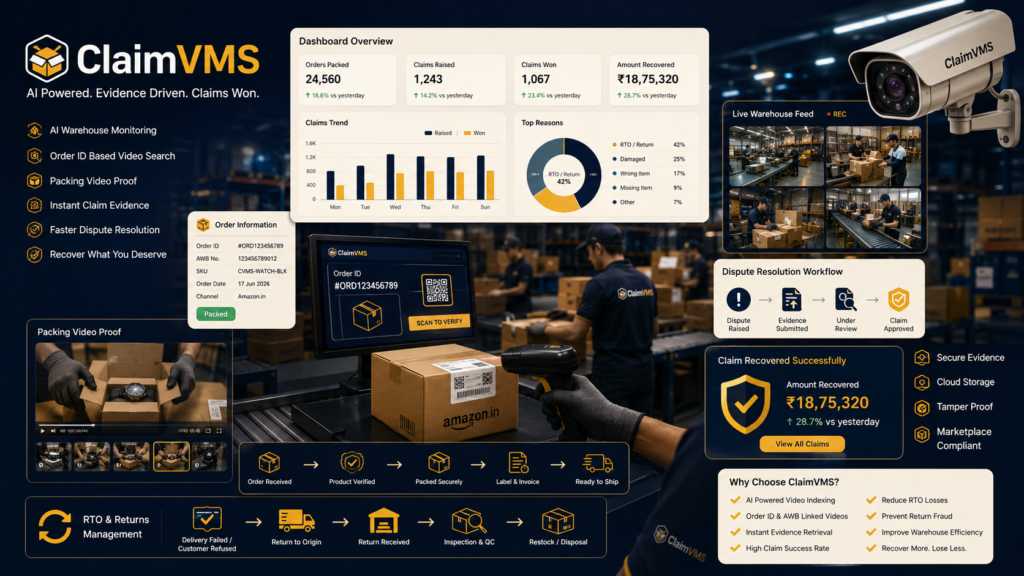
This is where ClaimVMS transforms warehouse operations by providing AI-powered packing video verification and digital claim evidence.
What is Return to Origin (RTO)?
Return to Origin (RTO) occurs when a shipment is sent back to the seller instead of being successfully delivered.
Common reasons include:
- Customer refused delivery
- Incorrect address
- Invalid phone number
- Multiple failed delivery attempts
- Customer unavailable
- Fake COD orders
- Duplicate purchases
- Last-minute order cancellations
Unlike prepaid orders, COD orders carry significantly higher RTO rates because customers have no financial commitment before delivery.
Why is COD RTO So High in India?
Several operational factors contribute to higher RTO rates.
1. No Upfront Payment Commitment
Customers can easily refuse the parcel during delivery without financial loss.
2. Incorrect Customer Information
Wrong PIN codes, incomplete addresses, or unreachable phone numbers frequently lead to failed deliveries.
3. Impulse Buying
Many customers place COD orders without serious purchase intent.
4. Multiple Orders
Customers often order similar products from multiple sellers and accept only one.
5. Delivery Delays
Long delivery timelines increase cancellation and refusal rates.
The Hidden Cost of RTO
Most sellers only calculate shipping expenses.
However, the actual financial impact includes:
- Warehouse labor
- Inventory blockage
- Quality inspection
- Repacking
- Product depreciation
- Marketplace penalties
- Customer support costs
- Lost selling opportunities
These hidden costs silently reduce overall business margins.
The Bigger Problem: RTO Disputes
Not every returned parcel comes back in its original condition.
Many sellers experience:
- Empty box returns
- Product swapping
- Used products
- Damaged products
- Wrong item disputes
- Missing accessories
- False customer claims
Without warehouse evidence, proving what was originally packed becomes nearly impossible.
Why Traditional CCTV Isn’t Enough
Many warehouses rely on standard CCTV systems.
Unfortunately, conventional CCTV has several limitations:
- Videos are recorded continuously.
- Searching footage takes hours.
- Clips aren’t linked with Order IDs.
- Courier AWB numbers aren’t associated with recordings.
- Evidence is difficult to retrieve during marketplace disputes.
When Amazon or Flipkart requests proof, manually locating footage often delays claim submissions.
How ClaimVMS Solves the Problem
ClaimVMS is an AI-powered warehouse video management and claim evidence platform designed specifically for ecommerce sellers.
Instead of recording endless CCTV footage, ClaimVMS intelligently connects every packing video with:
- Order ID
- Courier AWB
- SKU
- Invoice
- Barcode
- Packing operator
- Timestamp
Every shipment automatically becomes searchable within seconds.
AI-Powered Packing Verification
ClaimVMS captures and organizes:
- Packing process
- Product verification
- Quantity confirmation
- Barcode scanning
- Shipping label attachment
- Final package sealing
This creates indisputable digital proof for every order.
Faster Claim Recovery
When disputes arise, your team simply searches the Order ID.
Within seconds they can retrieve:
- Packing video
- Timestamp
- Invoice
- Shipment details
- Order evidence
Instead of manually reviewing hours of CCTV footage, your support team can immediately submit professional claim documentation.
Benefits of ClaimVMS
✔ AI-powered warehouse monitoring
✔ Order ID based video search
✔ Barcode-linked recordings
✔ Faster dispute resolution
✔ Amazon claim support
✔ Flipkart reimbursement evidence
✔ Meesho seller protection
✔ Warehouse process automation
✔ Secure cloud storage
✔ Quick claim documentation
✔ Reduced manual investigation
✔ Better operational transparency
Best Practices to Reduce RTO
Although RTO cannot be eliminated completely, sellers can significantly reduce losses by following these practices:
- Verify customer addresses
- Confirm high-value COD orders
- Improve delivery communication
- Use reliable courier partners
- Optimize warehouse dispatch time
- Record every packing process
- Maintain searchable shipment evidence
- Respond quickly to marketplace disputes
Why Modern Ecommerce Warehouses Need ClaimVMS
As ecommerce volumes continue to grow, manual proof collection is no longer practical.
ClaimVMS helps warehouses digitize packing verification, simplify claim management, and improve operational accountability.
Instead of losing revenue because evidence is unavailable, sellers gain a structured system for defending legitimate claims and improving warehouse efficiency.
Whether you sell on Amazon, Flipkart, Myntra, AJIO, Meesho, Shopify or your own D2C website, ClaimVMS helps convert warehouse recordings into searchable business evidence.
Final Thoughts
Return to Origin (RTO) is an unavoidable reality in Indian ecommerce, but unnecessary financial losses don’t have to be.
By combining warehouse video monitoring, AI-powered packing verification, barcode-linked recordings, and intelligent claim management, ClaimVMS enables sellers to respond to disputes faster and protect recoverable revenue.
The right proof at the right time can make the difference between a rejected claim and a successful reimbursement.
If your warehouse still relies on traditional CCTV footage, now is the time to upgrade to a smarter claim management solution.
FAQs
What is Return to Origin (RTO)?
Return to Origin (RTO) is the process where an ecommerce shipment is returned to the seller because delivery could not be completed due to customer refusal, incorrect address, failed delivery attempts, or unavailable recipients.
Why do COD orders have higher RTO rates?
Cash-on-Delivery orders involve no upfront payment, making customers more likely to refuse deliveries or change their minds compared to prepaid orders.
How does ClaimVMS help reduce RTO losses?
ClaimVMS records every packing process, links videos with Order IDs and AWBs, and provides searchable evidence for marketplace claims, helping sellers recover legitimate reimbursements faster.
Can ClaimVMS integrate with existing warehouse cameras?
Yes. ClaimVMS is designed to work with existing warehouse camera infrastructure while adding AI-powered order indexing and claim management capabilities.
Which marketplaces can benefit from ClaimVMS?
ClaimVMS supports ecommerce sellers operating on Amazon, Flipkart, Meesho, Myntra, AJIO, Shopify, WooCommerce, and other D2C platforms.
Why is packing video proof important?
Packing video proof provides verifiable evidence that the correct product was packed and shipped, helping sellers defend against false claims, product swaps, and damaged-item disputes.