
Ecommerce Returns Are No Longer Just a Customer Service Issue
Every ecommerce seller expects a certain percentage of returns. Some customers receive damaged products, others order the wrong item, and occasionally logistics mistakes happen.
However, a growing number of returns are not caused by defective products or shipping errors. Instead, they result from customer purchasing behaviors that quietly reduce profit margins without breaking any laws.
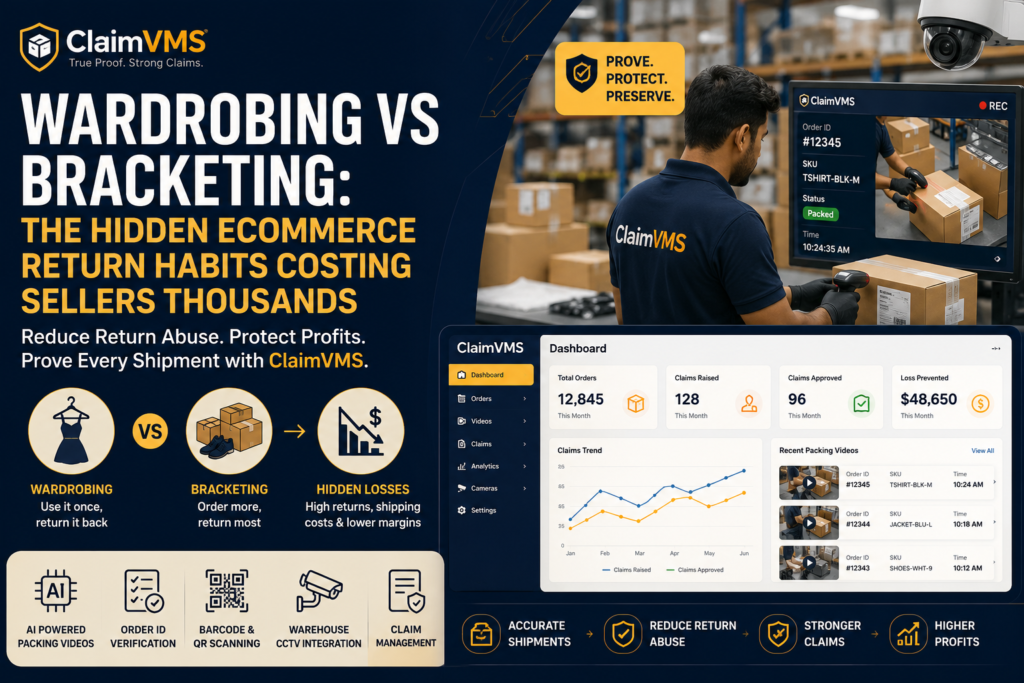
Two of the biggest challenges facing modern ecommerce businesses are wardrobing and bracketing.
These behaviors may appear harmless from a customer’s perspective, but for sellers, they create unnecessary operational costs, inventory losses, shipping expenses, and claim disputes.
As marketplaces like Amazon, Flipkart, Myntra, Meesho, AJIO, and other ecommerce platforms continue expanding, sellers are processing thousands of orders every day. Even a small increase in avoidable returns can translate into significant financial losses over time.
This is where a complete warehouse proof management solution like ClaimVMS becomes an essential part of modern ecommerce operations.
Rather than relying on manual records or customer statements, ClaimVMS provides AI-powered video evidence, Order ID verification, barcode tracking, and warehouse surveillance to help sellers confidently defend legitimate claims.
Understanding Wardrobing and Bracketing
Although these terms are often mentioned together, they represent two different shopping behaviors that affect ecommerce businesses in unique ways.
What Is Wardrobing?
Wardrobing occurs when a customer purchases a product, uses it temporarily, and then returns it while claiming that it is still unused or in original condition.
Common examples include:
- Wearing clothing for a wedding or party before returning it
- Using expensive electronics for a vacation
- Purchasing cameras for short-term projects
- Returning premium accessories after one-time use
In many situations, the returned item cannot be sold as brand-new again.
This creates additional inspection costs, inventory losses, and refund processing expenses for sellers.
What Is Bracketing?
Bracketing is another growing ecommerce trend.
Instead of purchasing one product, customers intentionally order multiple sizes, colors, or variations with the expectation of returning most of them.
Examples include:
- Ordering three shoe sizes and keeping only one
- Purchasing multiple clothing colors before deciding
- Buying several electronic accessories to compare them
- Ordering duplicate products for convenience
While customers appreciate flexible return policies, sellers absorb the costs associated with additional shipping, packaging, quality inspections, and reverse logistics.
Why These Behaviors Continue to Grow
Modern ecommerce has made shopping incredibly convenient.
Customers now expect:
- Fast shipping
- Free delivery
- Easy refunds
- No-question return policies
- Instant exchanges
While these conveniences improve customer satisfaction, they also reduce the hesitation to place multiple orders or return products after use.
As competition between marketplaces increases, generous return policies have unintentionally encouraged purchasing habits that place more financial responsibility on sellers.
The result is an increase in operational expenses that are often difficult to recover.
The Hidden Costs Beyond the Refund
Most sellers only calculate the refund amount when evaluating returns.
In reality, the actual financial impact is much greater.
Every unnecessary return can involve:
- Reverse shipping charges
- Warehouse handling costs
- Product quality inspections
- Inventory restocking
- Repackaging expenses
- Customer support resources
- Marketplace claim investigations
- Inventory depreciation
- Delayed resale opportunities
For businesses shipping hundreds or thousands of orders each day, these seemingly small expenses quickly accumulate into substantial operational losses.
Without proper documentation, it becomes difficult to distinguish genuine returns from preventable return abuse.
Why Traditional Warehouse Processes Are No Longer Enough
Many ecommerce warehouses still depend on:
- Manual packing checklists
- Paper invoices
- Static CCTV footage
- Individual employee records
- Spreadsheet tracking
Although these methods provide some operational visibility, they rarely produce reliable evidence during a dispute.
When a customer claims:
- Wrong product received
- Missing accessories
- Empty package
- Damaged shipment
- Used product delivered
warehouse teams often spend hours searching through CCTV recordings or manually reviewing dispatch records.
In many cases, no clear evidence is available to support the seller’s position.
As a result, sellers frequently approve refunds simply to avoid prolonged disputes.
How ClaimVMS Changes the Entire Process
ClaimVMS is designed specifically for ecommerce warehouses that require reliable proof for every shipment.
Instead of depending on scattered surveillance footage, ClaimVMS automatically creates an organized digital record for every packed order.
Every shipment can include:
- AI-powered packing video recording
- Order ID synchronization
- Barcode verification
- QR code validation
- Timestamped dispatch records
- Multiple camera angles
- Cloud-based video storage
- Fast search using Order ID
- Secure warehouse audit trail
This transforms ordinary warehouse recordings into structured claim evidence that can be retrieved within seconds whenever disputes arise.
Proof Is More Powerful Than Assumptions
When a seller cannot prove what actually left the warehouse, disputes often become one person’s word against another’s.
With ClaimVMS, every order has a verifiable digital history.
Instead of relying on assumptions, warehouse teams can immediately retrieve packing videos linked to the specific Order ID, verify the condition of the shipment before dispatch, and provide documented evidence during marketplace investigations.
This level of transparency not only improves internal accountability but also increases confidence when handling Amazon SAFE-T claims, return disputes, shipment investigations, and customer complaints.
Why Serial Returners Have a Bigger Impact Than You Think
Not every customer who returns a product is abusing the return policy. Genuine returns are a natural part of ecommerce, especially when products arrive damaged, defective, or don’t match customer expectations.
However, many warehouses discover that a relatively small percentage of customers generate a disproportionately large share of returns.
These customers may repeatedly:
- Order multiple sizes with the intention of returning most of them.
- Claim missing products despite receiving complete shipments.
- Report incorrect items even when the correct SKU was packed.
- Frequently request refunds after delivery.
- Open marketplace claims for orders that were dispatched accurately.
Without reliable order-level evidence, it becomes difficult to identify patterns or defend against repeated disputes.
ClaimVMS helps businesses maintain detailed shipment records that can be searched instantly by Order ID, SKU, invoice number, barcode, or packing date. This enables warehouse managers to review historical dispatch evidence whenever recurring claim patterns emerge.
A Real-World Ecommerce Scenario
Imagine an apparel seller shipping more than 700 orders every day across multiple online marketplaces.
The warehouse team works efficiently, but customer complaints begin increasing:
- Wrong color received
- Missing accessories
- Empty parcel claims
- Product used before return
- Refund requests without valid evidence
Initially, the operations team believes these are isolated incidents.
After reviewing monthly reports, however, they discover that these issues account for a significant percentage of refund-related losses.
The biggest challenge isn’t the returns themselves—it’s the inability to prove what was actually packed and dispatched.
Traditional CCTV footage is difficult to search, stored in separate folders, and often overwritten after a few weeks. Finding a single packing video may take hours, and in many cases the relevant footage is unavailable.
As a result, many claims are approved despite the warehouse having packed the correct order.
How ClaimVMS Solves This Challenge
ClaimVMS transforms warehouse recordings into searchable digital evidence.
Instead of storing hours of generic CCTV footage, the system automatically links every packing video with essential shipment information, including:
- Order ID
- SKU
- Invoice number
- Barcode
- QR code
- Packing operator
- Camera feed
- Dispatch timestamp
Whenever a customer raises a dispute, warehouse staff can retrieve the exact packing video in seconds instead of manually reviewing hours of surveillance footage.
This dramatically reduces investigation time while improving confidence during marketplace claims.
AI-Powered Warehouse Verification
Modern ecommerce operations require more than simple video recording.
ClaimVMS incorporates intelligent verification workflows designed for high-volume warehouses.
AI-Assisted Packing Evidence
Every shipment can be supported with:
- High-definition packing videos
- Multi-camera recording
- Barcode scanning
- QR code verification
- Timestamp validation
- Order synchronization
- Cloud backup
- Secure audit logs
The result is a complete digital proof trail from the beginning of packing until dispatch.
Benefits for Marketplace Sellers
Whether you sell on Amazon, Flipkart, Myntra, Meesho, AJIO, Shopify, WooCommerce, or your own ecommerce website, ClaimVMS helps strengthen warehouse accountability and streamline claim investigations.
Key benefits include:
Faster Claim Resolution
Instead of spending hours searching CCTV footage, locate the correct packing video within seconds.
Stronger Shipment Evidence
Provide clear visual proof showing:
- Correct product packed
- Correct quantity
- Proper packaging
- Shipment condition
- Dispatch verification
Improved Warehouse Accountability
Every packing process is associated with:
- Operator
- Camera
- Order
- Timestamp
This increases transparency across warehouse operations.
Reduced Investigation Time
Customer disputes no longer require manual video review across multiple storage devices.
Everything remains organized within a centralized dashboard.
Better Operational Insights
Warehouse managers can monitor:
- Packing accuracy
- Employee productivity
- Claim frequency
- Dispatch quality
- Investigation turnaround time
These insights support continuous process improvement.
Best Practices to Reduce Wardrobing and Bracketing
Although no system can eliminate return abuse entirely, sellers can significantly reduce avoidable losses by combining operational discipline with reliable evidence.
Consider these best practices:
- Record every packing process using multiple camera angles.
- Verify products with barcode or QR code scanning before dispatch.
- Link videos directly to the corresponding Order ID.
- Maintain secure cloud backups of packing evidence.
- Review repeated disputes for recurring customer patterns.
- Train warehouse staff to follow standardized packing procedures.
- Perform regular quality checks before sealing parcels.
- Use AI-powered dashboards to identify operational bottlenecks.
- Preserve shipment evidence for marketplace investigations.
- Continuously improve packing workflows based on analytics.
Together, these practices help create a more transparent, efficient, and dispute-ready warehouse.
Why ClaimVMS Is Different
Many businesses already have CCTV cameras installed.
However, standard surveillance systems are not designed for ecommerce claim management.
ClaimVMS goes beyond recording footage by organizing warehouse evidence into a structured, searchable system built specifically for ecommerce sellers.
Key capabilities include:
- AI-powered Packing Video Management
- Order ID-based Video Search
- Barcode & QR Code Integration
- Multi-camera Warehouse Recording
- Secure Cloud Storage
- Shipment Verification
- Warehouse Audit Trail
- Marketplace Claim Support
- Return Investigation Tools
- Analytics Dashboard
- Fast Video Retrieval
- Role-Based User Access
- Centralized Evidence Management
- Smart Warehouse Monitoring
Instead of searching through hours of CCTV recordings, warehouse teams access exactly the evidence they need—when they need it.
Conclusion
As ecommerce continues to grow, return management is becoming just as important as order fulfillment.
Behaviors such as wardrobing and bracketing may not always involve intentional fraud, but they still create measurable financial and operational challenges for sellers.
The ability to prove what was packed, how it was packed, and when it was dispatched is becoming a competitive advantage.
ClaimVMS empowers ecommerce businesses with AI-powered packing video management, intelligent shipment verification, and searchable warehouse evidence that supports faster investigations, stronger marketplace claims, and improved operational transparency.
Whether you’re managing hundreds or thousands of orders each day, investing in reliable proof can help reduce avoidable losses, improve customer trust, and strengthen your warehouse processes for long-term growth.
Frequently Asked Questions (FAQs)
1. What is wardrobing in ecommerce?
Wardrobing is the practice of purchasing a product, using it temporarily, and returning it while claiming it is still unused or in its original condition.
2. What is bracketing?
Bracketing is when customers intentionally purchase multiple sizes, colors, or product variations with the expectation of returning the items they don’t keep.
3. Why are wardrobing and bracketing expensive for sellers?
These behaviors increase reverse logistics costs, inspection time, packaging expenses, inventory losses, customer support workload, and marketplace dispute handling.
4. How does ClaimVMS help reduce return disputes?
ClaimVMS records AI-powered packing videos linked to Order IDs, barcodes, invoices, and timestamps, allowing warehouse teams to quickly retrieve shipment evidence during investigations.
5. Can ClaimVMS integrate with existing warehouse CCTV cameras?
Yes. ClaimVMS is designed to work alongside existing warehouse camera infrastructure while organizing footage into searchable order-based records.
6. Is ClaimVMS suitable for Amazon sellers?
Yes. ClaimVMS helps Amazon sellers maintain shipment evidence that supports investigations, return disputes, and Amazon SAFE-T claim processes.
7. Can ClaimVMS help identify packing mistakes?
Yes. By reviewing order-linked packing videos, warehouse managers can verify whether errors occurred during packing and improve quality control procedures.
8. What types of businesses benefit from ClaimVMS?
ClaimVMS is ideal for ecommerce brands, third-party logistics providers (3PLs), fulfillment centers, D2C businesses, warehouse operators, and sellers on marketplaces such as Amazon, Flipkart, Myntra, Meesho, and Shopify.