
If you’re an Amazon seller, chances are you’ve experienced this frustrating situation.
You shipped the correct product.
The customer files an A-to-Z Guarantee claim, Amazon refunds the buyer, and you lose both the product and the payment.
At this stage, your only opportunity to recover the money is through an Amazon SAFE-T Claim.
However, in 2026, filing a SAFE-T claim has become even more challenging.
Amazon has reduced claim timelines, increased evidence requirements, and expects sellers to submit precise, order-specific documentation within a limited time. Unfortunately, many genuine sellers lose claims—not because they’re wrong, but because they cannot produce the right evidence quickly enough.
This is where ClaimVMS transforms the process.
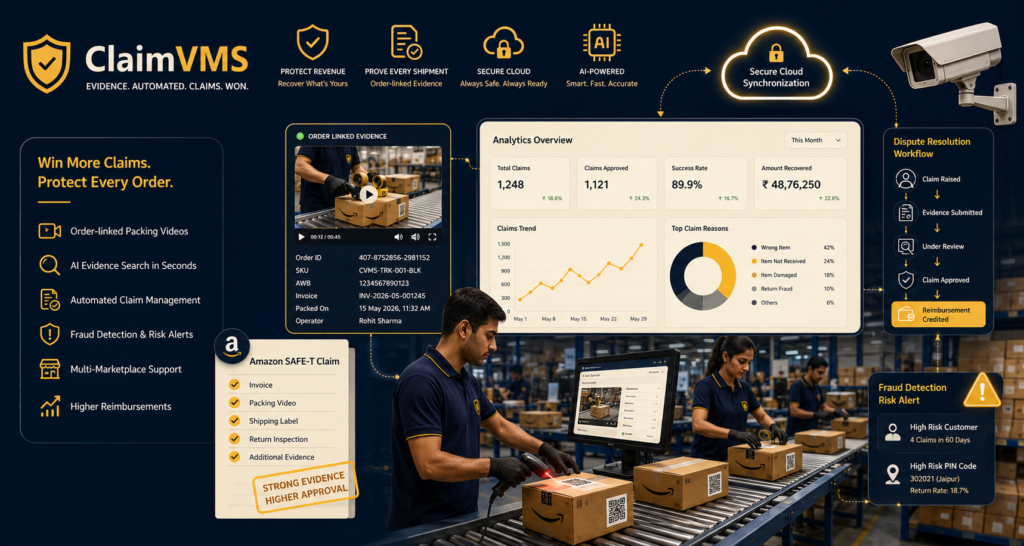
ClaimVMS automatically records every packing operation, links the video to the corresponding Order ID, SKU, invoice, and AWB, and enables sellers to retrieve proof within seconds. Instead of relying on warehouse CCTV or manual searches, sellers can submit professional, order-linked evidence that strengthens their marketplace claims.
If you want to improve your Amazon claim approval rate and reduce refund losses, this guide explains everything you need to know.
What Is an Amazon SAFE-T Claim?
SAFE-T stands for Seller Assurance for E-commerce Transactions.
It is Amazon’s reimbursement process that allows sellers to recover money after Amazon has issued a refund to a buyer under the A-to-Z Guarantee.
Many new sellers confuse these two terms.
They are completely different.
A-to-Z Guarantee Claim
This claim is filed by the customer when they believe there is an issue with their order.
Examples include:
- Wrong product received
- Item not delivered
- Product arrived damaged
- Refund not received
- Missing accessories
Amazon investigates and may refund the buyer.
SAFE-T Claim
A SAFE-T Claim is filed by the seller after Amazon issues a refund that the seller believes was incorrect or unjustified.
Instead of arguing with customer support, sellers submit evidence proving that:
- The correct item was shipped
- The parcel was properly packed
- The returned product was different
- The buyer damaged the product
- The refund decision should be reversed
If Amazon accepts the evidence, the seller receives reimbursement.
Why SAFE-T Claims Matter More Than Ever
Every false refund directly impacts your business.
A single fraudulent claim can result in:
- Loss of product value
- Shipping expenses
- Return logistics costs
- Marketplace fees
- Reduced profit margins
For businesses shipping hundreds or thousands of orders every month, these losses accumulate rapidly.
Many sellers assume occasional refund fraud is simply part of doing business.
It doesn’t have to be.
A well-prepared SAFE-T claim can help recover revenue that would otherwise be lost.
What’s Changed in Amazon SAFE-T Claims in 2026?
Amazon has introduced several operational changes that require sellers to respond much faster than before.
The biggest change is the reduced filing window.
Instead of waiting weeks before preparing evidence, sellers must now act quickly once a return is received or a refund is issued.
This means warehouses can no longer rely on manually reviewing CCTV footage days later.
Every hour matters.
The faster you retrieve evidence, the stronger your claim becomes.
Why Most Amazon SAFE-T Claims Get Rejected
Many sellers believe that simply explaining their situation is enough.
Unfortunately, Amazon evaluates documentation—not assumptions.
Below are the most common reasons SAFE-T claims fail.
1. No Proof of What Was Actually Packed
A customer claims they received the wrong item.
The seller knows the correct product was dispatched.
However, without visual evidence linked to that specific order, Amazon cannot verify the seller’s statement.
Written explanations rarely outweigh customer claims.
2. Generic CCTV Footage
Many warehouses already have surveillance cameras.
Unfortunately, traditional CCTV is rarely useful during SAFE-T investigations.
Why?
Because CCTV records by:
- Time
- Camera location
- Warehouse area
It does not identify:
- Order ID
- SKU
- Courier AWB
- Invoice
- Parcel number
Reviewing several hours of footage for one disputed shipment is both time-consuming and unreliable.
3. Late Claim Submission
Amazon claim timelines are strict.
Many sellers spend days searching for evidence.
By the time they locate the correct recording, the claim deadline has already passed.
Even a valid claim may be rejected simply because it was submitted too late.
4. Mismatched Documentation
A common reason for rejection is inconsistent information.
For example:
- Invoice shows one SKU
- Shipping label shows another
- Claim description mentions different details
- Video cannot be matched with the shipment
Even minor inconsistencies reduce the credibility of the claim.
Successful SAFE-T claims require every piece of evidence to match perfectly.
The Biggest Challenge for Ecommerce Sellers
The real issue isn’t filing a SAFE-T claim.
The real issue is finding reliable evidence quickly.
Imagine processing 800 orders every day.
A buyer disputes Order #458721.
Your warehouse has CCTV covering the packing station.
Now someone has to:
- Identify the packing time
- Find the correct camera
- Review several hours of footage
- Locate the parcel
- Verify the product
- Export the video
- Upload it before the claim deadline
This process may take several hours—or even days.
For businesses handling hundreds of daily shipments, it quickly becomes unmanageable.
A Real-World Example
Consider an Amazon seller shipping approximately 600 orders every day.
One week after a major sale, the seller receives several A-to-Z claims.
Customers report:
- Wrong product delivered
- Empty package received
- Missing accessories
- Damaged items
The warehouse manager knows the orders were packed correctly.
The evidence exists—but it’s buried inside multiple CCTV recordings.
Finding each order requires manually reviewing hours of video.
Some disputes close before the required footage can even be submitted.
As a result, legitimate claims are lost—not because the seller was at fault, but because the evidence wasn’t immediately accessible.
This is a challenge faced by many growing ecommerce businesses.
Winning SAFE-T claims doesn’t depend on writing better explanations. It depends on having the right evidence ready before a dispute begins.
Businesses that consistently recover reimbursements focus on creating order-linked proof for every shipment, making it easy to respond within Amazon’s claim timelines.
That is where a dedicated solution like ClaimVMS becomes an essential part of modern ecommerce operations.
How ClaimVMS Helps You Win More Amazon SAFE-T Claims
Winning an Amazon SAFE-T claim isn’t about writing a convincing explanation—it’s about providing evidence that clearly proves what happened.
When a dispute occurs, Amazon expects sellers to submit documentation that verifies:
- The correct product was picked
- The right SKU was packed
- The parcel was sealed properly
- The shipment matched the Order ID
- The returned product differs from what was originally shipped (where applicable)
For many sellers, gathering this information manually is time-consuming and often impossible within Amazon’s claim window.
ClaimVMS automates this entire process.
Instead of relying on generic CCTV footage or manually recorded videos, ClaimVMS creates order-linked digital evidence for every shipment.
Every packing video is automatically connected to:
- Order ID
- Invoice Number
- SKU
- Courier AWB
- Packing Date & Time
- Operator Details
When a SAFE-T claim is raised, sellers simply search the Order ID and retrieve the exact packing video within seconds.
Step-by-Step: Filing a Strong Amazon SAFE-T Claim
Step 1: Review the Customer’s Claim
As soon as Amazon notifies you of an A-to-Z Guarantee claim or refund, carefully review:
- Customer complaint
- Refund reason
- Return status
- Claim timeline
Understanding the exact allegation helps determine which evidence you need.
Step 2: Retrieve Order-Specific Evidence
Instead of searching hours of warehouse CCTV, ClaimVMS lets you retrieve the complete packing record instantly.
The system automatically provides:
- Packing video
- Order information
- Product verification
- Shipping label confirmation
- Barcode scan details
This eliminates manual searching and reduces response time significantly.
Step 3: Verify the Returned Product
If the buyer returns an item, inspect it immediately.
Compare:
- Product condition
- Serial numbers
- SKU
- Accessories
- Packaging
- Weight
If the returned product differs from the dispatched product, document everything with photographs and video.
Step 4: Submit Consistent Documentation
Successful SAFE-T claims rely on consistency.
Ensure every document matches:
- Invoice
- Order ID
- AWB Number
- Product SKU
- Packing Video
- Return Inspection
Any mismatch can weaken your claim.
Step 5: Monitor Claim Progress
Once submitted, monitor the claim through Amazon Seller Central.
If additional evidence is requested, respond promptly using the documentation already stored in ClaimVMS.
Because all videos remain searchable, retrieving supporting evidence takes only a few seconds.
Why Traditional CCTV Is No Longer Enough
Many warehouse owners believe installing CCTV cameras is sufficient.
Unfortunately, traditional surveillance systems were never designed for ecommerce dispute management.
Standard CCTV recordings:
❌ Record by time
❌ Record by camera location
❌ Cannot identify individual orders
❌ Are difficult to search
❌ Require manual review
❌ Consume valuable claim response time
When Amazon requests proof for a specific Order ID, warehouse CCTV often becomes hundreds of hours of unusable footage.
Why Order-Linked Video Evidence Matters
Modern ecommerce requires evidence that is directly connected to every shipment.
With ClaimVMS, every packing process becomes searchable using:
- Order ID
- Invoice Number
- AWB Number
- SKU
- Customer Name
- Dispatch Date
Instead of asking,
“Which camera recorded this parcel?”
you simply search the Order ID.
The correct packing video appears instantly.
This dramatically improves investigation speed and strengthens seller evidence.
Key Features of ClaimVMS
AI-Powered Packing Video Recording
Automatically records every packing process without requiring employees to manually start recording.
Order ID Linking
Every video is automatically associated with:
- Order ID
- Invoice
- Courier
- SKU
- AWB Number
This creates reliable evidence for future disputes.
Instant Video Search
Retrieve videos within seconds using multiple search parameters.
No more reviewing hours of warehouse footage.
Secure Cloud Storage
Packing videos remain safely stored in the cloud.
No dependence on DVR backups or local storage limitations.
Marketplace Claim Support
ClaimVMS helps sellers organize evidence for disputes across:
- Amazon
- Flipkart
- AJIO
- Myntra
- Meesho
- Shopify
- WooCommerce
- Other ecommerce platforms
Barcode & QR Code Integration
Automatically verifies scanned products before dispatch, reducing packing errors and strengthening evidence quality.
AI Dashboard & Analytics
Track:
- Claim trends
- Fraud patterns
- Repeat customers
- High-risk PIN codes
- Return percentages
- Warehouse performance
This helps businesses identify fraud before it becomes a major financial problem.
Best Practices for Amazon Sellers
Record Every Order
Do not record only expensive products.
Fraud can happen with any shipment.
Every order deserves proper evidence.
Respond Quickly
Amazon claim timelines are strict.
Retrieve and submit evidence immediately after receiving a dispute notification.
Keep Records Organized
Store all videos using searchable Order IDs rather than folders based on dates or camera numbers.
Organization saves valuable time.
Track Repeat Fraud
Monitor customers who repeatedly file:
- Wrong item claims
- Empty box complaints
- Product swap requests
- Frequent returns
Recognizing patterns helps reduce future losses.
Review Warehouse Processes
Regularly audit packing procedures to ensure:
- Correct SKU selection
- Barcode verification
- Proper parcel sealing
- Accurate shipping labels
Good operational discipline strengthens every future SAFE-T claim.
Why Ecommerce Businesses Choose ClaimVMS
Thousands of ecommerce orders leave warehouses every day.
Each shipment carries a potential dispute risk.
ClaimVMS helps businesses protect revenue by providing:
✅ Automatic packing video recording
✅ AI-powered video search
✅ Order-linked digital proof
✅ Faster dispute resolution
✅ Organized claim management
✅ Reduced refund fraud
✅ Better operational visibility
Instead of spending hours searching warehouse footage, sellers can focus on growing their business while ClaimVMS manages the evidence.
Final Thoughts
Amazon SAFE-T claims are becoming more evidence-driven every year.
As claim timelines become shorter and refund fraud becomes more sophisticated, manual warehouse processes are no longer enough.
The businesses that consistently recover reimbursements are those that prepare before disputes occur—not after.
By creating searchable, order-linked packing videos for every shipment, ClaimVMS helps sellers respond faster, defend genuine shipments, and improve their chances of successful claim resolution.
Whether you ship 100 orders a day or 10,000, having the right proof at the right time can make the difference between absorbing unnecessary losses and protecting your hard-earned revenue.
Frequently Asked Questions (FAQs)
1. What is an Amazon SAFE-T Claim?
An Amazon SAFE-T (Seller Assurance for E-commerce Transactions) Claim is a reimbursement request that sellers submit after Amazon issues a refund to a customer under the A-to-Z Guarantee. If the seller believes the refund was unjustified, they can submit evidence to recover the lost amount.
2. How do I file an Amazon SAFE-T Claim?
To file a SAFE-T Claim:
- Log in to Amazon Seller Central.
- Navigate to the Performance section.
- Open the eligible order.
- Submit your SAFE-T claim.
- Attach supporting evidence such as invoices, shipping labels, packing videos, return inspection photos, and tracking details.
- Monitor the claim status until Amazon completes its review.
3. What evidence helps win Amazon SAFE-T Claims?
The strongest evidence includes:
- Order-linked packing videos
- Invoice copy
- Shipping label
- AWB details
- Barcode scanning records
- Product SKU verification
- Return inspection photos
- Parcel sealing video
Using ClaimVMS, sellers can automatically generate and retrieve all this evidence within seconds.
4. Can warehouse CCTV footage be used for SAFE-T Claims?
Generic warehouse CCTV footage is usually insufficient because it records activity based on time and camera location rather than a specific Order ID.
ClaimVMS solves this by linking every packing video directly to the corresponding order, making evidence much easier to retrieve and present during disputes.
5. How does ClaimVMS help Amazon sellers?
ClaimVMS automates the entire proof management process by:
- Recording every packing operation
- Linking videos to Order IDs
- Storing evidence securely in the cloud
- Enabling instant video retrieval
- Simplifying marketplace dispute management
- Helping sellers defend against refund fraud and false claims
6. Which ecommerce marketplaces does ClaimVMS support?
ClaimVMS supports businesses selling on:
- Amazon
- Flipkart
- AJIO
- Myntra
- Meesho
- Shopify
- WooCommerce
- Other ecommerce marketplaces
7. Can ClaimVMS reduce refund fraud?
Yes.
By creating searchable, order-linked packing videos and maintaining complete shipment records, ClaimVMS helps sellers present stronger evidence during disputes, reducing losses caused by false refund claims and return fraud.
8. Is ClaimVMS suitable for small businesses?
Absolutely.
Whether you process 50 orders per day or 10,000 shipments daily, ClaimVMS scales according to your warehouse operations and helps protect every shipment with reliable video proof.
Conclusion
Amazon SAFE-T Claims have become an essential part of protecting ecommerce businesses against fraudulent refunds and unnecessary financial losses. As Amazon’s claim review process becomes more evidence-driven, relying solely on warehouse CCTV or manual documentation is no longer enough.
The most successful sellers don’t wait until a dispute occurs—they prepare in advance by creating reliable, order-linked proof for every shipment.
ClaimVMS empowers ecommerce businesses with automated packing video recording, AI-powered video search, secure cloud storage, and streamlined claim management, making it easier to respond quickly and confidently to marketplace disputes.
Whether you sell on Amazon, Flipkart, AJIO, Myntra, Meesho, Shopify, or WooCommerce, ClaimVMS helps safeguard your revenue by turning every shipment into verifiable digital evidence.