
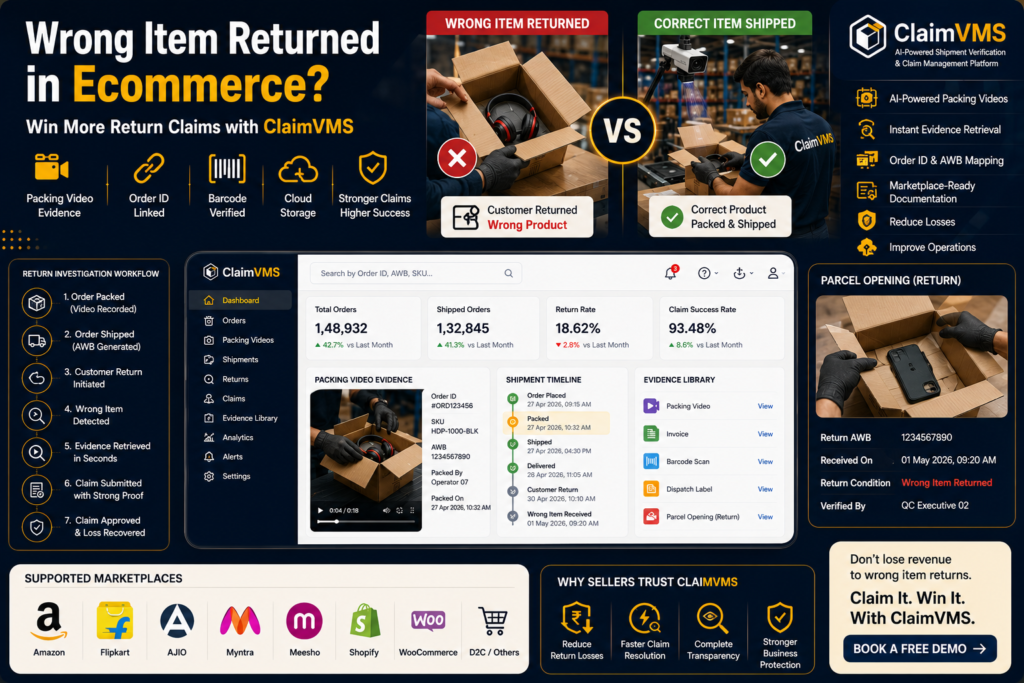
Every ecommerce seller eventually faces a return that doesn’t make sense.
You carefully pack the correct product, verify the order, dispatch it on time, and the customer receives the shipment successfully.
A few days later, the returned parcel arrives.
When your warehouse team opens it, the package contains:
- A completely different product
- A cheaper substitute
- A damaged item that wasn’t shipped
- An old used product
- Missing accessories
- Or sometimes even an empty package
This is known as a Wrong Item Return, and it has become one of the biggest causes of financial losses for ecommerce sellers across India.
For sellers on Amazon, Flipkart, AJIO, Myntra, Meesho, Shopify, WooCommerce, and D2C websites, wrong item returns are no longer isolated incidents—they are an operational challenge that requires structured evidence, not assumptions.
Many sellers know they packed the correct product.
The problem is proving it.
Unfortunately, photographs, invoices, courier tracking, and handwritten explanations rarely provide enough evidence during marketplace investigations.
This is where ClaimVMS changes the process.
ClaimVMS automatically records every packing process, links every recording with the Order ID, AWB Number, Invoice, SKU, Packing Operator, and Dispatch Timestamp, and stores everything in a searchable cloud platform.
Instead of manually searching hours of CCTV footage after a dispute arises, warehouse teams can retrieve complete shipment evidence in seconds.
In this guide, we’ll explain why wrong item return claims often fail, what marketplaces expect from sellers, and how ClaimVMS helps businesses create stronger shipment documentation before disputes ever occur.
What Is a Wrong Item Return?
A wrong item return occurs when the customer returns something different from the product originally shipped.
Examples include:
- Different product
- Different brand
- Different model
- Used product
- Damaged replacement
- Counterfeit product
- Empty parcel
- Missing accessories
These situations create both financial losses and operational delays because businesses must investigate what actually happened.
Why Wrong Item Returns Are Increasing
As ecommerce grows across India, order volumes continue increasing.
Higher shipment volumes naturally create more opportunities for:
- Return fraud
- Product substitution
- Incorrect returns
- Empty box returns
- Warehouse mistakes
- Customer disputes
Although many returns are genuine, businesses should have systems in place to verify every shipment objectively.
The Biggest Challenge Isn’t the Return—It’s the Proof
Most sellers immediately know something is wrong.
The returned product clearly doesn’t match what was dispatched.
However, marketplace investigations depend on evidence rather than assumptions.
Without structured shipment documentation, businesses often struggle to demonstrate:
- What product was packed
- Which accessories were included
- Whether the parcel was sealed correctly
- What actually left the warehouse
Simply knowing the shipment was correct is not enough.
It must be documented.
Why Many Wrong Item Claims Get Rejected
One of the biggest misconceptions among ecommerce sellers is that reporting the problem should be enough.
In reality, investigations focus on independently verifiable evidence.
Common reasons claims are rejected include:
- Missing packing videos
- Incomplete shipment records
- Poor-quality documentation
- Delayed submissions
- Missing Order IDs
- Missing AWB Numbers
- Unorganized warehouse records
The stronger and more organized the documentation, the easier it becomes to review the shipment.
Why Photographs Alone Usually Aren’t Enough
Photographs certainly provide useful supporting information.
However, they only capture a single moment.
For example, a photograph of the returned product shows:
- What came back.
It does not show:
- What was originally packed.
- Whether accessories were included.
- How the parcel was sealed.
- Which shipping label was applied.
Packing videos provide the complete shipment story.
Why Traditional CCTV Doesn’t Solve the Problem
Many warehouses already have CCTV systems installed.
These cameras improve warehouse security.
However, traditional CCTV was never designed for ecommerce investigations.
Typical limitations include:
- Continuous recording
- Time-based searching
- No Order ID mapping
- No AWB linkage
- Difficult retrieval
- Large video archives
Finding one shipment may require reviewing several hours of footage.
How ClaimVMS Is Different
ClaimVMS transforms ordinary warehouse recordings into structured shipment documentation.
Every packing process is automatically linked with:
- Order ID
- AWB Number
- Invoice
- SKU
- Packing Operator
- Dispatch Timestamp
- Packing Video
- Shipment Timeline
Instead of searching by date and time, users simply search using the Order ID.
The Importance of Order-Linked Packing Videos
Packing videos provide visual verification of the complete shipment process.
A typical recording captures:
- Product selection
- Product condition
- Barcode verification
- Accessories included
- Packaging process
- Parcel sealing
- Shipping label application
Because each recording is linked with shipment information, businesses can retrieve the correct evidence almost instantly.
How ClaimVMS Organizes Shipment Evidence
Every shipment processed through ClaimVMS automatically creates a structured record containing:
- Packing Video
- Order ID
- AWB Number
- Invoice
- SKU
- Packing Operator
- Dispatch Timestamp
- Shipment History
This centralized approach eliminates the need to manually organize evidence after disputes occur.
Real-World Example
Imagine an electronics seller dispatches a premium Bluetooth speaker.
Several days later, the returned parcel contains an inexpensive wired speaker from another manufacturer.
Without structured documentation, warehouse staff must manually search CCTV footage, courier records, invoices, and warehouse logs.
Using ClaimVMS, they simply search the Order ID.
Within seconds, they retrieve:
- Packing Video
- Product Verification
- Barcode Scan
- Parcel Sealing
- Shipping Label
- Dispatch Timestamp
- Invoice
- Shipment History
Instead of relying on assumptions, the warehouse now has complete shipment evidence ready for internal review or marketplace investigation.
Benefits of Structured Shipment Documentation
Businesses using standardized shipment documentation typically experience:
- Faster shipment verification
- Better warehouse accountability
- Organized evidence management
- Reduced manual CCTV searching
- Improved documentation quality
- Faster internal investigations
- Better operational transparency
- Centralized shipment history
- Improved warehouse productivity
- Stronger marketplace claim preparation
Why Preparation Is More Important Than Reaction
Many businesses begin collecting evidence only after a dispute occurs.
By then, valuable time has already been lost.
A proactive documentation system ensures that every shipment already has:
- Packing Video
- Order ID Mapping
- AWB Mapping
- Invoice Linking
- Dispatch Verification
- Shipment Timeline
When a dispute arises, the evidence is already available.
What Should You Do When a Wrong Item Return Arrives?
The first few hours after receiving a suspicious return are critical.
Instead of opening the parcel immediately, warehouse teams should follow a standardized verification process that preserves shipment evidence.
A consistent workflow reduces documentation gaps and improves internal investigations.
Step 1: Inspect the Return Parcel Before Opening
Before opening the package, carefully inspect the parcel externally.
Verify:
- Return shipping label
- AWB Number
- Order ID
- Parcel condition
- Packaging damage
- Seal condition
If possible, record the inspection on video before breaking the seal.
This creates a documented starting point for the investigation.
Step 2: Record the Parcel Opening
The parcel should be opened while continuously recording.
Ensure the video clearly captures:
- Shipping label
- Order ID
- Parcel opening
- Product removed
- Accessories received
- Packaging condition
Avoid pausing or editing the recording.
A continuous video provides a clearer timeline of events.
Step 3: Verify the Returned Product
After opening the parcel, compare the returned product against the original shipment information.
Check:
- Product model
- SKU
- Barcode
- Brand
- Color
- Quantity
- Accessories
- Physical condition
Even small differences should be documented.
Step 4: Retrieve the Original Packing Video
This is where structured shipment documentation becomes invaluable.
Using ClaimVMS, warehouse teams simply search by:
- Order ID
or
- AWB Number
The platform immediately retrieves:
- Original Packing Video
- Invoice
- Product Verification
- Barcode Scan
- Dispatch Timestamp
- Shipment Timeline
Instead of spending hours reviewing CCTV footage, the evidence is available in seconds.
Step 5: Compare What Left the Warehouse with What Returned
A proper investigation compares both events side by side.
The comparison includes:
Original Shipment:
- Product packed
- Barcode scanned
- Accessories included
- Parcel sealed
- Shipping label applied
Returned Shipment:
- Product received
- Product condition
- Accessories present
- Parcel condition
- Weight verification
This comparison creates a clear internal record of the shipment lifecycle.
Amazon SAFE-T Investigations
Amazon sellers frequently encounter disputes involving:
- Wrong item returned
- Empty box returns
- Product swapping
- Missing accessories
- Damaged returns
Well-organized shipment documentation allows sellers to retrieve evidence quickly whenever internal reviews or marketplace investigations require shipment verification.
Flipkart Seller Documentation
Flipkart investigations often involve:
- Product mismatch
- Packaging disputes
- Logistics issues
- Missing products
- Wrong returns
Businesses with standardized documentation can respond more efficiently because shipment evidence is already organized and searchable.
AJIO Seller Documentation Standards
AJIO typically requires detailed shipment verification during return investigations.
Businesses should maintain:
- Packing videos
- Order-linked shipment records
- Dispatch timestamps
- Invoice mapping
- Barcode verification
Preparing documentation before disputes occur significantly improves operational readiness.
Myntra and Meesho Return Investigations
Fashion marketplaces frequently investigate:
- Wrong products
- Wrong sizes
- Missing accessories
- Product condition
- Packaging quality
Consistent warehouse documentation simplifies these investigations.
Why Weight Verification Matters
Weight discrepancies can provide valuable supporting evidence during investigations.
Comparing:
- Dispatch weight
- Courier recorded weight
- Returned parcel weight
may reveal inconsistencies that help explain what occurred during shipment.
Weight verification should always complement—not replace—packing videos and shipment documentation.
Common Mistakes Sellers Make
Many businesses unintentionally weaken their investigations by making avoidable documentation mistakes.
Common issues include:
- Opening returns without recording
- Delayed documentation
- Missing Order IDs
- Missing AWB Numbers
- Poor video quality
- Inconsistent packing procedures
- Manual file organization
- Searching CCTV after disputes occur
Standardized documentation eliminates many of these problems.
How ClaimVMS Improves Marketplace Claim Readiness
ClaimVMS was designed specifically for ecommerce shipment verification.
Every shipment automatically includes:
- Packing Video
- Order ID
- AWB Number
- Invoice
- SKU
- Packing Operator
- Dispatch Timestamp
- Shipment Timeline
This creates a complete shipment history before disputes ever arise.
One Search Retrieves Everything
Instead of manually reviewing:
- CCTV footage
- Shared folders
- Emails
- Excel sheets
- Courier portals
Warehouse staff simply search:
- Order ID
or
- AWB Number
ClaimVMS instantly displays:
- Packing Video
- Invoice
- Shipment Details
- Barcode Verification
- Dispatch History
- Product Verification
Evidence retrieval becomes almost instantaneous.
Benefits of Using ClaimVMS
ClaimVMS helps ecommerce businesses improve shipment verification and operational efficiency.
Key benefits include:
✔ AI-powered packing video recording
✔ Order-linked shipment documentation
✔ Automatic Order ID mapping
✔ AWB Number integration
✔ Invoice linking
✔ Barcode verification
✔ Cloud-based evidence storage
✔ Centralized shipment history
✔ Faster evidence retrieval
✔ Better warehouse accountability
✔ Improved operational transparency
✔ Simplified marketplace investigations
Who Should Use ClaimVMS?
ClaimVMS is suitable for businesses shipping through:
- Amazon
- Flipkart
- AJIO
- Myntra
- Meesho
- Shopify
- WooCommerce
- D2C Websites
It is also ideal for:
- Warehouse Managers
- Fulfillment Centers
- Third-Party Logistics Providers (3PL)
- Ecommerce Operations Teams
Whether shipping hundreds or thousands of orders each month, ClaimVMS helps businesses standardize shipment documentation while improving operational efficiency.
Best Practices to Reduce Wrong Item Return Losses
Every ecommerce warehouse should establish a consistent documentation workflow.
Recommended practices include:
- Record every packing process.
- Scan product barcodes before packing.
- Verify accessories.
- Record parcel sealing.
- Link videos with Order IDs.
- Maintain centralized cloud storage.
- Train warehouse staff regularly.
- Audit documentation quality monthly.
- Review return investigation reports.
- Continuously improve warehouse processes.
These operational improvements strengthen shipment verification long before disputes occur.
The Future of Wrong Item Return Investigations
Marketplace investigations are becoming increasingly evidence-driven.
Successful ecommerce businesses are moving away from manual CCTV searches toward:
- AI-powered shipment verification
- Order-linked packing videos
- Centralized evidence management
- Searchable shipment documentation
- Automated warehouse workflows
ClaimVMS helps businesses make this transition while improving warehouse productivity and investigation readiness.
Conclusion
Wrong item returns have become one of the most expensive operational challenges for ecommerce sellers in India.
Although businesses often know the correct product was dispatched, marketplace investigations require structured, verifiable evidence rather than assumptions.
Traditional CCTV, invoices, and photographs remain useful, but they rarely provide the complete shipment history needed during investigations.
ClaimVMS solves this challenge by automatically recording every packing process, linking videos with Order IDs, AWB numbers, invoices, SKUs, and dispatch timestamps, and organizing everything within a centralized, searchable platform.
Instead of spending hours searching footage after disputes arise, warehouse teams can retrieve complete shipment evidence within seconds, improve internal investigations, strengthen marketplace claim submissions, and build scalable warehouse operations.
As ecommerce continues growing across India, businesses that invest in structured shipment documentation today will be better prepared to manage tomorrow’s disputes with greater confidence and operational efficiency.
Frequently Asked Questions (FAQs)
1. What is a wrong item return in ecommerce?
A wrong item return occurs when a customer returns a product different from the one originally shipped, such as another model, brand, damaged product, counterfeit item, or a package with missing accessories.
2. Why are wrong item return claims often rejected?
Most claims are rejected because sellers cannot provide sufficient order-linked evidence proving what was originally packed and dispatched. Missing packing videos and incomplete shipment records are common reasons.
3. How does ClaimVMS help during wrong item investigations?
ClaimVMS records every packing process and links each video with the Order ID, AWB number, invoice, SKU, and dispatch timestamp, allowing warehouse teams to retrieve structured shipment evidence within seconds.
4. Can ClaimVMS work with existing warehouse CCTV systems?
Yes. ClaimVMS integrates with most existing CCTV infrastructure while converting standard recordings into searchable, order-linked shipment documentation.
5. Why are packing videos important?
Packing videos visually document product verification, barcode scanning, accessories, packaging, parcel sealing, and shipping labels before dispatch, creating reliable shipment evidence.
6. What information should be recorded during return inspections?
Businesses should document the return label, AWB number, Order ID, parcel condition, parcel opening, returned product, accessories, and product verification in one continuous recording.
7. Which marketplaces can use ClaimVMS?
ClaimVMS supports sellers operating on Amazon, Flipkart, AJIO, Myntra, Meesho, Shopify, WooCommerce, and other ecommerce platforms.
8. Can ClaimVMS improve warehouse productivity?
Yes. By eliminating manual CCTV searches and centralizing shipment documentation, ClaimVMS helps warehouse teams retrieve evidence faster and focus on operational tasks.
9. How quickly can shipment evidence be retrieved?
Users simply search using the Order ID or AWB number, and ClaimVMS retrieves the associated packing video, invoice, shipment details, and dispatch history within seconds.
10. Why is proactive shipment documentation important?
Creating structured evidence before disputes occur enables businesses to respond quickly to investigations, improve warehouse accountability, reduce documentation delays, and strengthen marketplace claim submissions.