
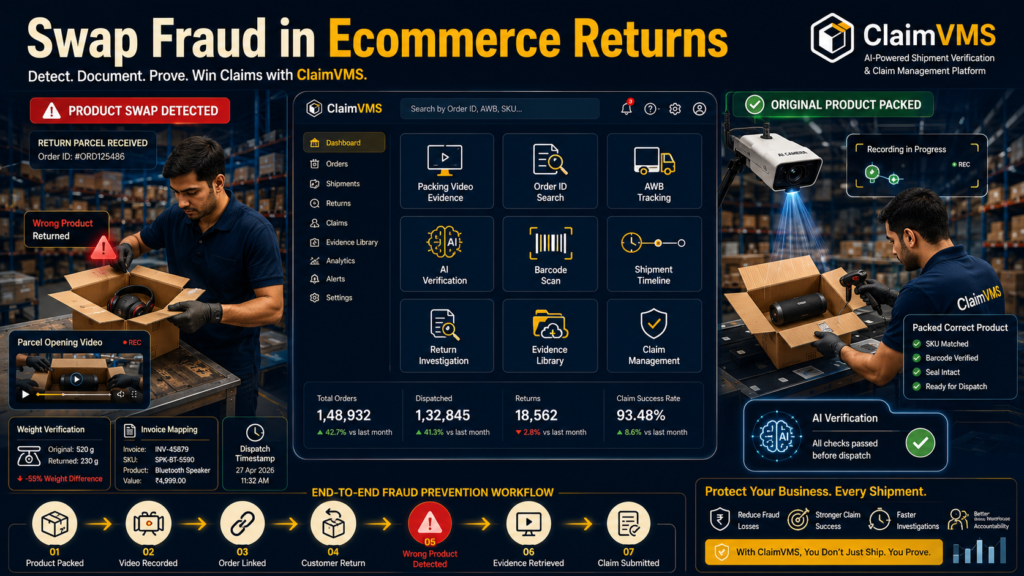
Imagine shipping a brand-new Bluetooth speaker worth ₹4,999 to a customer.
Your warehouse team carefully picks the correct product, scans the barcode, records the packing process, seals the parcel, and dispatches it through the courier.
A few days later, the customer requests a return.
The returned parcel arrives at your warehouse.
When your team opens the package, the original speaker is gone.
Instead, the box contains:
- A broken speaker from another brand
- A counterfeit product
- A used device
- A damaged replacement
- A low-value substitute
- Or, in some cases, an empty box or heavy object placed inside to match the parcel weight
Unfortunately, this scenario is becoming increasingly common across Indian ecommerce marketplaces.
This is known as swap fraud—one of the most expensive and difficult-to-prove forms of ecommerce return fraud.
For sellers operating on Amazon, Flipkart, AJIO, Myntra, Meesho, Shopify, WooCommerce, and D2C websites, swap fraud doesn’t just result in the loss of a product. It also creates additional expenses through reverse logistics, customer support, claim processing, warehouse investigations, and inventory adjustments.
The biggest challenge isn’t recognizing that something went wrong.
It’s proving exactly what left your warehouse.
This is where ClaimVMS provides a significant advantage.
ClaimVMS is an AI-powered shipment verification and claim management platform that automatically records every packing process, links videos with Order IDs, AWB Numbers, SKUs, Invoices, Packing Operators, and Dispatch Timestamps, and stores everything in a centralized, searchable evidence library.
Instead of spending hours searching CCTV footage after a dispute arises, warehouse teams can retrieve shipment evidence within seconds.
In this guide, you’ll learn what swap fraud is, why it continues to increase in Indian ecommerce, how to identify suspicious returns, and how ClaimVMS helps businesses strengthen shipment verification before disputes ever occur.
What Is Swap Fraud in Ecommerce?
Swap fraud occurs when a customer receives the correct product but returns a different item instead.
The returned product may be:
- A counterfeit version
- A damaged item
- A lower-value substitute
- An older version
- A completely unrelated product
- An empty package
- A parcel containing missing accessories
Because the original product never returns to the seller, the financial impact can be significant.
How Swap Fraud Differs from Normal Returns
Not every return is fraudulent.
Many customers return products because of:
- Size issues
- Genuine defects
- Incorrect deliveries
- Compatibility problems
- Changed purchase decisions
Swap fraud is different.
The customer does not return the same product that was originally shipped.
Instead, the seller receives something entirely different.
Why Swap Fraud Is Increasing Across Indian Ecommerce
Several industry trends have made swap fraud more common.
These include:
- Higher ecommerce order volumes
- Liberal return policies
- Increased Cash on Delivery (COD)
- Faster return processing
- Growing resale markets
- High demand for premium electronics
- Fashion product exchanges
- Wider marketplace return windows
As ecommerce continues expanding, businesses should prepare stronger shipment verification processes rather than relying solely on manual investigations.
Industries Most Affected by Swap Fraud
Although swap fraud can affect almost any ecommerce business, certain product categories experience greater exposure.
These include:
Electronics
High-value products such as:
- Smartphones
- Earbuds
- Power banks
- Smartwatches
- Bluetooth speakers
are frequently targeted because they are easy to resell.
Fashion & Apparel
Fashion sellers often experience:
- Brand swapping
- Used clothing returns
- Counterfeit exchanges
- Size-related manipulation
These cases become difficult to investigate without structured shipment documentation.
Beauty & Personal Care
Products may be:
- Opened
- Partially used
- Refilled
- Replaced with lower-quality alternatives
Visual shipment records help verify the original dispatch condition.
Branded Consumer Goods
Premium branded products may be replaced with:
- Fake versions
- Older products
- Different models
- Damaged inventory
Without shipment evidence, distinguishing between genuine returns and fraudulent substitutions becomes challenging.
Why Sellers Lose Most Swap Fraud Claims
Many ecommerce businesses know they shipped the correct product.
Unfortunately, marketplace investigations rely on evidence rather than assumptions.
Common reasons sellers struggle during investigations include:
- Missing packing videos
- Incomplete warehouse records
- Manual CCTV searches
- Missing Order IDs
- Missing AWB Numbers
- Poor documentation quality
- Delayed evidence submission
The issue usually isn’t the investigation itself.
It’s the lack of structured shipment evidence.
Why Traditional CCTV Is Not Enough
Many warehouses already have surveillance cameras installed.
These systems improve warehouse security but are rarely optimized for ecommerce claim investigations.
Typical limitations include:
- Continuous recording
- Time-based searching
- No Order ID linkage
- No AWB mapping
- Manual evidence retrieval
- Large unorganized video archives
Finding one shipment among several days of recordings can take hours.
How ClaimVMS Solves This Challenge
ClaimVMS converts ordinary warehouse recordings into structured shipment documentation.
Every order is automatically linked with:
- Order ID
- AWB Number
- Invoice
- SKU
- Packing Operator
- Dispatch Timestamp
- Packing Video
- Shipment Timeline
Instead of searching CCTV footage manually, warehouse teams simply search by Order ID or AWB Number.
The Importance of Order-Linked Packing Videos
Packing videos create a complete visual record of the shipment before dispatch.
A typical ClaimVMS recording includes:
- Product selection
- Barcode verification
- Product condition
- Accessories included
- Packaging process
- Parcel sealing
- Shipping label application
Because each video is linked directly with shipment data, retrieval becomes almost instantaneous.
Real-World Scenario
Imagine an ecommerce seller dispatches an original branded smartwatch.
Several days later, the returned parcel contains an old damaged watch from another manufacturer.
Without structured shipment documentation, warehouse staff must manually review CCTV footage, invoices, courier records, and warehouse logs.
Using ClaimVMS, they simply search the Order ID.
Within seconds, they retrieve:
- Original Packing Video
- Product Verification
- Barcode Scan
- Invoice
- Parcel Sealing
- Dispatch Timestamp
- Shipment Timeline
This creates a clear record of what actually left the warehouse.
Why Building Evidence Before a Dispute Matters
Many businesses begin collecting documentation only after receiving a suspicious return.
By then:
- Time has already been lost.
- CCTV searches become difficult.
- Files may be scattered.
- Investigation windows become shorter.
ClaimVMS ensures shipment evidence already exists before disputes occur.
Every shipment automatically receives:
- Packing Video
- Order ID Mapping
- AWB Mapping
- Invoice Linking
- Dispatch Timestamp
- Centralized Cloud Storage
When an investigation begins, the evidence is already available.
Benefits of Structured Shipment Documentation
Businesses using ClaimVMS typically improve:
- Shipment verification
- Warehouse accountability
- Evidence organization
- Investigation speed
- Documentation consistency
- Marketplace claim readiness
- Warehouse productivity
- Operational transparency
- Internal quality control
- Claim preparation efficienc
How to Detect Swap Fraud Before Opening the Return Parcel
The investigation should begin before the parcel is opened.
Many warehouses immediately open returned packages without documenting their condition, making it harder to establish what was actually received.
Instead, every suspicious return should follow a standardized inspection process.
Before opening the parcel, verify:
- Order ID
- AWB Number
- Courier Label
- Package Condition
- Seal Integrity
- Parcel Weight
- Signs of Tampering
- External Damage
If anything appears unusual, record it immediately before breaking the seal.
Create a Standard Return Inspection Process
Every warehouse should follow the same workflow whenever a return is received.
A recommended process is:
- Verify the Order ID and AWB.
- Record the sealed parcel from all sides.
- Capture the courier label clearly.
- Weigh the parcel before opening.
- Open the parcel in one continuous recording.
- Compare the returned item with the original shipment.
- Retrieve the original packing video.
- Save all evidence in one investigation folder.
Consistency improves documentation quality and reduces missing evidence.
Why Weight Verification Matters
Although weight alone cannot prove swap fraud, it provides valuable supporting evidence.
Compare:
- Dispatch Weight
- Courier Pickup Weight
- Return Parcel Weight
Significant differences may indicate:
- Missing accessories
- Empty box returns
- Product substitution
- Partial returns
- Incorrect packaging
Weight verification works best when combined with packing videos and shipment records.
Retrieve the Original Shipment Evidence
When swap fraud is suspected, warehouse teams need immediate access to the original shipment documentation.
Using ClaimVMS, simply search:
- Order ID
or
- AWB Number
The platform instantly displays:
- Packing Video
- Product Verification
- Barcode Scan
- Invoice
- Dispatch Timestamp
- Shipment Timeline
- Packing Operator
- Warehouse History
Instead of reviewing hours of CCTV footage, evidence is available within seconds.
Compare the Original Shipment with the Returned Parcel
The investigation should compare both stages of the shipment lifecycle.
Original Dispatch
- Correct product selected
- Barcode scanned
- Accessories verified
- Parcel sealed
- Shipping label applied
Returned Parcel
- Product received
- Condition
- Accessories returned
- Barcode verification
- Weight comparison
- Packaging condition
This side-by-side comparison creates a structured investigation record.
Amazon SAFE-T Claim Documentation
Amazon sellers frequently encounter:
- Wrong item returns
- Empty box returns
- Product swapping
- Missing accessories
- Damaged returns
Marketplace investigations require organized documentation.
Businesses that already maintain order-linked shipment evidence can respond much faster than those relying on manual warehouse searches.
Flipkart Seller Protection
Flipkart investigations commonly involve:
- Product mismatch
- Wrong item returned
- Packaging disputes
- Product condition verification
- Shipment confirmation
Maintaining searchable shipment documentation significantly improves investigation readiness.
AJIO Return Documentation
AJIO often requires sellers to provide detailed shipment verification during return investigations.
Recommended documentation includes:
- Packing Videos
- Order ID Mapping
- AWB Number
- Dispatch Timestamp
- Invoice
- Barcode Verification
Preparing this information before disputes occur reduces investigation delays.
Myntra and Meesho Return Investigations
Fashion marketplaces frequently investigate:
- Product swapping
- Wrong sizes
- Missing accessories
- Damaged products
- Counterfeit returns
Consistent shipment documentation allows warehouse teams to review these cases quickly and accurately.
Common Documentation Mistakes That Lead to Claim Failures
Many sellers unknowingly weaken their own investigations.
Common mistakes include:
- Recording only selected orders
- Poor camera positioning
- Low video quality
- Missing barcode verification
- Manual file naming
- Videos not linked to Order IDs
- Scattered storage systems
- Delayed evidence retrieval
- Inconsistent packing procedures
- Opening returned parcels without recording
Standardized workflows help eliminate these issues.
How ClaimVMS Improves Marketplace Claim Readiness
ClaimVMS was designed specifically for ecommerce shipment verification.
Every dispatched order automatically generates a structured evidence record containing:
- Packing Video
- Order ID
- AWB Number
- Invoice
- SKU
- Dispatch Timestamp
- Packing Operator
- Shipment Timeline
Instead of building documentation after a dispute, everything is already organized.
One Search Retrieves Complete Shipment History
Warehouse teams no longer need to search through:
- CCTV footage
- Shared folders
- Local hard drives
- Emails
- Excel files
- Courier portals
Simply search:
- Order ID
or
- AWB Number
ClaimVMS immediately retrieves:
- Packing Video
- Invoice
- Shipment Details
- Barcode Verification
- Dispatch History
- Product Verification
- Investigation Timeline
Evidence retrieval becomes nearly instantaneous.
Benefits of Using ClaimVMS
ClaimVMS helps ecommerce businesses strengthen shipment verification while improving warehouse efficiency.
Key advantages include:
✔ AI-powered packing video recording
✔ Order-linked shipment documentation
✔ Automatic Order ID mapping
✔ AWB Number integration
✔ Barcode verification
✔ Invoice linking
✔ Cloud-based evidence storage
✔ Centralized shipment history
✔ Instant video retrieval
✔ Reduced manual CCTV searching
✔ Better warehouse accountability
✔ Improved operational transparency
✔ Faster marketplace investigations
✔ Simplified claim preparation
Who Should Use ClaimVMS?
ClaimVMS is ideal for businesses selling through:
- Amazon
- Flipkart
- AJIO
- Myntra
- Meesho
- Shopify
- WooCommerce
- D2C Websites
It also supports:
- Warehouse Managers
- Fulfillment Centers
- Third-Party Logistics (3PL)
- Operations Teams
- Enterprise Ecommerce Businesses
Whether processing 100 orders or 20,000 orders per day, ClaimVMS helps standardize shipment documentation and improve operational control.
Best Practices to Prevent Swap Fraud Losses
Every warehouse should establish clear operational standards.
Recommended practices include:
- Record every packing process.
- Scan every product barcode.
- Verify accessories before sealing.
- Record parcel sealing.
- Link every shipment with its Order ID.
- Store shipment records in centralized cloud storage.
- Record every return parcel opening.
- Audit packing stations regularly.
- Train warehouse staff consistently.
- Review fraud trends every month.
Small improvements in documentation can significantly reduce investigation time and improve claim outcomes.
The Future of Ecommerce Fraud Prevention
As ecommerce continues to grow, investigations are becoming increasingly evidence-driven.
Future-ready warehouse operations will rely on:
- AI-powered shipment verification
- Automated packing video recording
- Order-linked documentation
- Real-time warehouse analytics
- Cloud-based evidence management
- Faster investigation workflows
ClaimVMS helps businesses transition from traditional CCTV recording to intelligent shipment verification designed specifically for ecommerce operations.
Conclusion
Swap fraud is no longer an occasional issue—it has become a recurring operational challenge for ecommerce sellers across India.
While many businesses recognize fraudulent returns immediately, proving what was originally shipped remains the biggest obstacle during marketplace investigations.
Traditional CCTV systems, invoices, and photographs provide only partial evidence.
ClaimVMS addresses this challenge by automatically recording every packing process, linking videos with Order IDs, AWB numbers, invoices, SKUs, and dispatch timestamps, and organizing everything into a searchable evidence platform.
Instead of spending hours reviewing warehouse footage after disputes arise, businesses can retrieve complete shipment records within seconds, strengthen internal investigations, improve operational transparency, and prepare better marketplace claims.
As ecommerce order volumes continue to increase, sellers who invest in structured shipment documentation today will be better equipped to reduce fraud-related losses, protect profit margins, and build scalable warehouse operations for the future.
Frequently Asked Questions (FAQs)
1. What is swap fraud in ecommerce?
Swap fraud occurs when a customer receives the correct product but returns a different item, such as a counterfeit, damaged product, lower-value substitute, or unrelated item instead of the original purchase.
2. How is swap fraud different from a normal return?
In a normal return, the customer sends back the same product that was originally delivered. In swap fraud, the returned product is different from the one shipped.
3. How does ClaimVMS help investigate swap fraud?
ClaimVMS automatically records packing videos and links them with the Order ID, AWB number, invoice, SKU, and dispatch timestamp, enabling warehouse teams to retrieve shipment evidence instantly during investigations.
4. Why are packing videos important?
Packing videos document product verification, barcode scanning, accessories, packaging, parcel sealing, and shipping labels before dispatch, creating reliable shipment evidence.
5. Can ClaimVMS work with existing CCTV cameras?
Yes. ClaimVMS integrates with most existing warehouse CCTV systems and converts standard recordings into searchable, order-linked shipment documentation.
6. Which marketplaces can use ClaimVMS?
ClaimVMS supports sellers operating on Amazon, Flipkart, AJIO, Myntra, Meesho, Shopify, WooCommerce, and other ecommerce platforms.
7. Why should warehouses record return parcel openings?
Recording the parcel opening helps document the condition of the returned shipment, verify packaging integrity, and create additional evidence during investigations.
8. How quickly can shipment evidence be retrieved?
Warehouse staff simply search using the Order ID or AWB number, and ClaimVMS retrieves the associated packing video, invoice, shipment details, and dispatch history within seconds.
9. Can ClaimVMS improve warehouse productivity?
Yes. By reducing manual CCTV searches, centralizing shipment documentation, and simplifying evidence retrieval, ClaimVMS helps warehouse teams investigate cases much more efficiently.
10. What is the biggest benefit of ClaimVMS?
The biggest advantage is having complete, order-linked shipment evidence—including packing videos, Order IDs, AWB numbers, invoices, and dispatch history—available instantly whenever disputes arise.