
What Is an Amazon A-to-Z Claim?
The Amazon A-to-Z Guarantee is Amazon’s buyer protection program designed to protect customers purchasing from third-party sellers. When buyers believe an issue has not been resolved through normal communication, they can escalate the matter by filing an Amazon A-to-Z claim.
For sellers, this is much more than a customer complaint.
An A-to-Z claim can directly affect your:
- Revenue
- Order Defect Rate (ODR)
- Account Health
- Buy Box eligibility
- Seller reputation
- Selling privileges
Most sellers focus on resolving customer issues, but once an A-to-Z claim is filed, the discussion shifts from customer service to evidence.
Amazon reviews the available proof submitted by both parties before making its decision.
This means the seller with stronger, verifiable evidence usually has the advantage.
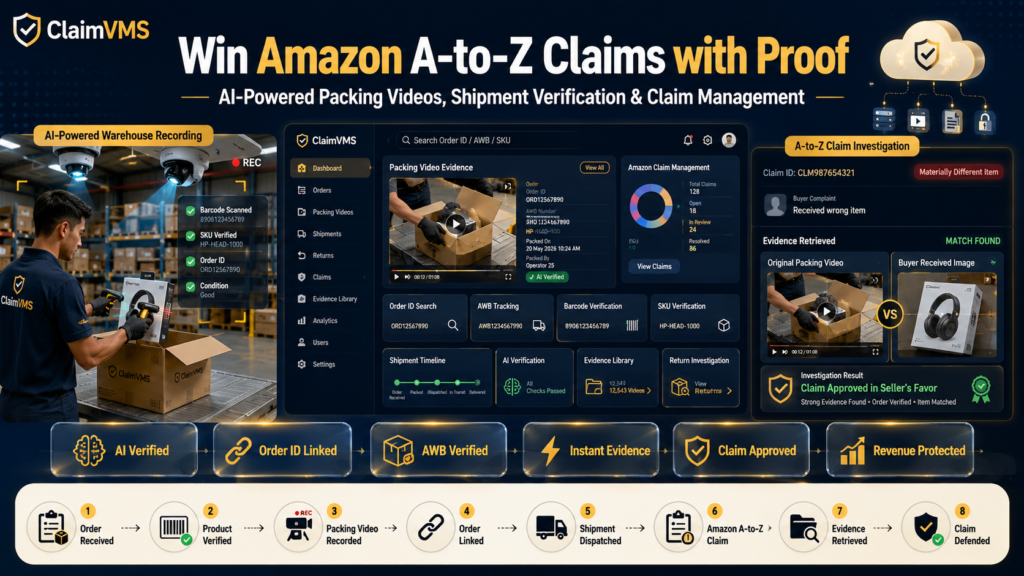
Modern evidence platforms like ClaimVMS help sellers prepare for disputes before they happen by automatically recording packing videos, verifying shipments with AI, and securely linking every shipment to its Order ID and AWB.
Why Amazon A-to-Z Claims Matter More Than Ever
Competition on Amazon has increased significantly over the past few years.
At the same time, buyer disputes have become more frequent due to:
- Lost shipments
- Wrong item deliveries
- Damaged products
- Fraudulent return requests
- False “Item Not Received” claims
- Product mismatch disputes
Every successful buyer claim costs sellers twice.
First, they lose the product or refund amount.
Second, they risk damaging their seller performance metrics.
Multiple claim losses can gradually increase the Order Defect Rate (ODR), making it harder to maintain healthy account performance.
Instead of treating claims as isolated incidents, successful businesses build systems that continuously generate shipment evidence before disputes occur.
Common Reasons Buyers File Amazon A-to-Z Claims
Most A-to-Z claims fall into three primary categories.
1. Item Not Received (INR)
The buyer claims the order never arrived or was delivered significantly later than expected.
Sometimes these are genuine courier issues.
Other times they involve fraudulent “package not received” claims even after successful delivery.
2. Materially Different Item
This is one of the most common claim categories.
Customers may report:
- Wrong product received
- Wrong size
- Wrong color
- Missing accessories
- Damaged product
- Used product received
- Product different from listing description
For sellers, these disputes are often difficult because tracking information cannot prove what was actually packed inside the parcel.
3. Return Not Refunded
The customer claims they returned the product but never received a refund.
These disputes usually involve:
- Return tracking
- Refund processing delays
- Warehouse receiving records
- Communication history
Each claim type requires different evidence.
Submitting the same documents for every dispute significantly reduces your chances of winning.
Understanding the Impact on Your Seller Account
Many sellers only think about the refund amount.
The bigger concern is your account health.
When Amazon rules against a seller:
- Refunds are deducted from seller balances.
- Order Defect Rate (ODR) increases.
- Account health weakens.
- Buy Box opportunities may decrease.
- Future account reviews become stricter.
Repeated claim losses can eventually result in account restrictions or suspension.
Winning disputes protects both your revenue and your long-term selling performance.
Why Sellers Lose Amazon A-to-Z Claims
Many sellers assume their case is strong because they know they packed the correct product.
Unfortunately, Amazon cannot make decisions based on assumptions.
The most common reasons sellers lose include:
- Missing shipment evidence
- No packing video
- Incorrect documentation
- Late responses
- Generic CCTV footage
- Missing Order ID linkage
- No barcode verification
- No SKU verification
- Weak claim explanations
- Submitting irrelevant evidence
Simply providing tracking information is rarely enough in disputes involving wrong products or damaged items.
Amazon wants evidence that directly addresses the buyer’s complaint.
Tracking Information Alone Is Not Enough
Many sellers respond by uploading:
- Courier tracking
- Dispatch confirmation
- Invoice
- Product listing
- Written explanation
These documents only prove that a parcel was shipped.
They do not prove:
- which product was packed,
- whether accessories were included,
- whether the carton contained the correct SKU,
- whether the item was damaged before shipping,
- or whether the parcel was sealed correctly.
This is why many “Materially Different” claims are lost despite successful delivery.
The Evidence Amazon Actually Looks For
Every Amazon investigator attempts to answer one simple question:
Can the seller prove what happened before the shipment left the warehouse?
Strong evidence usually includes:
- Packing video
- Barcode verification
- SKU verification
- Shipping label visibility
- Order ID linkage
- AWB linkage
- Invoice
- Shipment timeline
- Customer communication
- Carrier tracking
The more directly your evidence relates to the disputed order, the stronger your case becomes.
Why Proof-Based Packing Videos Make a Difference
Packing videos have become one of the most valuable forms of shipment evidence.
Unlike static photographs, a continuous packing video can demonstrate:
- Product condition before packing
- Correct product selection
- Barcode scanning
- SKU confirmation
- Accessories included
- Protective packaging
- Carton sealing
- Shipping label attachment
When linked with the Order ID and AWB, this creates a complete chain of evidence that can be retrieved whenever a dispute arises.
Instead of relying on written explanations, sellers can present objective visual proof.
How ClaimVMS Helps Build Stronger Evidence
ClaimVMS is designed specifically for modern e-commerce operations.
Instead of manually collecting evidence after a claim appears, the platform automatically creates verifiable shipment records during packing.
Every shipment can include:
- AI-powered packing video
- Barcode verification
- SKU validation
- Order ID mapping
- AWB verification
- Shipment timeline
- Cloud-based evidence storage
- Instant evidence retrieval
- Return investigation records
- Claim management dashboard
This proactive approach helps businesses respond to disputes quickly while reducing manual investigation time.
Understanding Amazon’s 48–72 Hour Response Window
One of the biggest mistakes sellers make is delaying their response.
Amazon generally provides a limited response window after an A-to-Z claim is filed.
During this period, sellers should:
- Review the buyer’s complaint.
- Identify the claim category.
- Collect relevant evidence.
- Organize supporting documents.
- Submit a clear, factual response.
Waiting until the last moment increases the risk of incomplete submissions and missed deadlines.
Having all shipment evidence readily available allows sellers to respond faster and more confidently.
Step 1: Review the Claim Immediately
As soon as you receive an A-to-Z notification:
- Open the dispute in Seller Central.
- Read the buyer’s complaint carefully.
- Note the response deadline.
- Identify whether the issue involves delivery, product condition, or refunds.
Understanding the exact dispute determines which evidence you should prepare.
Step 2: Identify the Correct Claim Type
Not every claim requires the same documentation.
For example:
- Item Not Received → Delivery confirmation and carrier records.
- Materially Different → Packing video, barcode verification, SKU confirmation, shipment evidence.
- Return Not Refunded → Return tracking, warehouse receipt, refund documentation.
Matching the evidence to the specific complaint greatly improves your chances of success.
Step 3: Collect Evidence Before Responding
Before submitting your response, organize every relevant document.
This may include:
- Packing video
- Invoice
- Carrier tracking
- Shipping confirmation
- Barcode scan
- SKU verification
- Order ID
- AWB details
- Customer communication
- Product listing
Submitting organized evidence presents a stronger case than uploading unrelated files individually.
Step 4: Submit Your Response Through Seller Central
Once you’ve gathered the appropriate evidence, submit your response directly through Amazon Seller Central.
Your response should be:
- Clear
- Professional
- Fact-based
- Well-organized
Avoid emotional language or accusations against the buyer.
Instead, explain what happened during fulfillment and attach evidence that directly supports your case.
A strong response typically includes:
- Order details
- Dispatch date
- Tracking information
- Invoice
- Packing evidence
- Barcode verification
- Shipment timeline
- Supporting documents
Leading with your strongest evidence makes it easier for Amazon’s review team to evaluate the claim.
Step 5: Resolve Genuine Issues Before Amazon Decides
Not every A-to-Z claim is fraudulent.
If your investigation confirms that the buyer’s complaint is genuine, resolving the issue promptly can minimize the impact on your seller account.
Depending on the situation, this may include:
- Issuing a refund
- Replacing the product
- Providing additional support
- Resolving the issue directly with the customer
Early resolution often helps prevent unnecessary account performance issues.
The Evidence That Wins Amazon A-to-Z Claims
Not every document carries the same value during an Amazon investigation.
The strongest cases combine multiple pieces of evidence that clearly prove what happened before shipment.
ClaimVMS helps organize these records into a complete shipment history, allowing sellers to retrieve the right evidence within seconds.
Best Evidence for “Item Not Received” Claims
When buyers report that an order never arrived, Amazon primarily evaluates shipping and delivery records.
Useful evidence includes:
- Carrier tracking information
- Delivery confirmation
- GPS delivery records (when available)
- Signature confirmation for high-value shipments
- Dispatch confirmation
- Order timeline
The objective is to demonstrate that the shipment reached the customer’s delivery location successfully.
Best Evidence for “Materially Different” Claims
This category includes disputes involving:
- Wrong product
- Wrong size
- Wrong color
- Missing accessories
- Defective item
- Damaged item
- Incorrect variant
Unlike delivery disputes, tracking information cannot prove what was inside the parcel.
For these cases, the strongest evidence includes:
- Packing video
- Barcode scan
- SKU verification
- Product condition before packing
- Shipping label visibility
- Order ID verification
- AWB linkage
- Packing timestamp
Together, these records demonstrate exactly what was packed before dispatch.
Best Evidence for “Return Not Refunded” Claims
When buyers claim they returned a product but did not receive a refund, sellers should provide documentation showing the return process.
Helpful evidence includes:
- Return shipment tracking
- Warehouse receiving confirmation
- Refund processing records
- Return inspection reports
- Customer communication
- Refund transaction details
Keeping organized return records reduces confusion during investigations.
Why ClaimVMS Provides Stronger Shipment Evidence
Traditional warehouse systems were not designed for marketplace investigations.
Most warehouses rely on:
- Manual photographs
- CCTV recordings
- Paper documentation
- Excel records
These systems make retrieving order-specific evidence difficult.
ClaimVMS creates a structured evidence library where every shipment is automatically linked to:
- Order ID
- AWB
- SKU
- Barcode
- Packing video
- Invoice
- Shipment timeline
Instead of searching through hours of CCTV footage, warehouse teams can retrieve evidence almost instantly.
Real Example: How One Seller Improved A-to-Z Claim Outcomes
A growing home and lifestyle brand processed hundreds of Amazon orders every day.
Whenever buyers reported receiving the wrong product, the warehouse team struggled to prove what had actually been packed.
Although the warehouse used CCTV cameras, finding the correct footage often required several hours of manual searching.
Many recordings lacked clear visibility of:
- Product barcode
- SKU
- Shipping label
- Order information
As a result, several disputes were lost despite the correct products being dispatched.
After implementing ClaimVMS, every shipment automatically generated:
- AI-verified packing video
- Barcode verification
- SKU confirmation
- Order ID linkage
- AWB mapping
When similar disputes occurred, the operations team retrieved the exact packing video within seconds.
The evidence clearly showed the correct product being packed and dispatched, allowing the seller to defend legitimate claims more effectively while reducing investigation time.
Five Common Mistakes Sellers Make During Amazon A-to-Z Claims
Many disputes are lost because of avoidable mistakes rather than weak cases.
The most common errors include:
Missing the response deadline
Delaying evidence collection often results in incomplete submissions.
Using the same documents for every claim
Each dispute requires different supporting evidence.
Submitting only tracking information
Tracking proves shipment movement, not product accuracy.
Writing emotional responses
Professional, evidence-based responses carry far more weight.
Failing to organize shipment records
Searching manually through warehouse footage wastes valuable response time.
How to Appeal an Amazon A-to-Z Claim
If Amazon rules against your claim, sellers may have the opportunity to submit an appeal.
An effective appeal should include:
- New supporting evidence
- Additional shipment documentation
- Packing video (if previously unavailable)
- Updated carrier information
- Clarification of disputed facts
Rather than repeating the original response, focus on providing information that was not previously available during the first review.
Well-supported appeals often have stronger outcomes than generic reconsideration requests.
How ClaimVMS Simplifies Appeals
One of the biggest challenges during appeals is locating shipment evidence after several weeks.
ClaimVMS maintains a searchable cloud-based evidence library where sellers can retrieve:
- Packing videos
- Barcode verification
- SKU records
- AWB information
- Shipment timeline
- Operator activity
- Invoice linkage
This allows businesses to respond quickly without depending on archived CCTV recordings.
Amazon A-to-Z Claim Readiness Checklist
Ask yourself these questions before the next dispute arrives.
Can you:
- Retrieve a packing video using an Order ID within seconds?
- Verify which SKU was packed?
- Confirm the barcode scanned during packing?
- Match the AWB to the shipment?
- View the shipment timeline?
- Verify the product condition before dispatch?
- Access invoices immediately?
- Produce evidence before Amazon’s response deadline?
If the answer to any of these questions is “No,” your warehouse may be relying on incomplete shipment records.
Why Evidence Is the Future of Marketplace Claims
Marketplace investigations are becoming increasingly evidence-driven.
Written explanations alone are no longer enough to resolve complex disputes.
Businesses that maintain structured shipment records can:
- Respond faster
- Improve claim success rates
- Reduce fraudulent losses
- Protect seller performance
- Minimize manual investigations
- Improve warehouse accountability
The focus has shifted from explaining what happened to proving what happened.
Preparing for Every Amazon Claim Before It Happens
Successful Amazon sellers don’t wait for disputes to begin collecting evidence.
Instead, they build systems that automatically verify every shipment before dispatch.
By combining:
- AI-powered packing videos
- Barcode verification
- SKU validation
- Order ID mapping
- AWB tracking
- Shipment timelines
- Centralized evidence storage
ClaimVMS helps sellers prepare for disputes before they happen.
This proactive approach allows warehouse teams to retrieve evidence quickly, respond with confidence, and reduce unnecessary financial losses during Amazon A-to-Z investigations.
Why Modern Amazon Sellers Choose ClaimVMS
Winning Amazon A-to-Z claims isn’t just about responding quickly—it’s about having the right evidence ready before a dispute begins.
Many sellers still rely on CCTV footage, packing photos, spreadsheets, and manual documentation. While these methods may help with internal operations, they often fall short during marketplace investigations because the evidence is difficult to retrieve, isn’t linked to the order, or doesn’t clearly prove what was packed.
ClaimVMS eliminates these challenges by automatically creating a searchable evidence trail for every shipment.
Every packing process is securely recorded and connected with:
- Order ID
- AWB Number
- Product SKU
- Barcode
- Packing Timestamp
- Shipment Timeline
- AI Verification Status
Instead of searching through hours of warehouse recordings, your team can retrieve complete shipment evidence within seconds.
How ClaimVMS Helps You Win More Amazon A-to-Z Claims
ClaimVMS is built specifically for marketplace sellers who want to reduce fraudulent claims and protect their revenue.
The platform helps you:
- Record every packing process automatically
- Verify products using barcode scanning
- Validate the correct SKU before dispatch
- Link videos with Order ID and AWB
- Store evidence securely in the cloud
- Retrieve videos instantly using Order ID
- Investigate return disputes faster
- Manage claims from a centralized dashboard
- Reduce manual investigation time
- Improve warehouse accountability
Whether you’re processing 50 orders or 50,000 orders per day, ClaimVMS provides structured shipment evidence that supports faster and more accurate dispute resolution.
Key Features of ClaimVMS
ClaimVMS combines AI-powered warehouse verification with enterprise-grade claim management.
Core features include:
- AI-Powered Packing Video Recording
- Order ID Verification
- Barcode Verification
- SKU Verification
- AWB Tracking
- Shipment Timeline
- Cloud-Based Evidence Library
- Return Investigation Dashboard
- Claim Management System
- Search by Order ID
- Search by AWB
- Search by SKU
- AI Shipment Verification
- Warehouse Analytics
- Multi-User Access
- Secure Cloud Storage
- Evidence Export
- Fast Video Retrieval
Together, these features help businesses create reliable shipment records while simplifying Amazon claim investigations.
Best Practices for Winning Amazon A-to-Z Claims
Successful sellers follow a standardized evidence process for every shipment.
Recommended best practices include:
- Record every packing process.
- Scan product barcodes before packing.
- Verify the correct SKU.
- Link evidence with Order ID.
- Verify AWB before dispatch.
- Store shipment evidence securely.
- Monitor warehouse packing quality.
- Review disputes immediately.
- Respond before Amazon’s deadline.
- Keep communication factual and professional.
- Organize documents before submission.
- Preserve shipment records until the return window closes.
These simple operational improvements significantly strengthen your ability to defend legitimate claims.
Why Proof-Based Packing Is Becoming the Industry Standard
Marketplace investigations are becoming increasingly evidence-driven.
Written explanations alone no longer carry the same weight they once did.
Businesses that maintain AI-verified shipment records can:
- Respond to disputes faster
- Reduce investigation time
- Improve claim approval rates
- Protect seller performance
- Reduce fraudulent refunds
- Improve warehouse accuracy
- Increase customer confidence
- Protect business revenue
Instead of proving your case after a dispute, ClaimVMS helps you create the proof before the shipment leaves your warehouse.
Conclusion
Amazon A-to-Z claims are an unavoidable part of modern e-commerce.
What separates successful sellers from everyone else isn’t the number of disputes they receive—it’s how quickly and accurately they respond.
Without reliable shipment evidence, even genuine sellers may struggle to defend themselves against false claims.
ClaimVMS transforms warehouse operations by automatically recording packing videos, verifying products with AI, linking every shipment to its Order ID and AWB, and storing evidence in a searchable cloud library.
From packing verification to return investigation and claim management, ClaimVMS gives businesses the confidence to handle Amazon A-to-Z disputes with clear, verifiable proof instead of assumptions.
Frequently Asked Questions (FAQs)
What is an Amazon A-to-Z Claim?
An Amazon A-to-Z Claim is Amazon’s buyer protection program that allows customers to request a refund if an issue with a third-party seller cannot be resolved directly.
How long do sellers have to respond to an Amazon A-to-Z Claim?
Amazon generally provides a limited response window after a claim is filed. Sellers should respond as quickly as possible with complete supporting evidence.
What evidence is most useful for Amazon A-to-Z claims?
Useful evidence includes packing videos, Order ID verification, barcode scans, SKU verification, AWB details, shipment timelines, invoices, delivery confirmation, and customer communication.
Can tracking information alone win an Amazon A-to-Z claim?
No. Tracking confirms shipment movement but cannot verify what product was packed inside the parcel. Additional shipment evidence is often required.
How do packing videos help during Amazon investigations?
Packing videos provide visual proof showing the product condition, barcode scan, SKU verification, packaging process, carton sealing, and shipping label before dispatch.
How does ClaimVMS help Amazon sellers?
ClaimVMS automatically records packing videos, verifies shipments using AI, links evidence with Order IDs and AWBs, and enables instant retrieval during claim investigations.
Can ClaimVMS reduce false buyer claims?
Yes. Since every shipment is verified before dispatch, businesses can quickly determine whether claims involve genuine delivery issues or potentially fraudulent disputes.
Is ClaimVMS suitable for high-volume warehouses?
Yes. ClaimVMS is designed for businesses processing anything from hundreds to thousands of shipments per day while maintaining searchable evidence for every order.
What information is linked with each shipment?
ClaimVMS can automatically associate:
- Order ID
- AWB
- Barcode
- SKU
- Packing Video
- Shipment Timeline
- AI Verification
- Invoice
making evidence retrieval fast and efficient.