
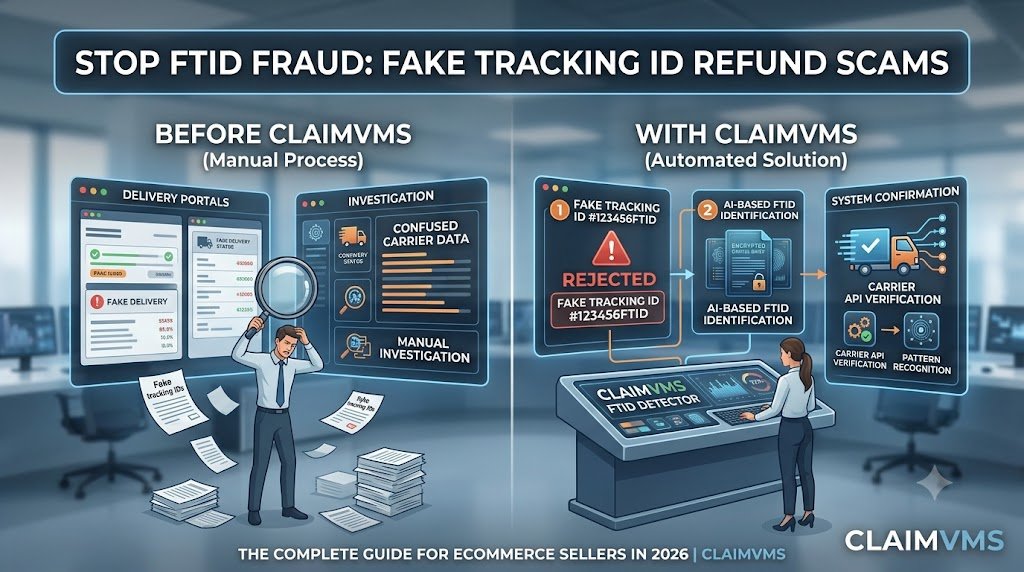
What Is FTID Fraud?
FTID (Fake Tracking ID) fraud is an ecommerce return scam where a buyer receives a refund by using a fake or unrelated tracking number while keeping the original product.
Instead of returning the purchased item, the fraudster submits a tracking number associated with another shipment or a low-value parcel. Since the courier scan appears legitimate, many automated refund systems approve the refund before the returned package is properly inspected.
As a result:
- The customer keeps the original product.
- The seller issues a refund.
- The actual item is never returned.
- The business loses both revenue and inventory.
Industry reports estimate that return fraud costs retailers billions of dollars every year, making FTID fraud one of the fastest-growing ecommerce threats.
How FTID Fraud Works
The process is surprisingly simple, which is why it has become increasingly common across ecommerce platforms.
A typical FTID fraud scenario looks like this:
- The customer requests a return.
- A return shipping label is generated.
- Instead of sending back the purchased item, the buyer provides a different tracking number or ships a low-value parcel.
- The courier records the shipment as delivered.
- The seller’s automated refund process detects a valid tracking scan and releases the refund.
- The original product never returns to the warehouse.
By the time the warehouse team discovers the returned package is empty, contains junk, or is linked to the wrong shipment, the refund has already been processed.
The fraud succeeds because many refund systems verify the tracking status instead of verifying the actual contents of the returned package.
Why FTID Fraud Is Increasing in 2026
Several ecommerce trends have contributed to the rapid growth of Fake Tracking ID fraud.
Growing Return Volumes
As online shopping continues to grow, warehouses process thousands of returns every day.
Higher return volumes make it easier for fraudulent returns to blend in with legitimate ones.
Increasing Refund Abuse
Return fraud has become more organized.
Fraudsters frequently exploit:
- Flexible return policies
- Automated refund systems
- Weak warehouse verification
- Delayed package inspections
Without strong verification procedures, many fraudulent refunds are approved automatically.
Repeat Offenders
A relatively small group of customers is often responsible for a large percentage of fraudulent returns.
These buyers repeatedly exploit marketplace policies using methods such as:
- Fake tracking IDs
- Empty-box returns
- Product swapping
- False “item not received” claims
Monitoring repeat refund behavior is an important part of modern fraud prevention.
Real Business Example
Imagine a growing apparel brand processing nearly 600 ecommerce orders every day through Shopify and multiple online marketplaces.
The company had built an efficient customer-friendly refund process.
Whenever a return tracking number showed successful delivery, refunds were automatically approved to maintain customer satisfaction.
Initially, everything appeared normal.
However, warehouse staff began noticing unusual patterns.
Several returned parcels:
- Were significantly lighter than expected.
- Contained inexpensive substitute products.
- Arrived completely empty.
- Had tracking information that didn’t match the original shipment.
Unfortunately, refunds had already been issued before these discrepancies were discovered.
The company wasn’t losing money because of normal returns.
It was losing money because its refund process trusted the courier scan without verifying what had actually been returned.
After implementing ClaimVMS, every dispatched order was automatically recorded during packing and linked to:
- Order ID
- AWB Number
- SKU
- Invoice
- Packing Timestamp
When suspicious returns appeared, the warehouse team instantly retrieved the original packing video and compared it with the returned parcel.
Instead of relying solely on tracking information, they now had visual proof showing exactly what had left the warehouse.
The biggest weakness wasn’t the fake tracking number—it was approving refunds without verifying what had actually been shipped and returned. ClaimVMS provided the evidence needed to close that gap.
How to Detect and Prevent FTID Fraud
Completely eliminating Fake Tracking ID fraud may not always be possible, but businesses can significantly reduce losses by improving their return verification process.
The goal is simple:
Never approve a refund based solely on a courier tracking scan.
Instead, combine delivery verification with warehouse inspection and order-specific shipment evidence.
1. Avoid Automatic Refunds for High-Value Orders
Many ecommerce businesses automatically process refunds once a courier marks a return as delivered.
While this improves customer experience, it also creates opportunities for fraud.
For expensive products, refunds should only be approved after:
- Warehouse inspection
- Weight verification
- Product authentication
- Packaging review
This simple policy change can prevent many FTID-related losses.
2. Verify Returned Package Weight
Package weight is often the first indicator that something is wrong.
When a returned parcel weighs significantly less than the product originally shipped, it should immediately be flagged for manual review.
Warehouse teams should compare:
- Original shipment weight
- Expected product weight
- Returned parcel weight
Large discrepancies frequently indicate:
- Empty-box returns
- Fake tracking scams
- Product substitution
- Missing accessories
3. Record Every Packing Process
The strongest defense against FTID fraud begins before the order leaves the warehouse.
ClaimVMS automatically records every packing session and securely links each video with:
- Order ID
- AWB Number
- SKU
- Invoice
- Packing Date & Time
This creates permanent evidence showing exactly what was dispatched.
When disputes occur, sellers can instantly retrieve the original packing video instead of relying on assumptions or incomplete CCTV recordings.
4. Build Evidence Instead of Arguments
Winning disputes depends on documentation—not explanations.
A strong claim should include multiple pieces of supporting evidence, such as:
- Original packing video
- Product photographs
- AWB information
- Weight records
- Return parcel inspection photos
- Courier documentation
Together, these records create a complete timeline of the shipment from dispatch to return.
5. Monitor Repeat Refund Behavior
Fraud is rarely isolated to a single transaction.
Businesses should identify customers who repeatedly:
- Request refunds
- Return empty packages
- Submit suspicious tracking numbers
- File excessive disputes
- Frequently report missing deliveries
Monitoring repeat behavior helps businesses introduce additional verification before approving future refunds.
How ClaimVMS Helps Prevent FTID Fraud
ClaimVMS provides an automated evidence management system designed specifically for ecommerce fulfillment.
Every shipment is automatically documented during packing and linked with:
- Order ID
- AWB Number
- SKU
- Invoice
- Packing Timestamp
Whenever a suspicious return or refund request appears, your team can retrieve the original packing video within seconds.
Instead of relying only on courier scans, ClaimVMS gives sellers visual proof showing:
- The correct product
- Product condition before dispatch
- Included accessories
- Packaging quality
- Shipping label details
This evidence strengthens marketplace disputes, payment chargebacks, courier investigations, and internal warehouse reviews.
Why Ecommerce Sellers Choose ClaimVMS
ClaimVMS helps businesses build a consistent shipment verification process through:
- Automatic packing video recording
- Order-linked video management
- Instant search by Order ID or AWB
- Cloud and local storage options
- Existing CCTV/IP camera integration
- Marketplace dispute support
- Courier claim documentation
- Warehouse accountability
- Faster evidence retrieval
- Centralized claim management dashboard
Instead of searching through hours of CCTV footage, warehouse teams can locate the exact shipment video within seconds.
The best way to stop FTID fraud isn’t simply detecting fake tracking numbers—it’s maintaining verifiable proof of every shipment before the refund process begins. ClaimVMS helps sellers build that proof automatically.
Frequently Asked Questions (FAQs)
What is FTID fraud?
FTID (Fake Tracking ID) fraud is a return scam where a buyer uses a fake or unrelated tracking number to obtain a refund while keeping the original product. Since the tracking status appears valid, some automated refund systems approve the refund before verifying the returned item’s contents.
How can ecommerce sellers detect Fake Tracking ID fraud?
Sellers can reduce FTID fraud by:
- Avoiding automatic refunds based only on tracking status
- Verifying returned package weight
- Inspecting returned items before issuing refunds
- Comparing shipment records with return details
- Maintaining order-linked packing video evidence
- Monitoring repeat refund behavior
These practices make fraudulent returns much easier to identify.
Can sellers recover money lost due to FTID fraud?
Yes.
If sellers have strong supporting evidence, they can challenge marketplace disputes or payment chargebacks.
Useful evidence includes:
- Packing videos
- Product photographs
- Shipping documentation
- Weight records
- Return inspection reports
- Courier tracking information
Well-documented evidence significantly improves the chances of recovering fraudulent losses.
How does ClaimVMS help prevent FTID fraud?
ClaimVMS automatically records every packing process and links each recording with:
- Order ID
- AWB Number
- SKU
- Invoice
- Packing Timestamp
When a suspicious refund request or chargeback occurs, sellers can instantly retrieve the original shipment evidence and use it to support marketplace disputes, payment investigations, and courier claims.
Does ClaimVMS work with existing warehouse cameras?
Yes.
ClaimVMS integrates with most existing CCTV and IP camera systems, allowing businesses to automate packing video management without replacing their current warehouse infrastructure.
Which ecommerce platforms can use ClaimVMS?
ClaimVMS supports sellers operating on:
- Amazon
- Shopify
- eBay
- WooCommerce
- Magento
- Flipkart
- Meesho
- AJIO
- Myntra
- Custom ecommerce websites
The same evidence management process works across multiple marketplaces.
Why is order-linked packing video important?
Packing videos create visual proof showing exactly what was dispatched before the shipment left the warehouse.
This helps businesses:
- Investigate Fake Tracking ID fraud
- Handle chargeback disputes
- Detect product swaps
- Verify missing-item claims
- Support courier investigations
- Reduce refund fraud
- Improve warehouse accountability
Reliable shipment evidence enables faster investigations and stronger dispute responses.
Final Thoughts
Fake Tracking ID fraud is becoming one of the fastest-growing forms of ecommerce refund abuse.
Businesses that rely only on courier tracking updates remain vulnerable because tracking numbers confirm delivery—not the contents of a package.
The most effective strategy combines:
- Warehouse inspection
- Weight verification
- Customer risk monitoring
- Order-linked packing videos
- Structured evidence management
ClaimVMS provides an automated video proof and claim management platform that records every shipment, links evidence to each order, and makes packing videos searchable within seconds.
Whether you sell on Amazon, Shopify, eBay, Flipkart, Meesho, AJIO, Myntra, WooCommerce, or your own D2C website, ClaimVMS helps protect your business against FTID fraud, strengthen dispute responses, and recover revenue that would otherwise become permanent losses.