
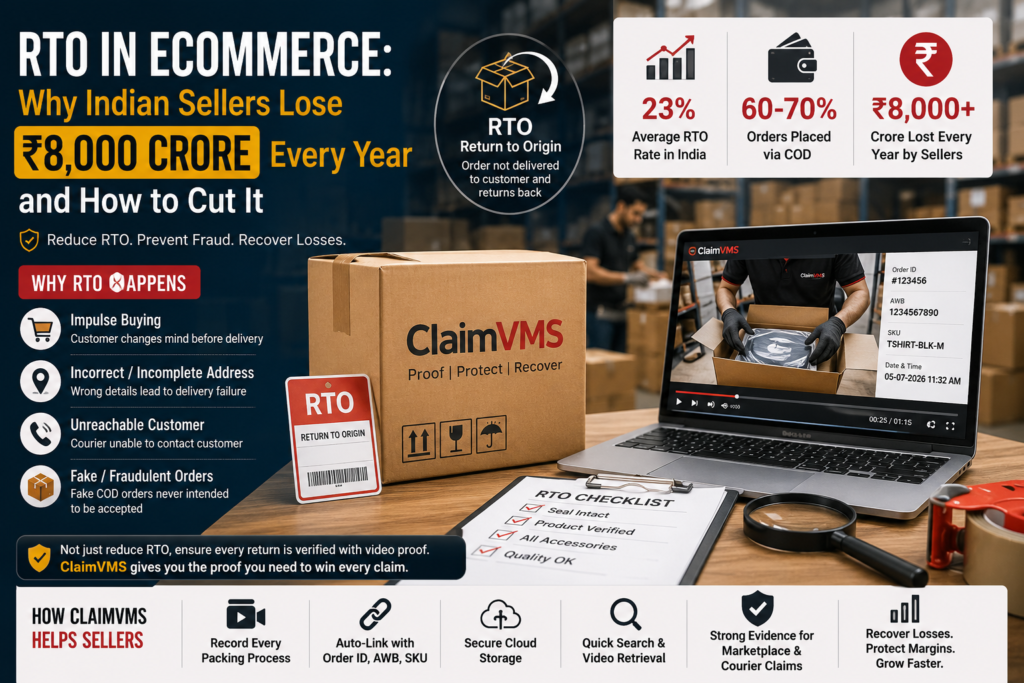
What Is RTO in Ecommerce?
RTO (Return to Origin) in ecommerce occurs when an order never reaches the customer and is sent back to the seller. This usually happens because the customer refuses delivery, the address is incorrect or incomplete, the customer is unavailable, or the courier cannot complete the delivery.
According to industry reports, India’s average RTO rate is around 23%, and Indian D2C brands collectively lose more than ₹8,000 crore every year because of failed deliveries and reverse logistics. The financial impact extends beyond shipping charges. Sellers also face inventory losses, damaged products, operational expenses, and fraudulent returns.
An RTO is different from a customer return.
A return happens after successful delivery, while an RTO occurs before the customer ever accepts the package. Since there is no completed sale, sellers bear both forward and reverse logistics costs without generating any revenue.
For businesses that rely heavily on Cash on Delivery (COD), RTO remains one of the biggest hidden costs affecting profitability.
Why RTO in Ecommerce Is So High in India
India’s ecommerce ecosystem is unique because a significant percentage of online orders are still placed using Cash on Delivery (COD).
Industry estimates indicate that nearly 60–70% of ecommerce orders continue to use COD. While this payment option increases customer convenience and order volume, it also creates much higher RTO rates compared to prepaid orders.
Prepaid orders generally experience less than 2% RTO, whereas COD orders often see 25–30% RTO, with categories such as fashion, footwear, beauty products, and general merchandise reaching 40% or more.
The reason is simple.
When customers haven’t paid in advance, refusing delivery carries virtually no financial consequence.
The result is a much higher rate of abandoned purchases.
The Biggest Reasons Behind High RTO Rates
Several factors contribute to India’s high Return-to-Origin rate.
Impulse Buying
Customers often place orders without fully committing to the purchase. By the time the package arrives, they may no longer want the product and simply refuse delivery.
Incorrect or Incomplete Addresses
Missing landmarks, incorrect PIN codes, incomplete addresses, or unreachable phone numbers prevent successful delivery, forcing courier companies to return the shipment.
Fake COD Orders
Some orders are intentionally placed using fake information by bots, prank users, competitors, or habitual order refusers. These orders were never intended to be accepted.
Poor Customer Communication
Lack of order confirmation, shipment updates, and delivery reminders often causes customers to miss deliveries or reject the parcel.
Every failed delivery creates multiple expenses for sellers:
- Forward shipping charges
- Reverse shipping charges
- Warehouse handling costs
- Inventory holding expenses
- Packaging costs
- Loss of potential sales
- Reduced product value if returned damaged
India’s reverse logistics industry continues to expand rapidly, making RTO management one of the most critical challenges for ecommerce businesses today.
The Hidden Cost of RTO That Most Sellers Ignore
Most discussions around RTO focus only on reducing failed deliveries.
However, there is another significant financial loss that many sellers overlook.
When an RTO shipment returns to the warehouse, many businesses immediately restock the returned product without thoroughly verifying its contents.
Unfortunately, not every returned parcel contains the same product that originally left the warehouse.
Some returned packages contain:
- Swapped products
- Used items
- Damaged merchandise
- Missing accessories
- Empty boxes
- Lower-value replacement products
Without reliable proof of what was originally packed, sellers have little evidence to challenge fraudulent returns or file successful marketplace claims.
This is where many businesses lose money a second time.
First, they lose revenue because the order became an RTO.
Then they lose additional money because they cannot prove that the returned parcel was tampered with.
Why Video Proof Makes the Difference
The only reliable way to verify what actually left your warehouse is through order-linked packing evidence.
ClaimVMS automatically records every packing process and securely links each recording with the corresponding:
- Order ID
- AWB Number
- SKU
- Invoice
- Packing Timestamp
When an RTO parcel returns with missing, damaged, or swapped products, your team can instantly retrieve the original packing evidence.
Instead of relying on assumptions, you have verifiable proof showing exactly what was packed before shipment.
This evidence significantly strengthens marketplace disputes, courier claims, and internal investigations while reducing losses caused by fraudulent RTO parcels.
Reducing RTO lowers the number of failed deliveries. Having video proof ensures the remaining losses don’t become permanent write-offs.
How One Ecommerce Brand Recovered Thousands Every Month with ClaimVMS
Consider an apparel seller operating from Jaipur who ships nearly 300 orders every day across Amazon, Flipkart, Myntra, and their own D2C website.
Like many Indian ecommerce businesses, a large percentage of their orders were Cash on Delivery, and their Return-to-Origin rate was close to the industry average.
To reduce failed deliveries, the company introduced several operational improvements:
- COD order confirmation through phone calls and OTP verification
- Address validation before dispatch
- Special discounts to encourage prepaid orders
- Blocking customers with repeated delivery refusals
Within a few months, these changes noticeably reduced their RTO rate.
However, another problem remained hidden.
Several RTO parcels that returned to the warehouse contained products that were lighter, damaged, or completely different from what had originally been shipped.
Since manually inspecting every returned parcel wasn’t practical, many fraudulent returns were unknowingly accepted and restocked.
Everything changed after implementing ClaimVMS.
Every order was automatically recorded during packing, and each video was securely linked with its corresponding Order ID, SKU, invoice, and AWB number.
Whenever a suspicious RTO parcel arrived, the warehouse team simply searched the Order ID and retrieved the original packing video within seconds.
Instead of guessing what had been shipped, they had clear visual proof.
This evidence helped them:
- Identify product swaps immediately
- Detect empty-box returns
- Reject fraudulent warehouse claims
- Strengthen courier investigations
- Submit stronger marketplace dispute evidence
- Recover losses that previously had to be written off
The biggest realization wasn’t just that they reduced RTO.
It was that they stopped losing money on the RTO parcels that still came back.
How to Reduce RTO in Ecommerce
Reducing Return-to-Origin requires improving operations before dispatch while protecting your business after parcels return.
The most successful ecommerce brands focus on both.
1. Verify COD Orders Before Shipping
Cash on Delivery orders should always be confirmed before dispatch.
Use:
- OTP verification
- Automated WhatsApp confirmation
- Phone call confirmation
- SMS approval
These simple steps help eliminate fake orders and reduce impulsive purchases.
2. Validate Customer Addresses
Incorrect addresses remain one of the biggest causes of delivery failures.
Address validation systems can identify:
- Invalid PIN codes
- Missing landmarks
- Duplicate addresses
- High-risk delivery locations
- Incorrect contact information
Correcting these issues before dispatch significantly improves delivery success rates.
3. Encourage Prepaid Orders
Prepaid customers have already committed financially, making them far less likely to refuse delivery.
Common incentives include:
- Small discounts
- Cashback offers
- Loyalty rewards
- Free shipping
- Faster delivery
Even shifting a portion of COD customers to prepaid can substantially reduce RTO.
4. Identify Repeat Delivery Refusers
Not every customer behaves the same.
Track customers who repeatedly:
- Refuse deliveries
- Cancel at the doorstep
- Frequently create RTO orders
These customers can be restricted to prepaid payment methods or subjected to additional verification.
5. Improve Customer Communication
Many RTO orders occur simply because customers were unaware their package was arriving.
Improve communication by sending:
- Order confirmations
- Shipping notifications
- WhatsApp tracking updates
- Delivery reminders
- Courier contact details
Keeping customers informed greatly increases successful deliveries.
6. Record Every Packing Process
Even after implementing every preventive measure, some RTO orders will still happen.
What determines whether those losses become recoverable is your ability to prove exactly what left your warehouse.
Recording every packing process provides evidence that protects your business against:
- Product swapping
- Empty-box returns
- Missing accessories
- Fake damage claims
- Courier disputes
- Marketplace investigations
This final step transforms unavoidable RTO losses into recoverable claims.
The first five strategies reduce how many parcels come back. The sixth determines how much money you recover from the ones that still do.
Where ClaimVMS Fits Into Your RTO Strategy
ClaimVMS is not designed to reduce your RTO percentage directly. Factors like COD verification, address validation, customer communication, and prepaid incentives are responsible for lowering failed deliveries.
What ClaimVMS does is protect your business from the second financial loss that happens when an RTO parcel returns with missing, damaged, or swapped products.
ClaimVMS automatically captures your warehouse packing process and securely links every recording with:
- Order ID
- AWB Number
- SKU
- Invoice
- Packing Date & Time
When a returned parcel appears suspicious, your team can retrieve the original packing video in seconds.
Instead of relying on manual records or assumptions, you have verifiable visual evidence that shows exactly what left your warehouse.
This evidence helps strengthen:
- Amazon SAFE-T Claims
- Flipkart Seller Protection claims
- Meesho dispute cases
- AJIO seller investigations
- Myntra return disputes
- Courier liability claims
- Internal warehouse audits
Rather than accepting every suspicious return as a loss, sellers can submit documented proof and improve the likelihood of recovering their money.
Why Ecommerce Sellers Choose ClaimVMS
ClaimVMS is built specifically for Indian ecommerce businesses that need reliable evidence for every dispatched order.
Key capabilities include:
- Automatic packing video recording
- Order ID, AWB, and SKU mapping
- Fast video search and retrieval
- Cloud and local storage options
- Works with existing warehouse CCTV cameras
- Marketplace dispute evidence management
- Courier claim support
- Secure claim documentation
- Multi-user warehouse access
- Easy deployment with minimal hardware changes
Instead of changing your warehouse workflow, ClaimVMS integrates into your existing packing process and automatically creates evidence for every shipment.
Five Questions Every Ecommerce Seller Should Ask About RTO
Before focusing only on reducing RTO, evaluate whether your current process protects you against recoverable losses.
1. Do you know your current RTO rate separately for COD and prepaid orders?
Without tracking these numbers independently, it’s difficult to identify where your biggest losses originate.
2. Does your warehouse verify every returned parcel before restocking it?
Accepting returned parcels without inspection increases the risk of inventory fraud and product swapping.
3. Can your team retrieve the packing evidence for any order within two minutes?
Fast access to proof is critical when responding to marketplace disputes and courier investigations.
4. Are your COD orders verified before dispatch?
Order confirmation through OTP, calls, or WhatsApp significantly reduces fake and impulsive purchases.
5. Do you calculate the complete cost of RTO?
Many businesses only count the lost sale.
The actual cost also includes:
- Forward shipping
- Reverse shipping
- Packaging
- Warehouse handling
- Inventory depreciation
- Product damage
- Fraud-related losses
Understanding the complete financial impact helps prioritize the right preventive measures.
Stop Losing Money Twice on the Same Order
Reducing RTO is only one part of protecting your ecommerce business.
The larger opportunity lies in preventing recoverable losses after returned parcels reach your warehouse.
By combining:
- COD verification
- Address validation
- Better customer communication
- Prepaid incentives
- Order-linked packing evidence
you create a complete RTO protection strategy.
ClaimVMS provides the proof layer that helps sellers confidently investigate suspicious returns, support marketplace claims, and recover losses that would otherwise become permanent write-offs.
Whether you sell on Amazon, Flipkart, Meesho, AJIO, Myntra, Shopify, or WooCommerce, having reliable packing evidence ensures every shipment is backed by verifiable proof.
Frequently Asked Questions (FAQs)
What is RTO in ecommerce?
RTO (Return to Origin) refers to an order that could not be delivered to the customer and is returned to the seller. Common reasons include customer refusal, incorrect addresses, failed delivery attempts, or unreachable customers.
How can ecommerce sellers reduce RTO?
The most effective strategies include:
- Verifying COD orders
- Validating customer addresses
- Encouraging prepaid payments
- Sending delivery reminders
- Tracking repeat delivery refusals
- Improving customer communication
Does reducing RTO eliminate return fraud?
No.
Reducing RTO decreases the number of failed deliveries, but it does not prevent fraud involving returned parcels, such as product swapping or empty-box returns.
Video-based packing evidence remains essential for investigating these cases.
How does ClaimVMS help with RTO?
ClaimVMS automatically records the packing process for every order and links the recording with the Order ID, AWB, SKU, and invoice.
When disputes arise, sellers can quickly retrieve visual proof to support marketplace claims, courier investigations, and warehouse audits.
Which marketplaces can ClaimVMS support?
ClaimVMS can be used by sellers operating on:
- Amazon
- Flipkart
- Meesho
- AJIO
- Myntra
- Shopify stores
- WooCommerce stores
- Other ecommerce platforms
Why is packing video important?
Packing videos provide visual evidence of the exact product packed before dispatch.
This helps businesses:
- Detect product swaps
- Investigate missing items
- Support marketplace claims
- Handle courier disputes
- Reduce fraudulent losses
- Improve warehouse accountability
With a reliable evidence system in place, businesses can recover losses more effectively and build greater confidence in their fulfillment operations.