
For many ecommerce sellers, an “Item Not Received” (INR) claim seems straightforward. A customer says they never received the order, so the seller responds with the courier tracking details.
In some cases, this works.
But in today’s ecommerce landscape, tracking alone is no longer enough to defend every INR dispute.
Whether you sell on Shopify, WooCommerce, Amazon, Flipkart, Meesho, Myntra, AJIO, or your own D2C website, buyers are becoming more sophisticated in how they raise disputes. Many claims now focus on what was inside the parcel rather than whether the parcel was delivered.
To protect revenue and reduce fraudulent claims, businesses need evidence that covers the entire fulfillment journey—not just the shipping process.
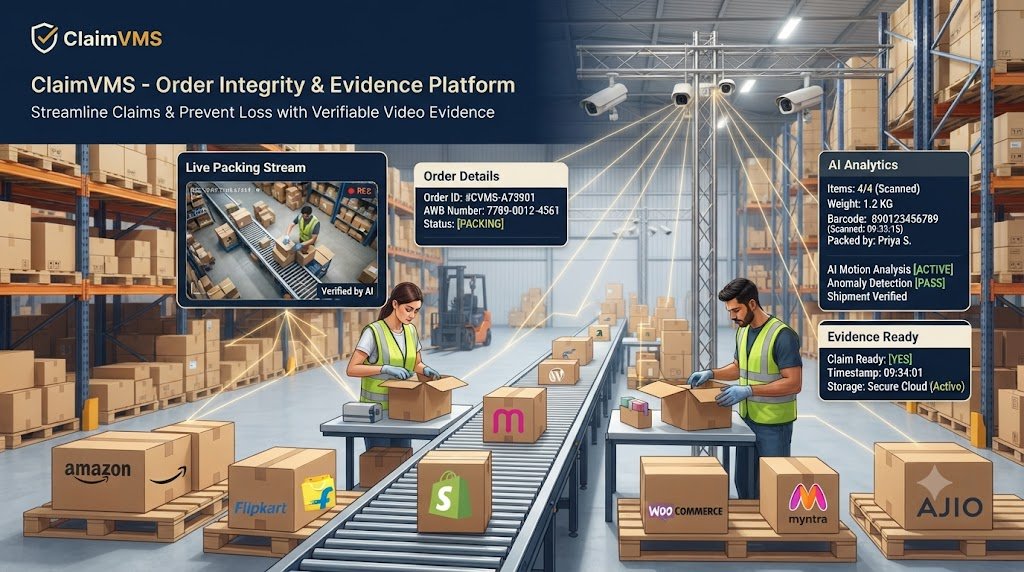
ClaimVMS helps ecommerce businesses achieve this by combining warehouse CCTV with order-linked packing videos, giving sellers stronger evidence whenever a dispute arises.
Not Every “Item Not Received” Claim Is the Same
Many businesses make the mistake of treating every INR dispute as a delivery issue.
In reality, these claims usually fall into three different categories.
Genuine Non-Delivery
The customer states that the shipment never arrived.
In this case, courier tracking, delivery confirmation, GPS records, and signature proof are the strongest forms of evidence.
Empty Parcel Claims
The buyer confirms that the package arrived but claims there was nothing inside.
This changes the investigation completely.
Delivery tracking only proves the parcel reached the destination.
It does not prove that the product was inside the parcel when it left your warehouse.
Wrong Product Inside the Parcel
Here, the customer confirms receiving a shipment but claims the contents were different from what they ordered.
Again, courier tracking only confirms delivery.
It cannot verify which product was packed before dispatch.
This is where visual dispatch evidence becomes critical.
Why These Disputes Are Increasing
The rapid growth of ecommerce has also led to more sophisticated forms of return and refund fraud.
Businesses increasingly encounter claims involving:
- Empty parcel allegations
- Wrong item complaints
- Product swapping
- False delivery disputes
- Return abuse
- Friendly fraud
- Organized refund scams
Because many sellers rely only on courier tracking, fraudulent buyers know that proving the actual contents of a parcel is often difficult.
This evidence gap makes these disputes attractive to fraudsters.
The Evidence Gap Most Sellers Don’t Realize They Have
Consider what most businesses submit during an INR dispute:
- Courier tracking
- Shipping confirmation
- Invoice
- Product listing
- Customer order details
These documents answer one question:
Was a parcel shipped?
However, investigators frequently need another answer:
What exactly was inside the parcel when it was dispatched?
Without proof from the packing stage, sellers often struggle to defend claims involving empty parcels or incorrect products.
How ClaimVMS Closes the Evidence Gap
ClaimVMS goes beyond traditional CCTV recording by converting warehouse footage into searchable dispatch evidence.
Every packing session can be linked with:
- Order ID
- AWB Number
- Invoice Number
- Barcode
- QR Code
- Dispatch timestamp
When a dispute is raised, warehouse teams can instantly retrieve the exact packing video associated with the shipment instead of manually reviewing hours of CCTV footage.
This significantly improves both response time and evidence quality.
Real-World Example
Imagine an ecommerce seller processing hundreds of orders every day.
A customer later raises an “Item Not Received” dispute, claiming the parcel arrived empty.
The warehouse team immediately gathers:
- Courier tracking
- Delivery confirmation
- Invoice
- Order details
While these records prove that the shipment reached the customer, they still don’t answer the key question:
Was the product actually packed before dispatch?
With ClaimVMS, the seller retrieves the packing video linked to the Order ID.
The recording clearly shows:
- Product verification
- SKU confirmation
- Item placement inside the parcel
- Packaging process
- Parcel sealing
- Shipping label attachment
Instead of relying only on paperwork, the seller submits visual proof showing exactly what left the warehouse.
Why Traditional CCTV Isn’t Designed for Ecommerce Evidence
Most warehouses already have surveillance cameras installed.
Unfortunately, standard CCTV systems are built for security—not dispute management.
Typical challenges include:
- Videos organized only by date and time.
- Multiple camera angles to review manually.
- Hours of footage for every shift.
- Difficult video exports.
- Time-consuming evidence searches.
Finding one shipment can easily take hours.
ClaimVMS transforms existing CCTV infrastructure into an intelligent evidence management system by automatically indexing recordings using shipment information instead of timestamps.
Building a Modern Dispatch Verification Process
Today’s ecommerce businesses need more than shipment tracking.
A strong dispatch verification process includes:
- SKU verification before packing
- Barcode scanning
- Packing video recording
- Parcel sealing under camera view
- Shipping label confirmation
- Secure video storage
- Order-linked indexing
- Instant evidence retrieval
These practices not only improve dispute handling but also strengthen warehouse accuracy and operational transparency.
Why Visual Dispatch Evidence Matters More Than Ever
As marketplaces continue tightening seller performance standards, businesses must be prepared to demonstrate exactly how every order was fulfilled.
Visual dispatch evidence helps sellers:
- Respond faster to disputes
- Reduce fraudulent claims
- Improve warehouse accountability
- Strengthen customer confidence
- Support marketplace investigations
- Protect revenue from avoidable losses
Rather than depending solely on courier tracking, ecommerce businesses can create a complete record of every shipment from packing to dispatch, making dispute resolution faster, more reliable, and far more effective.
Choosing the Right Evidence for Every “Item Not Received” Dispute
One of the most common reasons sellers lose disputes is submitting the same evidence for every type of claim.
Different INR disputes require different forms of proof.
Before preparing your response, identify exactly what the buyer is claiming.
If the customer says the parcel never arrived, delivery confirmation becomes your strongest evidence.
If the customer claims the parcel arrived empty or contained the wrong product, dispatch verification becomes equally important.
Understanding the dispute before submitting evidence significantly improves the chances of a successful outcome.
What Evidence Should Be Included in an INR Dispute Response?
A strong dispute response combines multiple sources of evidence instead of relying on a single document.
An ideal evidence package should include:
Order-linked packing video
Courier tracking information
Delivery confirmation
Invoice and order details
Shipping label details
Barcode or QR scan records
Product listing at the time of purchase
Customer communication (if available)
Warehouse dispatch records
Together, these records create a complete timeline from order confirmation to final delivery.
Why Packing Videos Have Become Essential for Ecommerce Sellers
Courier tracking confirms that a parcel moved through the logistics network.
It does not verify:
Which SKU was packed
Product quantity
Accessories included
Product condition before dispatch
Packaging process
Parcel sealing
Order-linked packing videos provide this missing information.
A well-recorded packing video captures:
Product verification
Barcode scanning
Correct SKU selection
Packing process
Parcel sealing
Shipping label attachment
This visual record becomes one of the strongest forms of evidence during dispute investigations.
How ClaimVMS Simplifies Evidence Retrieval
Searching through traditional CCTV footage can consume hours, especially in high-volume warehouses.
ClaimVMS eliminates this challenge by automatically indexing every packing session using shipment information.
Users can search videos using:
Order ID
AWB Number
Invoice Number
Barcode
Dispatch Date
Customer Order Details
Instead of manually reviewing surveillance footage, warehouse teams can retrieve the required recording within seconds.
This dramatically reduces response time for marketplace disputes.
Best Practices to Reduce “Item Not Received” Claims
Strong warehouse processes reduce both operational mistakes and fraudulent claims.
Recommended best practices include:
Verify every SKU before packing.
Scan products using barcodes or QR codes.
Record every packing station.
Seal parcels under camera coverage.
Store videos securely.
Preserve courier documentation.
Respond to disputes quickly.
Maintain accurate product listings.
Train warehouse staff on standard packing procedures.
Regularly audit fulfillment accuracy.
Consistent execution of these practices creates a reliable fulfillment process that is easier to defend when disputes arise.
Building a Complete Dispatch Verification Workflow
Modern ecommerce businesses should verify every shipment from product selection through final dispatch.
An effective workflow includes:
Order verification.
SKU confirmation.
Barcode scanning.
Packing video recording.
Parcel sealing.
Shipping label verification.
Order-linked video indexing.
Secure evidence storage.
This structured process minimizes fulfillment errors while creating reliable evidence for future disputes.
Why Speed Matters During Marketplace Investigations
Marketplaces and payment providers often require sellers to respond within strict timelines.
Delayed responses can lead to automatic dispute losses, even when strong evidence exists.
ClaimVMS enables businesses to:
Retrieve videos instantly.
Export dispute-ready evidence.
Share recordings securely.
Maintain organized archives.
Respond within marketplace deadlines.
Fast access to evidence improves operational efficiency while reducing the stress of manual CCTV searches.
How ClaimVMS Supports Modern Ecommerce Operations
ClaimVMS is designed specifically for businesses that need reliable shipment verification.
The platform helps sellers:
Record every packing process.
Link recordings to Order IDs.
Search evidence instantly.
Export videos for disputes.
Improve warehouse accountability.
Reduce manual CCTV review.
Support marketplace investigations.
Strengthen fraud prevention strategies.
Whether you process a few hundred orders or thousands every day, ClaimVMS helps create a searchable evidence library for every shipment.
Final Thoughts
“Item Not Received” disputes are no longer limited to parcels that genuinely fail to reach customers.
Today’s ecommerce sellers also face empty parcel claims, incorrect product allegations, and increasingly sophisticated forms of return fraud.
Courier tracking remains an important part of dispute management, but it cannot explain what happened during the packing process.
By combining delivery records with order-linked packing videos and structured dispatch verification, businesses can build stronger evidence, respond faster to investigations, and better protect themselves against costly disputes.
ClaimVMS transforms warehouse operations into a dependable source of visual proof, giving ecommerce sellers greater confidence when handling customer claims.
Frequently Asked Questions
Is courier tracking enough to win an Item Not Received dispute?
Courier tracking is essential for genuine non-delivery claims, but it cannot prove what was inside a parcel. For empty parcel or wrong item disputes, dispatch verification provides stronger supporting evidence.
Why are packing videos important for ecommerce businesses?
Packing videos document the fulfillment process by showing SKU verification, product placement, packaging, and parcel sealing. This creates valuable visual evidence for dispute investigations.
Can ClaimVMS work with existing warehouse CCTV cameras?
Yes. ClaimVMS integrates with compatible CCTV infrastructure and converts standard warehouse recordings into searchable, order-linked evidence.
How quickly can videos be retrieved?
Because videos are indexed using Order IDs, AWB numbers, and shipment details, they can typically be located within seconds.
Which ecommerce platforms can benefit from ClaimVMS?
ClaimVMS supports sellers operating on Amazon, Flipkart, Meesho, Myntra, AJIO, Shopify, WooCommerce, Magento, and other ecommerce platforms where shipment verification is important.
How does dispatch verification improve dispute resolution?
Dispatch verification provides visual proof of the packing process, helping businesses demonstrate what was packed and shipped for a specific order. When combined with courier records and order details, it creates a stronger evidence package for marketplace and payment disputes.