
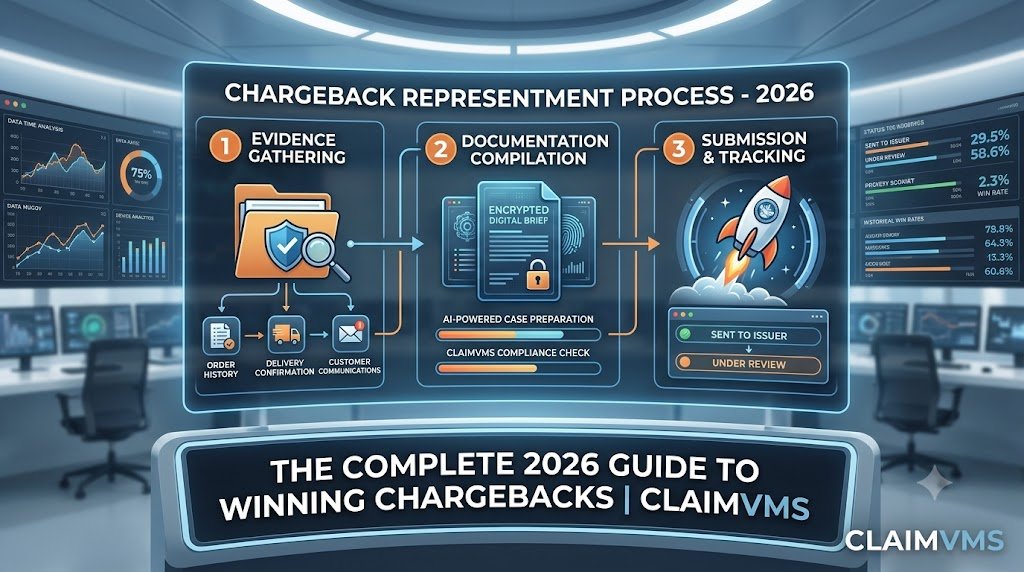
What Is Chargeback Representment?
Chargebacks are an unavoidable reality for ecommerce businesses in 2026. Every day, thousands of online sellers lose revenue because customers dispute legitimate transactions.
Fortunately, sellers are not powerless.
Chargeback representment is the official process that allows a seller to challenge a chargeback by submitting evidence proving that the transaction was genuine and the order was fulfilled correctly.
Whether you sell on Amazon, Flipkart, Meesho, Myntra, AJIO, Shopify, WooCommerce, Magento, or your own D2C website, representment gives you the opportunity to recover lost revenue.
However, success depends entirely on the quality of the evidence you submit.
This guide explains how chargeback representment works, why many sellers lose, and how ClaimVMS helps businesses build stronger evidence before disputes even happen.
Why Chargeback Representment Matters More Than Ever
Chargeback volumes continue to increase every year as ecommerce grows.
At the same time, payment providers and banks are becoming stricter when reviewing merchant responses.
Many disputes today involve:
- Friendly fraud
- Empty box claims
- Wrong item received
- Item Not Received (INR)
- Product not as described
- Unauthorized transactions
Without proper documentation, merchants often lose both the payment and the product.
Representment allows sellers to present factual evidence showing that the order was packed, shipped, and delivered correctly.
The stronger your evidence, the greater your chances of recovering the disputed amount.
How Chargeback Representment Works
The representment process begins when a customer disputes a transaction through their bank or payment provider.
The payment processor temporarily reverses the transaction and notifies the seller.
The seller is then given a limited period to submit supporting evidence.
That evidence is reviewed before a final decision is made.
If the evidence is convincing, the chargeback may be reversed and the payment returned to the seller.
If the evidence is weak—or submitted after the deadline—the seller usually loses the case.
Why Most Ecommerce Sellers Lose Chargeback Representments
Many sellers believe submitting an invoice and courier tracking is enough.
Unfortunately, it usually isn’t.
The biggest reason merchants lose is that their evidence cannot independently prove what actually happened during fulfillment.
For example:
If a customer says,
“I never received my package.”
The reviewer expects delivery evidence.
If the customer says,
“The box contained the wrong product.”
The reviewer expects proof of what was packed.
Many sellers send identical documents for every dispute.
As a result, they fail to answer the specific question raised by the chargeback.
The Three Biggest Evidence Mistakes
Most unsuccessful chargeback responses suffer from one or more of these problems.
Unverifiable Evidence
Documents such as:
- Manual warehouse notes
- Internal packing records
- Staff explanations
- Screenshots
may explain what happened but cannot independently verify the shipment.
Wrong Evidence for the Wrong Dispute
Each dispute requires different proof.
Examples include:
- Item Not Received → Delivery confirmation
- Wrong Item → Packing verification
- Empty Box → Packing video
- Unauthorized Payment → Transaction verification
Using unrelated evidence weakens your response.
Evidence That Doesn’t Answer the Customer’s Claim
Courier tracking proves the shipment was delivered.
It does not prove:
- What product was packed
- Whether the parcel was empty
- Whether the correct quantity was shipped
- Whether the package was sealed correctly
This missing proof is where many disputes are lost.
Understanding the Chargeback Representment Process
Winning a representment requires following a structured process instead of reacting at the last minute.
Every successful ecommerce business follows the same workflow.
Step 1: Receive the Chargeback Notification
Once a dispute is raised, immediately record:
- Order ID
- Transaction Amount
- Marketplace or Payment Gateway
- Dispute Reason
- Response Deadline
Missing the deadline usually results in an automatic loss.
Step 2: Understand the Reason Code
Different chargeback reasons require different evidence.
Common dispute categories include:
- Item Not Received (INR)
- Wrong Item Received
- Product Not As Described
- Empty Box Claims
- Friendly Fraud
- Unauthorized Transactions
- Duplicate Charges
Before collecting documents, understand exactly what the customer is claiming.
Step 3: Collect Evidence Based on the Claim
Instead of gathering random documents, build an evidence package that directly answers the dispute.
For example:
For Item Not Received
- Courier Tracking
- Proof of Delivery
- Delivery Timestamp
- AWB Details
- Packing Video
For Wrong Item Received
- Packing Video
- Barcode Verification
- Invoice
- Product SKU
- Warehouse Verification
For Unauthorized Transaction
- Customer Communication
- Order History
- Payment Confirmation
- Delivery Proof
- Packing Verification
Submitting relevant evidence dramatically improves the quality of your representment.
Why ClaimVMS Makes Representment Easier
Searching through hours of CCTV footage during a dispute wastes valuable time.
ClaimVMS automatically records every packing process and links it with:
- Order ID
- AWB Number
- Invoice
- Barcode
- Product Details
- Date & Time
- Camera Recording
When a chargeback arrives, your team can locate the exact packing video within seconds instead of manually reviewing warehouse recordings.
This allows businesses to respond faster while building a stronger dispute package.
Organized Evidence Leads to Better Outcomes
The strongest representment cases are built on organized, searchable, and verifiable evidence.
Instead of relying on memory or handwritten notes, successful ecommerce businesses maintain a complete fulfillment record for every order.
ClaimVMS helps create this evidence automatically during the packing process, making it available whenever a dispute arises.
The Evidence Hierarchy That Wins Chargeback Representments
Not every document carries the same weight during a chargeback review.
Banks, payment processors, and marketplaces evaluate evidence based on how accurately it proves the customer’s claim.
The strongest ecommerce sellers build multiple layers of evidence for every order.
Tier 1: Order-Linked Packing Video (Most Powerful Evidence)
The most valuable evidence is created during the packing process.
ClaimVMS automatically records every packing activity while linking the video to:
- Order ID
- AWB Number
- Invoice
- Product SKU
- Barcode
- Date & Time
- Operator Details
- Camera Recording
Unlike handwritten warehouse records, packing videos visually prove:
- The correct product was picked.
- The correct quantity was packed.
- The product was undamaged.
- The parcel was sealed correctly.
- The shipping label matched the order.
This provides independent visual evidence that strengthens your representment response.
Tier 2: Delivery Confirmation
Delivery evidence confirms that the shipment reached the customer’s address.
Useful documents include:
- Courier Tracking
- Proof of Delivery (POD)
- GPS Delivery Confirmation
- Signature Confirmation
- Courier Delivery Photographs
- Delivery Timestamp
This evidence is especially valuable for Item Not Received (INR) disputes.
However, it cannot prove what was inside the parcel.
Tier 3: Customer Communication
Customer interactions often support your case.
Useful records include:
- Email conversations
- WhatsApp messages
- Support tickets
- Live chat records
- Customer acknowledgements
If a customer confirmed receiving the order before raising a dispute, these records can strengthen your response.
Tier 4: Product Verification Documents
Supporting documents help complete the evidence package.
Examples include:
- Invoice
- Product photographs
- Barcode verification
- Product SKU records
- Product listings
- Warranty information
- Return policy
Although these documents provide useful context, they are most effective when combined with packing videos and delivery proof.
Why Fulfillment Evidence Matters
Many ecommerce sellers have:
- Order history
- Courier tracking
- Payment confirmation
- Warehouse CCTV
But they often lack one critical piece of evidence:
Proof of exactly what was packed into the parcel.
General warehouse CCTV usually cannot identify:
- The specific order
- The product packed
- The shipping label
- The sealing process
Without this evidence, dispute reviewers often rely on the customer’s statement.
How ClaimVMS Closes the Evidence Gap
ClaimVMS was designed to eliminate this missing link.
Instead of manually searching through CCTV footage, ClaimVMS automatically creates searchable fulfillment records.
Every order receives:
- Order-linked packing video
- AWB-linked verification
- Invoice mapping
- Barcode validation
- Time-stamped recordings
- Secure cloud storage
- Fast evidence retrieval
When a dispute is raised, the required evidence can be located within seconds.
AI Is Changing Chargeback Reviews
Modern payment providers increasingly use automated systems to review disputes before they reach a human reviewer.
These systems prefer evidence that is:
- Structured
- Searchable
- Time-stamped
- Order-linked
- Easy to verify
Random screenshots and handwritten explanations are becoming less effective.
By maintaining organized fulfillment records, ecommerce businesses improve the quality of their dispute submissions.
Five Common Mistakes That Cause Representments to Fail
Even legitimate sellers lose disputes because of avoidable mistakes.
1. Missing the Submission Deadline
Every dispute has a response window.
Submitting evidence after the deadline almost always results in an automatic loss.
Always monitor dispute notifications and respond promptly.
2. Using the Same Evidence for Every Case
Every dispute is different.
For example:
- Item Not Received requires delivery confirmation.
- Wrong Item Received requires packing verification.
- Empty Box Claims require visual packing proof.
- Unauthorized Transactions require payment and customer verification.
Tailor your evidence to the dispute reason.
3. Depending Only on Manual Records
Warehouse notes and spreadsheets may support your case, but they rarely provide independent proof.
Visual evidence such as packing videos offers far greater credibility.
4. Writing Emotional Responses
Representment letters should remain:
- Professional
- Clear
- Objective
- Evidence-based
Focus on facts rather than opinions.
5. Ignoring Previous Dispute Trends
Businesses should regularly review:
- Chargeback reasons
- Win rates
- Loss patterns
- Repeat fraud attempts
- Marketplace trends
Analyzing this data helps improve future dispute responses.
Why ClaimVMS Helps Sellers Win More Representments
ClaimVMS is built specifically for ecommerce businesses that require reliable fulfillment evidence.
Instead of creating documentation after a dispute occurs, ClaimVMS automatically records every order during the packing process.
Key features include:
- Order-linked packing videos
- AWB-linked video records
- Barcode verification
- Invoice verification
- Time-stamped recordings
- Instant evidence search
- Secure cloud storage
- Quick export for dispute submissions
This proactive approach helps businesses prepare stronger representment packages while reducing the time spent gathering evidence.
Build Evidence Before the Dispute Happens
The most successful ecommerce sellers understand one important principle:
Evidence should be created before a customer files a chargeback—not afterward.
A complete fulfillment record includes:
- Order verification
- Product verification
- Barcode scanning
- Packing video
- Invoice validation
- Shipping label confirmation
- Courier tracking
- Proof of Delivery
When combined, these records create a strong chain of evidence that supports your representment.
Final Thoughts
Chargeback representment is one of the most effective ways for ecommerce businesses to recover revenue lost to false disputes and friendly fraud.
Success depends on submitting accurate, organized, and verifiable evidence within the required timeframe.
Courier tracking proves where the parcel went.
Packing videos prove what was packed.
Together, they create a complete evidence trail that significantly strengthens your representment response.
With ClaimVMS, ecommerce sellers can automatically document every shipment, retrieve evidence in seconds, and confidently respond to disputes across Amazon, Flipkart, Meesho, Myntra, AJIO, Shopify, WooCommerce, Magento, and other ecommerce platforms.
Frequently Asked Questions (FAQs)
What is chargeback representment?
Chargeback representment is the formal process through which a seller challenges a chargeback by submitting evidence showing that the transaction and order fulfillment were legitimate.
What evidence is most effective during representment?
The strongest evidence includes order-linked packing videos, courier delivery confirmation, Proof of Delivery (POD), customer communication, invoices, barcode verification, and AWB-linked shipment records.
How does ClaimVMS help with chargeback representment?
ClaimVMS automatically records the packing process, links videos to Order IDs and AWB numbers, stores fulfillment evidence securely, and enables instant retrieval during dispute resolution.
Can packing videos improve representment success?
Yes. Packing videos provide independent visual proof of what was packed before dispatch, making them highly valuable for disputes involving wrong items, empty boxes, damaged products, and friendly fraud.
Which ecommerce platforms can use ClaimVMS?
ClaimVMS supports sellers on Amazon, Flipkart, Meesho, Myntra, AJIO, Shopify, WooCommerce, Magento, and custom ecommerce websites, helping businesses improve fulfillment transparency and dispute management.