
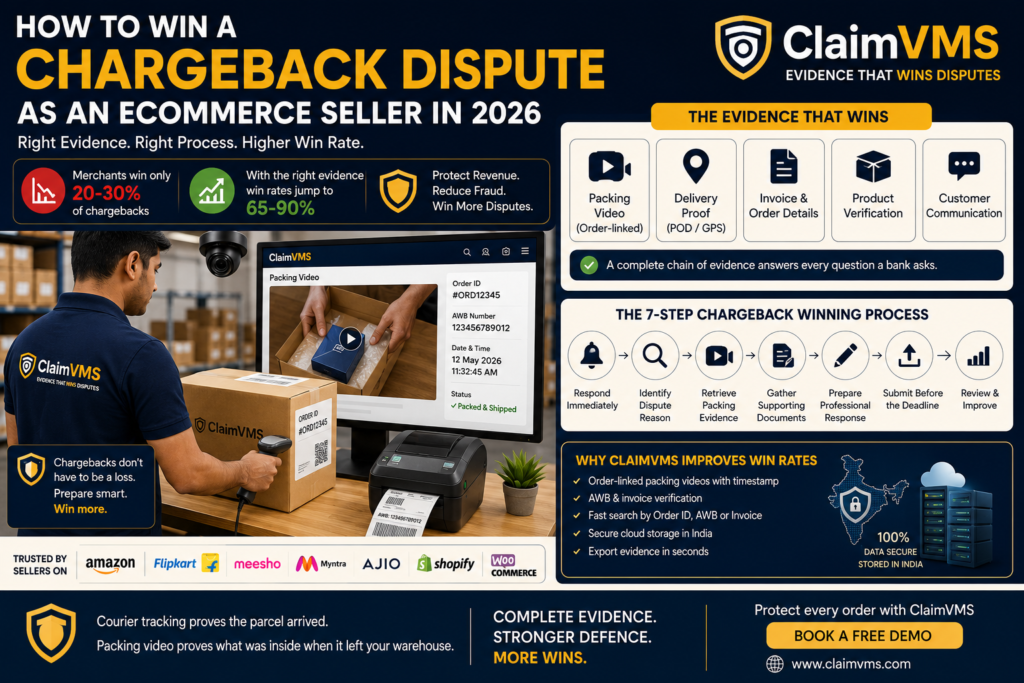
Why Chargeback Disputes Are Becoming More Expensive for Ecommerce Sellers
Chargebacks are one of the biggest financial risks for ecommerce businesses in 2026. Whether you sell on Amazon, Flipkart, Meesho, Myntra, AJIO, Shopify, WooCommerce, or your own D2C website, every chargeback costs more than just the product value.
A successful chargeback can lead to:
- Loss of product and payment
- Additional chargeback processing fees
- Higher payment processor risk scores
- Poor marketplace account health
- Increased seller penalties
- Reduced customer trust
Industry studies show that many ecommerce businesses win only a small percentage of chargeback disputes—not because they are wrong, but because they fail to submit the right evidence.
The difference between losing a chargeback and successfully defending one often comes down to how well you can prove what happened during order fulfillment.
This guide explains how ecommerce sellers can improve their chargeback success rate in 2026 using a structured evidence process and how ClaimVMS helps create evidence before disputes even occur.
Why Many Ecommerce Sellers Lose Chargeback Disputes
Most sellers assume that submitting an invoice, courier tracking, and an order confirmation email is enough.
Unfortunately, it usually isn’t.
Banks, payment processors, and ecommerce marketplaces increasingly rely on structured, verifiable evidence instead of handwritten explanations or screenshots.
One of the biggest reasons sellers lose chargebacks is because they submit evidence that answers the wrong question.
For example:
If a buyer claims:
“I never received my order.”
The bank wants delivery evidence.
If the buyer claims:
“The wrong product arrived.”
The bank wants proof of what was packed inside the parcel.
Many sellers submit the same documents for every dispute regardless of the reason code.
As a result, even genuine sellers lose disputes that could have been won.
Why Evidence Matters More Than Ever
Today’s dispute systems are becoming increasingly automated.
Before a human reviewer examines your case, many payment providers perform automated checks on the evidence submitted.
Evidence that is:
- searchable
- time-stamped
- linked to the Order ID
- properly organized
- independently verifiable
is significantly more valuable than random screenshots or manual explanations.
This is why ecommerce businesses are investing in fulfillment verification systems like ClaimVMS, which automatically records packing activities and links them to every shipment.
Instead of searching through hours of CCTV footage, sellers can instantly retrieve the correct evidence using the Order ID or AWB number.
Understanding Different Types of Chargeback Disputes
Not every chargeback is the same.
Different dispute reasons require different types of evidence.
Some of the most common chargeback categories include:
- Item Not Received (INR)
- Wrong Item Received
- Item Not As Described
- Empty Box Claims
- Unauthorized Transactions
- Friendly Fraud
- Duplicate Payments
- Subscription Billing Disputes
Using the wrong evidence for the dispute reason is one of the most common mistakes ecommerce sellers make.
The Evidence Hierarchy That Helps Win Chargebacks
Not all evidence carries the same value.
Some documents simply support your case, while others directly prove what happened.
The strongest ecommerce businesses build multiple layers of evidence.
Tier 1: Order-Linked Packing Video (Highest Value)
This is the strongest type of fulfillment evidence available.
ClaimVMS automatically records the entire packing process and links every video to:
- Order ID
- AWB Number
- Invoice
- Product Details
- Date & Time
- Operator
- Camera Recording
When a dispute occurs, sellers can instantly retrieve the exact packing video.
Unlike written warehouse notes, packing videos visually prove:
- The correct product was picked.
- The correct quantity was packed.
- The parcel was sealed.
- Shipping labels matched the order.
- The shipment left the warehouse correctly.
This creates independent visual proof that is extremely valuable during dispute investigations.
Tier 2: Delivery Confirmation
The second layer of evidence confirms that the parcel reached the customer’s delivery address.
Useful delivery evidence includes:
- Courier tracking
- Proof of Delivery (POD)
- GPS delivery confirmation
- Delivery timestamps
- Signature confirmation for high-value orders
- Courier delivery photographs (where available)
This evidence answers one important question:
“Did the parcel reach the customer?”
However, delivery confirmation cannot prove what was inside the package.
Tier 3: Customer and Transaction Records
These records help demonstrate that the purchase was legitimate.
Examples include:
- Previous successful orders
- Customer communication
- Payment confirmation
- Device and IP information (where supported)
- Billing information
- Order confirmation emails
- Customer acknowledgements
Although useful, these records work best when combined with packing and delivery evidence.
Tier 4: Supporting Documentation
Additional documents can strengthen your response but rarely win disputes on their own.
These include:
- Product photographs
- Product listings
- Return policy
- Warranty information
- Order invoices
- Shipping labels
- Product manuals
- Customer service records
These documents provide useful context but should always accompany stronger evidence.
Evidence That Usually Doesn’t Win a Chargeback Alone
Many sellers rely on documents that unfortunately do not independently prove their case.
Examples include:
- Internal warehouse notes
- Manual packing records
- Order management screenshots
- Product images without Order ID
- Courier pickup confirmation
- Inventory records
- Staff statements
These records may show that an order existed, but they cannot prove exactly what was packed or shipped.
That is why visual packing evidence has become increasingly important for ecommerce sellers.
How ClaimVMS Builds Stronger Chargeback Evidence
ClaimVMS is designed specifically for ecommerce businesses that need reliable, searchable proof for every shipment.
Instead of relying solely on CCTV footage or courier tracking, ClaimVMS automatically generates a complete fulfillment record that includes:
- Order-linked packing video
- AWB-linked video records
- Invoice verification
- Barcode scanning
- Time-stamped recordings
- Searchable evidence by Order ID
- Fast video retrieval during disputes
By creating this evidence at the time of packing—not after a dispute arises—ClaimVMS helps sellers respond faster and build stronger cases when defending against chargebacks.
Matching the Right Evidence to the Right Chargeback
Every chargeback comes with a dispute reason, and each reason requires different supporting evidence.
Submitting the wrong evidence is one of the biggest reasons ecommerce sellers lose chargebacks—even when the customer is making a false claim.
Below are some common dispute types and the evidence that helps strengthen your case.
Item Not Received (INR)
When a customer claims they never received their order, your evidence should focus on delivery verification.
Useful documentation includes:
- Courier tracking history
- Proof of Delivery (POD)
- Delivery confirmation
- GPS delivery details (if available)
- Signature confirmation for high-value shipments
- Order-linked packing video from ClaimVMS
While delivery records prove the parcel reached its destination, packing videos provide additional assurance that the shipment left your warehouse correctly.
Wrong Item or Item Not As Described
These disputes require proof of exactly what was packed.
Useful evidence includes:
- Order-linked packing video
- Barcode scanning records
- Invoice verification
- Product SKU confirmation
- Product photographs
- Warehouse packing verification
ClaimVMS automatically records the packing process, making it easy to demonstrate that the correct product was packed before dispatch.
Unauthorized Transaction
When a buyer claims they did not authorize the purchase, supporting records may include:
- Customer order history
- Billing information
- Device information
- IP address records (where available)
- Delivery confirmation
- Packing evidence
Although payment processors evaluate multiple factors, having complete fulfillment records strengthens your overall response.
Duplicate Payment or Billing Issues
These disputes usually require:
- Payment confirmation
- Invoice
- Transaction reference
- Customer communication
- Refund history (if applicable)
Maintaining organized documentation helps resolve these disputes more efficiently.
Marketplace Disputes in 2026
Different ecommerce marketplaces have different dispute policies, but they all expect sellers to provide strong fulfillment evidence.
Depending on the platform, dispute responses may require:
- Delivery confirmation
- AWB details
- Customer communication
- Invoice
- Proof of Delivery
- Packing records
- Video evidence
- Warehouse documentation
The more complete your evidence package, the stronger your response becomes.
The Seven-Step Process for Winning Chargeback Disputes
Winning a chargeback isn’t about collecting random documents.
It requires following a structured process.
Step 1: Respond Immediately
Never ignore a chargeback notification.
Record:
- Order ID
- Dispute amount
- Platform
- Reason code
- Submission deadline
Missing the deadline often results in an automatic loss.
Step 2: Identify the Dispute Reason
Before gathering evidence, understand exactly why the chargeback was raised.
Different disputes require different documentation.
For example:
- Item Not Received
- Wrong Item
- Product Quality
- Friendly Fraud
- Unauthorized Transaction
Choosing the right evidence from the beginning saves valuable time.
Step 3: Retrieve the Packing Evidence
This is where ClaimVMS saves hours of manual work.
Simply search using:
- Order ID
- AWB Number
- Invoice Number
Within seconds, ClaimVMS retrieves the complete packing video linked to that shipment.
Instead of manually reviewing hours of CCTV footage, your team can immediately access the required evidence.
Step 4: Gather Supporting Documents
Along with the packing video, collect:
- Courier tracking
- Invoice
- Proof of Delivery
- Customer communication
- Product details
- Payment confirmation
Together, these documents create a stronger dispute response.
Step 5: Prepare a Professional Response
Your dispute explanation should be:
- Clear
- Professional
- Fact-based
- Concise
Avoid emotional language.
Instead, explain how each piece of evidence supports your case.
Step 6: Submit Before the Deadline
Whether responding through:
- Amazon
- Flipkart
- Shopify Payments
- Payment Gateway
- Bank Portal
always submit your evidence before the response window closes.
Late submissions are rarely accepted.
Step 7: Review Every Outcome
Every chargeback provides valuable insights.
Track:
- Win rate
- Loss reasons
- Common fraud patterns
- Repeat customers
- Marketplace trends
These insights help improve future dispute handling and reduce losses over time.
Why ClaimVMS Improves Chargeback Success Rates
Most sellers begin collecting evidence only after receiving a dispute.
By then, valuable proof may already be difficult to locate.
ClaimVMS changes this approach.
Every shipment automatically receives:
- Order-linked packing video
- AWB-linked verification
- Time-stamped recordings
- Barcode verification
- Invoice mapping
- Searchable records
- Secure video storage
When a dispute occurs, your team can retrieve the complete evidence package in seconds.
This reduces response time while improving confidence during dispute resolution.
The Missing Piece in Most Chargeback Cases
Most ecommerce businesses already have:
- Courier tracking
- Invoices
- Order history
- Customer emails
What many businesses lack is visual proof of what was packed inside the parcel.
Without that proof, banks and marketplaces often rely on the buyer’s statement.
ClaimVMS fills this evidence gap by recording every packing process automatically, giving sellers independent proof of every shipment.
Protect Every Order Before a Dispute Happens
Winning chargebacks starts long before a customer files a complaint.
The strongest evidence is created during order fulfillment—not afterward.
By combining:
- Packing video
- AWB verification
- Barcode scanning
- Invoice validation
- Courier delivery records
you create a complete chain of evidence that helps defend against false claims and friendly fraud.
Final Thoughts
Chargebacks are an unavoidable part of ecommerce, but losing them doesn’t have to be.
The key to improving dispute outcomes is having accurate, searchable, and verifiable fulfillment evidence.
Courier tracking proves where the parcel went.
Packing videos prove what was inside.
Together, they provide a complete evidence trail that strengthens your response and helps protect your business from costly fraud.
With ClaimVMS, ecommerce sellers can automatically document every order, retrieve evidence within seconds, and respond confidently to disputes across Amazon, Flipkart, Meesho, Myntra, AJIO, Shopify, WooCommerce, and other ecommerce platforms.
Frequently Asked Questions (FAQs)
What is a chargeback dispute in ecommerce?
A chargeback dispute occurs when a customer asks their bank or payment provider to reverse a payment. Sellers must submit evidence proving that the order was processed, packed, shipped, and delivered correctly.
How can ecommerce sellers improve their chargeback win rate?
Sellers can improve their success rate by maintaining organized fulfillment records, responding before deadlines, submitting delivery confirmation, and using order-linked packing videos from ClaimVMS as supporting evidence.
Does a packing video help in chargeback disputes?
Yes. A packing video provides visual proof of the product packed, helping sellers respond to disputes involving wrong items, empty box claims, damaged products, or friendly fraud.
How quickly can ClaimVMS retrieve evidence?
ClaimVMS allows users to search videos using the Order ID, AWB Number, or Invoice Number, enabling teams to retrieve the required packing footage within seconds.
Which ecommerce platforms can use ClaimVMS?
ClaimVMS is suitable for businesses selling on Amazon, Flipkart, Meesho, Myntra, AJIO, Shopify, WooCommerce, Magento, and custom ecommerce websites, helping streamline dispute management and strengthen fulfillment evidence.