
Why Item Not Received (INR) Disputes Are Increasing in 2026
For ecommerce sellers, an Item Not Received (INR) dispute can be one of the most frustrating challenges. Whether you sell on Amazon, Flipkart, Meesho, Myntra, AJIO, Shopify, WooCommerce, or your own D2C website, a single INR claim can result in lost revenue, chargebacks, marketplace penalties, and damaged seller metrics.
Industry reports indicate that Item Not Received claims remain one of the leading reasons for chargebacks worldwide, with a significant percentage linked to friendly fraud rather than genuine delivery failures.
The biggest mistake sellers make is believing that courier tracking marked as “Delivered” is enough evidence.
It isn’t.
Winning an INR dispute requires proving both delivery and the actual contents of the parcel.
This guide explains exactly what evidence marketplaces and payment providers expect in 2026—and how ClaimVMS helps sellers build a complete evidence trail.
Understanding an Item Not Received (INR) Dispute
An Item Not Received dispute occurs when a buyer claims that the ordered product never arrived.
Once the dispute is raised:
- Payment may be reversed.
- The seller may lose both the product and the payment.
- Additional dispute fees may apply.
- Marketplace account health may be affected.
However, not every INR dispute is genuine.
Generally, these disputes fall into two categories.
1. Genuine Delivery Failure
Examples include:
- Courier lost the shipment
- Wrong delivery address
- Parcel stolen after delivery
- Failed courier delivery
In these situations, sellers usually work with courier partners or insurance providers.
2. Friendly Fraud
Friendly fraud occurs when the buyer actually receives the parcel but later claims they never received it.
Sometimes the claim evolves into:
- “The box was empty.”
- “The wrong product arrived.”
- “I received an empty package.”
This is where many sellers lose because they cannot prove what was packed inside the shipment.
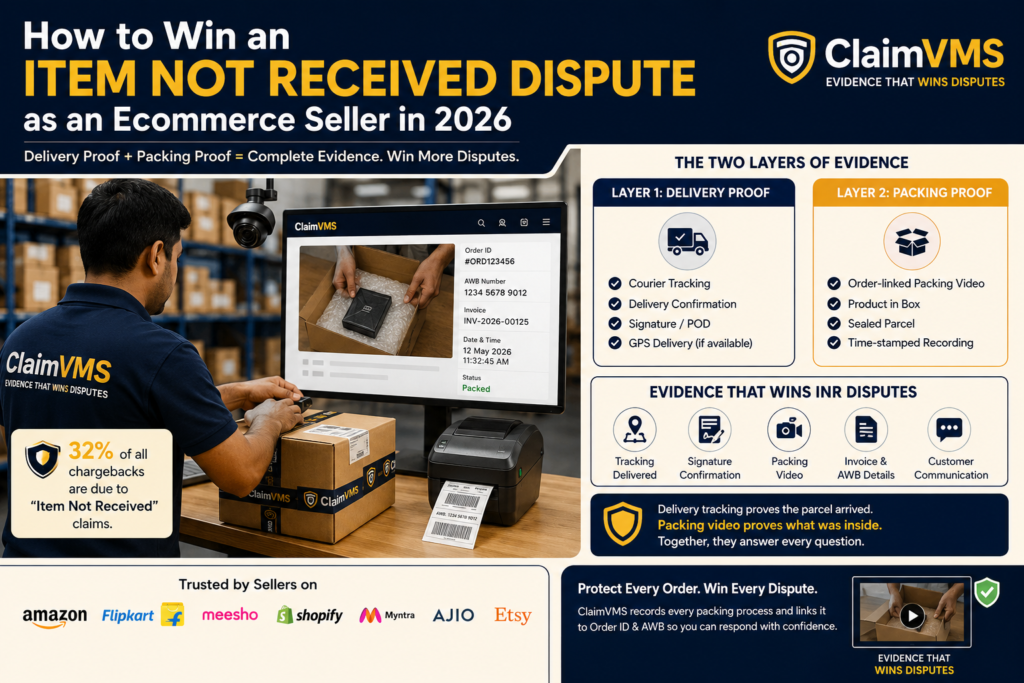
The Two Layers of Evidence Every Seller Needs
Winning an INR dispute requires two separate types of proof.
Many sellers only have the first.
Successful sellers always maintain both.
Layer 1: Delivery Proof
Delivery proof confirms that the parcel reached the customer’s address.
Useful evidence includes:
- Courier tracking history
- Delivery confirmation
- GPS delivery information (where available)
- Delivery timestamp
- Signature confirmation for high-value shipments
- Courier proof of delivery (POD)
This evidence answers only one question:
“Was the parcel delivered?”
Layer 2: Packing Proof
Delivery proof alone cannot answer another critical question:
“What was actually inside the parcel?”
If the customer claims:
- Empty box
- Missing product
- Wrong product
- Partial shipment
Courier tracking becomes insufficient.
This is where ClaimVMS becomes essential.
ClaimVMS automatically records the complete packing process while linking every video with:
- Order ID
- AWB Number
- Invoice
- Date & Time
- Operator
- Camera recording
The video becomes permanent proof of exactly what was packed before the parcel left your warehouse.
Evidence That Helps You Win INR Disputes
Strong evidence typically includes:
- Courier delivery confirmation
- Tracking showing successful delivery
- Signature confirmation (where applicable)
- Customer communication history
- Invoice
- AWB details
- Weight records
- Order-linked packing video from ClaimVMS
When all these are submitted together, they create a complete chain of evidence.
Evidence That Usually Isn’t Enough
Many sellers submit documents that unfortunately don’t prove the shipment contents.
Examples include:
- Order confirmation
- Invoice alone
- Product photographs
- Courier pickup confirmation
- Internal packing notes
- Warehouse records without visual proof
These documents show the order existed.
They do not prove the correct product was packed.
Marketplace Expectations in 2026
Different ecommerce platforms have different dispute processes, but nearly all expect sellers to provide clear fulfillment evidence.
Depending on the marketplace, useful documentation may include:
- Delivery confirmation
- Tracking history
- Customer delivery acknowledgment
- Signature proof
- Courier POD
- Warehouse packing evidence
- Product packing videos
The stronger the evidence package, the greater the chances of successfully defending the dispute.
How ClaimVMS Strengthens INR Dispute Resolution
ClaimVMS is built specifically for ecommerce sellers who want reliable proof for every shipment.
For every packed order, ClaimVMS automatically stores:
- Packing video
- Order ID
- AWB Number
- Invoice details
- Timestamp
- Camera footage
- Searchable records
When an INR dispute is raised, your team can locate the correct packing video within seconds instead of manually searching hours of CCTV footage.
This significantly reduces response time and improves dispute handling efficiency.
Complete Evidence Wins More Disputes
Think of dispute evidence like building a chain.
Without one link, the entire case becomes weaker.
With ClaimVMS, your evidence chain becomes:
- Correct order received
- Correct product picked
- Product packed on camera
- Parcel sealed
- AWB linked
- Courier accepted shipment
- Customer delivery confirmed
This complete sequence makes it much easier to defend against false INR claims and friendly fraud.
Why Ecommerce Sellers Choose ClaimVMS
ClaimVMS helps businesses reduce losses caused by fraudulent claims by providing searchable, order-linked packing videos.
Whether you sell on Amazon, Flipkart, Meesho, Myntra, AJIO, Shopify, WooCommerce, or your own ecommerce store, ClaimVMS gives your team the visual evidence needed to respond confidently to disputes.
Instead of relying only on courier tracking, you can submit both delivery proof and packing proof, creating a far stronger case for dispute resolution.
Final Thoughts
An Item Not Received dispute is no longer just about proving delivery.
Today’s disputes often involve claims about what was—or wasn’t—inside the package.
Courier tracking proves the shipment reached the destination.
ClaimVMS proves exactly what left your warehouse.
Together, they create a complete evidence trail that helps ecommerce sellers reduce fraud, respond faster, and improve their chances of winning INR disputes in 2026.