
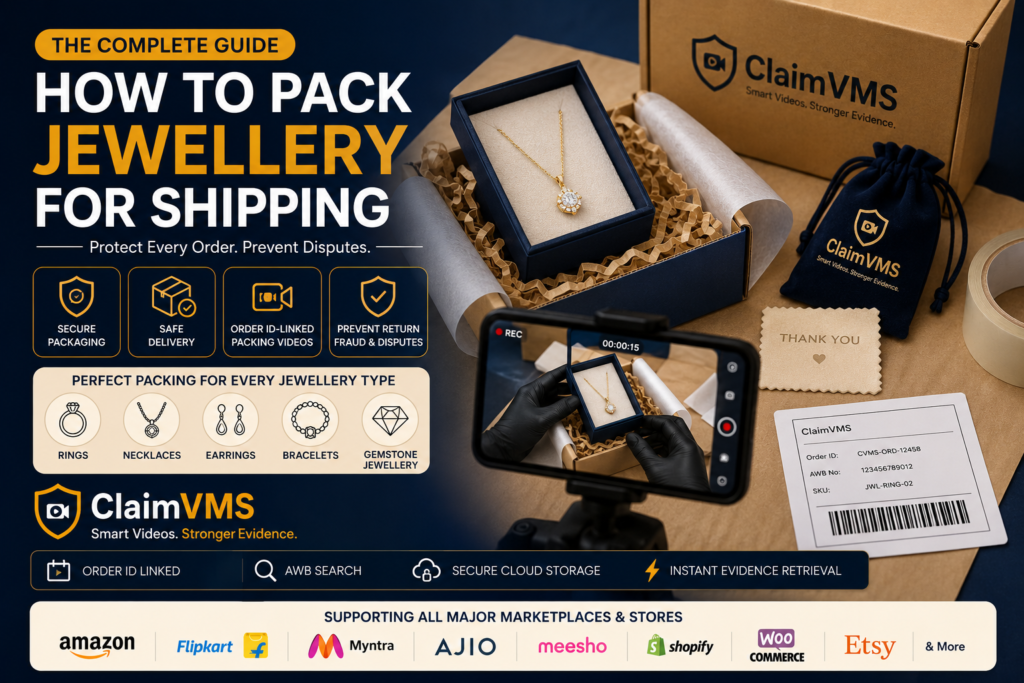
Selling jewellery online is about much more than creating beautiful products. Every shipment represents your craftsmanship, your reputation, and your business. Whether you sell through Shopify, WooCommerce, Amazon, Flipkart, AJIO, Meesho, Etsy, or your own D2C website, how you pack jewellery directly affects both customer satisfaction and your ability to handle disputes.
Most jewellery packing guides focus only on protecting products during transit.
However, successful ecommerce businesses understand there are two equally important goals:
- Protecting the jewellery from physical damage.
- Protecting your business from return fraud and false disputes.
Even perfectly packed jewellery can become the subject of:
- Wrong item claims
- Item Not as Described (INAD)
- Fake damage complaints
- Empty parcel claims
- Product swapping
- Missing accessories
- Return fraud
Bubble wrap, jewellery boxes, and anti-tarnish strips cannot protect your business against these disputes.
This is where ClaimVMS becomes an essential part of modern ecommerce fulfillment.
ClaimVMS automatically records Order ID-linked packing videos, giving sellers searchable shipment evidence that can be retrieved within seconds whenever disputes arise.
By combining proper packaging with structured fulfillment documentation, businesses can protect both their products and their profits.
Why Jewellery Requires Special Packing
Jewellery is one of the most delicate product categories in ecommerce.
Unlike larger consumer products, jewellery is:
- Lightweight
- High-value
- Fragile
- Easily scratched
- Difficult to replace
- Often handmade
- Frequently customized
Even minor movement during shipping can result in:
- Scratched finishes
- Bent clasps
- Tangled chains
- Loose gemstones
- Broken settings
- Damaged packaging
Proper packing minimizes these risks while creating a better customer experience.
The Two Goals of Jewellery Shipping
Many sellers believe shipping ends when the parcel is safely packed.
In reality, successful ecommerce shipping has two objectives.
Physical Protection
Your packaging should protect jewellery from:
- Impact
- Compression
- Moisture
- Dust
- Tarnish
- Scratches
- Chain tangling
Good packaging reduces genuine transit damage.
Business Protection
Good packaging alone cannot prevent fraudulent claims.
Customers may still report:
- The wrong item was received.
- The parcel arrived empty.
- The jewellery arrived damaged.
- Accessories were missing.
- The product was different from the listing.
ClaimVMS adds an extra layer of protection by documenting exactly what was packed before dispatch.
Essential Jewellery Packing Materials
Different jewellery requires different packing methods.
However, every shipment should prioritize product stability and protection.
Common materials include:
- Jewellery boxes
- Foam inserts
- Velvet pouches
- Anti-tarnish strips
- Acid-free tissue paper
- Bubble wrap
- Corrugated shipping boxes
- Void-fill paper
- Tamper-evident tape
- Shipping labels
Using quality packaging materials reduces transit-related damage and improves presentation.
Packing Rings Safely
Rings should never move freely inside their packaging.
Best practices include:
- Use foam or velvet ring holders.
- Secure the ring firmly.
- Prevent movement during transport.
- Add anti-tarnish protection where required.
- Place the ring box inside a rigid shipping box.
Before sealing the parcel, ClaimVMS records the packing process, documenting the ring’s condition and packaging.
Packing Necklaces Correctly
Necklaces are especially vulnerable to tangling.
Recommended practices include:
- Thread chains through a jewellery card.
- Secure the clasp.
- Wrap pendants with acid-free tissue.
- Lay necklaces flat inside the jewellery box.
- Avoid coiling chains tightly.
Proper packing minimizes movement and reduces tangling during shipping.
Packing Earrings
Earrings should always remain paired throughout transit.
Recommended methods include:
- Secure them on an earring display card.
- Use individual protective pouches.
- Protect delicate hooks and chains.
- Prevent movement inside the jewellery box.
Small accessories such as backs should also be clearly included before sealing.
Packing Bracelets
Bracelets require protection against scratching and movement.
Recommended steps include:
- Wrap each bracelet separately.
- Secure moving charms.
- Use anti-tarnish materials when appropriate.
- Prevent contact between multiple pieces.
Maintaining stability inside the parcel reduces cosmetic damage during shipping.
Packing Gemstone Jewellery
Gemstones require additional protection.
Special attention should be given to:
- Stone settings
- Surface scratches
- Pressure points
- Packaging orientation
- Cushioning materials
Care instructions should also accompany delicate gemstones where appropriate.
The Seven-Step Jewellery Packing Process
Creating a standardized workflow improves both shipment quality and warehouse consistency.
A recommended process includes:
Step 1
Inspect the jewellery before packing.
Verify:
- Product quality
- Stones
- Clasps
- Finish
- Accessories
Step 2
Record the packing process using ClaimVMS.
Each recording is automatically linked with:
- Order ID
- AWB Number
- SKU
- Marketplace
- Date & Time
Step 3
Apply protective materials.
Examples include:
- Anti-tarnish strips
- Tissue paper
- Foam inserts
Step 4
Secure the jewellery to prevent movement.
Step 5
Add branding materials.
For example:
- Thank-you card
- Care guide
- Warranty card
- Certificate of authenticity
Step 6
Place the jewellery box inside protective outer packaging.
Step 7
Seal the parcel and attach the shipping label.
ClaimVMS records the complete fulfillment process, creating shipment evidence before dispatch.
Why Packing Videos Matter More Than Listing Photos
Professional product photography helps customers understand what you sell.
However, listing images cannot prove:
- Which exact jewellery piece was packed.
- Which accessories were included.
- The condition before dispatch.
- The packaging process.
- Parcel sealing.
ClaimVMS records the actual shipment rather than the product catalog.
Every packing video becomes shipment-specific evidence linked directly to the customer order.
This distinction becomes extremely valuable whenever disputes arise.
Why ClaimVMS Protects Jewellery Sellers Better
Good packaging protects jewellery during transit.
Great documentation protects your business after delivery.
Many jewellery sellers lose disputes not because they packed the product incorrectly, but because they cannot prove exactly what left their workshop or warehouse.
ClaimVMS solves this problem by automatically creating Order ID-linked packing videos for every shipment.
Every recording is linked with:
- Order ID
- AWB Number
- SKU
- Marketplace
- Date & Time
- Warehouse Operator
- Packing Station
Instead of relying only on invoices and courier tracking, businesses can retrieve visual shipment evidence within seconds.
How ClaimVMS Works During Packing
ClaimVMS integrates directly into the packing workflow without slowing down operations.
A typical process looks like this:
Step 1
The warehouse operator scans or selects the order.
Step 2
ClaimVMS automatically starts recording.
Step 3
The recording captures:
- Jewellery inspection
- Product verification
- Stone condition
- Accessories
- Certificate of authenticity
- Warranty card
- Packaging materials
- Parcel sealing
- Shipping label application
Step 4
The completed video is securely indexed.
Step 5
If a dispute occurs, users search using the Order ID or AWB Number to retrieve the exact packing video.
The process eliminates manual CCTV searches while improving warehouse efficiency.
ClaimVMS vs Traditional Documentation
Most jewellery businesses rely on paperwork such as invoices, courier tracking, and product photographs.
While important, these records cannot visually verify the exact shipment.
| Feature | Traditional Documentation | ClaimVMS |
|---|---|---|
| Product Photos | ✓ | ✓ |
| Customer Invoice | ✓ | ✓ |
| Courier Tracking | ✓ | ✓ |
| Packing Video | ✗ | ✓ |
| Order ID Linked Evidence | ✗ | ✓ |
| AWB Search | ✗ | ✓ |
| Shipment Timeline | ✗ | ✓ |
| Jewellery Verification | ✗ | ✓ |
| Centralized Evidence Dashboard | ✗ | ✓ |
| Marketplace Dispute Support | Limited | ✓ |
ClaimVMS creates one centralized shipment evidence system instead of scattered records across multiple platforms.
Preventing Return Fraud with Better Documentation
Return fraud has become one of the largest financial challenges for online jewellery sellers.
Common fraud scenarios include:
- Product swapping
- Fake damage claims
- Empty parcel complaints
- Missing accessories
- Wrong product claims
- Item Not as Described (INAD)
- Stone substitution
- False refund requests
Proper packaging reduces transit damage.
Packing videos reduce uncertainty during dispute investigations.
ClaimVMS helps businesses document exactly what was packed before dispatch, making every shipment easier to verify when questions arise.
Best Practices for Jewellery Packing
Technology is most effective when combined with consistent warehouse procedures.
Recommended practices include:
- Inspect every jewellery piece before packing.
- Record close-up views of gemstones and finishes.
- Display certificates of authenticity.
- Include warranty cards where applicable.
- Show all accessories before sealing.
- Apply anti-tarnish protection when required.
- Secure jewellery against movement.
- Clearly capture the shipping label.
- Maintain proper lighting.
- Avoid camera blind spots.
- Securely store every packing video.
Following the same workflow for every shipment improves both documentation quality and operational consistency.
Jewellery Dispatch Checklist
Before dispatching any jewellery order, verify the following:
Before Packing
- Inspect the jewellery carefully.
- Verify the correct product.
- Check gemstones and clasps.
- Confirm customer customization.
During Packing
- Start the ClaimVMS recording.
- Show the jewellery clearly.
- Display accessories.
- Include certificates and care cards.
- Apply anti-tarnish protection.
- Secure the jewellery inside the box.
Outer Packaging
- Use rigid outer packaging.
- Add protective void fill.
- Apply tamper-evident tape.
- Attach the shipping label.
Before Shipping
- Confirm the parcel is sealed.
- Verify the Order ID.
- Ensure the packing video has been saved.
- Dispatch the shipment.
A standardized checklist reduces packing errors while creating consistent shipment documentation.
Why Order-Level Evidence Is Essential
Product listing photographs are designed to market jewellery.
Packing videos document the specific order.
This difference is important.
Listing photos show:
- The design
- Product features
- Marketing images
Packing videos show:
- The actual jewellery shipped
- Product condition before dispatch
- Packaging process
- Accessories included
- Parcel sealing
ClaimVMS records the exact shipment that left the warehouse, providing order-specific evidence rather than catalog images.
The Future of Jewellery Fulfillment
Jewellery businesses are increasingly adopting technology that improves both operational efficiency and customer trust.
Modern fulfillment strategies now include:
- AI-assisted warehouse monitoring
- Order-linked packing videos
- Barcode-triggered recording
- Intelligent evidence retrieval
- Secure cloud video storage
- Warehouse analytics
- Centralized shipment documentation
- Marketplace integrations
ClaimVMS is designed to support this next generation of ecommerce fulfillment by combining structured warehouse documentation with intelligent video management.
Conclusion
Packing jewellery safely involves much more than selecting the right box or protective materials.
Successful ecommerce businesses protect both the product and the shipment evidence.
Traditional documentation such as invoices, courier tracking, and listing photographs remains valuable, but these records cannot verify exactly what was packed inside a specific parcel.
ClaimVMS closes this evidence gap by automatically recording Order ID-linked packing videos, organizing shipment documentation, and enabling instant retrieval whenever disputes occur.
Whether you sell through Amazon, Flipkart, AJIO, Meesho, Etsy, Shopify, WooCommerce, or your own ecommerce website, ClaimVMS helps strengthen fulfillment documentation, improve warehouse accountability, and simplify dispute management.
By combining professional packaging with structured evidence management, jewellery businesses can protect their products, improve operational efficiency, and reduce the impact of costly return disputes.
Frequently Asked Questions
Q1. How should jewellery be packed for shipping?
Jewellery should be secured using appropriate inserts, anti-tarnish materials where necessary, protective outer packaging, and careful cushioning to prevent movement during transit.
Q2. Why should jewellery sellers record packing videos?
Packing videos provide order-specific shipment documentation that helps verify what was packed before dispatch whenever customer disputes arise.
Q3. How does ClaimVMS help jewellery businesses?
ClaimVMS automatically records Order ID-linked packing videos, organizes them in a searchable dashboard, and enables fast retrieval of shipment evidence.
Q4. Can ClaimVMS work with existing warehouse cameras?
Yes. ClaimVMS integrates with compatible warehouse camera systems and transforms recordings into searchable Order ID-linked shipment evidence.
Q5. Which ecommerce platforms are supported?
ClaimVMS supports Amazon, Flipkart, AJIO, Meesho, Etsy, Shopify, WooCommerce, Magento, and custom ecommerce websites, enabling businesses to manage shipment evidence from one centralized platform.