
Why Every D2C Brand Needs a Return Rate Benchmark
A return rate benchmark helps ecommerce businesses understand whether their return percentage is normal for their industry or a sign of operational issues.
According to recent industry research, the average return rate varies significantly depending on the sales channel.
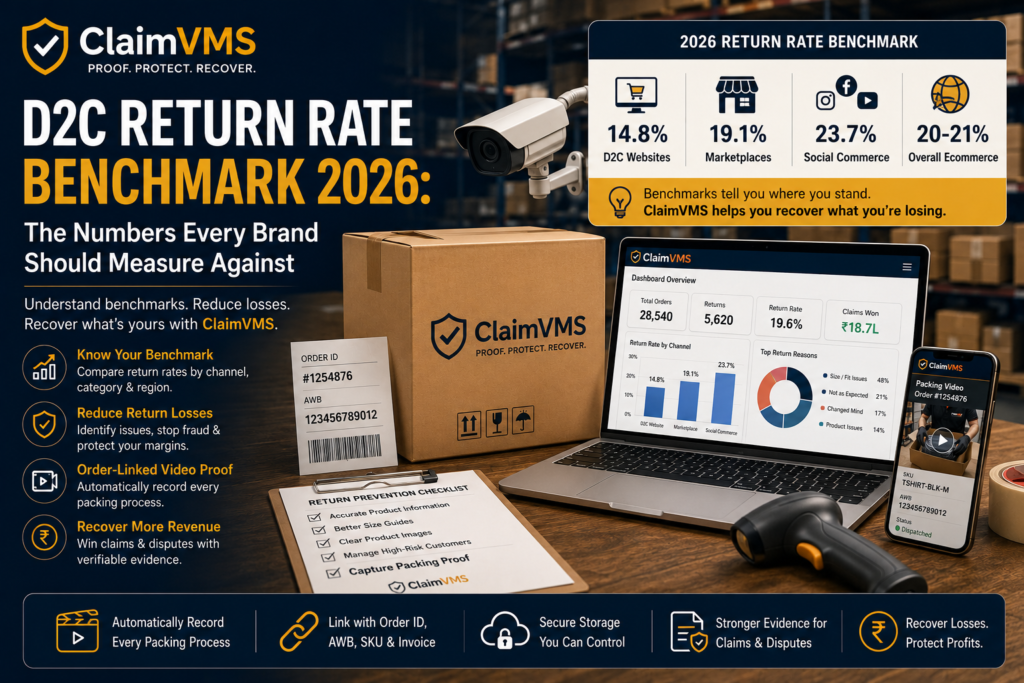
Typical 2026 benchmarks include:
| Sales Channel | Average Return Rate |
|---|---|
| D2C Websites | ~14.8% |
| Marketplaces | ~19.1% |
| Social Commerce | ~23.7% |
| Overall Ecommerce | ~20–21% |
These numbers provide an important reference point for evaluating business performance.
However, simply knowing your return rate isn’t enough.
Many ecommerce brands focus only on reducing returns while overlooking a much larger issue—how much money they lose from fraudulent, damaged, or disputed returns that could have been recovered with proper evidence.
A benchmark tells you where you stand.
ClaimVMS helps you understand where your recoverable revenue is being lost.
Both metrics are essential for profitable ecommerce growth.
Understanding Return Rate Benchmarks by Category
Not every product category experiences the same return rate.
Customer behavior, product type, and buying patterns all influence how often products are returned.
Below are common industry benchmarks.
| Category | Average Return Rate |
|---|---|
| Apparel | 24–26% (can reach 40%) |
| Footwear | 15–20% |
| Electronics | Lower than fashion but varies by product |
| Physical Retail Stores | 5–9% |
Fashion and apparel consistently record the highest return rates because customers frequently order multiple sizes or colors before deciding what to keep.
Electronics generally experience fewer returns but often involve higher-value disputes when products are returned damaged, incomplete, or replaced.
Because of these differences, businesses should always compare themselves with companies selling similar products rather than relying on a single overall ecommerce average.
Regional Return Rate Benchmarks: US, UK, and India
Customer buying behavior varies considerably across different countries.
Understanding regional benchmarks helps businesses compare their performance more accurately.
United States
The US ecommerce market generally experiences return rates around 20–21%, especially within apparel and lifestyle categories.
Generous return policies and the widespread practice of ordering multiple sizes contribute to higher return volumes.
United Kingdom & Europe
Fashion brands across the UK and many European countries often experience return rates exceeding 25%, with certain apparel categories approaching 50%.
Free returns have become a standard customer expectation, encouraging frequent product exchanges.
India
India presents unique ecommerce challenges.
Return rates typically range between 15% and 35%, depending on product category.
Fashion, footwear, beauty products, and lifestyle items generally experience the highest return percentages.
In addition to standard customer returns, Indian sellers also deal with:
- Cash-on-Delivery (COD) order refusals
- Return-to-Origin (RTO)
- Product swapping
- Empty-box return fraud
- Courier-related disputes
- Fake damage claims
These additional risks make evidence management just as important as return reduction.
Why Ecommerce Return Rates Have Increased So Rapidly
Return rates have nearly doubled over the past few years due to changing customer behavior.
Several major trends are driving this increase.
Bracketing
Customers intentionally purchase multiple sizes, colors, or product variations, planning to keep only one and return the rest.
This practice has become especially common in apparel and footwear.
Wardrobing
Some customers purchase products for temporary use—such as events, vacations, or photoshoots—and then return them as if they were unused.
Premium fashion brands are particularly affected.
Refund Abuse
Fraudulent refund requests continue to increase across ecommerce marketplaces.
Examples include:
- False damage claims
- Empty-box returns
- Product swapping
- Missing accessory claims
- Fake “item not received” reports
These cases create significant financial losses when sellers lack sufficient evidence.
AI-Assisted Return Fraud
As generative AI tools become more widely available, fraudulent documentation and refund claims have become increasingly sophisticated.
Some buyers now create convincing refund explanations, edited images, or fabricated evidence to support false claims.
Without reliable proof from the seller’s side, resolving these disputes becomes much more difficult.
The objective isn’t to achieve zero returns. The real goal is to recover as much value as possible from returns that would otherwise become permanent losses.
What Every Return Actually Costs Your Business
Many ecommerce brands think a return simply means losing one sale.
In reality, every return creates multiple additional costs that directly reduce your profit margin.
A single returned order may include:
- Reverse shipping charges
- Product inspection costs
- Repackaging expenses
- Warehouse handling charges
- Restocking labor
- Inventory depreciation
- Discounting opened products
- Customer support costs
For many businesses, processing a return can cost 20–65% of the product’s value, depending on the product category and fulfillment process.
If the returned product cannot be resold as new, the financial loss becomes even greater.
Products may need to be:
- Sold at a discount
- Moved to clearance inventory
- Refurbished
- Written off completely
This is why profitable ecommerce businesses don’t measure only their return rate—they also measure how much value they recover from returned orders.
Return Fraud Is Becoming More Expensive
Not every returned order is genuine.
A growing percentage of ecommerce returns involve fraudulent activity that directly impacts seller profits.
Common examples include:
- Product swapping
- Empty-box returns
- Missing accessories
- Fake damage claims
- Used products returned as new
- Incorrect items placed inside the package
These disputes become extremely difficult to challenge if sellers cannot prove what was originally packed.
High-value products face even greater risk because fraudulent claims often increase with order value.
For ecommerce brands, reducing fraud is now just as important as reducing return rates.
The Metric That Matters More Than Return Rate
Most businesses monitor only one KPI:
Return Rate
While useful, this number tells only part of the story.
A more valuable business metric is:
Net Recovered Return Cost
This measures how much money your business successfully recovers from fraudulent, damaged, or disputed returns.
Consider two brands:
Brand A
- Return Rate: 22%
- Recovers almost none of its disputed returns
Brand B
- Return Rate: 22%
- Uses video evidence to recover a significant portion of fraudulent claims
Although both companies have identical return rates, Brand B protects far more profit.
That’s why successful ecommerce businesses track both:
- Return Rate
- Recovery Rate
Improving recovery often has a faster impact on profitability than trying to eliminate returns altogether.
Why Serial Returners Matter
Industry studies show that a relatively small group of customers is responsible for a disproportionately large number of returns.
These repeat returners frequently:
- Order multiple sizes
- Abuse flexible return policies
- Submit repeated refund requests
- Generate recurring disputes
Identifying these customers allows businesses to:
- Apply additional verification
- Restrict Cash on Delivery eligibility
- Improve fraud detection
- Reduce unnecessary losses
Managing high-risk customer behavior is one of the most effective ways to improve return economics.
How ClaimVMS Helps Ecommerce Sellers Recover More
ClaimVMS doesn’t aim to eliminate customer returns.
Instead, it helps ecommerce businesses protect themselves when fraudulent or disputed returns occur.
ClaimVMS automatically records every packing process and securely links each video with:
- Order ID
- AWB Number
- SKU
- Invoice
- Packing Timestamp
Whenever a customer raises a dispute, reports missing items, claims product damage, or returns an incorrect item, your team can retrieve the original packing video within seconds.
This creates reliable visual evidence for:
- Amazon SAFE-T Claims
- Flipkart Seller Protection cases
- Meesho disputes
- AJIO return investigations
- Myntra claims
- Courier liability claims
- Internal warehouse audits
Instead of relying on manual documentation, ClaimVMS provides order-specific video proof that strengthens every dispute.
Reducing returns improves customer operations. Recovering fraudulent losses improves business profitability. ClaimVMS helps you achieve the second.
Real Example: Same Return Rate, Better Profitability with ClaimVMS
Imagine a growing D2C apparel brand shipping nearly 500 orders every day through its own website and major marketplaces.
For years, the company maintained an average return rate close to 27%, which was considered normal for the fashion industry.
The management initially focused on reducing returns through:
- Better product descriptions
- Improved size guides
- Higher-quality product images
- Customer support improvements
Although these efforts helped customers make better purchasing decisions, one major problem remained.
Many returned products were arriving:
- Worn after use
- Swapped with lower-value items
- Missing accessories
- Damaged before reaching the warehouse
The warehouse team often approved refunds because they had no reliable evidence showing what had originally been packed.
The business wasn’t losing money because customers returned products.
It was losing money because it couldn’t challenge fraudulent returns.
After implementing ClaimVMS, every order was automatically recorded during the packing process.
Each packing video was linked to:
- Order ID
- AWB Number
- SKU
- Invoice
- Date & Time
Whenever a suspicious return arrived, the warehouse team simply searched the Order ID and reviewed the original packing video.
Instead of relying on assumptions, they had visual proof showing:
- The correct product
- Original condition
- Included accessories
- Proper packaging
- Dispatch timestamp
The company’s return percentage changed very little.
However, the amount of money recovered from fraudulent disputes increased significantly.
The biggest improvement wasn’t a lower return rate.
It was recovering revenue that previously became permanent write-offs.
How to Improve Both Return Rate and Recovery Rate
Successful ecommerce brands work on two goals simultaneously.
The first is reducing unnecessary returns.
The second is recovering losses from returns that cannot be avoided.
The most effective strategy includes:
Improve Product Information
Provide accurate product descriptions, high-quality images, sizing charts, and specification details to reduce customer disappointment.
Reduce Sizing Issues
For fashion brands, better fit guides and measurement tools help reduce returns caused by incorrect sizing.
Improve Customer Expectations
Clear delivery timelines, product videos, and realistic product photography reduce post-purchase dissatisfaction.
Monitor High-Risk Customers
Identify buyers with repeated refund requests, excessive returns, or suspicious purchasing behavior.
Capture Packing Evidence
Every dispatched order should have verifiable proof showing exactly what left the warehouse.
Order-linked packing videos provide strong evidence for handling:
- Marketplace disputes
- Courier claims
- Product swap investigations
- Empty-box complaints
- Fake damage reports
- Missing item claims
Together, these strategies reduce operational losses while improving claim success rates.
Why ClaimVMS Is the Proof Layer Every Ecommerce Business Needs
ClaimVMS acts as your warehouse evidence management platform.
Instead of manually searching CCTV footage, ClaimVMS automatically organizes every packing recording by:
- Order ID
- AWB Number
- SKU
- Invoice
- Date and Time
Within seconds, your team can retrieve the exact packing video required for a dispute or investigation.
ClaimVMS supports sellers across:
- Amazon
- Flipkart
- Meesho
- AJIO
- Myntra
- Shopify
- WooCommerce
- Other ecommerce platforms
Whether you’re responding to a marketplace claim, investigating warehouse discrepancies, or handling courier disputes, ClaimVMS ensures every shipment is backed by reliable visual evidence.
Stop Measuring Only Return Rates—Start Measuring Recoverable Revenue
Return rates are an important ecommerce metric, but they don’t tell the complete story.
The real question every ecommerce business should ask is:
“How much money are we recovering from disputed, fraudulent, and damaged returns?”
Businesses that combine:
- Better customer experience
- Accurate product information
- Fraud prevention
- Order-linked packing videos
- Strong dispute documentation
are better positioned to reduce unnecessary losses and improve long-term profitability.
With ClaimVMS, every shipment leaves your warehouse with secure visual proof—helping you protect revenue, resolve disputes faster, and build a stronger ecommerce operation.
Frequently Asked Questions (FAQs)
What is a good D2C return rate in 2026?
A healthy return rate depends on your sales channel and product category. D2C websites generally average around 15%, marketplaces around 19%, while fashion and apparel brands may experience 25–40% returns. Instead of comparing against a global average, benchmark your business against similar products and sales channels.
Why are ecommerce return rates increasing?
Return rates are rising due to several factors, including:
- Bracketing (ordering multiple sizes or colors)
- Wardrobing (using products before returning them)
- Cash-on-Delivery behavior
- Refund abuse
- Product swapping
- Empty-box returns
- More sophisticated fraud using AI-generated documentation
These trends have made return management a major operational challenge for ecommerce businesses.
Does a lower return rate always mean higher profits?
Not necessarily.
Two businesses may have the same return rate but very different profitability.
The company that successfully recovers losses from fraudulent or disputed returns will generally retain much higher margins than one that simply accepts every return without investigation.
How does ClaimVMS help ecommerce sellers?
ClaimVMS automatically records the packing process for every order and securely links each video with the corresponding:
- Order ID
- AWB Number
- SKU
- Invoice
- Packing Timestamp
When a dispute arises, sellers can retrieve the original packing video within seconds and use it as supporting evidence for marketplace claims, courier investigations, and fraud disputes.
Which ecommerce platforms does ClaimVMS support?
ClaimVMS works with businesses selling on:
- Amazon
- Flipkart
- Meesho
- AJIO
- Myntra
- Shopify
- WooCommerce
- Magento
- Custom ecommerce websites
Can ClaimVMS help with fake return fraud?
Yes.
ClaimVMS helps businesses investigate cases involving:
- Product swapping
- Empty-box returns
- Missing accessories
- Fake damage claims
- Incorrect item returns
- “Item not received” disputes
By providing order-linked packing videos, sellers have stronger evidence to support claims and challenge fraudulent return requests.
Why are packing videos important for ecommerce businesses?
Packing videos provide verifiable proof of exactly what was packed and dispatched.
This evidence helps businesses:
- Reduce fraudulent claims
- Improve marketplace dispute success
- Support courier investigations
- Protect warehouse operations
- Increase customer trust
- Recover losses that would otherwise become write-offs
Final Thoughts
Every ecommerce business tracks return rates.
The most successful businesses also track recoverable revenue.
Reducing unnecessary returns is important, but protecting your business from fraudulent and disputed returns is equally critical.
ClaimVMS provides an automated video proof and claim management platform that helps ecommerce sellers document every shipment, retrieve evidence instantly, and improve claim success across marketplaces and courier partners.
Whether you’re selling on Amazon, Flipkart, Meesho, AJIO, Myntra, Shopify, or your own D2C website, ClaimVMS ensures every order is backed by reliable visual proof—helping you minimize losses, resolve disputes faster, and build a more profitable ecommerce operation.