
Why Meesho and Snapdeal Sellers Face Unique Claim Challenges
Every ecommerce marketplace has its own dispute process, but Meesho and Snapdeal present two of the most challenging claim environments for Indian sellers.
On Meesho, sellers frequently deal with:
- Wrong Forward Return (WFR)
- Product swap fraud
- Returnless refunds
- Catalogue health issues
- Seller account suspension risks
On Snapdeal, the biggest challenge is responding to claims quickly with proper evidence before the claim window closes.
Many sellers lose perfectly valid claims—not because they are wrong—but because they cannot provide order-specific proof in time.
This is where ClaimVMS becomes valuable.
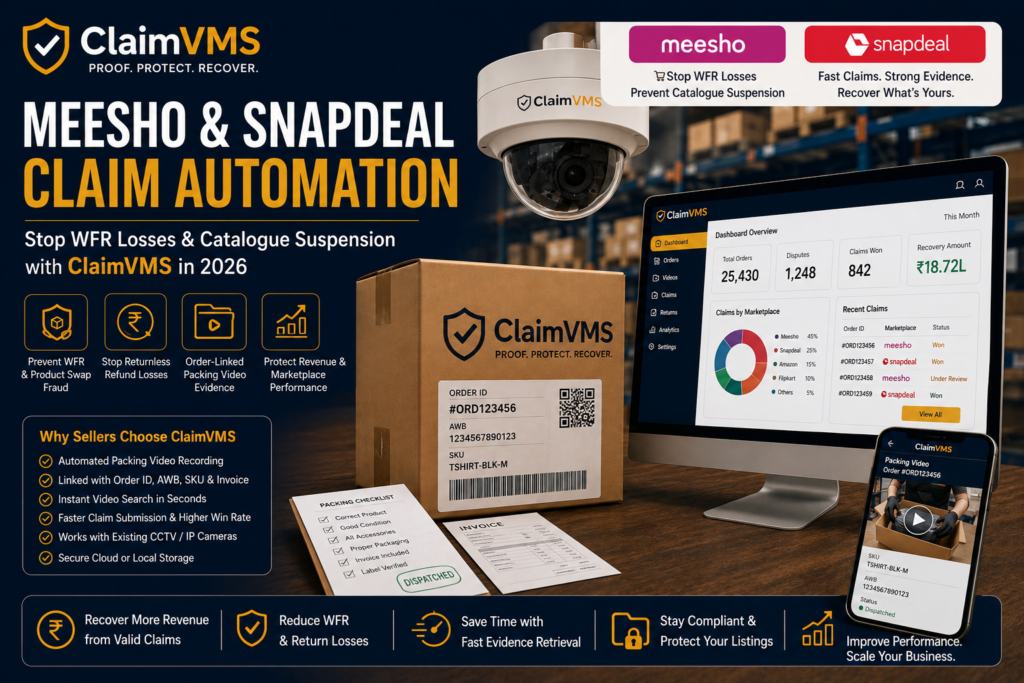
ClaimVMS automatically records every packing process and links each video with the corresponding:
- Order ID
- AWB Number
- SKU
- Invoice
- Packing Timestamp
When a dispute occurs, your team can retrieve the exact packing video within seconds instead of searching through hours of CCTV footage.
The result is faster claim submission, stronger evidence, and better recovery of disputed revenue.
Understanding WFR (Wrong Forward Return) on Meesho
Wrong Forward Return (WFR) is one of the most common forms of return fraud affecting Meesho sellers.
In a WFR case:
- The seller ships the correct product.
- The customer keeps the original item.
- A different or lower-value product is returned instead.
- The seller receives an incorrect item while losing both the original inventory and the sale amount.
Without proof of what actually left the warehouse, proving WFR becomes extremely difficult.
Many sellers simply absorb the loss because they cannot demonstrate what was packed for that specific order.
Why WFR Is So Costly
WFR creates multiple losses simultaneously.
Sellers lose:
- Original inventory
- Marketplace revenue
- Shipping charges
- Product value
- Customer confidence
- Operational time
Repeated unresolved WFR disputes can also affect overall seller performance metrics.
If too many disputes remain uncontested, marketplaces may interpret the issue as poor fulfillment quality instead of customer fraud.
Over time, this can negatively impact seller performance and catalogue visibility.
Understanding Returnless Refunds
Returnless refunds work differently.
Instead of asking the customer to send the product back, the marketplace immediately refunds the buyer while allowing them to keep the item.
This policy is commonly used for lower-value products where reverse logistics costs exceed the product price.
For sellers, however, the outcome is straightforward:
- The revenue is lost.
- The product is never recovered.
- No physical inspection is possible.
- There is little evidence available after the refund has been processed.
Because there is no returned parcel, documentation created before dispatch becomes extremely valuable.
Why Dispatch Evidence Matters
Once a returnless refund is approved, creating evidence afterward is impossible.
The only reliable approach is documenting every shipment before it leaves the warehouse.
ClaimVMS automatically captures:
- Product condition
- Correct SKU
- Accessories included
- Packaging process
- Order ID
- AWB Number
- Invoice
- Packing timestamp
Every shipment receives its own searchable video record.
When disputes arise later, sellers already have organized evidence available.
Real Seller Example
Imagine a Mumbai-based fashion seller shipping nearly 400 orders every day across Meesho and Snapdeal.
Although business was growing, monthly losses continued increasing because of repeated WFR cases and delayed dispute submissions.
Typical problems included:
- Ethnic wear replaced with cheaper garments
- Accessories swapped before return
- Wrong products received
- Refunds approved without sufficient seller evidence
On Snapdeal, another issue emerged.
The operations team manually searched CCTV footage whenever disputes occurred.
Finding the correct recording often took hours.
By the time evidence was collected, the claim submission window had already passed.
The seller wasn’t losing money because the products were defective.
They were losing money because they couldn’t retrieve evidence quickly enough.
After implementing ClaimVMS, every packing process was automatically recorded and linked with the relevant Order ID.
Instead of manually reviewing warehouse footage, the team simply entered the Order ID and retrieved the required packing video within seconds.
The result was:
- Faster dispute responses
- Better claim documentation
- Reduced WFR losses
- Improved operational efficiency
- Higher recovery of disputed revenue
The biggest improvement wasn’t fewer disputes—it was having the right evidence ready before every claim deadline.
How ClaimVMS Helps Meesho Sellers Handle WFR Disputes
Winning a WFR dispute isn’t about filing more claims—it’s about submitting the right evidence quickly.
ClaimVMS helps sellers create an automated documentation process by recording every packing session and securely linking each video to:
- Order ID
- AWB Number
- SKU
- Invoice
- Packing Date & Time
When a WFR claim is raised, your team can search the Order ID and retrieve the exact packing video within seconds.
Instead of relying on generic CCTV recordings, ClaimVMS provides order-specific visual evidence showing:
- The correct product
- Product condition before dispatch
- Included accessories
- Packaging process
- Shipping label verification
This makes dispute responses faster, more organized, and better supported with evidence.
Why Ordinary CCTV Footage Isn’t Enough
Many warehouses already have CCTV cameras installed.
However, traditional CCTV recordings create several operational challenges.
Warehouse teams often struggle with:
- Searching hours of footage
- Identifying the correct packing event
- Matching timestamps manually
- Verifying Order IDs
- Exporting evidence before claim deadlines
Generic surveillance footage rarely provides an efficient workflow for marketplace disputes.
ClaimVMS transforms ordinary warehouse cameras into an order-linked evidence management system.
Instead of searching by time, users simply search by:
- Order ID
- AWB Number
- SKU
- Invoice Number
The required video is available almost instantly.
Protecting Your Marketplace Performance
Repeated unresolved disputes can negatively affect seller performance.
Marketplace algorithms continuously evaluate fulfillment quality based on:
- Customer complaints
- Return patterns
- Dispute history
- Seller response quality
- Documentation provided
When sellers consistently fail to respond with adequate evidence, repeated claim losses may impact account health and overall marketplace performance.
Maintaining organized dispatch documentation helps businesses demonstrate consistent fulfillment quality whenever investigations occur.
How ClaimVMS Simplifies Snapdeal Claim Management
Snapdeal sellers often work within tight timelines for dispute submission.
When evidence collection is delayed, otherwise valid claims may not be submitted before the review window closes.
ClaimVMS helps eliminate this delay by automatically organizing packing videos immediately after dispatch.
Each shipment receives:
- Order-linked video proof
- Searchable evidence
- Secure storage
- Fast retrieval
- Centralized documentation
As soon as a dispute is received, the operations team can retrieve the required evidence without manually reviewing CCTV footage.
This reduces response time and helps teams manage a larger number of claims more efficiently.
One Platform for Multiple Marketplaces
Many ecommerce businesses sell across several marketplaces simultaneously.
Instead of maintaining different documentation processes for each platform, ClaimVMS provides a unified evidence management solution.
The platform supports businesses selling through:
- Meesho
- Snapdeal
- Amazon
- Flipkart
- AJIO
- Myntra
- Shopify
- WooCommerce
- Other ecommerce platforms
Every shipment follows the same automated documentation workflow regardless of where the order originated.
This simplifies warehouse operations while improving consistency across all marketplace claims.
Why Ecommerce Sellers Choose ClaimVMS
ClaimVMS is designed specifically for ecommerce fulfillment and dispute management.
Key features include:
- Automatic packing video recording
- Order ID and AWB mapping
- SKU-based video search
- Invoice linking
- Secure cloud or local storage
- Works with existing warehouse CCTV cameras
- Fast evidence retrieval
- Marketplace dispute support
- Courier claim documentation
- Multi-user warehouse access
- Centralized claim management dashboard
Instead of reacting to disputes after they occur, ClaimVMS helps sellers build an evidence-first fulfillment process that supports faster investigations and stronger claim documentation.
Every successful dispute begins long before the return arrives. The strongest claims are backed by clear, order-linked evidence created during packing—not after the complaint is raised.
Frequently Asked Questions (FAQs)
What is WFR in Meesho?
WFR (Wrong Forward Return) is a type of return fraud where the seller dispatches the correct product, but the customer returns a different, damaged, or lower-value item instead. Without order-specific packing proof, it becomes difficult for sellers to prove what was originally shipped.
What is a Returnless Refund?
A returnless refund is a marketplace policy where the customer receives a refund without being required to return the product. This usually applies to low-value items where return shipping costs exceed the product value. Since there is no returned parcel to inspect, pre-dispatch documentation becomes essential.
How does ClaimVMS help with Meesho disputes?
ClaimVMS automatically records every packing process and links each video with the corresponding Order ID, AWB, SKU, Invoice, and packing timestamp. When a dispute arises, sellers can instantly retrieve the relevant packing video and use it as supporting evidence for marketplace investigations.
Can ClaimVMS help with Snapdeal claims?
Yes. ClaimVMS helps Snapdeal sellers organize packing evidence, retrieve videos quickly, and respond to disputes within the required timelines. Faster access to order-specific proof improves operational efficiency and strengthens claim documentation.
Does ClaimVMS work with existing warehouse cameras?
Yes. ClaimVMS is designed to integrate with most existing warehouse CCTV/IP camera systems, eliminating the need for major hardware changes. Sellers can continue using their current camera setup while automating packing video management.
Which ecommerce platforms does ClaimVMS support?
ClaimVMS supports businesses selling on:
- Amazon
- Flipkart
- Meesho
- Snapdeal
- AJIO
- Myntra
- Shopify
- WooCommerce
- Magento
- Custom ecommerce websites
Why is order-linked packing video important?
Order-linked packing videos provide verifiable visual proof of exactly what was packed and dispatched. This helps sellers:
- Investigate product swap fraud
- Handle WFR disputes
- Support courier claims
- Respond to marketplace investigations
- Improve warehouse accountability
- Recover losses that would otherwise become write-offs
Final Thoughts
Marketplace disputes are becoming more frequent, and sellers who rely solely on manual documentation often struggle to recover losses.
The most successful ecommerce businesses don’t wait until a claim is filed—they create evidence during the packing process.
ClaimVMS automates this entire workflow by recording every shipment, linking videos to Order IDs, and making evidence searchable within seconds.
Whether you sell on Meesho, Snapdeal, Amazon, Flipkart, AJIO, Myntra, Shopify, or WooCommerce, ClaimVMS gives your business the proof needed to respond to disputes faster, protect marketplace performance, and recover more revenue with confidence.