
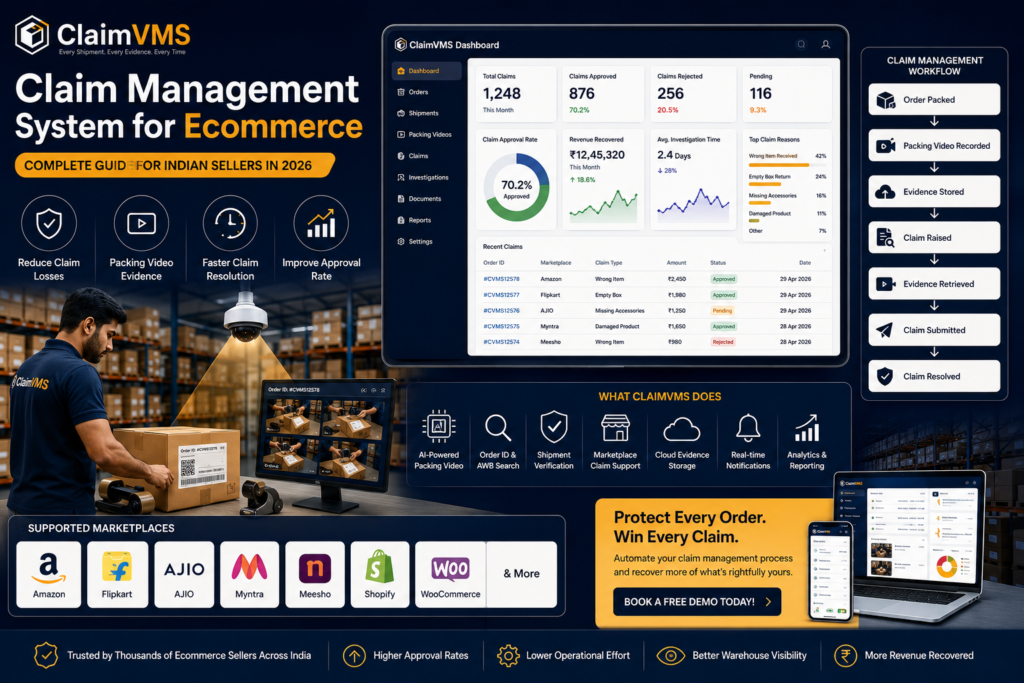
Running a successful ecommerce business today involves much more than selling products. Every day, sellers deal with returns, refund requests, damaged deliveries, courier disputes, missing items, and marketplace investigations.
Whether you sell on Amazon, Flipkart, Myntra, AJIO, Meesho, Shopify, WooCommerce, or your own D2C website, handling claims manually has become increasingly difficult as order volumes grow.
Most sellers lose money not because their claims are invalid—but because they cannot retrieve the right evidence quickly, submit claims within marketplace deadlines, or maintain organized shipment records.
This is where a Claim Management System (CMS) becomes essential.
Unlike traditional warehouse documentation methods, ClaimVMS helps ecommerce businesses create a complete shipment evidence ecosystem by automatically recording packing videos, linking every shipment with Order IDs, AWB numbers, invoices, SKUs, and dispatch details.
Instead of spending hours searching CCTV footage or collecting scattered documents, warehouse teams can retrieve shipment evidence within seconds whenever a claim investigation occurs.
In this guide, we’ll explain what an ecommerce claim management system is, why manual claim handling fails, and how ClaimVMS helps Indian ecommerce sellers simplify claim management while improving operational efficiency.
What Is a Claim Management System for Ecommerce?
A Claim Management System (CMS) is software that helps ecommerce businesses manage the complete lifecycle of return-related investigations and marketplace disputes.
Rather than treating every claim as an isolated event, a CMS organizes every stage into a structured workflow.
Typical claim management includes:
- Claim identification
- Shipment verification
- Packing evidence retrieval
- Documentation management
- Investigation support
- Deadline tracking
- Claim history
- Performance reporting
Instead of relying on spreadsheets, emails, and manual CCTV searches, businesses manage everything from a centralized dashboard.
Why Ecommerce Sellers Need a Claim Management System
As ecommerce operations grow, so does the complexity of handling returns.
Warehouse teams often manage:
- Hundreds of daily shipments
- Marketplace returns
- Courier disputes
- Wrong item complaints
- Empty parcel claims
- Missing accessory reports
- Damaged delivery investigations
Managing these processes manually quickly becomes inefficient.
Without a structured claim management system, businesses often experience:
- Delayed investigations
- Missed marketplace deadlines
- Lost shipment records
- Manual CCTV searching
- Inconsistent documentation
- Lower operational visibility
A centralized claim management platform helps standardize every step.
Understanding the Ecommerce Claim Lifecycle
Many sellers think filing a claim simply means uploading documents to a marketplace portal.
In reality, a complete claim process consists of multiple operational stages.
Stage 1: Claim Identification
Every investigation begins with identifying a claimable event.
Examples include:
- Wrong product returned
- Empty box return
- Missing accessories
- Courier damage
- Weight discrepancy
- Product swapping
- Return fraud
- Marketplace investigation
Early identification improves response time.
Stage 2: Shipment Verification
Once a claim is identified, the shipment must be verified.
Businesses typically confirm:
- Order ID
- AWB Number
- Invoice
- Customer information
- Dispatch date
- SKU
- Warehouse location
Organized shipment records reduce investigation time.
Stage 3: Evidence Retrieval
This is where many manual processes fail.
Warehouse teams often spend considerable time searching:
- CCTV recordings
- Shared folders
- Email attachments
- Local storage devices
- Hard drives
Without proper indexing, locating the correct shipment can become extremely time-consuming.
How ClaimVMS Simplifies Evidence Retrieval
ClaimVMS automatically links every packing video with:
- Order ID
- AWB Number
- Invoice
- SKU
- Packing Operator
- Dispatch Timestamp
- Shipment Status
Instead of reviewing hours of CCTV footage, users simply search using an Order ID or AWB number.
The relevant shipment documentation appears almost instantly.
Stage 4: Documentation Management
Marketplace investigations often require multiple supporting records.
A well-organized claim file may include:
- Packing Video
- Invoice
- Shipping Label
- Courier Details
- Weight Verification
- Product Images
- Dispatch Records
Keeping all documentation together reduces manual effort and improves investigation quality.
Stage 5: Investigation Workflow
After evidence is collected, warehouse teams review:
- Product condition
- Packing accuracy
- Accessories included
- Label verification
- Shipment integrity
A standardized investigation process helps ensure consistent decision-making across all claims.
Why Traditional CCTV Is No Longer Enough
Many warehouses already have CCTV cameras installed.
However, traditional CCTV systems were never designed specifically for ecommerce claim management.
Common limitations include:
- Continuous recordings
- No Order ID mapping
- No AWB search
- Difficult retrieval
- Manual time-based searching
- No shipment indexing
As shipment volumes increase, these limitations become increasingly significant.
ClaimVMS vs Traditional Warehouse Recording
Instead of storing generic surveillance footage, ClaimVMS creates structured shipment documentation.
Each shipment is linked with:
- Order ID
- AWB Number
- Invoice
- SKU
- Packing Video
- Dispatch Timestamp
- Warehouse Operator
Every shipment becomes fully searchable.
This significantly reduces the time required during marketplace investigations.
Example: Manual Claim Investigation
A customer reports:
“The parcel arrived without the charger.”
Warehouse staff begin searching:
- CCTV recordings
- Dispatch logs
- Emails
- Courier documents
After considerable effort, they still struggle to locate the correct shipment footage.
Meanwhile, marketplace response deadlines continue approaching.
The Same Investigation Using ClaimVMS
Now imagine the warehouse uses ClaimVMS.
The operations team enters:
- Order ID
or
- AWB Number
The system immediately retrieves:
- Packing video
- Invoice
- Shipment details
- Product verification
- Dispatch timestamp
- Packing operator information
Instead of spending hours searching manually, evidence becomes available within moments.
Benefits of a Structured Claim Management System
Implementing a dedicated claim management system offers several operational advantages.
These include:
- Faster evidence retrieval
- Better shipment traceability
- Organized documentation
- Improved warehouse accountability
- Reduced manual effort
- Faster marketplace responses
- Better operational transparency
- Simplified investigation workflows
- Improved audit readiness
- Centralized shipment history
Businesses become proactive rather than reactive when managing claims.
Marketplace Claim Management Is Different for Every Platform
One of the biggest challenges for Indian ecommerce sellers is that every marketplace follows its own claim process, documentation requirements, and submission deadlines.
Warehouse teams often manage multiple marketplaces simultaneously, making manual claim handling increasingly difficult.
A centralized claim management system helps standardize documentation while allowing businesses to respond more efficiently to platform-specific investigations.
Amazon Claim Management
Amazon sellers frequently deal with claims involving:
- Wrong item returns
- Missing accessories
- Damaged returns
- Empty parcel disputes
- Product swaps
When responding to investigations, sellers may need organized shipment documentation that includes:
- Packing evidence
- Order ID
- AWB Number
- Invoice
- Product verification
- Dispatch records
Maintaining structured documentation helps operations teams retrieve relevant shipment information much faster.
Flipkart Claim Management
Flipkart investigations commonly involve:
- Logistics-related disputes
- Wrong product returns
- Damaged deliveries
- Missing product claims
Warehouse teams benefit from maintaining consistent shipment records that simplify internal verification whenever disputes arise.
AJIO Claim Management
AJIO investigations often require prompt responses within defined operational timelines.
Businesses handling large shipment volumes need systems that help them:
- Locate shipment records quickly.
- Retrieve packing documentation.
- Verify dispatched products.
- Maintain organized evidence.
Delays in locating documentation can affect investigation efficiency.
Myntra and Meesho Claim Management
Fashion marketplaces frequently experience returns related to:
- Incorrect sizes
- Wrong products
- Missing accessories
- Product condition
- Packaging concerns
Standardized shipment documentation supports consistent internal investigations across all marketplaces.
Why Manual Claim Management Breaks at Scale
Manual processes may work when businesses ship only a few orders each day.
However, as order volumes increase, several operational problems appear.
Warehouse teams often spend valuable time:
- Searching CCTV footage
- Reviewing emails
- Checking spreadsheets
- Locating invoices
- Finding courier records
These repetitive tasks reduce productivity and increase investigation time.
The Hidden Cost of Manual Claim Management
Manual workflows create additional operational expenses beyond labor.
Common challenges include:
- Delayed investigations
- Missed response deadlines
- Duplicate documentation
- Inconsistent record keeping
- Limited shipment visibility
- Longer customer resolution times
These inefficiencies become more noticeable as businesses continue to grow.
How ClaimVMS Simplifies Warehouse Operations
ClaimVMS transforms warehouse documentation into a structured evidence management system.
Instead of storing unrelated surveillance footage, every shipment becomes an organized digital record.
Each shipment is linked with:
- Order ID
- AWB Number
- Invoice
- SKU
- Packing Video
- Dispatch Timestamp
- Warehouse Operator
- Shipment History
Everything is stored securely and remains searchable whenever required.
Search Every Shipment in Seconds
Traditional CCTV systems require warehouse teams to search recordings based on time.
ClaimVMS changes this completely.
Users simply search using:
- Order ID
- AWB Number
- Invoice Number
- SKU
The system retrieves the associated shipment records almost instantly.
This significantly reduces investigation time.
Improve Warehouse Accountability
Organized shipment documentation creates greater visibility across warehouse operations.
Managers can review:
- Packing accuracy
- Shipment history
- Product verification
- Dispatch activities
- Warehouse performance
Structured documentation helps improve operational consistency without increasing manual effort.
Support Faster Internal Investigations
Whenever disputes occur, businesses need reliable shipment records.
ClaimVMS enables operations teams to retrieve:
- Packing videos
- Shipment details
- Product verification
- Dispatch information
- Order history
Instead of collecting documents from multiple systems, everything is available from a centralized dashboard.
Benefits of Using ClaimVMS
Implementing ClaimVMS provides several operational advantages.
Key benefits include:
✔ Order-linked packing videos
✔ AWB-based search
✔ Invoice mapping
✔ Shipment history
✔ Cloud-based evidence storage
✔ Faster documentation retrieval
✔ Reduced manual investigation time
✔ Improved warehouse accountability
✔ Better shipment traceability
✔ Organized claim documentation
✔ Centralized warehouse records
✔ Improved operational transparency
Best Practices for Ecommerce Claim Management
Successful ecommerce businesses follow standardized claim management procedures.
Recommended practices include:
- Record every packing operation.
- Verify shipment details before dispatch.
- Link documentation with Order IDs.
- Maintain searchable shipment records.
- Standardize warehouse workflows.
- Train warehouse staff regularly.
- Review claim trends monthly.
- Archive shipment evidence securely.
- Monitor recurring investigation patterns.
- Continuously improve operational processes.
Small improvements in documentation often lead to significant efficiency gains over time.
Who Should Use ClaimVMS?
ClaimVMS is designed for businesses managing regular ecommerce shipments and marketplace operations.
Ideal users include:
- Amazon Sellers
- Flipkart Sellers
- Myntra Sellers
- AJIO Sellers
- Meesho Sellers
- Shopify Stores
- WooCommerce Stores
- D2C Brands
- Warehouse Managers
- Fulfillment Centers
- Third-Party Logistics Providers (3PL)
- Ecommerce Operations Teams
Whether shipping hundreds or thousands of orders each month, structured shipment documentation supports more efficient warehouse operations.
The Future of Ecommerce Claim Management
As ecommerce continues to evolve, claim management is becoming increasingly data-driven.
Businesses no longer rely solely on invoices and courier tracking.
Instead, they are building complete shipment documentation systems that provide:
- Better operational visibility
- Faster investigations
- Improved warehouse transparency
- Organized shipment history
- Reliable evidence retrieval
ClaimVMS supports this evolution by helping businesses create searchable shipment records before disputes occur rather than reacting afterward.
Conclusion
Effective claim management is no longer just about submitting documents after a dispute.
It begins the moment an order is packed.
Businesses that maintain organized shipment documentation, standardized warehouse procedures, and searchable evidence are better prepared to manage marketplace investigations efficiently.
ClaimVMS enables ecommerce sellers to record packing operations, link every shipment with Order IDs and AWB numbers, and organize evidence within a centralized platform.
Instead of manually searching CCTV recordings or collecting scattered documents, warehouse teams can retrieve shipment records quickly, improve operational efficiency, and respond to investigations with greater confidence.
As ecommerce volumes continue to increase, adopting a structured claim management system will become an essential part of building scalable, transparent, and efficient warehouse operations.
Frequently Asked Questions (FAQs)
1. What is a Claim Management System for ecommerce?
A Claim Management System helps ecommerce businesses organize shipment documentation, manage investigations, retrieve packing evidence, and maintain structured claim records throughout the investigation process.
2. How does ClaimVMS help ecommerce sellers?
ClaimVMS records packing videos, links them with Order IDs, AWB numbers, invoices, and shipment details, enabling businesses to retrieve evidence quickly whenever marketplace investigations occur.
3. Can ClaimVMS work with existing warehouse CCTV cameras?
Yes. ClaimVMS is designed to integrate with most existing warehouse camera systems while organizing recordings into searchable shipment documentation.
4. Which marketplaces can benefit from ClaimVMS?
ClaimVMS supports sellers operating on Amazon, Flipkart, AJIO, Myntra, Meesho, Shopify, WooCommerce, and other ecommerce platforms.
5. Why is shipment documentation important?
Shipment documentation improves warehouse transparency, simplifies investigations, supports internal verification, and helps businesses retrieve organized evidence whenever required.
6. Can ClaimVMS improve warehouse efficiency?
Yes. By centralizing shipment records and enabling fast evidence retrieval, ClaimVMS reduces manual searching and streamlines warehouse workflows.
7. Who should use ClaimVMS?
Marketplace sellers, D2C brands, warehouse operators, fulfillment centers, and logistics providers managing regular ecommerce shipments can benefit from ClaimVMS.
8. What is the biggest challenge with manual claim management?
Manual claim management often involves searching CCTV footage, reviewing multiple documents, tracking emails, and maintaining spreadsheets, which becomes increasingly inefficient as shipment volumes grow.