
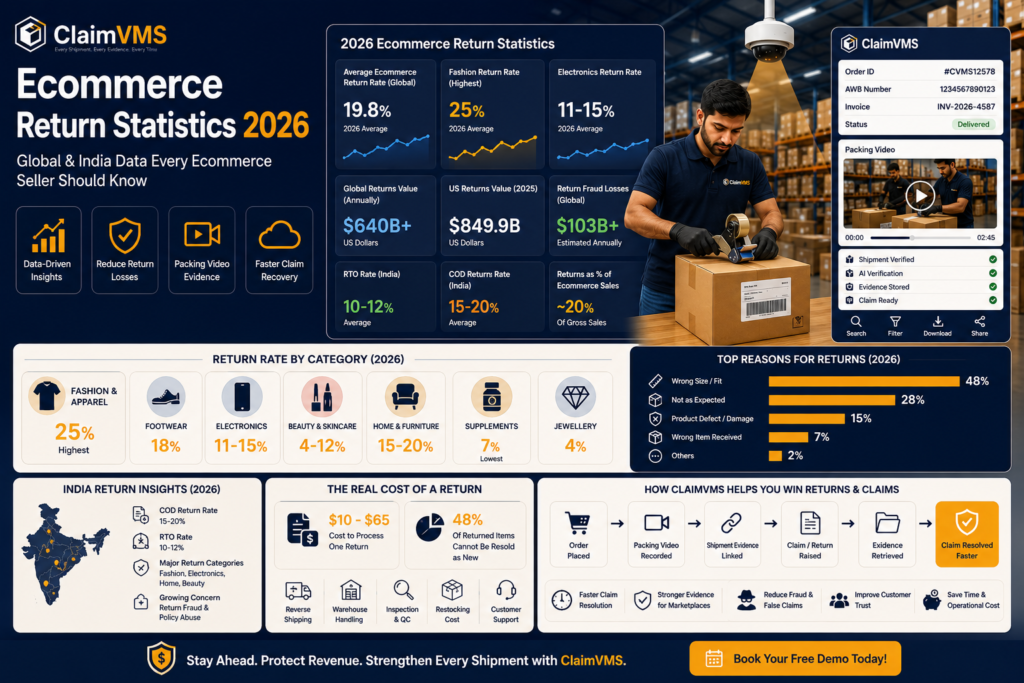
Returns have become one of the biggest operational and financial challenges for ecommerce businesses.
Whether you sell on Amazon, Flipkart, Myntra, AJIO, Meesho, Shopify, WooCommerce, or your own D2C website, understanding return statistics is no longer optional—it’s essential for improving profitability.
Every returned order affects multiple areas of your business, including logistics, warehouse operations, customer support, inventory management, and overall profit margins.
However, many sellers focus only on reducing return rates while overlooking another important metric:
How much revenue can actually be recovered from returned orders?
This is where ClaimVMS helps ecommerce businesses move beyond traditional warehouse documentation by creating structured shipment evidence through packing videos linked with Order IDs, AWB numbers, invoices, and dispatch records.
In this guide, we’ll explore the latest ecommerce return trends, what they mean for Indian sellers, and how better documentation can improve operational efficiency and claim management.
Why Ecommerce Returns Continue to Increase
Online shopping has made purchasing easier than ever.
Customers can compare products, order multiple options, and return unwanted items with minimal effort.
While this improves customer experience, it also increases operational complexity for sellers.
Several factors contribute to rising return volumes:
- Incorrect product expectations
- Size and fit issues
- Damaged shipments
- Wrong item deliveries
- Product quality concerns
- Friendly fraud
- Return abuse
- Buyer remorse
As ecommerce expands, businesses must prepare for higher return volumes while maintaining efficient warehouse operations.
Returns Are More Than Just Refunds
Many businesses calculate return losses only by considering refunded amounts.
In reality, every returned shipment generates several additional costs.
These include:
- Reverse logistics
- Return shipping charges
- Warehouse labor
- Product inspection
- Repackaging
- Inventory holding costs
- Customer support
- Restocking
- Product depreciation
When combined, these hidden expenses can significantly impact overall profitability.
Understanding the complete cost of returns allows businesses to build more effective recovery strategies.
Return Rates Vary Across Product Categories
Every ecommerce category experiences different return patterns.
Understanding category-specific behavior helps businesses improve inventory planning and return management.
Fashion & Apparel
Fashion consistently experiences some of the highest return volumes.
Common reasons include:
- Incorrect sizing
- Color differences
- Style preferences
- Multiple-size ordering
Electronics
Electronics generally experience lower return rates than fashion but involve more complex investigations.
Typical return reasons include:
- Defective products
- Compatibility concerns
- Wrong model received
- Missing accessories
Beauty Products
Beauty returns often relate to:
- Shade mismatch
- Customer preference
- Packaging issues
- Product reactions
Home & Furniture
Home products frequently generate returns due to:
- Size expectations
- Assembly concerns
- Shipping damage
- Color variations
Each category requires different operational controls and documentation procedures.
The Hidden Financial Impact of Returns
Returns affect much more than product revenue.
Every returned shipment may involve:
- Product value loss
- Shipping expenses
- Inspection costs
- Warehouse handling
- Inventory delays
- Marketplace fees
- Customer service time
For businesses processing hundreds of returns every month, these costs accumulate rapidly.
Reducing return-related operational expenses often delivers greater long-term savings than focusing only on sales growth.
Why Return Fraud Is Becoming a Major Concern
Not every return results from a genuine customer issue.
Businesses increasingly encounter situations such as:
- Empty parcel returns
- Wrong item returns
- Used product returns
- Missing accessory claims
- False damage reports
- Fake refund requests
These situations require careful investigation before decisions are made.
Without organized shipment documentation, verifying these cases becomes challenging.
The Importance of Shipment Documentation
Traditional documentation typically includes:
- Invoice
- Shipping label
- Courier tracking
- Delivery confirmation
- Customer communication
While these records confirm shipment activity, they do not verify exactly what was packed before dispatch.
This creates gaps whenever disputes arise.
Visual shipment documentation provides additional verification during investigations.
How ClaimVMS Helps Ecommerce Businesses
ClaimVMS transforms ordinary warehouse operations into a structured evidence management system.
Every shipment can be linked with:
- Packing Video
- Order ID
- AWB Number
- Invoice
- SKU
- Dispatch Timestamp
- Packing Operator
- Shipment History
This enables businesses to retrieve shipment documentation quickly whenever investigations occur.
Example: Without ClaimVMS
A customer reports:
“The parcel arrived without the charger.”
The seller provides:
- Invoice
- Courier tracking
- Dispatch confirmation
Although these records confirm shipment, they cannot verify whether the charger was packed.
The investigation becomes difficult.
Example: With ClaimVMS
Now consider the same shipment documented using ClaimVMS.
The warehouse records:
- Product verification
- Accessories packed
- Packing process
- Shipping label application
- Final sealed parcel
Later, the operations team retrieves:
- Packing video
- Order ID
- AWB Number
- Invoice
- Dispatch timestamp
Instead of relying solely on written records, the business has organized shipment documentation supporting the investigation.
Why Warehouse Documentation Matters in 2026
As ecommerce operations continue growing, businesses require faster and more reliable methods for verifying shipments.
Structured documentation improves:
- Operational transparency
- Warehouse accountability
- Investigation efficiency
- Shipment traceability
- Claim management
- Customer support
Businesses that organize shipment evidence before disputes occur are better prepared for future operational challenges.
Ecommerce Return Trends in India
India’s ecommerce ecosystem continues to expand rapidly, bringing both new opportunities and operational challenges.
Unlike many global markets, Indian sellers also deal with Cash on Delivery (COD) orders, Return-to-Origin (RTO) shipments, and marketplace-specific claim processes.
Common operational challenges include:
- High COD return rates
- Return-to-Origin (RTO) shipments
- Marketplace-specific return policies
- Courier claim investigations
- Return fraud
- Wrong item returns
- Empty parcel disputes
Managing these situations efficiently requires organized shipment documentation and standardized warehouse workflows.
Understanding Return-to-Origin (RTO) Challenges
Return-to-Origin occurs when a shipment cannot be successfully delivered and is returned to the seller.
Common reasons include:
- Customer unavailable
- Incorrect address
- Order refusal
- Failed delivery attempts
- Customer cancellation
Although RTO is different from customer returns, it still generates additional costs such as:
- Reverse logistics
- Warehouse handling
- Inventory delays
- Repackaging
- Courier charges
Reducing RTO rates through order verification and customer confirmation can improve overall profitability.
Consumer Behavior Is Changing
Today’s online shoppers have different purchasing habits than just a few years ago.
Many customers:
- Compare multiple products.
- Order multiple sizes.
- Expect faster refunds.
- Prefer simple return processes.
- Read return policies before purchasing.
This shift has increased pressure on ecommerce businesses to provide excellent customer experiences while maintaining operational control.
What Drives Most Ecommerce Returns?
Although every business is different, the most common reasons include:
- Incorrect sizing
- Wrong product selection
- Product not matching expectations
- Shipping damage
- Missing accessories
- Product defects
- Delayed delivery
- Buyer remorse
Understanding return reasons allows businesses to improve product listings, packaging, and warehouse operations.
How Better Product Information Reduces Returns
Many returns occur because customers receive products that differ from their expectations.
Businesses can reduce unnecessary returns by providing:
- High-quality product images
- Multiple viewing angles
- Product videos
- Accurate specifications
- Detailed descriptions
- Size charts
- Installation instructions
- Frequently Asked Questions
Improving product content helps customers make better purchasing decisions before placing an order.
Why Shipment Verification Is Becoming Essential
Invoices and courier tracking numbers confirm that a shipment moved through the logistics network.
However, they cannot verify:
- Which product was packed
- Product condition
- Quantity packed
- Accessories included
- Packaging quality
As marketplaces strengthen documentation requirements, businesses increasingly benefit from maintaining structured shipment verification records.
How ClaimVMS Simplifies Claim Management
ClaimVMS helps ecommerce businesses organize shipment documentation automatically.
Every dispatched order can include:
- Packing Video
- Order ID
- AWB Number
- Invoice
- SKU Details
- Packing Timestamp
- Warehouse Operator
- Shipment History
Instead of manually searching CCTV footage, operations teams can locate shipment evidence within minutes.
Best Practices for Reducing Return Losses
Although returns are a normal part of ecommerce, businesses can reduce losses through operational improvements.
Recommended practices include:
- Improve product descriptions.
- Standardize packing procedures.
- Verify shipment weight.
- Record packing operations.
- Inspect returned products.
- Monitor return patterns.
- Train warehouse staff.
- Maintain searchable shipment documentation.
- Audit warehouse processes regularly.
- Review return analytics monthly.
These improvements help reduce operational errors while strengthening claim investigations.
Benefits of Using ClaimVMS
ClaimVMS provides a centralized platform for shipment documentation and evidence management.
Key benefits include:
✔ Order-linked packing videos
✔ Fast Order ID search
✔ AWB-based evidence retrieval
✔ Invoice mapping
✔ Cloud-based video storage
✔ Improved warehouse accountability
✔ Faster claim documentation
✔ Better shipment traceability
✔ Organized investigation records
✔ Reduced manual CCTV searching
✔ Improved operational transparency
✔ Supports marketplace claim documentation
Who Should Use ClaimVMS?
ClaimVMS is suitable for businesses managing regular ecommerce shipments.
Ideal users include:
- Amazon Sellers
- Flipkart Sellers
- Myntra Sellers
- AJIO Sellers
- Meesho Sellers
- Shopify Stores
- WooCommerce Stores
- D2C Brands
- Warehouse Operators
- Fulfillment Centers
- Third-Party Logistics Providers (3PL)
- Ecommerce Operations Teams
Whether shipping a few hundred orders or several thousand each month, structured shipment documentation improves efficiency across warehouse operations.
The Future of Ecommerce Returns
Returns will continue to be an important part of ecommerce operations.
Businesses that invest in:
- Better product information
- Standardized warehouse workflows
- Organized shipment documentation
- Faster investigation processes
- Data-driven operational improvements
will be better prepared to manage increasing return volumes while protecting profitability.
ClaimVMS supports this transformation by helping businesses build reliable shipment evidence into every order before disputes arise.
Conclusion
Ecommerce return statistics reveal an important reality—returns are no longer just a customer service issue. They directly affect logistics, inventory, warehouse operations, and business profitability.
While reducing return rates is important, businesses should also focus on improving documentation, operational visibility, and claim management.
ClaimVMS enables ecommerce businesses to record packing operations, link shipment videos with Order IDs and AWB numbers, and organize every shipment in a searchable evidence platform.
Instead of spending valuable time searching through CCTV recordings or collecting scattered documents, teams can retrieve shipment records quickly and respond more confidently during marketplace investigations.
As ecommerce continues to grow in 2026 and beyond, businesses that invest in structured shipment documentation will be better equipped to reduce operational risk, improve claim response times, and strengthen customer trust.
Frequently Asked Questions (FAQs)
1. What is the average ecommerce return rate?
Return rates vary depending on product category, marketplace, and region. Fashion generally experiences higher return rates than categories such as electronics or beauty products.
2. Why do ecommerce returns continue to increase?
Common reasons include changing customer expectations, incorrect product selection, sizing issues, shipping damage, buyer remorse, and increasing online shopping activity.
3. How does ClaimVMS help ecommerce sellers?
ClaimVMS records packing videos, links them with Order IDs, AWB numbers, invoices, and shipment details, enabling faster retrieval of evidence during claim investigations.
4. What is Return-to-Origin (RTO)?
Return-to-Origin occurs when a shipment cannot be delivered and is returned to the seller due to reasons such as delivery refusal, incorrect addresses, or failed delivery attempts.
5. Why is shipment documentation important?
Shipment documentation helps businesses verify dispatched products, maintain organized records, improve warehouse accountability, and retrieve evidence efficiently during disputes.
6. Can ClaimVMS work with existing CCTV systems?
Yes. ClaimVMS is designed to integrate with most existing warehouse camera systems while organizing recordings into searchable shipment records.
7. Which ecommerce businesses should use ClaimVMS?
Marketplace sellers, D2C brands, fulfillment centers, warehouse operators, and logistics providers managing regular shipments can benefit from ClaimVMS.
8. How can businesses reduce return-related losses?
Improving product information, standardizing warehouse procedures, documenting shipments, analyzing return trends, and maintaining organized evidence systems can significantly improve return management and operational efficiency.