
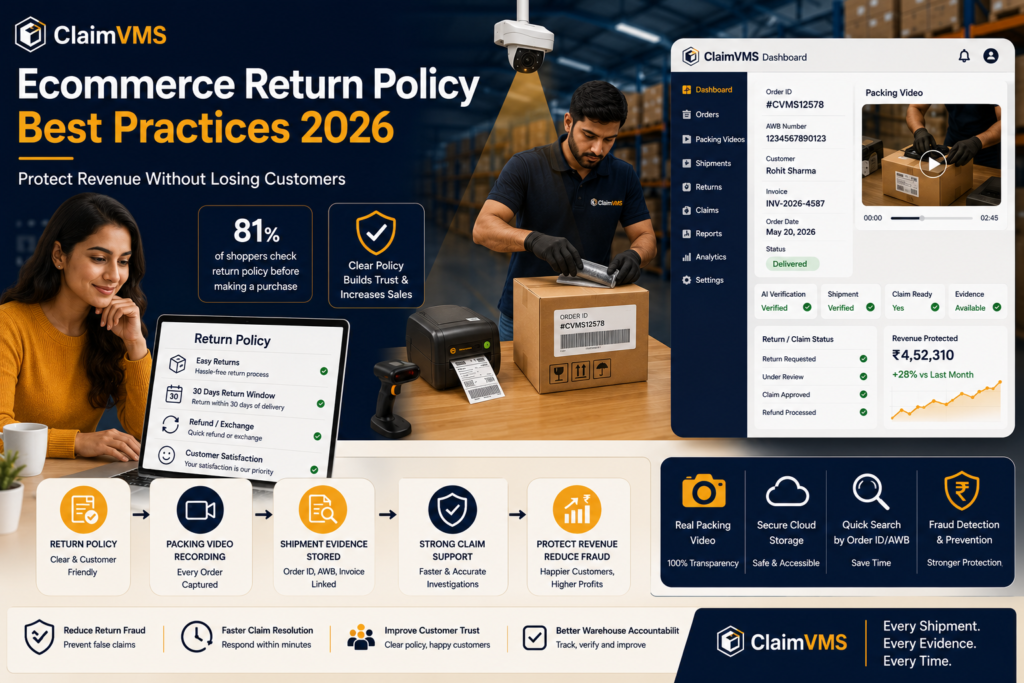
A return policy is one of the most influential pages on any ecommerce website. Before placing an order, many customers review return terms to understand how easy it will be to exchange, replace, or return a product if something goes wrong.
While a customer-friendly return policy builds trust and improves conversion rates, it can also expose businesses to refund abuse, return fraud, and false claims if not supported by proper verification processes.
Modern ecommerce sellers need more than a generous return policy—they need a policy that is clear, enforceable, and supported by reliable evidence.
This is where ClaimVMS helps.
ClaimVMS enables ecommerce businesses to strengthen their return management process by recording packing videos, linking every shipment with Order IDs, AWB numbers, invoices, and dispatch details, and maintaining searchable documentation whenever disputes or claim investigations arise.
In this guide, we’ll explore the best return policy practices for ecommerce businesses in 2026 and how combining customer-friendly policies with structured shipment documentation creates a stronger protection system for sellers.
Why Your Return Policy Matters More Than Ever
Today’s ecommerce shoppers expect flexible return options.
A complicated or confusing return policy can discourage purchases, reduce customer trust, and increase support requests.
At the same time, overly generous policies without verification procedures may encourage fraudulent activities such as:
- Empty box returns
- Used product returns
- Product swapping
- False damage claims
- Missing item complaints
- Friendly fraud
- Refund abuse
The goal is to balance customer satisfaction with operational protection.
A well-designed return policy should support both.
The Biggest Problem with Most Return Policies
Most ecommerce return policies clearly explain:
- Return eligibility
- Return windows
- Refund conditions
- Exchange rules
- Damaged item procedures
- Non-returnable products
However, they rarely explain how businesses verify these claims.
Without shipment documentation, sellers often struggle to verify:
- Original product condition
- Correct product dispatch
- Accessories included
- Quantity packed
- Packaging condition
- Shipping label verification
As a result, businesses may find it difficult to investigate disputes effectively.
Build a Return Policy That Protects Both Customers and Your Business
A strong return policy should focus on three objectives.
Customer Confidence
Customers should easily understand:
- When returns are accepted
- How refunds work
- Exchange timelines
- Replacement procedures
- Shipping responsibilities
Simple language reduces confusion.
Fraud Prevention
Return policies should clearly state:
- Items must be returned in original condition.
- Missing accessories may affect eligibility.
- Products may undergo inspection before approval.
- Evidence may be required during claim investigations.
Clear expectations help reduce misunderstandings.
Operational Consistency
Every return should follow the same internal process.
Standardized workflows improve:
- Warehouse efficiency
- Investigation accuracy
- Customer communication
- Documentation quality
Best Practice 1: Write Policies Using Simple Language
Avoid complicated legal wording.
Instead of:
Returns are subject to discretionary quality evaluation.
Use:
Products must be returned unused, with original packaging and all included accessories.
Simple language reduces customer confusion while making policies easier to enforce internally.
Best Practice 2: Create Product-Specific Return Policies
Different product categories have different return risks.
Examples:
Clothing
- Size exchanges
- Tag verification
- Condition inspection
Electronics
- Serial number verification
- Functional testing
- Accessory verification
Beauty Products
- Seal verification
- Hygiene restrictions
- Open-package policies
Home Decor
- Transit damage inspection
- Packaging condition
- Assembly verification
Tailoring return rules by category creates a better customer experience while reducing operational issues.
Best Practice 3: Encourage Exchanges Before Refunds
Many customers simply want the correct product.
Instead of immediately offering refunds, businesses can encourage:
- Size exchanges
- Color changes
- Product replacements
- Store credit
- Alternative products
Exchange-first workflows help maintain customer relationships while reducing revenue loss.
Best Practice 4: Define Reasonable Return Windows
The return period should balance customer convenience with operational practicality.
Common examples include:
- 7-day returns
- 15-day returns
- 30-day returns
Some product categories may require different timelines based on usage and resale potential.
Clearly displaying return deadlines helps avoid confusion.
Best Practice 5: Speed Up Refund Decisions
Customers often become frustrated when refunds take too long.
Businesses should:
- Confirm return receipt quickly.
- Inspect products promptly.
- Communicate status updates.
- Process eligible refunds without unnecessary delays.
A faster resolution process improves customer trust and reduces escalation.
Best Practice 6: Request Supporting Documentation for Certain Claims
When customers report:
- Damaged products
- Missing accessories
- Wrong items
- Defective products
Businesses can request:
- Photos
- Videos
- Product packaging images
- Shipping label images
Collecting relevant documentation before processing claims improves investigation quality and helps resolve issues more efficiently.
Best Practice 7: Build Evidence Into Every Shipment
The most effective return policies are supported by strong shipment documentation.
Instead of relying solely on invoices and courier tracking, businesses should maintain records showing:
- Product packed
- Accessories included
- Packaging condition
- Shipping label applied
- Final sealed parcel
- Dispatch timestamp
ClaimVMS simplifies this process by recording packing operations and linking each video directly to:
- Order ID
- AWB Number
- Invoice
- SKU
- Dispatch Time
- Warehouse Operator
This creates a searchable shipment history that supports claim investigations whenever disputes arise.
Why Traditional CCTV Alone Is Not Enough
Many warehouses already have CCTV systems.
However, traditional recordings often present challenges.
Common limitations include:
- Time-based searching
- No Order ID mapping
- No AWB association
- Hours of footage
- Difficult retrieval
- Limited shipment organization
Finding the correct shipment can become time-consuming during investigations.
ClaimVMS transforms ordinary warehouse recordings into structured, order-linked shipment documentation.
A Real-World Return Scenario Without ClaimVMS
Imagine an ecommerce seller ships a branded smartwatch to a customer.
A few days later, the buyer raises a return request, claiming:
“The product inside the parcel was damaged when it arrived.”
The seller submits:
- Order invoice
- Courier tracking information
- Dispatch confirmation
- Customer communication
Although these documents confirm the shipment was delivered, they don’t verify the product’s condition before dispatch.
As a result, the investigation depends largely on written explanations from both the buyer and the seller, making it difficult to determine what actually happened.
The Same Return Scenario Using ClaimVMS
Now consider the same shipment being processed using ClaimVMS.
During packing, the warehouse records:
- Product inspection
- Product condition
- Accessories included
- Packaging process
- Shipping label application
- Final sealed parcel
The system automatically links the recording with:
- Order ID
- AWB Number
- Invoice Number
- Dispatch Timestamp
- SKU Details
- Packing Operator
When the customer raises a dispute, the operations team retrieves the shipment documentation within minutes.
Instead of relying only on invoices and courier records, they now have structured evidence showing exactly how the shipment was prepared before dispatch.
How ClaimVMS Makes Return Policies More Effective
A return policy alone defines the rules.
ClaimVMS helps businesses support those rules with organized shipment documentation.
Instead of manually reviewing hours of CCTV footage, operations teams can instantly retrieve shipment records using:
- Order ID
- AWB Number
- Invoice Number
- Customer Name
- SKU
- Dispatch Date
This significantly improves operational efficiency during claim investigations.
Benefits of Structured Shipment Documentation
Maintaining organized shipment records offers several long-term advantages.
Businesses can benefit from:
- Faster evidence retrieval
- Improved warehouse accountability
- Better shipment traceability
- Reduced manual investigation time
- Organized documentation
- Easier internal audits
- Improved operational transparency
- Better quality control
- Faster marketplace claim responses
- Simplified order verification
Rather than reacting to disputes after they occur, businesses can proactively document every shipment.
Strengthen Customer Trust Through Transparency
A transparent return process benefits both buyers and sellers.
Customers appreciate businesses that:
- Clearly explain return conditions.
- Process requests promptly.
- Communicate throughout the return journey.
- Handle claims fairly.
- Resolve issues efficiently.
Internally, documented workflows also help customer support teams respond with greater confidence.
Build a Standard Return Investigation Workflow
Every ecommerce business should establish a consistent process for handling return investigations.
A recommended workflow includes:
Step 1
Receive the return request.
Step 2
Verify order details.
Step 3
Review customer-provided documentation.
Step 4
Retrieve shipment documentation.
Step 5
Inspect returned product.
Step 6
Compare dispatch and return records.
Step 7
Approve or reject the request based on documented findings.
Following a consistent workflow improves operational accuracy while reducing investigation delays.
Common Mistakes Businesses Make with Return Policies
Many ecommerce businesses unintentionally weaken their return management process.
Some common mistakes include:
- Using unclear return conditions
- Applying identical policies across all product categories
- Delaying refund decisions
- Failing to inspect returned products
- Depending solely on courier tracking
- Maintaining unorganized warehouse records
- Searching manually through CCTV footage
- Lacking standardized investigation procedures
Addressing these issues helps create a stronger and more efficient return management system.
Best Practices for Preventing Return Fraud
Although return fraud cannot be eliminated completely, businesses can significantly reduce risk through operational improvements.
Recommended practices include:
- Clearly communicate return conditions.
- Verify high-value shipments before dispatch.
- Record packing operations.
- Standardize warehouse procedures.
- Inspect all returned products.
- Train warehouse staff regularly.
- Maintain searchable shipment records.
- Audit return patterns periodically.
- Monitor repeat return behavior.
- Document every investigation.
Combining clear policies with organized evidence helps improve decision-making during claim reviews.
Who Should Use ClaimVMS?
ClaimVMS is designed for ecommerce businesses that require reliable shipment documentation and streamlined claim management.
Ideal users include:
- Amazon Sellers
- Flipkart Sellers
- Myntra Sellers
- Meesho Sellers
- AJIO Sellers
- Shopify Stores
- WooCommerce Stores
- D2C Brands
- Warehouse Managers
- Fulfillment Centers
- Third-Party Logistics Providers (3PL)
- Ecommerce Operations Teams
Whether managing a few hundred shipments or thousands of daily orders, ClaimVMS helps businesses organize shipment records more efficiently.
The Future of Ecommerce Return Management
Return management is evolving beyond traditional paperwork and manual verification.
As marketplaces strengthen documentation requirements and ecommerce volumes continue to grow, businesses need systems that provide accurate, searchable, and reliable shipment records.
ClaimVMS enables organizations to move from reactive dispute handling to proactive shipment documentation by linking every packing video with Order IDs, AWB numbers, invoices, and dispatch details.
This creates a stronger operational foundation for claim investigations while improving warehouse visibility and accountability.
Conclusion
An effective return policy is more than a list of rules—it is a key component of customer experience, operational efficiency, and business protection.
While clear return conditions help customers understand the process, successful ecommerce businesses also invest in structured shipment documentation that supports those policies during real-world investigations.
ClaimVMS empowers sellers by recording packing operations, organizing shipment evidence, and enabling fast retrieval of order-linked documentation whenever disputes arise.
By combining transparent return policies with reliable shipment records, businesses can improve claim management, strengthen warehouse operations, and build greater confidence in every order they dispatch.
Frequently Asked Questions (FAQs)
1. What makes a good ecommerce return policy?
A good return policy is clear, easy to understand, fair to customers, and supported by standardized internal processes that help businesses verify return requests efficiently.
2. Why is shipment documentation important for return management?
Shipment documentation provides organized records of the packing and dispatch process, helping businesses retrieve evidence quickly during claim investigations and internal reviews.
3. How does ClaimVMS improve return management?
ClaimVMS records packing videos, links them with Order IDs, AWB numbers, invoices, and shipment details, making evidence searchable and easier to retrieve during investigations.
4. Can ClaimVMS work with existing warehouse cameras?
Yes. ClaimVMS is designed to integrate with most existing warehouse CCTV systems, allowing businesses to enhance documentation without replacing their current camera infrastructure.
5. Which ecommerce platforms can benefit from ClaimVMS?
ClaimVMS is suitable for sellers operating on Amazon, Flipkart, Myntra, Meesho, AJIO, Shopify, WooCommerce, and other ecommerce platforms.
6. How can businesses reduce return fraud?
Businesses can reduce return fraud by implementing clear return policies, documenting shipments, inspecting returned products, maintaining organized records, and following standardized investigation procedures.
7. Why should businesses record packing videos?
Packing videos provide an additional layer of shipment documentation, helping verify product condition, packaging, and dispatch details before the parcel leaves the warehouse.
8. Who should implement a structured return management system?
Any ecommerce business that regularly processes customer returns—including marketplace sellers, D2C brands, warehouses, and fulfillment centers—can benefit from a structured return management and documentation system.