
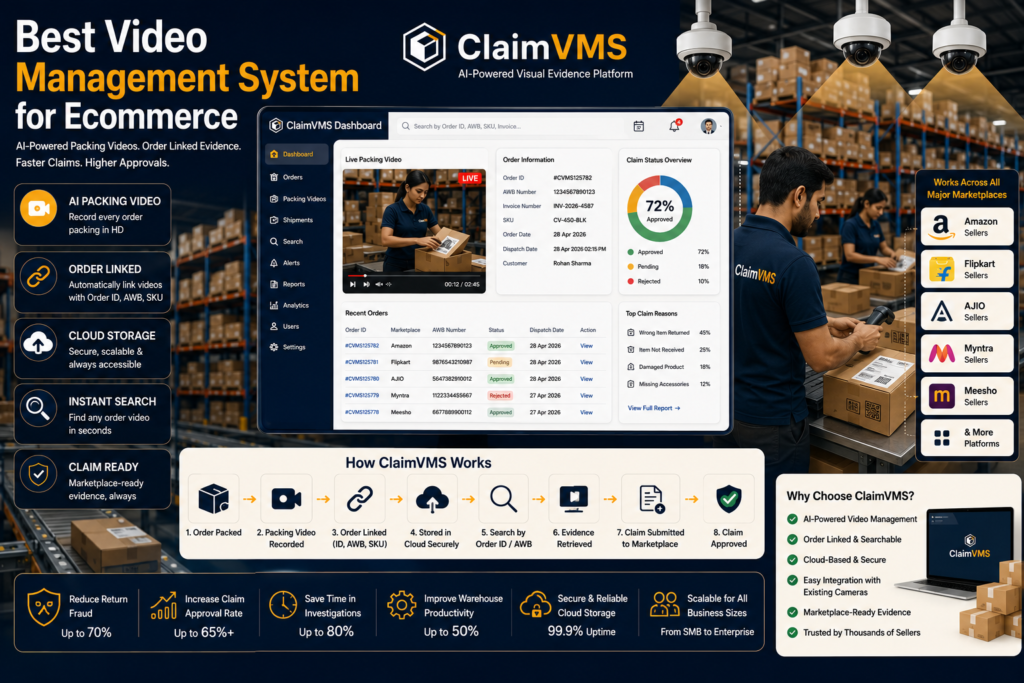
As ecommerce continues to grow across India, online sellers are shipping more orders than ever before. Along with this growth comes an increase in return requests, damaged shipment claims, courier disputes, empty-box fraud, and marketplace investigations.
Whether you sell on Amazon, Flipkart, AJIO, Myntra, Meesho, Shopify, WooCommerce, or your own D2C website, protecting every shipment has become a critical part of running a profitable ecommerce business.
Many sellers assume that installing CCTV cameras in their warehouse is enough to safeguard their operations. Unfortunately, traditional CCTV systems are designed for surveillance—not ecommerce claim management.
When a dispute occurs, warehouse teams often spend hours searching footage based on timestamps, manually matching videos with Order IDs, and collecting invoices, shipping labels, and dispatch records. This process is time-consuming, inefficient, and often delays responses to marketplace investigations.
This is why more businesses are adopting a Video Management System (VMS) built specifically for ecommerce.
ClaimVMS is an AI-powered Video Management System that transforms ordinary warehouse cameras into a complete shipment documentation platform. Every packing video is automatically linked with the Order ID, AWB Number, SKU, invoice, packing operator, and dispatch timestamp, allowing businesses to retrieve shipment evidence within seconds.
Instead of relying on scattered CCTV recordings, ClaimVMS provides structured, searchable proof that supports warehouse operations, improves shipment verification, and simplifies marketplace claim investigations.
In this guide, you’ll learn what an ecommerce Video Management System is, why it’s becoming essential for Indian sellers, and how to choose the right VMS for your warehouse.
What Is a Video Management System (VMS) for Ecommerce?
A Video Management System (VMS) for ecommerce is specialized software that records, organizes, and manages packing videos for every order processed in a warehouse.
Unlike traditional surveillance systems, a VMS is built specifically to create order-linked shipment evidence.
Each packing video is automatically connected with:
- Order ID
- AWB Number
- Invoice
- SKU
- Packing Operator
- Dispatch Timestamp
- Warehouse Location
- Shipment Status
This allows warehouse teams to retrieve shipment records instantly using Order IDs instead of manually searching hours of CCTV footage.
Why a VMS Is Different from Traditional CCTV
Many businesses believe that installing CCTV cameras provides enough evidence during return disputes.
However, CCTV systems are designed for security monitoring, not ecommerce operations.
Traditional CCTV systems typically:
- Record continuously.
- Store footage by date and time.
- Require manual searching.
- Do not associate videos with Order IDs.
- Cannot search using AWB numbers.
- Do not organize shipment records automatically.
As warehouse order volumes increase, manually locating a single shipment recording becomes increasingly difficult.
How a Modern Ecommerce VMS Works
A Video Management System creates structured documentation for every shipment instead of recording general warehouse activity.
Every completed order becomes an organized digital record containing:
- Packing Video
- Order ID
- AWB Number
- Invoice
- SKU
- Dispatch Timestamp
- Warehouse Operator
- Shipment History
Instead of browsing surveillance footage, users simply search using an Order ID or AWB Number.
The corresponding shipment documentation appears within seconds.
How ClaimVMS Records Every Shipment
ClaimVMS follows a standardized documentation workflow for every order.
Step 1: Verify the Order
Before packing begins, warehouse staff verify:
- Order ID
- Product SKU
- Invoice
- Customer Details
- Barcode
This ensures the correct item is selected before recording starts.
Step 2: Record the Packing Process
Once verification is complete, ClaimVMS records the entire packing operation.
The recording captures:
- Product inspection
- Product condition
- Barcode scanning
- Included accessories
- Packaging process
- Box sealing
- Shipping label placement
Every important step is documented.
Step 3: Link the Video Automatically
Unlike traditional CCTV, ClaimVMS automatically maps the recording with:
- Order ID
- AWB Number
- Invoice
- SKU
- Dispatch Time
- Packing Operator
No manual renaming or sorting is required.
Step 4: Store Everything Securely
Every shipment record is securely stored in cloud storage.
Videos remain searchable using:
- Order ID
- AWB Number
- Invoice Number
- SKU
- Dispatch Date
Warehouse teams can retrieve any shipment within seconds.
Step 5: Retrieve Evidence Instantly
Whenever a marketplace investigation or customer dispute occurs, users simply search:
- Order ID
or
- AWB Number
ClaimVMS instantly retrieves:
- Packing Video
- Shipment Details
- Invoice
- Product Verification
- Dispatch Timestamp
- Warehouse History
This significantly reduces investigation time.
Why Indian Ecommerce Sellers Need a VMS in 2026
India’s ecommerce industry is expanding rapidly, and with higher shipment volumes comes an increase in operational complexity.
Warehouse teams now manage:
- Marketplace orders
- Customer returns
- Courier investigations
- Wrong item complaints
- Empty box disputes
- Product swap investigations
- Weight discrepancy claims
- Return fraud cases
Managing these processes manually becomes increasingly difficult as businesses grow.
A dedicated Video Management System helps standardize shipment documentation and improve operational efficiency.
Challenges Faced Without a Video Management System
Businesses relying solely on manual documentation often experience:
- Hours spent searching CCTV footage
- Missing shipment records
- Delayed claim investigations
- Difficult evidence retrieval
- Poor warehouse visibility
- Duplicate documentation
- Inconsistent record keeping
- Slower marketplace responses
These operational challenges can affect productivity and delay claim resolution.
How ClaimVMS Solves These Problems
ClaimVMS converts traditional warehouse recordings into structured shipment evidence.
Every order includes:
- Packing Video
- Order ID
- AWB Number
- Invoice
- SKU Details
- Dispatch Timestamp
- Warehouse Operator
- Shipment Timeline
Everything is organized in one centralized dashboard, making shipment verification faster and more reliable.
Example: Investigation Without ClaimVMS
A customer reports:
“The parcel arrived without the product.”
The warehouse team begins searching:
- CCTV recordings
- Dispatch logs
- Email confirmations
- Courier documents
Locating the correct footage can take hours, especially during busy periods.
The Same Investigation Using ClaimVMS
With ClaimVMS, the warehouse team simply searches using:
- Order ID
or
- AWB Number
Within seconds, the system retrieves:
- Packing Video
- Product Verification
- Shipment Details
- Invoice
- Dispatch Time
- Packing Operator Information
Instead of relying on manually searched surveillance footage, the business has structured, order-linked evidence readily available.
Key Benefits of Using a Video Management System
A modern ecommerce VMS provides several operational advantages.
These include:
- Faster shipment verification
- Instant Order ID search
- AWB-based video retrieval
- Organized warehouse documentation
- Improved shipment traceability
- Better warehouse accountability
- Centralized cloud storage
- Reduced manual searching
- Faster marketplace investigations
- Improved operational transparency
These capabilities help businesses improve warehouse efficiency while simplifying shipment verification and claim management.
Marketplace Requirements Continue to Evolve
As ecommerce marketplaces strengthen seller protection programs, the quality of shipment documentation has become increasingly important.
Different marketplaces follow different investigation processes, but they all expect sellers to maintain accurate shipment records that can support order verification when disputes occur.
Businesses selling across multiple platforms benefit from maintaining a standardized documentation process for every shipment.
Amazon Sellers Need Faster Evidence Retrieval
Amazon sellers regularly encounter investigations involving:
- Wrong product returns
- Missing accessories
- Empty box claims
- Damaged product complaints
- Return fraud
- Shipment discrepancies
When responding to these cases, operations teams often need quick access to:
- Packing videos
- Order details
- Invoice
- AWB Number
- Dispatch records
- Product verification
ClaimVMS centralizes this information, enabling warehouse teams to retrieve shipment documentation within seconds instead of manually reviewing CCTV recordings.
Flipkart Marketplace Investigations
Flipkart sellers frequently deal with investigations involving:
- Wrong item returns
- Damaged shipments
- Logistics disputes
- Missing products
- Packaging verification
Maintaining order-linked shipment documentation improves warehouse efficiency and simplifies internal investigations.
AJIO Sellers Require Strong Shipment Documentation
AJIO sellers often handle return investigations that require reliable shipment records.
To prepare for these investigations, businesses should maintain documentation that includes:
- Order-linked packing videos
- Product verification
- Dispatch timestamp
- Invoice mapping
- Shipment history
Organized documentation helps teams respond more efficiently whenever investigations arise.
Myntra and Meesho Sellers
Fashion marketplaces experience higher return volumes than many other ecommerce categories.
Common investigations involve:
- Incorrect size
- Wrong product
- Missing accessories
- Product condition
- Packaging issues
Using a Video Management System helps create standardized shipment records regardless of the marketplace.
Video Management System vs Traditional CCTV
Although both systems record warehouse activity, they serve very different purposes.
| Traditional CCTV | ClaimVMS Video Management System |
|---|---|
| Continuous surveillance recording | Order-specific packing video recording |
| Search by date and time | Search by Order ID, AWB, SKU or Invoice |
| Security monitoring | Shipment verification platform |
| Manual video searching | Instant order-based retrieval |
| No shipment linkage | Automatic Order ID mapping |
| No AWB integration | AWB-linked documentation |
| Difficult evidence collection | Centralized shipment history |
| General warehouse monitoring | Ecommerce claim documentation |
Traditional CCTV helps monitor warehouse security.
ClaimVMS helps verify individual ecommerce shipments.
What Makes the Best Video Management System?
Choosing the right Video Management System involves more than selecting recording software.
A modern ecommerce VMS should provide:
Automatic Order Linking
Every recording should automatically connect with:
- Order ID
- AWB Number
- SKU
- Invoice
- Dispatch Timestamp
Automation reduces manual work and minimizes documentation errors.
Instant Search
Warehouse teams should retrieve shipment documentation using:
- Order ID
- AWB Number
- Invoice Number
- SKU
Searching by timestamps should no longer be necessary.
Cloud Storage
Shipment videos should be securely stored with centralized access.
Cloud storage enables:
- Better security
- Easy backup
- Multi-location access
- Faster retrieval
- Organized documentation
Works With Existing Cameras
Businesses should not need to replace their warehouse camera systems.
ClaimVMS is designed to work with most existing CCTV infrastructure, helping organizations adopt smarter documentation without significant hardware changes.
AI-Assisted Organization
Modern warehouses generate thousands of shipment recordings every month.
AI-powered organization helps:
- Index videos
- Categorize shipments
- Improve search speed
- Simplify warehouse operations
- Reduce manual effort
How ClaimVMS Improves Warehouse Productivity
Warehouse teams spend considerable time handling repetitive administrative tasks.
ClaimVMS automates many documentation processes, allowing staff to focus on:
- Packing accuracy
- Quality control
- Shipment verification
- Inventory management
- Warehouse efficiency
- Customer support
Instead of searching videos manually, teams retrieve order-linked evidence almost instantly.
Best Practices for Managing Packing Videos
To maximize the value of shipment documentation, businesses should follow standardized operating procedures.
Recommended practices include:
- Record every packed shipment.
- Verify products before sealing.
- Clearly capture accessories.
- Ensure shipping labels remain visible.
- Link every recording with Order IDs.
- Store videos securely in the cloud.
- Train warehouse staff regularly.
- Audit documentation quality periodically.
- Review warehouse workflows monthly.
- Standardize packing procedures across all teams.
Following consistent documentation practices improves investigation quality while increasing warehouse accountability.
Benefits of Using ClaimVMS
ClaimVMS provides a complete Video Management System designed specifically for ecommerce operations.
Key advantages include:
✔ AI-powered packing video recording
✔ Order-linked shipment documentation
✔ Order ID search
✔ AWB Number search
✔ Invoice mapping
✔ Cloud-based video storage
✔ Centralized evidence management
✔ Faster shipment verification
✔ Improved warehouse accountability
✔ Better operational transparency
✔ Reduced manual CCTV searching
✔ Simplified marketplace investigations
Who Should Use ClaimVMS?
ClaimVMS is suitable for businesses that regularly dispatch ecommerce orders.
Ideal users include:
- Amazon Sellers
- Flipkart Sellers
- AJIO Sellers
- Myntra Sellers
- Meesho Sellers
- Shopify Stores
- WooCommerce Stores
- D2C Brands
- Warehouse Managers
- Fulfillment Centers
- Third-Party Logistics Providers (3PL)
- Ecommerce Operations Teams
Whether processing hundreds or thousands of shipments every month, structured shipment documentation helps improve warehouse efficiency.
The Future of Ecommerce Video Management
Warehouse operations are becoming increasingly intelligent and data-driven.
Businesses are moving beyond traditional CCTV systems toward platforms that provide:
- AI-assisted video organization
- Order-linked shipment evidence
- Searchable documentation
- Cloud-based storage
- Warehouse analytics
- Operational transparency
- Faster investigations
ClaimVMS supports this transformation by helping businesses organize shipment evidence before disputes occur rather than reacting after problems arise.
Conclusion
A Video Management System is no longer simply a warehouse recording solution—it has become an essential operational tool for ecommerce businesses.
Traditional CCTV systems provide surveillance, but they do not organize shipment evidence in a way that supports fast and efficient investigations.
ClaimVMS bridges this gap by recording packing videos, linking them with Order IDs, AWB numbers, invoices, and shipment details, and storing everything in a centralized, searchable platform.
With instant evidence retrieval, improved warehouse visibility, and structured shipment documentation, businesses can streamline internal investigations, improve operational efficiency, and strengthen their overall claim management process.
As ecommerce continues to grow across India, adopting a dedicated Video Management System will help businesses build scalable warehouse operations while maintaining confidence in every shipment they dispatch.
Frequently Asked Questions (FAQs)
1. What is a Video Management System (VMS) for ecommerce?
A Video Management System (VMS) is software that records, organizes, and stores order-packing videos while linking them with Order IDs, AWB numbers, invoices, and shipment details for quick retrieval.
2. How is ClaimVMS different from traditional CCTV?
Traditional CCTV focuses on surveillance and records footage continuously. ClaimVMS organizes order-specific packing videos, making them searchable by Order ID, AWB Number, SKU, or invoice, which is more useful for shipment verification and investigations.
3. Can ClaimVMS work with existing warehouse cameras?
Yes. ClaimVMS is designed to integrate with most existing warehouse CCTV systems, reducing the need for additional hardware investments.
4. Which marketplaces can benefit from ClaimVMS?
ClaimVMS is suitable for sellers operating on Amazon, Flipkart, AJIO, Myntra, Meesho, Shopify, WooCommerce, and other ecommerce platforms.
5. Why are packing videos important?
Packing videos create structured shipment documentation that helps businesses verify dispatched orders, improve warehouse accountability, and retrieve shipment evidence quickly during investigations.
6. How does ClaimVMS improve warehouse productivity?
ClaimVMS reduces manual video searching, automates documentation, centralizes shipment records, and enables faster evidence retrieval, allowing warehouse teams to focus on operational efficiency.
7. Is ClaimVMS suitable for small ecommerce businesses?
Yes. Whether a business ships a few hundred or several thousand orders each month, ClaimVMS helps standardize shipment documentation and supports scalable warehouse operations.
8. What are the key features to look for in a Video Management System?
Important features include automatic Order ID mapping, AWB integration, cloud storage, AI-assisted organization, instant search, compatibility with existing cameras, and centralized shipment documentation.
9. Can ClaimVMS help reduce investigation time?
Yes. By linking every packing video with order information and making it searchable, ClaimVMS enables warehouse teams to retrieve shipment evidence within seconds instead of manually reviewing hours of CCTV footage.
10. Why is a Video Management System becoming essential for ecommerce businesses?
As order volumes and marketplace investigations increase, businesses need structured, searchable shipment documentation rather than general surveillance footage. A Video Management System helps improve warehouse efficiency, shipment verification, and overall operational transparency.