
One of the most frustrating situations for any ecommerce seller is receiving a notification that says:
“Your return claim has been rejected.”
The customer has already received a refund, the returned product isn’t what you originally shipped—or it’s damaged, incomplete, or missing entirely—and now your marketplace claim has also been denied.
For many sellers, this results in a double loss: the product is gone, and the money is gone too.
Whether you sell on Amazon, Flipkart, AJIO, Myntra, Meesho, Shopify, WooCommerce, or your own D2C website, rejected return claims are becoming increasingly common as marketplaces tighten documentation and verification requirements.
The good news is that a rejected claim doesn’t always mean the process is over.
In many cases, sellers can appeal the decision, provide additional documentation, or request a manual review—provided they act quickly and have the right evidence.
This is where ClaimVMS helps ecommerce businesses prepare before disputes occur.
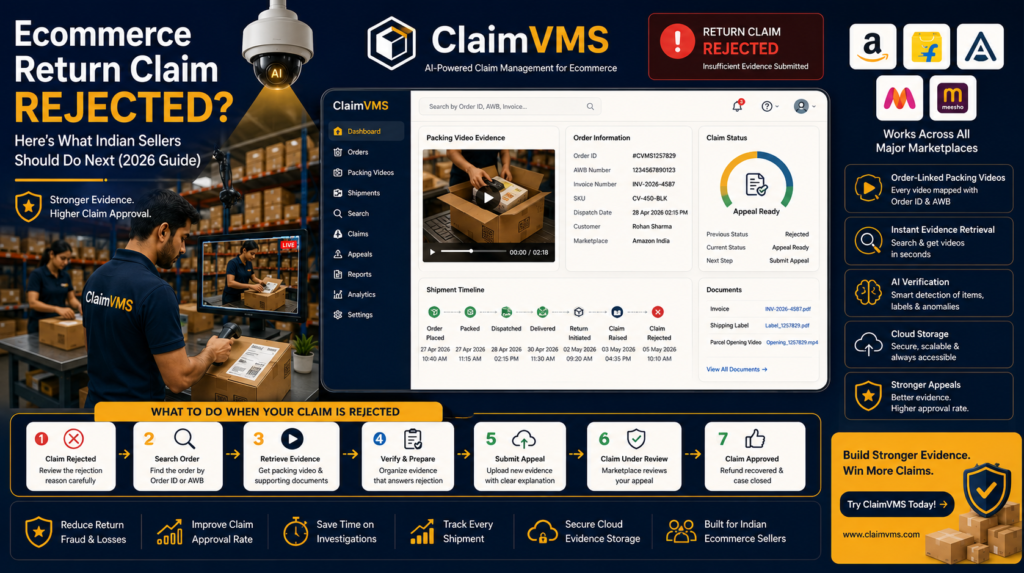
By recording packing videos, linking every shipment with Order IDs, AWB numbers, invoices, SKUs, and dispatch timestamps, ClaimVMS creates structured shipment evidence that can be retrieved within seconds whenever an investigation arises.
In this guide, you’ll learn why ecommerce return claims are rejected, what actions to take immediately, how to improve your chances during an appeal, and how structured shipment documentation can help reduce future claim rejections.
Why Ecommerce Return Claims Get Rejected
Most sellers assume their claim was rejected because the marketplace sided with the buyer.
In reality, many claims are rejected because the documentation submitted doesn’t meet the platform’s verification requirements.
Common reasons include:
- Insufficient shipment evidence
- Missing packing documentation
- Late claim submission
- Incomplete supporting records
- Unclear product verification
- Missing shipment details
- Policy-related issues
- Poor documentation quality
Understanding the exact reason for rejection is the first step toward deciding what to do next.
Don’t Ignore the Rejection Notification
One of the biggest mistakes sellers make is assuming that a rejected claim cannot be challenged.
Most marketplaces provide a limited period during which sellers can:
- Review the rejection.
- Submit additional documentation.
- Appeal the decision.
- Request a manual review.
Waiting too long may permanently close these options.
For this reason, every rejected claim should be reviewed as soon as possible after the notification is received.
Step 1: Carefully Review the Rejection Reason
Before preparing an appeal, read the rejection details thoroughly.
Many marketplaces provide a reason such as:
- Insufficient evidence
- Claim submitted outside the allowed timeframe
- Documentation incomplete
- Policy requirements not met
- Investigation already completed
Understanding the stated reason helps determine whether additional documentation can strengthen the appeal.
Avoid submitting the same information again without addressing the specific issue mentioned in the rejection.
Step 2: Review the Documentation You Submitted
Next, verify exactly what evidence was included in your original claim.
Typical documentation may include:
- Invoice
- Courier tracking
- Customer communication
- Product photographs
- Warehouse records
While these documents are useful, they may not fully demonstrate what was actually packed before dispatch.
This is where structured shipment documentation becomes especially valuable.
Why Packing Videos Matter
Packing videos provide visual documentation of the shipment before it leaves the warehouse.
A properly recorded packing video can capture:
- Product condition
- Product model
- Accessories included
- Quantity packed
- Packaging process
- Shipping label
- Parcel sealing
When linked with Order IDs and shipment information, these recordings become much easier to retrieve during investigations.
How ClaimVMS Organizes Shipment Evidence
Unlike traditional CCTV systems, ClaimVMS automatically creates searchable shipment records.
Every recorded shipment is linked with:
- Order ID
- AWB Number
- Invoice
- SKU
- Dispatch Timestamp
- Packing Operator
- Shipment History
Warehouse teams can locate evidence within seconds instead of manually reviewing hours of surveillance footage.
Example: Claim Rejected Without Structured Documentation
A customer reports that the parcel contained the wrong product.
The seller submits:
- Invoice
- Courier tracking
- Product photographs
Although these documents confirm that an order was shipped, they do not verify exactly what was packed before dispatch.
The marketplace requests stronger shipment verification.
Without additional evidence, the claim is rejected.
The Same Scenario Using ClaimVMS
Now consider the same order being processed using ClaimVMS.
During packing, the warehouse records:
- Product verification
- Product condition
- Barcode scanning
- Accessories packed
- Parcel sealing
- Shipping label application
The system automatically links the recording with:
- Order ID
- AWB Number
- Invoice
- SKU
- Dispatch Timestamp
If a dispute later occurs, warehouse staff simply search using the Order ID or AWB number.
The relevant shipment documentation is immediately available.
Step 3: Determine Whether Additional Evidence Exists
After reviewing the rejection reason, determine whether additional documentation is available.
Examples include:
- Packing video
- Parcel opening video
- Weight verification
- Product inspection photographs
- Warehouse logs
- Dispatch records
New evidence that directly addresses the rejection reason is generally more valuable than resubmitting the same documents.
Why Structured Evidence Improves Internal Investigations
Organized shipment documentation allows warehouse teams to:
- Verify dispatched products.
- Review packing accuracy.
- Confirm included accessories.
- Validate shipment details.
- Maintain consistent investigation records.
Instead of searching multiple systems, teams access everything from a centralized platform.
Common Documentation Mistakes
Many rejected claims result from avoidable documentation issues.
Common mistakes include:
- Missing packing videos
- Unorganized shipment records
- Poor image quality
- Missing Order IDs
- Missing AWB numbers
- Delayed documentation retrieval
- Inconsistent warehouse procedures
Implementing standardized documentation processes significantly improves operational consistency.
Benefits of ClaimVMS During Investigations
ClaimVMS simplifies evidence management by providing:
✔ AI-powered packing video recording
✔ Order-linked shipment documentation
✔ AWB Number search
✔ Invoice mapping
✔ Cloud-based evidence storage
✔ Centralized shipment history
✔ Faster evidence retrieval
✔ Improved warehouse accountability
✔ Better operational transparency
✔ Simplified investigation workflows
Marketplace Appeal Process: Amazon
Amazon sellers may occasionally encounter rejected investigations involving:
- Wrong item returns
- Empty box returns
- Missing accessories
- Product swapping
- Damaged returns
When preparing an appeal, businesses should review:
- Order details
- Shipment documentation
- Packing records
- Product verification
- Supporting evidence
Providing well-organized shipment documentation can improve the quality of an appeal and help reviewers understand the sequence of events more clearly.
Marketplace Appeal Process: Flipkart
Flipkart investigations commonly relate to:
- Logistics disputes
- Wrong product returns
- Product condition
- Missing items
- Packaging verification
Before appealing, warehouse teams should verify:
- Shipment records
- Dispatch information
- Packing documentation
- Internal warehouse logs
Consistent documentation helps simplify internal investigations.
Marketplace Appeal Process: AJIO
AJIO often requires structured shipment documentation when reviewing seller disputes.
Businesses should maintain:
- Packing videos
- Order verification
- Dispatch timestamps
- Shipment history
- Invoice mapping
The sooner additional documentation is prepared after receiving a rejection, the easier it becomes to complete the internal review process.
Marketplace Appeal Process: Myntra and Meesho
Fashion marketplaces frequently investigate claims involving:
- Incorrect products
- Missing accessories
- Product condition
- Packaging quality
- Size-related disputes
Organized shipment records help warehouse teams retrieve evidence quickly whenever additional verification is required.
What Evidence Makes an Appeal Stronger?
Not every document carries the same value during an investigation.
The most useful shipment documentation typically includes:
- Order-linked Packing Video
- Product Verification
- Parcel Opening Video
- Weight Verification
- Invoice
- AWB Number
- Dispatch Timestamp
- Warehouse Logs
When these records are linked together, warehouse teams can present a complete shipment history instead of isolated documents.
How ClaimVMS Strengthens Evidence Collection
ClaimVMS automatically creates structured shipment documentation for every packed order.
Each shipment record includes:
- Packing Video
- Order ID
- AWB Number
- Invoice
- SKU
- Packing Operator
- Dispatch Timestamp
- Shipment Timeline
Instead of collecting documents from multiple systems, all shipment evidence remains organized in one searchable platform.
What If Your Appeal Is Also Rejected?
If an appeal is unsuccessful, businesses should still review the investigation internally.
Important questions include:
- Was all available documentation submitted?
- Were shipment records complete?
- Was the evidence retrieved quickly?
- Were warehouse procedures followed correctly?
- Can future documentation be improved?
Rather than focusing only on the rejected claim, businesses should identify process improvements that reduce similar situations in the future.
Why Prevention Is Better Than Appeals
The most successful ecommerce businesses spend less time appealing claims because they prepare shipment evidence before disputes occur.
Preventive documentation offers several advantages:
- Faster investigations
- Better shipment traceability
- Improved warehouse accountability
- Reduced administrative effort
- Organized evidence management
- Consistent warehouse procedures
Preparing evidence before dispatch is generally more efficient than trying to recreate documentation after a dispute begins.
Best Practices to Reduce Future Claim Rejections
Every ecommerce warehouse should establish standardized documentation procedures.
Recommended practices include:
- Record every packing process.
- Verify products before sealing.
- Capture accessories clearly.
- Link videos with Order IDs.
- Store shipment documentation securely.
- Maintain searchable records.
- Train warehouse staff regularly.
- Audit documentation quality.
- Review recurring claim patterns.
- Standardize warehouse workflows.
These operational improvements help strengthen future investigations.
Benefits of Using ClaimVMS
ClaimVMS provides ecommerce businesses with a centralized shipment documentation platform.
Key benefits include:
✔ AI-powered packing video recording
✔ Order-linked shipment evidence
✔ Order ID search
✔ AWB Number search
✔ Invoice mapping
✔ Cloud-based storage
✔ Centralized documentation
✔ Faster evidence retrieval
✔ Better warehouse accountability
✔ Improved operational transparency
✔ Simplified investigation workflows
✔ Organized shipment history
Who Should Use ClaimVMS?
ClaimVMS is suitable for businesses managing ecommerce shipments across multiple marketplaces.
Ideal users include:
- Amazon Sellers
- Flipkart Sellers
- AJIO Sellers
- Myntra Sellers
- Meesho Sellers
- Shopify Stores
- WooCommerce Stores
- D2C Brands
- Warehouse Managers
- Fulfillment Centers
- Third-Party Logistics Providers (3PL)
- Ecommerce Operations Teams
Whether dispatching a few hundred orders or several thousand shipments each month, structured documentation improves operational efficiency.
The Future of Ecommerce Claim Management
Marketplace investigations are becoming increasingly documentation-driven.
Businesses that maintain:
- Organized shipment records
- AI-assisted documentation
- Searchable packing videos
- Centralized evidence storage
- Standardized warehouse procedures
will be better prepared to handle future investigations efficiently.
ClaimVMS helps businesses move from reactive claim handling to proactive shipment documentation.
Conclusion
Receiving a rejected return claim can be frustrating, but it does not always mark the end of the investigation.
The most effective response is to review the rejection carefully, identify missing documentation, gather any additional evidence, and respond within the marketplace’s available review or appeal process.
Long-term success, however, depends less on appealing rejected claims and more on preventing documentation gaps before shipments leave the warehouse.
ClaimVMS helps ecommerce businesses achieve this by recording every packing operation, linking videos with Order IDs, AWB numbers, invoices, and dispatch details, and organizing everything into a centralized, searchable evidence platform.
Instead of spending hours searching CCTV footage or collecting scattered documents, warehouse teams can retrieve shipment records in seconds, improve operational efficiency, and strengthen future claim investigations.
As ecommerce continues to grow, businesses that invest in structured shipment documentation will be better positioned to reduce documentation-related challenges, improve warehouse visibility, and respond to investigations with greater confidence.
Frequently Asked Questions (FAQs)
1. What should I do if my ecommerce return claim is rejected?
Start by reviewing the rejection reason carefully. Check whether additional shipment documentation—such as packing videos, dispatch records, or product verification—is available before preparing an appeal or internal review.
2. Why do ecommerce return claims get rejected?
Common reasons include insufficient documentation, incomplete shipment records, missing evidence, delayed submissions, or documentation that does not satisfy the marketplace’s verification requirements.
3. How does ClaimVMS help during claim investigations?
ClaimVMS records packing videos, links them with Order IDs, AWB numbers, invoices, and shipment details, enabling warehouse teams to retrieve organized evidence quickly whenever investigations occur.
4. Can ClaimVMS work with existing warehouse cameras?
Yes. ClaimVMS is designed to integrate with most existing CCTV and warehouse camera systems while adding structured shipment documentation capabilities.
5. What evidence is most useful during an appeal?
Order-linked packing videos, product verification, parcel opening videos, weight verification, invoices, AWB numbers, and dispatch records all contribute to a stronger and more organized investigation file.
6. How can businesses reduce future claim rejections?
Implement standardized packing procedures, record every shipment, maintain searchable documentation, train warehouse staff regularly, and review documentation quality through periodic audits.
7. Which ecommerce businesses should use ClaimVMS?
Marketplace sellers, D2C brands, fulfillment centers, warehouse operators, and logistics providers that manage regular ecommerce shipments can all benefit from ClaimVMS.
8. Does ClaimVMS improve warehouse productivity?
Yes. By reducing manual CCTV searches and centralizing shipment documentation, ClaimVMS helps warehouse teams retrieve evidence faster and spend more time on core operational tasks.
9. Can ClaimVMS support multiple marketplaces?
Yes. ClaimVMS is suitable for sellers operating on Amazon, Flipkart, AJIO, Myntra, Meesho, Shopify, WooCommerce, and other ecommerce platforms.
10. Why is structured shipment documentation important?
Structured documentation improves shipment traceability, warehouse accountability, investigation efficiency, and operational transparency while making evidence retrieval significantly faster.