
Every ecommerce seller eventually faces a frustrating situation.
A customer returns a product claiming it was damaged, incomplete, incorrect, or missing. The seller believes the order was packed correctly and files a marketplace claim with supporting documents. A few days later, the response arrives:
“Claim Rejected – Insufficient Evidence.”
For many sellers, this is where the process ends. They absorb the financial loss and move on to the next order.
However, in most cases, the rejection isn’t because the seller was wrong—it is because the submitted evidence wasn’t strong enough to independently verify what happened during packing and dispatch.
As ecommerce marketplaces continue strengthening seller protection programs, documentation has become just as important as the product itself.
Whether you sell on Amazon, Flipkart, AJIO, Myntra, Meesho, Shopify, WooCommerce, or your own D2C website, having organized shipment evidence can make a significant difference during investigations.
This is where ClaimVMS changes the process.
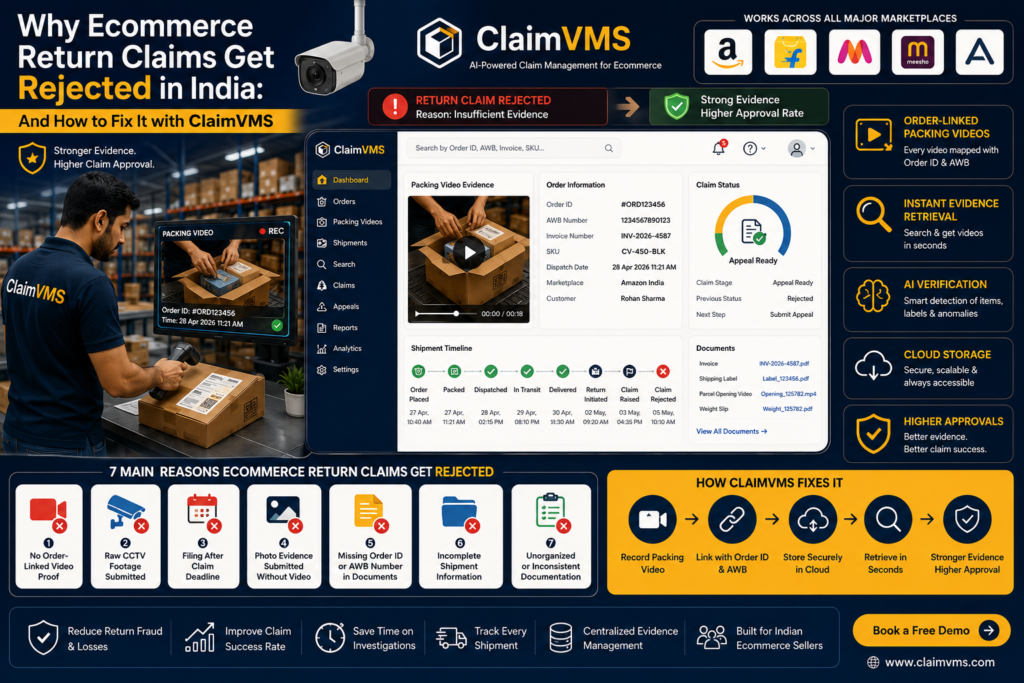
ClaimVMS automatically records every packing process, links each recording with Order ID, AWB Number, Invoice, SKU, Packing Operator, and Dispatch Timestamp, and stores everything in one searchable platform.
Instead of manually searching CCTV footage or collecting scattered documents, warehouse teams can retrieve complete shipment evidence within seconds.
In this guide, we’ll explain why ecommerce return claims are commonly rejected in India, what marketplaces expect from sellers, and how structured shipment documentation helps businesses improve internal investigations and strengthen future claim submissions.
The Real Reason Most Ecommerce Return Claims Get Rejected
Many sellers assume marketplaces automatically favor buyers.
While that assumption is common, it isn’t the primary reason most claims fail.
Marketplaces process thousands of investigations every day.
To maintain consistency, they rely on one fundamental principle:
Can the seller provide independently verifiable shipment evidence?
If the submitted documentation clearly demonstrates what was packed and dispatched, the investigation becomes much easier to evaluate.
If the documentation is incomplete, difficult to verify, or missing critical shipment details, the investigation becomes significantly more challenging.
This is why structured evidence matters far more than lengthy explanations.
What Marketplaces Usually Expect During Investigations
Although every marketplace has its own internal review process, investigators generally look for documentation that helps verify the shipment.
Typical records include:
- Order ID
- AWB Number
- Invoice
- Product Details
- Dispatch Information
- Packing Documentation
- Shipment Verification
- Supporting Images
- Packing Video (where available)
The more complete and organized the documentation is, the easier it becomes to review the shipment.
Reason 1: No Order-Linked Packing Video
One of the most common documentation gaps occurs when businesses cannot demonstrate what was actually packed before dispatch.
Invoices confirm that an order existed.
Courier tracking confirms that a parcel moved.
But neither document shows what was placed inside the package.
Packing videos provide visual documentation of:
- Product condition
- Product quantity
- Included accessories
- Barcode verification
- Packaging process
- Parcel sealing
- Shipping label application
When linked with Order IDs and shipment information, these recordings become significantly more useful during investigations.
How ClaimVMS Solves This Problem
ClaimVMS automatically creates order-linked shipment records.
Every packing video is connected with:
- Order ID
- AWB Number
- Invoice
- SKU
- Packing Operator
- Dispatch Timestamp
- Shipment History
Instead of searching manually, warehouse teams retrieve the correct shipment simply by entering the Order ID.
Reason 2: Relying Only on Traditional CCTV
Many warehouses already have CCTV systems installed.
While CCTV improves warehouse security, it was never designed specifically for ecommerce investigations.
Traditional CCTV recordings are:
- Time-based
- Continuous
- Difficult to search
- Not linked with Order IDs
- Not organized by shipment
Finding one specific packing event can require reviewing hours of footage.
Why ClaimVMS Is Different
ClaimVMS transforms warehouse recordings into searchable shipment documentation.
Instead of searching by:
- Camera Number
- Date
- Time
Users search by:
- Order ID
- AWB Number
- Invoice
- SKU
The correct shipment appears almost instantly.
Reason 3: Delayed Documentation Retrieval
Marketplace investigations often have limited response windows.
If warehouse staff spend hours locating shipment records, valuable investigation time may already be lost.
Manual retrieval typically involves searching:
- CCTV recordings
- Shared folders
- Email attachments
- Courier records
- Warehouse logs
These delays reduce operational efficiency.
ClaimVMS Enables Instant Evidence Retrieval
ClaimVMS centralizes shipment documentation into one searchable platform.
Users simply search using:
- Order ID
- AWB Number
- Invoice Number
- SKU
The system immediately retrieves:
- Packing Video
- Shipment Details
- Dispatch Records
- Product Verification
- Warehouse History
This dramatically reduces investigation preparation time.
Reason 4: Photos Without Complete Shipment Context
Photographs are useful during investigations.
However, photographs alone often cannot demonstrate the complete packing process.
For example:
A photograph of a damaged returned item shows the condition after the return.
It does not show:
- What was originally packed.
- Whether accessories were included.
- How the parcel was sealed.
Packing videos provide this additional context.
Photographs work best as supporting evidence alongside organized shipment documentation.
Reason 5: Missing Order Information
Even strong documentation becomes difficult to review when important shipment identifiers are missing.
Commonly omitted details include:
- Order ID
- AWB Number
- Invoice Number
- SKU
Without these references, investigators may struggle to match documentation with the correct shipment.
ClaimVMS automatically embeds shipment identifiers into every shipment record.
Reason 6: Inconsistent Warehouse Documentation
As businesses grow, documentation quality often becomes inconsistent.
Different warehouse staff may:
- Record videos differently.
- Store files in different folders.
- Name documents differently.
- Capture incomplete product views.
These inconsistencies make future investigations more difficult.
ClaimVMS standardizes documentation across the entire warehouse.
Every shipment follows the same structured workflow.
Reason 7: Evidence Stored Across Multiple Systems
Many businesses manage shipment documentation using:
- CCTV software
- Cloud drives
- Excel sheets
- Emails
- Courier portals
- Local computers
Retrieving information from multiple systems increases investigation time.
ClaimVMS centralizes:
- Packing Videos
- Shipment Records
- Order Information
- Dispatch Details
- Warehouse Documentation
Everything remains available through one dashboard.
Real-World Example
Imagine a customer claims that a smartphone parcel was delivered without the charger.
Without structured documentation, warehouse staff may spend hours reviewing CCTV recordings and searching invoices.
With ClaimVMS, they simply search the Order ID.
Within seconds, they retrieve:
- Packing Video
- Product Verification
- Charger Included
- Barcode Scan
- Parcel Sealing
- Dispatch Timestamp
- Invoice
- Shipment Details
Instead of relying on assumptions, the warehouse now has organized shipment documentation ready for internal review.
Benefits of Structured Shipment Documentation
Businesses using standardized documentation typically experience:
- Faster shipment verification
- Better warehouse visibility
- Organized evidence management
- Reduced manual searching
- Improved operational consistency
- Centralized shipment history
- Better warehouse accountability
- Faster internal investigations
- Simplified documentation retrieval
- Improved operational transparency.
Marketplace Documentation Requirements Continue to Evolve
Every ecommerce marketplace follows its own internal investigation process.
Although documentation requirements vary slightly, all major marketplaces expect sellers to provide evidence that clearly supports what was packed, dispatched, and returned.
Instead of preparing evidence only after a dispute occurs, businesses should create a standardized documentation process for every shipment before dispatch.
This approach significantly improves operational efficiency whenever investigations arise.
Amazon Seller Investigations
Amazon sellers frequently receive investigations involving:
- Wrong item returned
- Missing accessories
- Empty box returns
- Damaged products
- Product swapping
- Shipment discrepancies
During these investigations, warehouse teams often need quick access to:
- Order ID
- Invoice
- AWB Number
- Packing documentation
- Dispatch records
- Product verification
When shipment documentation is organized, responding becomes significantly easier.
Flipkart Return Investigations
Flipkart sellers commonly encounter claims involving:
- Logistics handling
- Product condition
- Wrong item returns
- Missing products
- Packaging disputes
Maintaining structured shipment documentation enables businesses to retrieve relevant records quickly and maintain consistency across investigations.
AJIO Documentation Standards
AJIO sellers generally work within shorter investigation timelines than many other marketplaces.
Preparing documentation after receiving a claim notification often leaves very little time for manual evidence collection.
Businesses that maintain organized shipment records—including packing videos, dispatch timestamps, invoices, and Order IDs—can respond much more efficiently.
Myntra and Meesho Seller Documentation
Fashion marketplaces frequently process investigations related to:
- Incorrect product
- Wrong size
- Missing accessories
- Damaged products
- Packaging concerns
Warehouse teams that follow standardized documentation procedures can retrieve shipment records much faster whenever internal verification is required.
What Strong Shipment Evidence Looks Like
Many sellers assume adding more documents automatically creates a stronger claim.
In reality, quality and organization matter far more than quantity.
A well-documented shipment typically includes:
- Order-linked Packing Video
- Invoice
- AWB Number
- Product Verification
- Dispatch Timestamp
- Parcel Label
- Product Images
- Warehouse Records
- Shipment Timeline
Together, these records provide a complete view of the shipment process.
Why Packing Videos Are the Foundation of Strong Evidence
Invoices confirm that an order existed.
Courier tracking confirms that a parcel was shipped.
Photographs capture individual moments.
Packing videos, however, document the complete packing process from start to finish.
They can show:
- Correct product selected
- Product condition before packing
- Accessories included
- Barcode verification
- Packaging process
- Parcel sealing
- Shipping label placement
When combined with Order IDs and AWB numbers, packing videos become one of the most valuable shipment records available.
How ClaimVMS Solves Every Documentation Challenge
ClaimVMS was built specifically for ecommerce warehouses.
Instead of storing videos separately from shipment information, ClaimVMS automatically connects every recording with:
- Order ID
- AWB Number
- Invoice
- SKU
- Dispatch Timestamp
- Packing Operator
- Shipment History
Warehouse staff no longer need to manually organize files after dispatch.
Everything is automatically indexed and searchable.
One Search Retrieves Everything
When an investigation occurs, users simply search using:
- Order ID
or
- AWB Number
ClaimVMS immediately displays:
- Packing Video
- Shipment Details
- Invoice
- Product Verification
- Dispatch Time
- Warehouse History
Evidence retrieval becomes a matter of seconds instead of hours.
Marketplace Claim Deadlines Matter
One of the most common operational challenges is delayed evidence collection.
Every marketplace has defined investigation or claim submission timelines.
Although timelines vary by platform and claim type, the underlying challenge remains the same:
Businesses that require several hours to locate shipment evidence often lose valuable response time.
Fast evidence retrieval helps warehouse teams prepare documentation before important deadlines pass.
The Cost of Manual Documentation
Many businesses still manage shipment evidence using:
- CCTV software
- Excel sheets
- Shared folders
- Email attachments
- Courier portals
- Local hard drives
Over time this creates:
- Duplicate files
- Missing documentation
- Slow investigations
- Human error
- Difficult retrieval
- Poor visibility
As shipment volume increases, these operational inefficiencies become more expensive.
Benefits of Using ClaimVMS
ClaimVMS centralizes warehouse documentation into one intelligent platform.
Key benefits include:
✔ AI-powered packing video recording
✔ Order-linked shipment documentation
✔ Order ID search
✔ AWB Number search
✔ Invoice mapping
✔ SKU mapping
✔ Cloud-based evidence storage
✔ Centralized shipment history
✔ Faster evidence retrieval
✔ Better warehouse accountability
✔ Improved operational transparency
✔ Simplified investigation workflows
Five Questions Every Seller Should Ask
Before the next marketplace investigation, consider the following:
- Can your team retrieve a packing video using only the Order ID?
- Can warehouse staff locate shipment documentation within two minutes?
- Are all videos automatically linked with AWB numbers?
- Is every shipment stored in one centralized platform?
- Would your documentation process still work if your order volume doubled next month?
If the answer to several of these questions is “No,” there may be opportunities to improve warehouse documentation.
Best Practices to Reduce Future Claim Rejections
Rather than improving claims after they are rejected, successful ecommerce businesses improve documentation before orders leave the warehouse.
Recommended practices include:
- Record every packing operation.
- Verify products before sealing.
- Capture accessories clearly.
- Scan product barcodes.
- Link every shipment with Order IDs.
- Store videos securely.
- Standardize warehouse workflows.
- Audit documentation quality regularly.
- Train packing staff consistently.
- Review recurring investigation patterns.
Small process improvements often produce significant long-term operational benefits.
Who Should Use ClaimVMS?
ClaimVMS is suitable for businesses shipping products across multiple ecommerce marketplaces.
Ideal users include:
- Amazon Sellers
- Flipkart Sellers
- AJIO Sellers
- Myntra Sellers
- Meesho Sellers
- Shopify Stores
- WooCommerce Stores
- D2C Brands
- Warehouse Managers
- Fulfillment Centers
- Third-Party Logistics Providers (3PL)
- Ecommerce Operations Teams
Whether processing hundreds or thousands of shipments every month, standardized shipment documentation supports more efficient warehouse operations.
The Future of Ecommerce Claim Documentation
Warehouse operations are becoming increasingly data-driven.
Instead of relying solely on traditional surveillance systems, businesses are adopting intelligent documentation platforms that provide:
- AI-assisted shipment indexing
- Searchable packing videos
- Cloud-based evidence storage
- Automated Order ID mapping
- Warehouse analytics
- Operational transparency
- Faster investigations
ClaimVMS is designed to support this transition by helping businesses create structured shipment evidence before disputes occur.
Conclusion
Most ecommerce return claim rejections are not caused by invalid claims—they are caused by documentation that cannot be easily verified.
Invoices, courier tracking, and photographs remain valuable, but they rarely provide the complete shipment story on their own.
By creating structured shipment documentation—including packing videos linked with Order IDs, AWB numbers, invoices, and dispatch details—businesses can prepare stronger evidence before investigations begin.
ClaimVMS enables ecommerce sellers to centralize every shipment into one searchable platform, making evidence retrieval faster, improving warehouse accountability, and simplifying internal investigations.
As ecommerce continues to grow across India, businesses that invest in organized shipment documentation today will be better equipped to manage tomorrow’s investigations with greater speed, confidence, and operational efficiency.
Frequently Asked Questions (FAQs)
1. Why do ecommerce return claims get rejected?
Most return claims are rejected because the submitted documentation does not sufficiently verify the shipment. Common issues include missing packing videos, incomplete shipment records, delayed evidence retrieval, and inconsistent documentation.
2. What evidence is most useful during a marketplace investigation?
The strongest documentation typically includes an order-linked packing video, Order ID, AWB number, invoice, product verification, dispatch timestamp, shipment history, and supporting product images.
3. How does ClaimVMS improve claim documentation?
ClaimVMS records every packing process, links each recording with Order IDs, AWB numbers, invoices, SKUs, and dispatch timestamps, allowing warehouse teams to retrieve organized shipment evidence within seconds.
4. Can ClaimVMS work with existing warehouse CCTV systems?
Yes. ClaimVMS is designed to integrate with most existing warehouse camera systems while transforming standard recordings into searchable shipment documentation.
5. Why are packing videos important?
Packing videos provide visual documentation of the complete packing process, including product verification, accessories, packaging, parcel sealing, and shipping labels, making investigations more efficient.
6. How quickly can ClaimVMS retrieve shipment records?
Users simply search using the Order ID or AWB number, and the relevant shipment documentation—including packing videos and dispatch information—is retrieved within seconds.
7. Which ecommerce businesses should use ClaimVMS?
ClaimVMS is ideal for Amazon, Flipkart, AJIO, Myntra, Meesho, Shopify, WooCommerce sellers, D2C brands, fulfillment centers, and logistics providers managing regular ecommerce shipments.
8. Can ClaimVMS help reduce future claim rejections?
Yes. By standardizing shipment documentation and ensuring every order has organized, searchable evidence, ClaimVMS helps businesses prepare stronger documentation before disputes arise.
9. Is ClaimVMS suitable for growing ecommerce businesses?
Yes. ClaimVMS scales from small ecommerce warehouses to large fulfillment operations by automating documentation and simplifying evidence management.
10. What is the biggest advantage of using ClaimVMS?
The biggest advantage is the ability to retrieve complete, order-linked shipment evidence—including packing videos, Order IDs, AWB numbers, invoices, and shipment history—from one centralized platform in just a few seconds.