
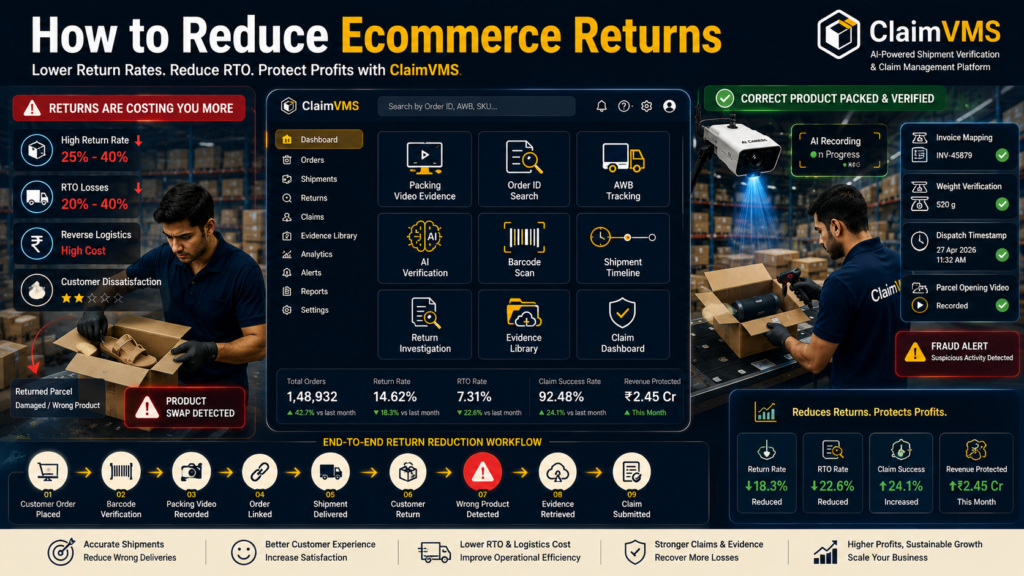
How to Reduce Ecommerce Returns is one of the biggest challenges for Amazon sellers, Flipkart sellers, D2C brands, and online retailers in India. As ecommerce continues to grow, businesses must reduce return rates, improve warehouse accuracy, strengthen shipment verification, and protect profit margins. In this guide, you’ll learn how to reduce ecommerce returns using proven operational strategies and discover how ClaimVMS helps businesses reduce return losses through AI-powered packing video evidence and claim management.
Returns are an unavoidable part of running an ecommerce business.
Whether you sell on Amazon, Flipkart, AJIO, Myntra, Meesho, Shopify, WooCommerce, or your own D2C website, every returned order impacts more than just revenue. It affects inventory, logistics, warehouse productivity, customer service, and overall profitability.
Many sellers believe that reducing returns simply means improving product images or writing better descriptions.
While these steps are important, they only address part of the problem.
Successful ecommerce businesses focus on two equally important goals:
- Reducing unnecessary returns before they happen.
- Minimizing financial losses when returns cannot be avoided.
A return doesn’t always mean the business has failed.
The real loss occurs when returned products cannot be verified, investigated, or recovered efficiently.
This is where ClaimVMS helps ecommerce businesses move beyond traditional warehouse management.
ClaimVMS is an AI-powered shipment verification and claim management platform that automatically records every packing process, links videos with Order IDs, AWB Numbers, SKUs, Invoices, Packing Operators, and Dispatch Timestamps, and stores everything in a centralized, searchable evidence library.
Instead of manually searching CCTV footage after a dispute occurs, warehouse teams can retrieve complete shipment evidence within seconds.
In this guide, we’ll explore practical strategies for reducing ecommerce returns, improving warehouse operations, lowering Return-to-Origin (RTO) rates, strengthening shipment verification, and protecting profit margins as your business scales.
Why Ecommerce Returns Cost More Than Most Sellers Realize
Most sellers measure returns by the number of products coming back.
However, the actual cost extends far beyond the refunded order.
Every returned shipment can involve:
- Reverse logistics
- Courier charges
- Warehouse handling
- Quality inspection
- Repackaging
- Inventory adjustments
- Customer support
- Administrative work
- Marketplace claim processing
- Delayed inventory availability
These operational expenses gradually reduce profit margins, especially for businesses processing hundreds or thousands of orders every day.
Reducing return-related costs requires both preventive measures and efficient operational systems.
Understanding the Different Types of Ecommerce Returns
Not every return occurs for the same reason.
Understanding why products come back helps businesses identify which problems can be prevented.
Common return categories include:
- Incorrect product ordered
- Size or fit issues
- Product damaged during transit
- Customer changed their mind
- Delivery refused
- Cash on Delivery (COD) cancellation
- Wrong product received
- Product swap
- Empty box return
- Missing accessories
Each category requires a different operational response.
Expectation Mismatch Is One of the Biggest Return Drivers
Many returns occur because customers receive something different from what they expected.
This usually happens when product listings contain:
- Inaccurate images
- Incomplete specifications
- Poor lighting
- Missing dimensions
- Generic descriptions
- Unclear sizing information
Customers make purchasing decisions based on the information available.
The more accurate the listing, the lower the likelihood of unnecessary returns.
Create Product Listings That Set Accurate Expectations
Every product page should answer the questions customers commonly ask before purchasing.
Include:
- High-resolution images
- Multiple viewing angles
- Product videos
- Dimensions
- Material details
- Weight
- Compatibility information
- Package contents
- Care instructions
Providing complete information helps customers make informed buying decisions.
Use Customer Reviews to Reduce Purchase Uncertainty
Authentic customer reviews provide valuable social proof.
Photo and video reviews help future buyers understand:
- Actual product appearance
- Real-world sizing
- Color accuracy
- Product quality
- Packaging
Businesses should encourage verified customers to share detailed reviews because they often reduce hesitation and improve purchase confidence.
Reduce Size-Related Returns
Sizing remains one of the largest causes of returns, particularly in fashion and footwear.
Instead of relying only on standard sizes like:
- Small
- Medium
- Large
- XL
provide detailed measurement guides including:
- Chest
- Waist
- Length
- Shoulder
- Sleeve
- Foot length
Accurate sizing information helps customers select the correct product before ordering.
Optimize Packaging to Prevent Transit Damage
Some returns result from products arriving damaged rather than defective.
Packaging should be designed for real shipping conditions.
Consider:
- Protective inserts
- Cushioning materials
- Strong cartons
- Waterproof packaging
- Tamper-evident seals
Testing packaging under actual shipping conditions helps identify weaknesses before customers do.
Reduce Return-to-Origin (RTO) Orders
Return-to-Origin (RTO) remains a major challenge, particularly for Cash on Delivery orders.
Common reasons include:
- Customer unavailable
- Delivery refused
- Incorrect address
- Order cancellation
- Fake orders
Reducing RTO requires better order verification before dispatch.
Identify High-Risk Orders Before Shipping
Not every order carries the same operational risk.
Businesses should monitor patterns such as:
- High RTO locations
- Frequent cancellations
- Repeat return behavior
- Unusually large orders
- High-value COD shipments
Identifying these trends allows businesses to apply additional verification where appropriate.
Warehouse Accuracy Is Critical for Return Reduction
Many returns originate inside the warehouse rather than after delivery.
Examples include:
- Wrong SKU picked
- Missing accessories
- Incorrect quantity
- Wrong shipping label
- Packaging errors
Standardized warehouse procedures help reduce these avoidable mistakes.
Barcode Verification Improves Packing Accuracy
Barcode scanning helps warehouse teams verify that the correct product is packed before shipment.
When integrated into the packing workflow, barcode verification reduces:
- Product mix-ups
- SKU errors
- Manual mistakes
- Dispatch inaccuracies
This additional verification step supports consistent order accuracy.
How ClaimVMS Improves Shipment Accuracy
ClaimVMS transforms traditional warehouse operations into an intelligent shipment verification system.
For every dispatched order, the platform automatically records and organizes:
- Packing Video
- Order ID
- AWB Number
- Invoice
- SKU
- Packing Operator
- Dispatch Timestamp
- Shipment Timeline
Instead of relying on manual documentation, every shipment automatically creates a structured evidence record.
The Value of AI-Powered Packing Videos
Packing videos provide much more than warehouse surveillance.
A typical ClaimVMS recording captures:
- Product selection
- Barcode verification
- Product condition
- Accessories included
- Packaging process
- Parcel sealing
- Shipping label application
Because every recording is linked directly to the shipment, evidence retrieval becomes fast and accurate.
Real-World Scenario
Imagine a growing D2C electronics brand shipping 2,000 orders per day.
Initially, the warehouse relies on manual documentation and standard CCTV.
As order volume increases, the business begins experiencing:
- More customer disputes
- Higher return rates
- Longer investigation times
- Increased marketplace claims
- Greater operational pressure
After implementing ClaimVMS, every shipment automatically receives structured documentation linked to the Order ID and AWB Number.
Instead of manually reviewing warehouse footage, the operations team retrieves shipment evidence within seconds, significantly improving warehouse productivity and investigation readiness.
Reducing Returns Starts with Better Warehouse Processes
Customer experience is important.
Product quality is important.
Accurate listings are important.
However, sustainable return reduction also depends on warehouse operations.
Businesses that invest in:
- Shipment verification
- Barcode validation
- Packing video documentation
- Standardized workflows
- Warehouse analytics
are better equipped to reduce avoidable returns while improving operational efficiency.
Reducing Return Losses Even When Returns Cannot Be Prevented
Not every ecommerce return can be avoided.
Customers may receive damaged products, change their minds, order the wrong size, or request a replacement for genuine reasons.
Instead of trying to eliminate all returns, successful ecommerce businesses focus on reducing the financial impact of each return.
This means having systems that can quickly answer important questions such as:
- Was the correct product packed?
- Were all accessories included?
- Was the parcel sealed correctly?
- Was the shipment dispatched in good condition?
- Can the warehouse retrieve evidence immediately?
When these questions can be answered quickly, return investigations become faster and more organized.
Why Shipment Verification Has Become Essential
As ecommerce order volumes continue to grow, marketplaces expect sellers to maintain accurate shipment records.
When disputes occur, businesses may need to verify:
- Order ID
- AWB Number
- Invoice
- SKU
- Dispatch Timestamp
- Product Condition
- Packaging Process
Without organized documentation, investigations often take longer and consume valuable warehouse resources.
Shipment verification should become part of every dispatch—not only after a dispute occurs.
Building an Order-Linked Evidence System
Many businesses still rely on:
- CCTV recordings
- Excel sheets
- Shared folders
- Manual file naming
- Email attachments
Although these methods work for small operations, they become increasingly difficult to manage as order volumes grow.
A scalable warehouse requires an evidence system where every shipment is automatically linked with:
- Order ID
- AWB Number
- Invoice
- Barcode
- Packing Video
- Dispatch Details
This allows warehouse teams to retrieve shipment history instantly instead of searching through multiple systems.
How ClaimVMS Helps Reduce Return Losses
ClaimVMS was built specifically for ecommerce fulfillment operations.
Instead of simply recording warehouse activity, it creates structured shipment documentation for every order.
Each shipment automatically includes:
- Packing Video
- Order ID
- AWB Number
- SKU
- Invoice
- Dispatch Timestamp
- Packing Operator
- Shipment Timeline
This information is stored securely and remains searchable whenever verification is required.
Instant Evidence Retrieval Saves Valuable Time
Imagine a customer reports that the wrong product was delivered.
Without a structured system, warehouse staff might spend hours reviewing CCTV footage, searching emails, checking courier portals, and locating invoices.
With ClaimVMS, they simply enter:
- Order ID
or
- AWB Number
Within seconds, they can access:
- Original Packing Video
- Barcode Verification
- Invoice
- Shipment Details
- Dispatch Timestamp
- Product Verification
- Packing Operator Details
The investigation begins immediately instead of after hours of searching.
Why Marketplace Claims Often Become Difficult
Marketplaces handle thousands of customer claims every day.
Investigations are generally based on documented shipment evidence rather than verbal explanations.
Sellers often struggle because:
- Packing videos are unavailable
- Files are difficult to locate
- Shipment records are incomplete
- Documentation is inconsistent
- Evidence submission is delayed
Preparing documentation before disputes occur improves operational readiness.
Warehouse Documentation Should Be Standardized
As businesses scale, every warehouse should follow a consistent documentation process.
An effective workflow includes:
- Barcode scanning
- Product verification
- Packing video recording
- Parcel sealing
- Shipping label confirmation
- Order ID mapping
- AWB Number mapping
- Cloud storage
Standardization improves both operational efficiency and shipment traceability.
Warehouse KPIs Every Ecommerce Business Should Monitor
Improving return performance requires measurable data.
Important warehouse KPIs include:
- Order Accuracy Rate
- Return Percentage
- Return-to-Origin (RTO) Rate
- Wrong Item Dispatch Rate
- Shipment Verification Coverage
- Packing Video Coverage
- Claim Approval Rate
- Evidence Retrieval Time
- Customer Complaint Rate
- Warehouse Productivity
- Reverse Logistics Cost
- Average Investigation Time
Monitoring these metrics helps identify operational issues before they affect profitability.
How AI Improves Warehouse Operations
Artificial Intelligence is becoming increasingly valuable in ecommerce fulfillment.
Modern warehouse systems help businesses:
- Automate documentation
- Improve shipment visibility
- Reduce manual searching
- Organize evidence
- Track operational performance
- Improve investigation speed
ClaimVMS combines AI-powered shipment verification with centralized evidence management, helping warehouse teams spend less time searching and more time improving operations.
How ClaimVMS Supports Different Ecommerce Platforms
ClaimVMS is designed for businesses selling through multiple sales channels.
It supports operations for:
- Amazon Sellers
- Flipkart Sellers
- AJIO Sellers
- Myntra Sellers
- Meesho Sellers
- Shopify Stores
- WooCommerce Stores
- D2C Brands
- Fulfillment Centers
- Third-Party Logistics Providers (3PL)
Whether businesses ship 100 orders or 20,000 orders per day, the platform provides structured shipment verification.
Benefits of Using ClaimVMS
Businesses implementing ClaimVMS benefit from:
✔ AI-powered packing video recording
✔ Automatic Order ID mapping
✔ AWB Number integration
✔ Barcode verification
✔ Invoice linking
✔ Shipment Timeline
✔ Cloud-based evidence storage
✔ Centralized warehouse documentation
✔ Faster shipment verification
✔ Reduced manual CCTV searches
✔ Better operational transparency
✔ Simplified marketplace claim preparation
✔ Improved warehouse productivity
✔ Faster investigation response
Best Practices to Reduce Ecommerce Returns
Although returns cannot always be eliminated, businesses can significantly reduce avoidable losses by following consistent operational practices.
Recommended best practices include:
- Use detailed product descriptions.
- Upload high-quality product images.
- Provide accurate size guides.
- Verify customer addresses.
- Confirm high-risk COD orders.
- Scan every product barcode.
- Record every packing process.
- Verify accessories before sealing.
- Maintain centralized shipment records.
- Audit warehouse documentation regularly.
- Monitor return trends monthly.
- Review customer feedback.
- Improve packaging quality.
- Standardize warehouse workflows.
- Train warehouse staff consistently.
Small improvements across the fulfillment process can create substantial long-term savings.
Preparing Your Business for Future Ecommerce Growth
India’s ecommerce industry continues to expand rapidly.
As order volumes increase, businesses will face:
- More returns
- More customer inquiries
- More marketplace investigations
- More operational complexity
The companies that succeed over the next decade will not simply process more orders.
They will build smarter warehouse systems capable of managing growth efficiently.
Operational intelligence will become a competitive advantage.
Conclusion
Reducing ecommerce returns is about much more than lowering return percentages.
It requires improving the entire fulfillment process—from product listings and packaging to warehouse operations, shipment verification, and evidence management.
While some returns are unavoidable, businesses can significantly reduce operational losses by implementing structured documentation and standardized warehouse workflows.
ClaimVMS helps ecommerce sellers achieve this by automatically recording every packing process, linking each shipment with Order IDs, AWB numbers, invoices, SKUs, and dispatch timestamps, and storing everything in a centralized, searchable platform.
Instead of spending valuable time searching for evidence after disputes arise, warehouse teams can retrieve complete shipment records within seconds, improve investigation efficiency, strengthen marketplace claim preparation, and protect profit margins as their business grows.
As ecommerce continues evolving, businesses that invest in AI-powered shipment verification and intelligent warehouse documentation today will be better positioned to scale confidently tomorrow.
Frequently Asked Questions (FAQs)
1. What is the best way to reduce ecommerce returns?
Reducing returns starts with accurate product listings, quality packaging, proper sizing information, efficient warehouse operations, and reliable shipment verification systems.
2. Why do ecommerce customers return products?
Common reasons include incorrect expectations, size issues, damaged deliveries, wrong products, Cash on Delivery refusals, customer preference changes, and genuine product defects.
3. How does ClaimVMS help reduce return losses?
ClaimVMS records packing videos, links them with Order IDs, AWB numbers, invoices, SKUs, and dispatch timestamps, allowing businesses to retrieve shipment evidence instantly during investigations.
4. Can ClaimVMS reduce Return-to-Origin (RTO) losses?
While RTO depends on multiple operational factors, ClaimVMS improves shipment documentation, warehouse visibility, and order verification, helping businesses manage return-related investigations more efficiently.
5. Why are packing videos important?
Packing videos document product verification, barcode scanning, accessories, packaging, parcel sealing, and shipping labels before dispatch, creating reliable shipment evidence.
6. Can ClaimVMS work with existing warehouse CCTV systems?
Yes. ClaimVMS integrates with most existing CCTV infrastructure while transforming standard recordings into searchable, order-linked shipment documentation.
7. Which ecommerce platforms can use ClaimVMS?
ClaimVMS supports sellers operating on Amazon, Flipkart, AJIO, Myntra, Meesho, Shopify, WooCommerce, and other ecommerce platforms.
8. What warehouse KPIs should ecommerce businesses monitor?
Important KPIs include order accuracy, return percentage, RTO rate, packing video coverage, shipment verification rate, evidence retrieval time, warehouse productivity, and claim approval rate.
9. How quickly can shipment evidence be retrieved?
Users simply search by Order ID or AWB number, and ClaimVMS retrieves the associated packing video, invoice, shipment details, and dispatch history within seconds.
10. What is the biggest advantage of ClaimVMS?
The biggest benefit is having complete, order-linked shipment evidence—including packing videos, Order IDs, AWB numbers, invoices, and dispatch history—available instantly whenever investigations or marketplace claims arise.