
Online shopping has transformed the way millions of Indians purchase products.
From electronics and fashion to groceries and home essentials, ecommerce platforms have made shopping faster, easier, and more convenient than ever before.
However, as online shopping continues to grow, so do ecommerce frauds.
Today, buyers may encounter problems such as:
- Fake shopping websites
- Payment fraud
- Non-delivery of products
- Counterfeit products
- Wrong item deliveries
- Refund delays
- UPI scams
- Social media shopping scams
At the same time, sellers face a different kind of fraud.
Every day, ecommerce businesses lose money due to:
- Empty box returns
- Product swap fraud
- Wrong item returns
- Return abuse
- Fake “item missing” claims
- False damage claims
- Courier disputes
While government agencies provide several ways for buyers to report online shopping fraud, sellers often have to rely on their own operational systems to investigate fraudulent returns and protect their revenue.
This is where ClaimVMS plays an important role.
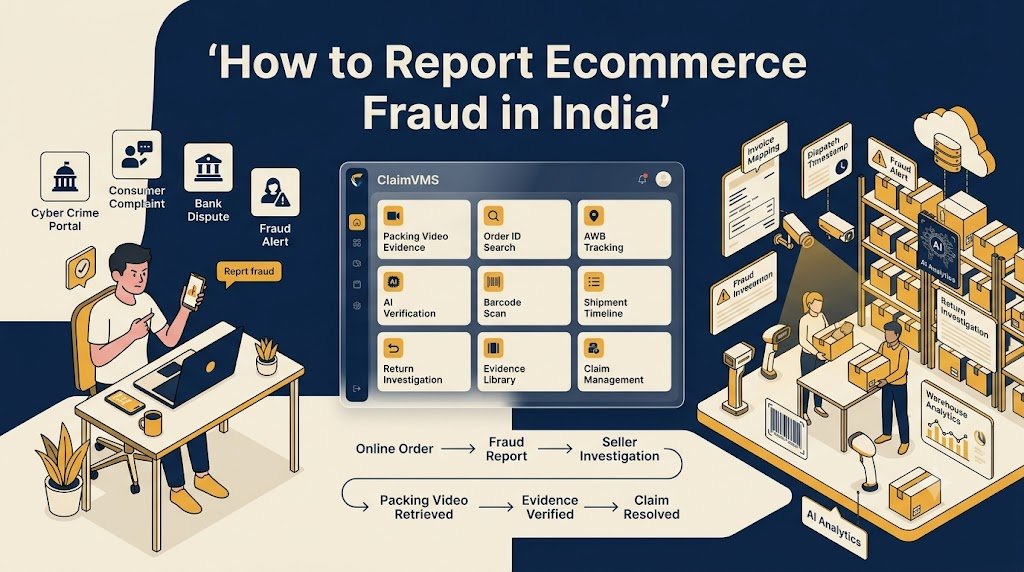
ClaimVMS is an AI-powered shipment verification and claim management platform that automatically records every packing process, links every recording with the Order ID, AWB Number, SKU, Invoice, Packing Operator, and Dispatch Timestamp, and stores everything in a centralized, searchable evidence platform.
Instead of manually searching CCTV footage after a dispute occurs, warehouse teams can retrieve complete shipment evidence within seconds.
In this guide, you’ll learn how buyers can report ecommerce fraud in India, which government channels to use, and how sellers can protect themselves from fraudulent returns using structured shipment verification.
What Is Ecommerce Fraud?
Ecommerce fraud refers to any deceptive activity that results in financial loss during an online shopping transaction.
Fraud can affect both:
- Online buyers
- Ecommerce sellers
Although both groups experience different challenges, each requires accurate documentation and timely action.
Common Types of Ecommerce Fraud Affecting Buyers
Indian online shoppers commonly experience:
- Fake ecommerce websites
- Payment fraud
- Product not delivered
- Counterfeit products
- Wrong product received
- Refund fraud
- UPI payment scams
- Social media shopping scams
Most of these cases involve financial transactions that should be reported immediately.
Common Types of Ecommerce Fraud Affecting Sellers
While buyers often receive attention, sellers increasingly face operational fraud that can significantly affect profitability.
Examples include:
- Empty box returns
- Product swap fraud
- Wrong item returned
- Used products returned as new
- Missing accessories
- False “item not received” claims
- Return abuse
- Courier weight discrepancies
Without structured shipment evidence, investigating these incidents becomes considerably more difficult.
Recognizing the Warning Signs of Online Shopping Fraud
Whether you are a buyer or seller, certain warning signs should never be ignored.
Examples include:
- Unrealistically low prices
- Unknown websites
- Requests for advance payment
- No customer support information
- Poor website design
- No return policy
- Unverified payment links
- Requests to continue conversations outside the platform
Being aware of these indicators helps reduce the likelihood of fraud.
What Buyers Should Do Immediately After Online Shopping Fraud
Time is extremely important after discovering online fraud.
The sooner action is taken, the greater the possibility of protecting funds and preserving evidence.
Recommended immediate actions include:
- Save screenshots
- Record transaction details
- Preserve payment confirmation
- Save order information
- Download invoices
- Avoid deleting communication history
Well-organized evidence improves complaint quality.
Collect Important Information Before Filing a Complaint
Most authorities request similar information.
Prepare:
- Order Number
- Transaction ID
- Payment Amount
- Payment Method
- Seller Details
- Website URL
- Invoice
- Screenshots
- Chat History
- Email Communication
Keeping this information organized helps speed up complaint processing.
Government Channels Available for Buyers
India offers several official channels for reporting ecommerce fraud.
Depending on the nature of the issue, buyers may contact:
- Cybercrime Helpline
- National Cyber Crime Reporting Portal
- National Consumer Helpline
- Local Cyber Crime Police Station
- Bank or Card Issuer
- UPI Payment Provider
Each organization handles different categories of complaints.
Why Acting Quickly Matters
Financial fraud investigations become more effective when reported promptly.
Delays may result in:
- Lost transaction history
- Missing evidence
- Delayed investigations
- Difficulty tracking funds
- Longer resolution timelines
Early reporting increases the likelihood of successful investigation.
How Ecommerce Platforms Handle Customer Disputes
Major ecommerce marketplaces generally provide internal support channels before customers escalate matters externally.
Customers usually have access to:
- Return Requests
- Refund Requests
- Product Replacement
- Customer Support
- Complaint Tracking
- Order History
If disputes remain unresolved, official government complaint channels may be considered.
The Hidden Side of Ecommerce Fraud That Few People Discuss
Most discussions about ecommerce fraud focus on buyers.
However, sellers also experience significant financial losses.
Common examples include:
- Product swapping
- Empty box returns
- Wrong item returns
- False missing product claims
- Return abuse
Unlike buyers, sellers often need detailed shipment evidence to investigate these incidents.
Simply knowing the correct product was shipped is rarely sufficient.
Documentation becomes essential.
Why Traditional CCTV Is No Longer Enough
Many warehouses already use CCTV systems.
Although useful for security, traditional surveillance has limitations during ecommerce investigations.
Common challenges include:
- Continuous recording
- Time-based searching
- No Order ID mapping
- No AWB linkage
- Manual retrieval
- Large video archives
Finding one shipment among several days of footage can consume valuable warehouse time.
How ClaimVMS Helps Ecommerce Sellers
ClaimVMS converts ordinary warehouse recordings into structured shipment evidence.
Every shipment is automatically linked with:
- Order ID
- AWB Number
- Invoice
- SKU
- Packing Operator
- Dispatch Timestamp
- Packing Video
- Shipment Timeline
Instead of manually reviewing CCTV footage, warehouse teams retrieve evidence simply by searching the Order ID or AWB Number.
The Importance of Order-Linked Packing Videos
Packing videos create a visual record of every shipment before dispatch.
A typical ClaimVMS recording captures:
- Product Selection
- Barcode Verification
- Product Condition
- Accessories Included
- Packaging Process
- Parcel Sealing
- Shipping Label Application
This documentation becomes valuable whenever shipment verification is required.
Real-World Example
Imagine an online electronics seller dispatches a premium wireless headset.
Several days later, the customer returns an inexpensive damaged headset from another manufacturer.
Without structured documentation, warehouse staff may need to review hours of CCTV footage.
Using ClaimVMS, they simply search the Order ID.
Within seconds they retrieve:
- Original Packing Video
- Barcode Verification
- Invoice
- Dispatch Timestamp
- Shipment Timeline
- Parcel Sealing Video
This allows the business to investigate the shipment far more efficiently.
Building Fraud-Resistant Ecommerce Operations
Both buyers and sellers benefit from organized documentation.
For sellers, fraud prevention increasingly depends on:
- AI-powered shipment verification
- Packing video evidence
- Order-linked documentation
- Barcode verification
- Warehouse analytics
- Centralized evidence management
Building these systems before disputes occur significantly improves operational readiness.
Step-by-Step Guide to Reporting Ecommerce Fraud in India
If you believe you’ve been cheated while shopping online, acting quickly can improve the chances of resolving the issue.
A structured approach helps preserve evidence and ensures your complaint reaches the appropriate authority.
The following steps provide a practical workflow for buyers.
Step 1: Contact the Seller or Ecommerce Platform
Before escalating the issue, contact the seller or marketplace through their official support channel.
Provide:
- Order ID
- Invoice
- Product photographs
- Screenshots
- Description of the issue
Many disputes involving damaged products, delayed deliveries, or incorrect items can often be resolved directly through the platform.
Keep copies of every communication for future reference.
Step 2: Preserve All Digital Evidence
Strong documentation improves complaint quality.
Save:
- Order confirmation
- Payment receipt
- Invoice
- Product listing
- Seller profile
- Delivery confirmation
- Chat conversations
- Emails
- Call records (if available)
- Photos and videos
Never delete evidence until the matter has been fully resolved.
Step 3: Contact Your Bank or Payment Provider
If the issue involves an unauthorized payment or suspected payment fraud, contact your:
- Bank
- Credit Card Provider
- Debit Card Issuer
- UPI Provider
- Digital Wallet
Request guidance regarding transaction disputes and available resolution procedures.
Prompt reporting may improve the likelihood of recovering funds, depending on the circumstances and applicable banking policies.
Step 4: File a Complaint Through Official Government Channels
If the seller or platform does not resolve the matter, buyers can submit complaints through official consumer and cybercrime channels.
Depending on the nature of the fraud, authorities may request:
- Order Number
- Transaction ID
- Payment Details
- Screenshots
- Product Information
- Communication History
Providing complete documentation generally helps investigators understand the issue more efficiently.
Step 5: Follow Up Regularly
After submitting a complaint:
- Save your complaint reference number.
- Record all follow-up communications.
- Respond promptly to additional information requests.
- Keep copies of updated evidence.
Maintaining organized records simplifies future correspondence.
Common Online Shopping Frauds Buyers Should Know
Fraud continues evolving as ecommerce grows.
Some of the most common frauds include:
Fake Ecommerce Websites
Fraudsters create websites that closely resemble legitimate brands.
Customers place orders and make payments but never receive the products.
Always verify:
- HTTPS security
- Company details
- Customer reviews
- Contact information
before purchasing.
Counterfeit Product Delivery**
Customers order genuine branded products but receive:
- Fake products
- Low-quality copies
- Different brands
Carefully compare the received product with the original listing.
Wrong Product Delivered
Sometimes customers receive:
- Different color
- Different size
- Different model
- Completely unrelated product
Photograph the parcel before opening whenever possible.
Refund Fraud
Some buyers return products successfully but experience delays receiving refunds.
Maintain:
- Return tracking number
- Courier receipt
- Refund confirmation emails
These records become useful if further escalation is required.
UPI and Payment Fraud
Fraudsters increasingly misuse:
- QR codes
- Payment requests
- Fake refund links
- Screen-sharing applications
Never approve payment requests unless you clearly understand the transaction.
Social Media Shopping Fraud
Purchasing through social media platforms can involve additional risks.
Warning signs include:
- No company website
- No GST details
- No customer support
- Payment requested through personal accounts
- Unrealistic discounts
Always verify seller authenticity before making payment.
The Growing Challenge for Ecommerce Sellers
While buyers receive protection through consumer complaint systems, sellers face an entirely different challenge.
Return fraud has become one of the fastest-growing operational risks in ecommerce.
Common examples include:
- Product swap fraud
- Empty box returns
- Wrong item returns
- Used product returns
- Missing accessories
- False “item not received” claims
- Courier disputes
Without shipment evidence, businesses often struggle to investigate these incidents effectively.
Why Sellers Need Structured Shipment Verification
Traditional warehouse documentation typically includes:
- CCTV footage
- Invoices
- Courier records
- Manual logs
As order volumes increase, retrieving information from multiple systems becomes increasingly difficult.
Modern ecommerce operations require structured shipment verification.
How ClaimVMS Helps Protect Ecommerce Sellers
ClaimVMS is designed specifically for ecommerce fulfillment operations.
Instead of simply recording warehouse activity, it creates structured shipment documentation for every order.
Each shipment automatically includes:
- Packing Video
- Order ID
- AWB Number
- SKU
- Invoice
- Dispatch Timestamp
- Packing Operator
- Shipment Timeline
Everything remains searchable whenever shipment verification becomes necessary.
Instant Evidence Retrieval
Rather than manually reviewing CCTV footage, warehouse teams simply search:
- Order ID
or
- AWB Number
ClaimVMS immediately retrieves:
- Packing Video
- Barcode Verification
- Shipment History
- Invoice
- Dispatch Timestamp
- Product Verification
This significantly reduces investigation time.
Benefits of AI-Powered Shipment Documentation
Businesses using ClaimVMS benefit from:
✔ AI-powered packing video recording
✔ Automatic Order ID mapping
✔ AWB Number integration
✔ Barcode verification
✔ Invoice linking
✔ Shipment Timeline
✔ Centralized evidence management
✔ Cloud-based storage
✔ Faster investigations
✔ Improved warehouse transparency
✔ Better operational control
✔ Marketplace-ready documentation
Who Can Benefit from ClaimVMS?
ClaimVMS supports businesses selling through:
- Amazon
- Flipkart
- AJIO
- Myntra
- Meesho
- Shopify
- WooCommerce
- D2C Websites
It is also suitable for:
- Warehouse Managers
- Fulfillment Centers
- Third-Party Logistics Providers (3PL)
- Ecommerce Operations Teams
Whether processing hundreds or thousands of daily shipments, structured documentation improves operational efficiency.
Best Practices for Buyers
To reduce the risk of online shopping fraud:
- Purchase from trusted sellers.
- Verify website authenticity.
- Read customer reviews.
- Keep invoices.
- Save payment confirmations.
- Avoid suspicious payment requests.
- Monitor bank transactions.
- Preserve screenshots.
- Report fraud promptly.
- Never share OTPs or banking credentials.
Best Practices for Ecommerce Sellers
Businesses should establish standardized warehouse procedures.
Recommended practices include:
- Record every packing process.
- Scan every barcode.
- Verify accessories before sealing.
- Link videos with Order IDs.
- Store evidence centrally.
- Train warehouse staff regularly.
- Review fraud trends monthly.
- Audit warehouse operations.
- Maintain shipment history.
- Standardize investigation procedures.
These operational improvements help businesses prepare for future disputes.
Conclusion
Ecommerce fraud affects both buyers and sellers, but each group faces different challenges.
Buyers should report suspicious transactions promptly, preserve evidence, and use official complaint channels whenever necessary.
Sellers, meanwhile, must focus on preventing revenue loss through better operational systems rather than reacting after disputes arise.
ClaimVMS helps businesses achieve this by automatically recording every packing process, linking shipment videos with Order IDs, AWB numbers, invoices, SKUs, and dispatch timestamps, and organizing everything within a centralized evidence platform.
Instead of spending hours searching warehouse recordings, businesses can retrieve shipment evidence within seconds, improve investigation efficiency, strengthen marketplace claim preparation, and build more resilient ecommerce operations.
As ecommerce continues growing across India, businesses that invest in structured shipment verification today will be better prepared to protect both their customers and their revenue tomorrow.
Frequently Asked Questions (FAQs)
1. How can I report ecommerce fraud in India?
You should first contact the ecommerce platform or seller, preserve all evidence, notify your bank if payment fraud is involved, and file complaints through the appropriate official consumer or cybercrime channels.
2. What evidence should I collect before reporting online shopping fraud?
Keep your Order ID, invoice, payment receipt, screenshots, product photographs, emails, chat history, courier details, and any communication with the seller.
3. What types of ecommerce fraud are most common?
Common frauds include fake shopping websites, counterfeit products, wrong item deliveries, payment fraud, refund fraud, product swap fraud, and empty box returns.
4. How does ClaimVMS help ecommerce sellers?
ClaimVMS automatically records packing videos and links them with Order IDs, AWB numbers, invoices, SKUs, and dispatch timestamps, enabling businesses to retrieve shipment evidence quickly during investigations.
5. Can ClaimVMS work with existing warehouse CCTV systems?
Yes. ClaimVMS integrates with existing CCTV infrastructure while transforming ordinary recordings into searchable, order-linked shipment documentation.
6. Which ecommerce platforms can use ClaimVMS?
ClaimVMS supports Amazon, Flipkart, AJIO, Myntra, Meesho, Shopify, WooCommerce, D2C brands, fulfillment centers, and third-party logistics providers.
7. Why are packing videos important for sellers?
Packing videos document product verification, barcode scanning, packaging, parcel sealing, shipping labels, and dispatch details, creating valuable shipment evidence.
8. How quickly can shipment evidence be retrieved?
Warehouse teams simply search using the Order ID or AWB number, and ClaimVMS retrieves the associated packing video and shipment records within seconds.
9. Can ClaimVMS help reduce return fraud losses?
Yes. By maintaining structured shipment documentation and searchable evidence, ClaimVMS helps businesses investigate return-related disputes more efficiently and improve claim preparation.
10. Why is structured shipment documentation important?
Structured documentation improves warehouse accountability, accelerates investigations, simplifies evidence retrieval, and helps businesses manage ecommerce disputes more effectively.