
Every ecommerce seller has experienced that frustrating moment.
Your warehouse team carefully packs the correct product, verifies the barcode, seals the parcel, hands it over to the courier, and the shipment is successfully delivered.
A few days later, a dispute appears.
The customer claims:
- Wrong product received
- Item missing
- Empty box delivered
- Damaged product received
- Missing accessories
- Package not delivered
Without proper shipment evidence, proving what actually left your warehouse becomes extremely difficult.
As ecommerce continues growing across India, marketplaces increasingly expect sellers to provide structured evidence during investigations. Generic CCTV footage, invoices, and manual warehouse records often fail to provide the level of documentation required for efficient claim resolution.
This is where a VMS for Ecommerce becomes essential.
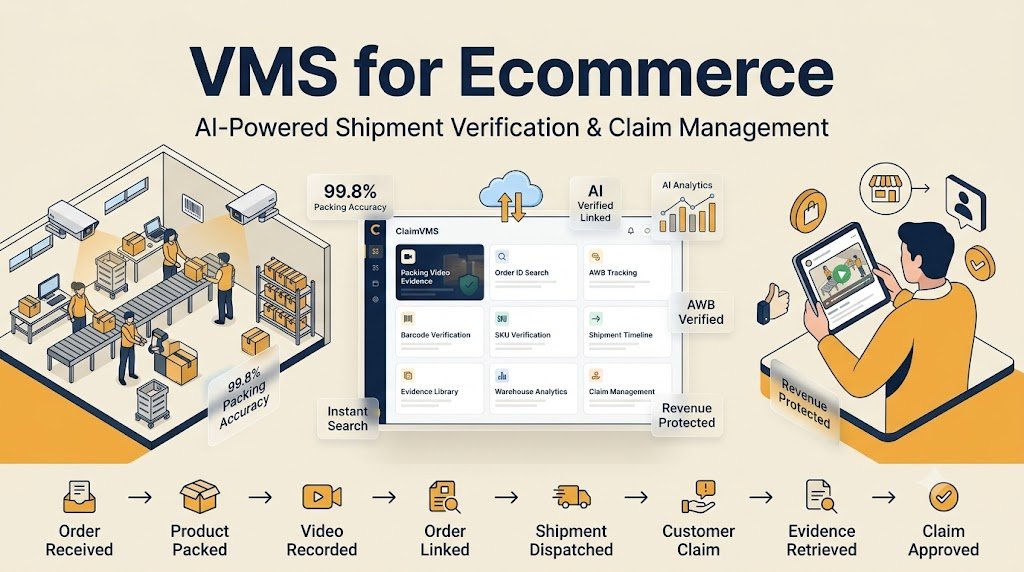
A Video Management System (VMS) designed specifically for ecommerce operations does much more than record warehouse activity.
It automatically links every packing video with the Order ID, AWB Number, SKU, Invoice, Packing Operator, and Dispatch Timestamp, creating a complete shipment history for every dispatched order.
ClaimVMS is an AI-powered Shipment Verification and Claim Management Platform built specifically for Indian ecommerce sellers.
Instead of manually searching warehouse CCTV footage, businesses can retrieve shipment evidence within seconds using a simple Order ID or AWB search.
In this guide, you’ll learn what a VMS for ecommerce is, why traditional CCTV is no longer sufficient, and how ClaimVMS helps ecommerce businesses improve shipment verification, reduce return fraud losses, and strengthen marketplace claim preparation.
What Is a VMS for Ecommerce?
A VMS (Video Management System) for ecommerce is specialized software that records, organizes, and manages shipment evidence during the packing process.
Unlike ordinary CCTV systems that simply record continuous footage, an ecommerce VMS creates structured documentation for every shipment.
Each order automatically receives:
- Packing Video
- Order ID
- AWB Number
- SKU
- Invoice
- Dispatch Timestamp
- Packing Operator
- Shipment Timeline
This information remains searchable whenever shipment verification becomes necessary.
Why Ecommerce Sellers Need More Than Traditional CCTV
Many warehouses already use CCTV cameras.
Although useful for security monitoring, standard surveillance systems were never designed for ecommerce claim investigations.
Typical limitations include:
- Continuous recording
- Time-based searching
- No Order ID mapping
- No AWB linkage
- No SKU verification
- Manual video retrieval
- Large video archives
Searching several hours of footage to locate one shipment wastes valuable warehouse time.
How a Modern Ecommerce VMS Works
An ecommerce VMS automates shipment documentation from the moment packing begins.
Instead of recording random warehouse activity, it creates shipment-specific evidence linked directly to operational data.
Typical workflow:
Customer Order
↓
Product Picking
↓
Barcode Verification
↓
Packing Video Recording
↓
Order ID Mapping
↓
AWB Number Linking
↓
Parcel Sealing
↓
Dispatch Verification
↓
Cloud Evidence Storage
Every shipment now has a complete digital history.
Why Shipment Verification Is Becoming More Important
As order volumes increase, so do:
- Customer disputes
- Wrong item claims
- Return fraud
- Product swap cases
- Empty box allegations
- Courier investigations
Marketplaces increasingly expect sellers to produce clear shipment documentation during claim investigations.
Having searchable shipment records improves investigation readiness and operational efficiency.
Common Ecommerce Disputes Faced by Sellers
Indian ecommerce businesses frequently investigate:
- Wrong item returned
- Product swap fraud
- Empty box returns
- Missing accessories
- False “item not received” claims
- Damaged product disputes
- Courier weight discrepancies
- Incorrect shipment claims
Each investigation becomes easier when complete shipment evidence is already available.
Why Generic CCTV Footage Often Isn’t Enough
Traditional CCTV records everything happening inside a warehouse.
However, when investigating one specific shipment, businesses usually need:
- Exact Order ID
- Exact AWB Number
- Correct SKU
- Packing process
- Parcel sealing
- Shipping label
- Dispatch Timestamp
Locating these details manually within hours of continuous recording can become extremely time-consuming.
How ClaimVMS Is Different
ClaimVMS was designed specifically for ecommerce fulfillment operations.
Instead of treating videos as surveillance footage, ClaimVMS transforms every shipment into structured operational evidence.
Every dispatched order automatically includes:
- Packing Video
- Order ID
- AWB Number
- SKU
- Invoice
- Dispatch Timestamp
- Packing Operator
- Shipment Timeline
Everything is securely organized inside a centralized cloud platform.
Automatic Order ID Mapping
One of the biggest advantages of ClaimVMS is automatic Order ID mapping.
Instead of manually naming video files, every recording is automatically connected with the shipment.
Warehouse teams no longer need to remember:
- Recording time
- Camera number
- Warehouse location
- File name
Searching by Order ID immediately retrieves the correct shipment.
AWB Number Integration
Every shipment is also linked with its Air Waybill (AWB).
This allows businesses to retrieve shipment documentation using either:
- Order ID
or
- AWB Number
This flexibility significantly improves warehouse investigations.
Barcode Verification Improves Packing Accuracy
ClaimVMS supports barcode-based shipment verification during packing.
Warehouse operators verify:
- Product SKU
- Quantity
- Variant
- Product Identity
before dispatch.
This additional verification reduces operational mistakes while improving shipment accuracy.
Cloud-Based Evidence Management
Rather than storing videos across multiple hard drives or DVR systems, ClaimVMS maintains centralized cloud storage.
Benefits include:
- Secure storage
- Fast searching
- Organized documentation
- Easy retrieval
- Long-term retention
- Centralized access
Warehouse teams can locate shipment evidence from anywhere.
Real-World Example
Imagine an electronics seller dispatches a premium smartwatch.
Three days later, the customer claims the wrong product was delivered.
Without ClaimVMS:
Warehouse staff spend hours reviewing CCTV footage, invoices, courier logs, and warehouse records.
With ClaimVMS:
They search:
- Order ID
Within seconds, the platform retrieves:
- Packing Video
- Barcode Verification
- Invoice
- SKU
- Parcel Sealing
- Dispatch Timestamp
- Shipment Timeline
Instead of relying on assumptions, the business has complete shipment documentation ready for investigation.
How ClaimVMS Improves Warehouse Operations
ClaimVMS helps warehouses move beyond traditional surveillance.
The platform improves:
- Shipment verification
- Packing accuracy
- Warehouse transparency
- Documentation quality
- Investigation readiness
- Evidence retrieval
- Operational accountability
- Return management
- Claim preparation
- Warehouse productivity
These improvements support both operational efficiency and customer trust.
Benefits of Implementing a VMS for Ecommerce
Businesses using a dedicated ecommerce VMS typically experience:
- Faster shipment verification
- Reduced manual CCTV searching
- Better warehouse documentation
- Improved shipment traceability
- Centralized evidence management
- Better internal audits
- Faster dispute investigations
- Improved warehouse accountability
- Stronger marketplace claim preparation
- Greater operational visibility
How ClaimVMS Helps Sellers Win Marketplace Claims
Winning a marketplace claim depends on one critical factor—verifiable shipment evidence.
When a dispute is raised, marketplaces typically evaluate:
- What product was packed
- Whether the correct SKU was shipped
- If the parcel was properly sealed
- Whether the shipping label matched the order
- When the shipment left the warehouse
Without structured documentation, proving these details becomes difficult.
ClaimVMS automatically creates a complete shipment record before the parcel leaves the warehouse, allowing businesses to retrieve evidence quickly whenever a dispute occurs.
Supporting Major Ecommerce Marketplaces
Indian ecommerce sellers often operate across multiple marketplaces, each with different dispute procedures and evidence requirements.
ClaimVMS is designed to support warehouse operations across:
- Amazon
- Flipkart
- AJIO
- Myntra
- Meesho
- Shopify
- WooCommerce
- D2C Websites
Instead of maintaining different documentation systems for each platform, ClaimVMS centralizes shipment verification into one unified solution.
How ClaimVMS Improves Amazon Seller Operations
Amazon sellers frequently encounter disputes involving:
- Wrong item claims
- Item not received
- Missing accessories
- Product damage
- Return fraud
- Empty box allegations
Using ClaimVMS, warehouse teams can quickly retrieve:
- Packing Video
- Barcode Verification
- Order ID
- AWB Number
- Shipment Timeline
- Dispatch Timestamp
This structured evidence supports faster internal investigations and improves preparedness for marketplace claim submissions.
How ClaimVMS Supports Flipkart Sellers
Flipkart sellers regularly manage:
- Product mismatch claims
- Wrong shipment investigations
- Return verification
- Courier disputes
- Packaging verification
Instead of manually reviewing CCTV footage, ClaimVMS enables warehouse teams to search for the exact shipment using the Order ID or AWB Number.
Supporting AJIO Return Investigations
AJIO sellers often require organized shipment documentation when handling return investigations.
ClaimVMS automatically maintains:
- Order-linked Packing Videos
- Barcode Verification
- Invoice Mapping
- Dispatch History
- Shipment Timeline
- Cloud-Based Evidence Storage
This organized documentation simplifies warehouse investigations whenever evidence is required.
Helping Myntra and Meesho Sellers
Fashion ecommerce generates a large volume of returns involving:
- Size exchanges
- Product substitutions
- Wrong item claims
- Missing accessories
- Return abuse
Structured shipment documentation helps warehouse teams verify exactly what was packed before dispatch.
Why AI Is Replacing Traditional Warehouse CCTV
Traditional CCTV systems focus on security monitoring.
Modern ecommerce warehouses require much more.
AI-powered shipment verification helps businesses:
- Organize shipment evidence automatically
- Reduce manual searches
- Improve warehouse visibility
- Standardize documentation
- Simplify investigations
- Increase operational efficiency
ClaimVMS transforms warehouse recordings into searchable operational intelligence rather than passive surveillance footage.
Key Features of ClaimVMS
ClaimVMS combines shipment verification with intelligent warehouse documentation.
Core features include:
✔ AI-powered Packing Video Recording
✔ Automatic Order ID Mapping
✔ AWB Number Integration
✔ Barcode Verification
✔ SKU Verification
✔ Invoice Linking
✔ Packing Operator Tracking
✔ Dispatch Timestamp Recording
✔ Shipment Timeline
✔ Cloud Evidence Library
✔ Warehouse Analytics
✔ Return Investigation Dashboard
✔ Claim Management Support
✔ Searchable Video Retrieval
✔ Multi-Warehouse Support
✔ Role-Based User Access
✔ Centralized Documentation
Cloud-Based Evidence Library
Every shipment processed through ClaimVMS becomes part of a centralized cloud evidence library.
Warehouse teams can retrieve information using:
- Order ID
- AWB Number
- SKU
- Invoice Number
- Dispatch Date
Evidence is no longer scattered across DVR systems, local hard drives, or manually named folders.
Why Warehouse Accountability Matters
As businesses scale from hundreds to thousands of daily shipments, manual processes become increasingly difficult to manage.
Structured documentation improves:
- Packing consistency
- Employee accountability
- Operational transparency
- Internal audits
- Investigation accuracy
Every shipment follows the same documented process.
Return Fraud Investigations Become Faster
When suspicious returns occur, warehouse teams no longer need to:
- Review hours of CCTV footage
- Search multiple storage devices
- Check handwritten logs
- Compare scattered records
ClaimVMS retrieves complete shipment evidence within seconds.
This significantly reduces investigation time.
Operational Benefits Beyond Marketplace Claims
Although ClaimVMS is widely used for shipment verification, businesses also benefit through improved warehouse operations.
Additional advantages include:
- Better inventory accuracy
- Improved dispatch quality
- Reduced packing errors
- Faster employee training
- Easier warehouse audits
- Improved quality control
- Better compliance documentation
- Enhanced operational reporting
The platform supports overall warehouse efficiency—not just claim investigations.
Return on Investment (ROI) for Ecommerce Businesses
Many sellers initially implement ClaimVMS to improve shipment verification.
However, the benefits extend across multiple operational areas.
Potential savings include:
- Reduced investigation time
- Lower administrative effort
- Improved warehouse productivity
- Better documentation quality
- Fewer manual searches
- Faster evidence retrieval
- Improved operational control
As order volumes grow, these efficiencies become increasingly valuable.
Best Practices for Using a VMS in Ecommerce
To maximize the value of a shipment verification system, businesses should establish standardized warehouse procedures.
Recommended practices include:
- Record every packing process.
- Scan every barcode.
- Verify product variants.
- Confirm accessories before sealing.
- Link every shipment to the Order ID.
- Store evidence centrally.
- Review warehouse performance regularly.
- Audit packing stations monthly.
- Train warehouse operators consistently.
- Monitor investigation metrics.
Consistency strengthens both operations and documentation.
The Future of Ecommerce Warehouse Operations
The future of ecommerce fulfillment extends far beyond CCTV recording.
Modern warehouses increasingly depend on:
- AI-powered verification
- Intelligent documentation
- Warehouse analytics
- Automated evidence management
- Shipment traceability
- Cloud-based operations
- Data-driven decision making
Businesses investing in these systems today will be better prepared for tomorrow’s operational challenges.
Why ClaimVMS Is More Than a Video Management System
ClaimVMS is not simply a Video Management System.
It is a complete AI-powered Shipment Verification and Claim Management Platform that helps ecommerce businesses:
- Verify shipments
- Improve warehouse accuracy
- Organize evidence
- Strengthen investigations
- Improve operational transparency
- Prepare marketplace-ready documentation
Instead of using disconnected tools, businesses manage shipment verification from one centralized platform.
Conclusion
As ecommerce continues growing across India, warehouse operations are becoming more complex and evidence-driven.
Traditional CCTV systems may still provide warehouse security, but they no longer meet the documentation requirements of modern ecommerce operations.
Businesses need structured shipment verification that connects every packing video with Order IDs, AWB numbers, invoices, SKUs, dispatch timestamps, and warehouse activity.
ClaimVMS provides exactly that.
By transforming ordinary warehouse recordings into searchable operational evidence, ClaimVMS helps ecommerce businesses improve shipment verification, strengthen return investigations, increase warehouse efficiency, and prepare better marketplace claim documentation.
Whether you’re shipping hundreds or thousands of orders every day, implementing a purpose-built VMS helps create a more organized, transparent, and scalable fulfillment operation.
Frequently Asked Questions (FAQs)
1. What is a VMS for ecommerce?
A VMS (Video Management System) for ecommerce is software that records packing videos and links them with Order IDs, AWB numbers, SKUs, invoices, and shipment details, making evidence retrieval fast and organized.
2. How is ClaimVMS different from traditional CCTV?
Traditional CCTV records continuous surveillance footage, while ClaimVMS automatically creates order-linked shipment documentation that is searchable by Order ID or AWB Number.
3. Can ClaimVMS work with existing CCTV cameras?
Yes. ClaimVMS integrates with most existing IP cameras and CCTV systems, allowing businesses to enhance their current infrastructure without replacing hardware.
4. Which ecommerce platforms are supported?
ClaimVMS supports Amazon, Flipkart, AJIO, Myntra, Meesho, Shopify, WooCommerce, D2C brands, fulfillment centers, and third-party logistics providers.
5. Why are packing videos important?
Packing videos document product verification, barcode scanning, packaging, parcel sealing, and shipment preparation, creating valuable evidence for warehouse investigations.
6. How quickly can shipment evidence be retrieved?
Warehouse teams simply search using the Order ID or AWB Number, and ClaimVMS retrieves the associated shipment documentation within seconds.
7. Does ClaimVMS support barcode verification?
Yes. Barcode verification helps warehouse operators confirm that the correct SKU, variant, and quantity are packed before dispatch.
8. Can ClaimVMS improve warehouse productivity?
Yes. By reducing manual CCTV searches, centralizing shipment documentation, and simplifying investigations, ClaimVMS improves overall warehouse efficiency.
9. Is ClaimVMS suitable for growing ecommerce businesses?
Absolutely. Whether processing hundreds or thousands of orders daily, ClaimVMS provides scalable shipment verification and centralized warehouse documentation.
10. What is the biggest advantage of ClaimVMS?
The biggest advantage is having complete, searchable shipment evidence—including packing videos, Order IDs, AWB numbers, invoices, SKUs, and dispatch history—available instantly whenever investigations or marketplace claims arise.