
Chargebacks have become one of the biggest operational challenges for ecommerce businesses. Whether you sell through Shopify, WooCommerce, Amazon, Flipkart, Etsy, AJIO, Meesho, Myntra, or your own D2C website, receiving a chargeback does not always mean the case is lost.
The outcome often depends on one critical factor—the quality of the evidence submitted during representment.
Many businesses lose legitimate disputes because they provide generic documents instead of evidence that directly addresses the reason for the chargeback.
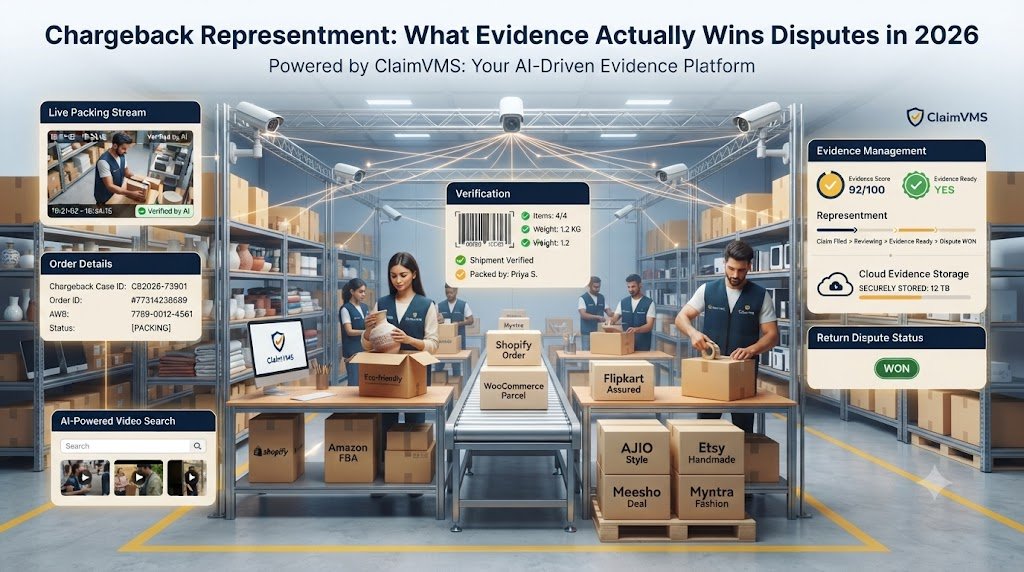
ClaimVMS helps ecommerce sellers strengthen their representment process by creating order-linked packing videos, searchable warehouse CCTV evidence, and organized shipment documentation that can be retrieved within seconds.
What Is Chargeback Representment?
Chargeback representment is the process of responding to a chargeback after a customer disputes a transaction through their payment provider or bank.
Instead of accepting the financial loss, the merchant submits supporting evidence that explains why the transaction was valid.
A successful representment typically includes:
- Order confirmation
- Invoice
- Courier tracking
- Shipment records
- Customer communication
- Packing video
- Warehouse documentation
The stronger and more relevant the evidence, the greater the chance of a successful outcome.
Why Many Merchants Lose Chargeback Disputes
Many ecommerce businesses submit the same documents for every chargeback.
A typical response often includes:
- Tracking number
- Invoice
- Product listing
- Customer email
- Short explanation
While these records are useful, they do not answer every dispute.
For example, courier tracking confirms a parcel was delivered, but it cannot prove what was packed inside the box.
Likewise, a product listing explains what should have been shipped, but it does not verify what actually left the warehouse.
This mismatch between the dispute and the submitted evidence is one of the most common reasons merchants lose representment cases.
Understanding Different Chargeback Categories
Every chargeback follows a different investigation process.
Common dispute categories include:
- Item Not Received (INR)
- Item Not as Described (SNAD)
- Wrong Item Received
- Unauthorized Transaction
- Damaged Product Claims
- Empty Parcel Complaints
- Credit Not Processed
Each category requires a different evidence strategy.
Submitting the same documentation for every dispute often leads to unnecessary losses.
Why Evidence Should Match the Dispute
Banks and payment providers investigate specific questions depending on the reason code.
For example:
Item Not Received
The investigator wants to verify whether the parcel was dispatched and successfully delivered.
Useful evidence includes:
- Courier tracking
- Delivery confirmation
- Signature confirmation (when available)
- Dispatch records
Item Not as Described
The investigation focuses on whether the dispatched product matched the advertised product.
Useful evidence includes:
- Order-linked packing video
- SKU verification
- Product inspection
- Product listing
- Shipment records
Wrong Item Received
The investigator needs to verify exactly which product left the warehouse.
Useful evidence includes:
- Packing video
- Barcode scan
- SKU verification
- Shipping label confirmation
- Dispatch logs
Matching the evidence to the dispute significantly improves the quality of the response.
How ClaimVMS Improves Chargeback Representment
ClaimVMS converts ordinary warehouse CCTV into an intelligent evidence management platform.
Every packing session is automatically linked with:
- Order ID
- AWB Number
- Invoice Number
- Barcode
- QR Code
- Dispatch Date
- Shipment Status
Instead of manually reviewing hours of surveillance footage, warehouse teams can locate the exact recording within seconds.
This enables faster and more organized dispute preparation.
A Practical Example
Imagine an electronics seller receives a chargeback claiming that the customer received the wrong charging cable.
The warehouse team gathers:
- Invoice
- Courier tracking
- Product listing
- Customer communication
Although these documents confirm the transaction, they still cannot independently verify what was packed.
Using ClaimVMS, the operations team searches the Order ID and retrieves the packing video.
The recording clearly shows:
- Correct SKU selection
- Barcode verification
- Product inspection
- Packing process
- Parcel sealing
- Shipping label attachment
Instead of relying solely on paperwork, the business now submits visual shipment evidence that directly addresses the customer’s claim.
Why Traditional CCTV Systems Create Problems
Most warehouses already use CCTV cameras for security purposes.
However, traditional surveillance systems are not designed for ecommerce dispute management.
Common limitations include:
- Videos organized by date and time
- Manual timeline searches
- Multiple camera angles
- Long retrieval times
- Limited shipment indexing
- Time-consuming exports
Finding one shipment often requires reviewing several hours of footage.
ClaimVMS automatically indexes recordings using shipment details, allowing warehouse teams to retrieve evidence almost instantly.
Why Order-Linked Packing Videos Improve Representment Success
Winning a chargeback depends on proving what happened during order fulfillment.
Order-linked packing videos provide:
- Shipment-specific evidence
- Faster investigation
- Better warehouse accountability
- Reduced manual CCTV review
- Stronger representment documentation
- Improved operational transparency
- Greater customer confidence
By documenting every packing process and linking it directly to the order, ClaimVMS helps businesses prepare stronger evidence for disputes while improving day-to-day warehouse operations.
Choosing the Right Evidence for Every Chargeback Reason Code
One of the biggest mistakes ecommerce businesses make is using the same evidence package for every chargeback.
Every dispute has a different reason code, and each one requires evidence that directly answers the investigator’s question.
Understanding the dispute before preparing your response significantly improves the quality of your representment.
Best Evidence for Item Not Received (INR) Chargebacks
When a customer claims that an order never arrived, investigators want to verify whether the shipment was successfully delivered.
The strongest supporting evidence includes:
Courier tracking information
Delivery confirmation
Delivery timestamp
Signature confirmation (where available)
Customer communication
Packing video for empty parcel allegations
While tracking confirms delivery, it cannot prove what was inside the parcel. This is where order-linked packing videos provide additional support, especially when customers claim they received an empty package.
Best Evidence for Item Not as Described (SNAD) Disputes
These disputes focus on whether the dispatched product matched the product that was advertised.
A strong evidence package should include:
Order-linked packing video
Product inspection records
SKU verification
Product listing
Invoice
Customer communication
Product listings explain what was offered for sale, but packing videos verify what was actually dispatched for the specific order.
Best Evidence for Wrong Item Received Claims
When customers claim they received the wrong product, businesses must demonstrate exactly what left the warehouse.
Useful evidence includes:
Packing video
Barcode scan records
SKU verification
Shipping label confirmation
Dispatch logs
Warehouse records
This shipment-specific documentation helps verify that the correct product was packed before dispatch.
Best Evidence for Damaged Product Claims
Some customers report that products arrived damaged during transit.
Useful supporting documentation includes:
Product inspection before packing
Packing video
Packaging process
Parcel sealing
Courier documentation
Return inspection photographs
These records help establish the product’s condition before it entered the courier network.
Building a Strong Chargeback Representment Package
A professional representment package should be structured and easy to review.
An effective submission generally includes:
A concise explanation of the dispute.
Invoice and order confirmation.
Courier tracking information.
Order-linked packing video.
Shipping label verification.
Product listing.
Customer communication.
Supporting warehouse documentation.
Presenting evidence in a logical order makes it easier for banks and payment providers to evaluate the case.
Common Mistakes That Reduce Representment Success
Many otherwise valid disputes are lost because of avoidable errors.
Some of the most common mistakes include:
Submitting the same evidence for every dispute.
Missing response deadlines.
Uploading incomplete documentation.
Relying only on courier tracking.
Using poor-quality warehouse footage.
Failing to organize evidence properly.
Not preserving shipment records.
Avoiding these mistakes improves operational consistency and dispute readiness.
How ClaimVMS Simplifies Evidence Retrieval
Searching manually through warehouse CCTV footage can consume valuable time.
ClaimVMS automatically indexes every recording using:
Order ID
AWB Number
Invoice Number
Barcode
QR Code
Dispatch Date
Shipment Status
Warehouse teams simply search using the shipment details and retrieve the required video within seconds.
This significantly reduces investigation time while improving the quality of evidence submitted.
Best Practices for Stronger Chargeback Management
Businesses that consistently achieve better representment outcomes usually follow disciplined warehouse procedures.
Recommended best practices include:
Verify every SKU before packing.
Scan products using barcodes or QR codes.
Record every packing station.
Seal parcels under camera coverage.
Preserve shipment documentation.
Archive packing videos securely.
Respond promptly to disputes.
Maintain accurate product listings.
Audit warehouse operations regularly.
Review chargeback trends every month.
These practices improve both warehouse efficiency and dispute preparedness.
Supporting Multi-Channel Ecommerce Operations
Many businesses now sell across multiple marketplaces and ecommerce platforms.
ClaimVMS centralizes evidence management for:
Shopify
WooCommerce
Amazon
Flipkart
Etsy
AJIO
Meesho
Myntra
Magento
Other ecommerce platforms
Instead of managing multiple evidence systems, businesses can retrieve shipment records from one searchable dashboard.
Final Thoughts
Winning chargeback representment is no longer about writing longer explanations.
It is about presenting accurate, organized, and shipment-specific evidence that directly addresses the reason for the dispute.
Invoices, courier tracking, and product listings remain important supporting documents, but they cannot independently prove what was packed inside a specific parcel.
By combining warehouse verification, order-linked packing videos, and searchable shipment records, ClaimVMS helps ecommerce businesses strengthen representment responses while improving warehouse transparency and operational efficiency.
As chargeback volumes continue to rise, businesses that invest in structured evidence management will be better positioned to reduce losses, improve dispute outcomes, and protect long-term profitability.
Frequently Asked Questions
What is chargeback representment?
Chargeback representment is the process of responding to a customer chargeback by submitting evidence that demonstrates the transaction was valid and the order was fulfilled correctly.
Why do many merchants lose representment cases?
Many businesses submit generic evidence that does not directly address the dispute reason. Matching evidence to the specific chargeback category significantly improves the quality of the response.
Why are packing videos important during representment?
Packing videos document the fulfillment process, including SKU verification, packaging, parcel sealing, and shipping label attachment, creating shipment-specific evidence.
Can ClaimVMS work with existing warehouse CCTV systems?
Yes. ClaimVMS integrates with compatible warehouse CCTV infrastructure and converts standard surveillance recordings into searchable, order-linked shipment evidence.
Which ecommerce platforms can use ClaimVMS?
ClaimVMS supports businesses selling through Shopify, WooCommerce, Amazon, Flipkart, Etsy, AJIO, Meesho, Myntra, Magento, and other ecommerce platforms.
How quickly can shipment evidence be retrieved?
Because every recording is indexed using Order IDs, AWB numbers, invoice details, and shipment information, warehouse teams can usually retrieve the required evidence within seconds.