
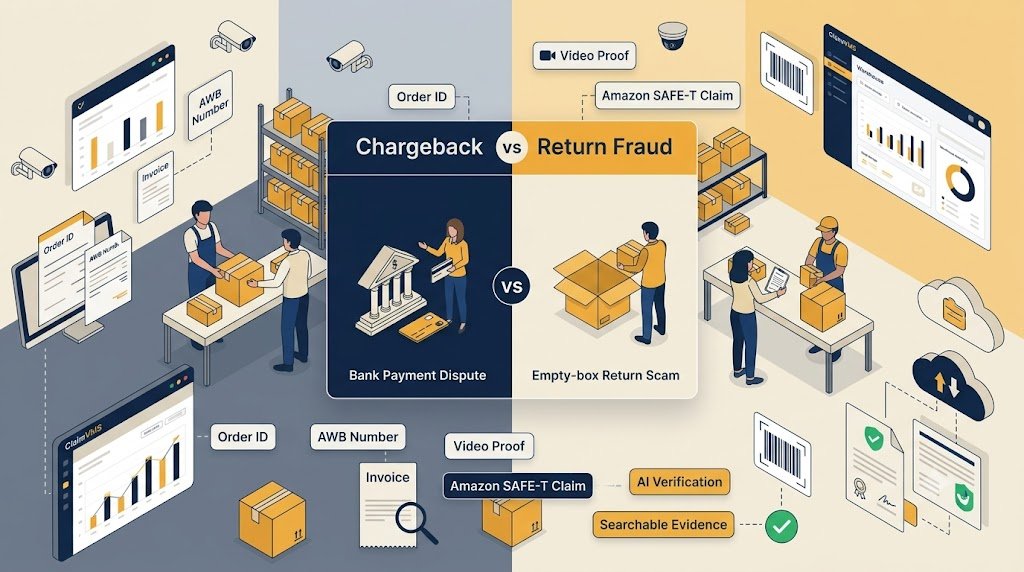
Chargeback vs Return Fraud: What Every Ecommerce Seller Needs to Know
Running an ecommerce business in 2026 is more challenging than ever. Along with increasing competition, sellers now face a growing number of fraudulent claims, fake returns, empty-box scams, and payment disputes that directly impact profitability.
One of the biggest misconceptions among online sellers is treating chargebacks and return fraud as the same issue.
They aren’t.
A chargeback is a payment dispute initiated through the customer’s bank, while return fraud occurs when buyers exploit marketplace return policies to receive refunds while keeping or replacing products.
Although these frauds follow different paths, they often involve the same dishonest customer—and both require one thing to successfully defend:
Reliable, order-linked evidence.
Without clear proof of what was packed, shipped, and delivered, sellers often lose disputes regardless of whether they are right.
This is where ClaimVMS transforms the entire dispute management process.
ClaimVMS automatically records every packing operation, securely stores video evidence, links it to Order IDs, AWB numbers, invoices, and tracking details, and helps sellers submit stronger documentation for marketplace claims and dispute investigations.
Instead of relying solely on tracking numbers, sellers gain undeniable visual proof.
Why Chargebacks and Return Fraud Are Rising in 2026
Ecommerce fraud has evolved dramatically over the last few years.
Today, fraudsters don’t simply steal payment cards—they exploit marketplace policies designed to protect customers.
Common fraud trends include:
- Empty box return claims
- Wrong item received complaints
- Item missing accusations
- Used product returns
- Product swapping
- Fake tracking abuse
- Friendly fraud
- Refund abuse
- Multiple refund attempts
Industry reports indicate that return fraud and friendly fraud continue to increase each year, costing ecommerce businesses billions globally.
For many Indian marketplace sellers on Amazon, Flipkart, Myntra, Meesho, AJIO, and other platforms, even a handful of fraudulent claims every month can significantly reduce profits.
Chargeback vs Return Fraud: Understanding the Difference
Although both involve financial loss, they occur through completely different systems.
| Chargeback | Return Fraud |
|---|---|
| Payment dispute | Product return abuse |
| Initiated through bank | Initiated through marketplace |
| Buyer disputes payment | Buyer abuses return policy |
| Reviewed by payment network | Reviewed by seller or marketplace |
| Evidence focuses on transaction | Evidence focuses on shipped product |
| Often results in bank reversing payment | Usually results in refund or replacement |
Simply put:
Chargeback = Payment Problem
Return Fraud = Product Problem
Understanding this distinction helps sellers prepare the correct evidence for each situation.
How Return Fraud Turns Into a Chargeback
Modern ecommerce fraud rarely follows a single path.
A dishonest buyer may:
- Receive the correct product.
- Request a refund.
- Return an empty box.
- Receive the refund.
- Still file a chargeback through the bank.
Now the seller loses:
- Product
- Refund amount
- Chargeback amount
- Chargeback fee
- Marketplace trust
- Valuable time
This “double-dipping” fraud is becoming increasingly common.
Without documented proof, recovering these losses becomes extremely difficult.
The Real Problem Isn’t the Fraud—It’s the Missing Evidence
Many sellers actually know the customer is committing fraud.
Unfortunately, knowing isn’t enough.
Marketplaces and payment providers require proof.
Typical seller documentation includes:
- Invoice
- Shipping label
- Tracking number
- Courier delivery confirmation
- Customer communication
While useful, these documents cannot prove:
- Which product was packed
- Quantity packed
- Product condition
- Accessories included
- Correct SKU
- Correct serial number
Tracking numbers only prove that a parcel moved.
They don’t prove what was inside it.
Common Types of Return Fraud
1. Empty Box Returns
The customer receives the order but returns an empty parcel while claiming the product was included.
Without packing evidence, sellers struggle to prove otherwise.
2. Product Swapping
The original product is replaced with:
- Older version
- Damaged unit
- Fake product
- Different brand
The buyer receives a refund while keeping the original item.
3. Wardrobing
Customers use products temporarily before returning them.
Common examples include:
- Clothing
- Shoes
- Electronics
- Home décor
- Event accessories
4. Missing Item Claims
Customers claim certain products were never included in the shipment.
Without visual packing proof, these disputes become difficult to challenge.
5. Wrong Item Received
Buyers report receiving a completely different product.
If the warehouse has no visual documentation, the marketplace often favors the buyer.
What Is Friendly Fraud?
Friendly fraud occurs when a legitimate customer disputes a genuine purchase.
Examples include:
- “I never received it.”
- “Someone else used my card.”
- “The product wasn’t inside.”
- “I didn’t order this.”
Although the transaction was legitimate, the seller must still prove it.
This type of fraud now represents one of the fastest-growing categories of ecommerce losses worldwide.
Why Traditional Evidence Isn’t Enough
Most ecommerce businesses still depend on:
- Courier tracking
- Shipping labels
- Order confirmations
- Invoices
- Warehouse logs
While important, these documents fail to answer one critical question:
What exactly was packed inside the parcel?
Marketplaces increasingly expect stronger documentation during investigations.
Video evidence provides an additional layer of confidence that traditional paperwork simply cannot.
How ClaimVMS Strengthens Seller Protection
ClaimVMS is designed specifically for ecommerce sellers who need reliable proof during dispute investigations.
The platform automatically creates a digital evidence trail for every shipment.
Each order is linked with:
- Packing video
- Order ID
- Invoice
- Tracking number
- Courier details
- Timestamp
- SKU information
- User details
- Claim history
When a dispute arises, sellers can quickly retrieve the corresponding evidence instead of manually searching through hours of CCTV footage.
A Typical Marketplace Claim Without ClaimVMS
Imagine a seller ships a smartphone.
A week later the buyer claims:
“The box arrived empty.”
The seller provides:
- Invoice
- Shipping label
- Delivery confirmation
Marketplace Response:
“Insufficient evidence.”
Result:
- Refund approved
- Seller loses product
- Seller loses payment
The Same Case Using ClaimVMS
Now imagine the same shipment recorded through ClaimVMS.
The seller retrieves:
- Packing video
- Timestamp
- Product verification
- Barcode scan
- Courier handover recording
- Order details
All evidence is submitted together.
Instead of assumptions, investigators receive visual proof showing exactly what was packed before dispatch.
This dramatically improves documentation quality and helps sellers respond more effectively to investigations.
How ClaimVMS Works
The entire process is designed to be simple.
Step 1
Record the packing process using existing warehouse cameras.
Step 2
ClaimVMS automatically links the video to the order.
Step 3
Videos are securely stored and indexed.
Step 4
If a dispute occurs, search using:
- Order ID
- AWB Number
- Invoice Number
- Customer Name
- SKU
Step 5
Download or share evidence within minutes.
No manual CCTV searching.
No lost recordings.
No unnecessary delays.
Benefits of Using ClaimVMS
✔ Faster claim documentation
✔ Organized evidence management
✔ Quick order search
✔ Reduced investigation time
✔ Improved operational transparency
✔ Better warehouse accountability
✔ Supports Amazon SAFE-T claims
✔ Supports marketplace investigations
✔ Works with existing warehouse cameras
✔ Cloud-based video management
✔ Easy retrieval of historical records
Who Should Use ClaimVMS?
ClaimVMS is ideal for:
- Amazon Sellers
- Flipkart Sellers
- Meesho Sellers
- Myntra Sellers
- AJIO Sellers
- Shopify Stores
- WooCommerce Stores
- D2C Brands
- Third-Party Logistics Providers (3PL)
- Warehouse Operators
- Ecommerce Fulfillment Centers
If your business ships hundreds or thousands of parcels every month, maintaining visual proof for every order can significantly improve operational efficiency during claim investigations.
Conclusion
As ecommerce grows, fraud tactics continue to evolve.
Whether it’s chargebacks, return fraud, missing-item claims, empty-box scams, or product swapping, one thing remains constant:
Strong evidence wins disputes.
Invoices and tracking numbers are important, but they rarely tell the complete story.
ClaimVMS helps bridge this gap by creating a structured, searchable, and secure evidence system for every packed order. With order-linked video records, sellers can retrieve supporting documentation quickly, strengthen marketplace claims, and improve confidence during dispute resolution.
Instead of reacting to fraud after losses occur, businesses can build a reliable proof system that supports transparency, accountability, and better claim management.
If you’re looking to streamline your ecommerce claim process and safeguard your shipments, ClaimVMS provides the tools needed to document every order with confidence.
Frequently Asked Questions (FAQs)
1. What is the difference between chargeback and return fraud?
A chargeback is a payment dispute initiated through a customer’s bank, while return fraud occurs when a customer abuses a seller’s or marketplace’s return policy to obtain an unfair refund or replacement.
2. Can packing videos help during marketplace claims?
Yes. Packing videos provide visual documentation showing the product packed before shipment, which can strengthen supporting evidence during marketplace investigations.
3. How does ClaimVMS help ecommerce sellers?
ClaimVMS records packing videos, links them with order information, securely stores evidence, and enables quick retrieval whenever claim documentation is required.
4. Which marketplaces can benefit from ClaimVMS?
ClaimVMS is suitable for sellers operating on Amazon, Flipkart, Myntra, Meesho, AJIO, Shopify, WooCommerce, and other ecommerce platforms.
5. Does ClaimVMS require new CCTV cameras?
No. In most cases, ClaimVMS works with existing warehouse camera setups, reducing additional infrastructure costs.
6. Can ClaimVMS help with Amazon SAFE-T Claims?
Yes. ClaimVMS helps sellers organize packing evidence and documentation that can support Amazon SAFE-T claim submissions and investigations.
7. Why are tracking numbers alone not enough?
Tracking numbers confirm parcel movement but do not verify the product packed inside the shipment. Video evidence provides additional verification of the packing process.
8. Who should implement a video-based claim management system?
Any ecommerce business shipping products regularly—including marketplace sellers, D2C brands, warehouses, and fulfillment centers—can benefit from maintaining structured packing evidence for faster dispute resolution.