
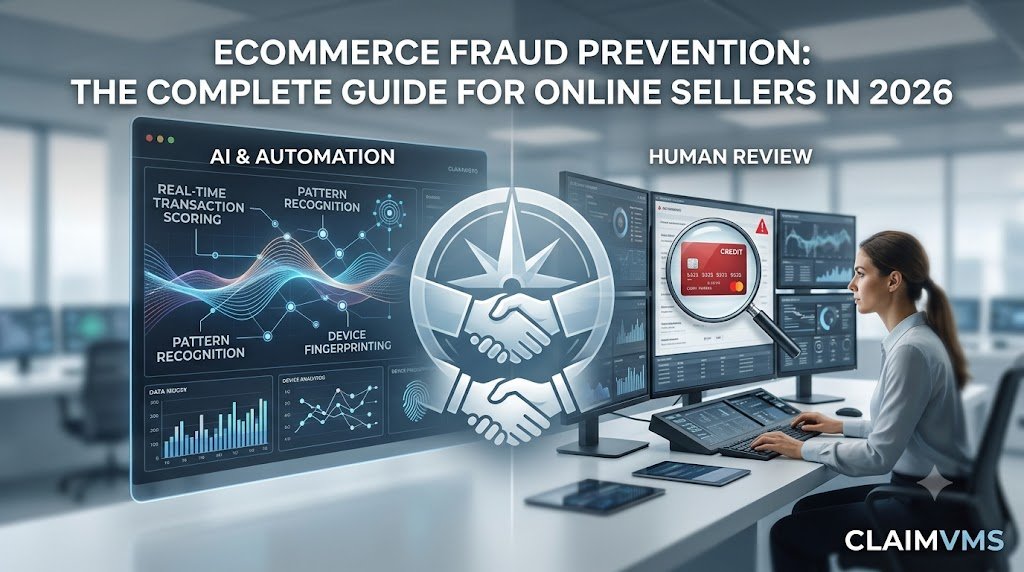
Ecommerce Fraud Is Costing Online Sellers More Than Ever
Running a successful ecommerce business is no longer just about attracting customers and increasing sales. Today, one of the biggest threats to profitability comes after an order is placed.
While payment fraud has existed for years, a new wave of post-purchase fraud is causing significant financial losses for online sellers. Fake return requests, empty box claims, product swaps, friendly fraud, and “Item Not Received (INR)” disputes are becoming increasingly common across major marketplaces.
Whether you sell on Amazon, Flipkart, Meesho, Myntra, AJIO, Shopify, WooCommerce, or your own D2C website, fraudulent claims can quickly reduce profits if you don’t have the right evidence to defend your business.
Many sellers believe fraud prevention ends once the payment is approved.
In reality, the most expensive fraud often begins after the order leaves your warehouse.
This is where ClaimVMS helps businesses protect every shipment with automated packing video evidence and intelligent dispute management.
What Is Ecommerce Fraud?
Ecommerce fraud refers to any intentional activity that causes financial loss to an online seller through deception, manipulation, or misuse of ecommerce systems.
Fraud can happen at different stages of an order:
- Before payment
- During checkout
- During shipping
- After delivery
- During returns and refunds
Modern ecommerce fraud is no longer limited to stolen credit cards.
Today, sellers face increasingly sophisticated scams that exploit marketplace policies and customer-friendly return systems.
Without proper documentation, proving these fraudulent activities becomes extremely difficult.
The Real Cost of Ecommerce Fraud
Most sellers only calculate the value of refunded orders.
However, the actual cost of fraud is much higher.
Every fraudulent order can create additional expenses such as:
- Lost products
- Shipping charges
- Return shipping costs
- Marketplace penalties
- Payment gateway fees
- Chargeback fees
- Warehouse labor
- Customer support time
- Inventory discrepancies
For growing ecommerce businesses, these hidden costs often exceed the value of the product itself.
As order volumes increase, even a small percentage of fraudulent transactions can significantly impact profitability.
Why Traditional Fraud Prevention Is No Longer Enough
Many ecommerce businesses invest heavily in payment security.
Common protection methods include:
- OTP verification
- CVV validation
- 3D Secure authentication
- AI payment risk scoring
- Address verification
- Device fingerprinting
These tools are excellent at stopping fraudulent payments.
However, they cannot prevent fraud that happens after the product has already been delivered.
For example:
- Fake return requests
- Product swap fraud
- Empty box returns
- Friendly fraud
- False damage claims
- Fake “Item Not Received” complaints
This is why modern ecommerce businesses need protection beyond the checkout page.
The Five Most Common Types of Ecommerce Fraud
Understanding different fraud types helps businesses implement stronger protection strategies.
Card-Not-Present (CNP) Fraud
Card-Not-Present fraud occurs when stolen payment card information is used to purchase products online.
Since the physical card is never presented, sellers rely on digital verification systems.
Although payment gateways detect many fraudulent transactions, some still pass through security checks.
Once the order is shipped, the fraud usually appears as a chargeback.
Friendly Fraud
Friendly fraud occurs when genuine customers make legitimate purchases but later dispute the transaction through their bank.
Common claims include:
- Item not received
- Product not as described
- Unauthorized transaction
Although the customer actually received the order, the seller must prove that the shipment was packed correctly and delivered successfully.
Without visual evidence, many businesses lose these disputes.
Return Fraud
Return fraud has become one of the fastest-growing ecommerce threats.
Common examples include:
- Wrong product returns
- Empty box returns
- Counterfeit product swaps
- Used product returns
- Fake damage claims
- Missing accessory claims
Unlike payment fraud, return fraud occurs after fulfillment, making warehouse evidence essential.
Account Takeover (ATO)
Account Takeover fraud occurs when criminals gain access to legitimate customer accounts.
After accessing the account, fraudsters may:
- Change delivery addresses
- Place unauthorized orders
- Use saved payment methods
- Redeem loyalty points
Strong passwords and multi-factor authentication help reduce this risk.
Refund Abuse and Policy Exploitation
Some customers intentionally exploit return policies without technically breaking any rules.
Examples include:
- Repeated refund requests
- Excessive return behavior
- Wardrobing
- False quality complaints
- Policy manipulation
Although these cases may appear legitimate, they often result in substantial long-term losses.
Why Post-Purchase Fraud Is Growing Faster Than Payment Fraud
Payment security has improved dramatically over the last decade.
Banks, payment gateways, and marketplaces now detect many fraudulent payments before they are approved.
As a result, fraudsters have shifted their attention toward post-purchase fraud.
Instead of stealing payment information, they exploit return policies and dispute processes.
This includes:
- Returning different products
- Claiming parcels arrived empty
- Generating fake damage evidence
- Filing false delivery complaints
- Requesting refunds after using products
Because these disputes happen after delivery, payment security tools cannot prevent them.
A Real Business Scenario
Imagine an online electronics seller processing more than 400 orders every day.
The business has excellent payment security.
Very few fraudulent transactions occur during checkout.
However, every month the warehouse receives:
- Empty return parcels
- Wrong products
- Counterfeit replacements
- Customers claiming products never arrived
- Fake damage complaints
The warehouse has CCTV cameras installed.
Unfortunately, finding the correct recording requires manually searching through hours of footage.
Even after locating the right timestamp, the video often cannot clearly identify:
- Product condition
- SKU
- Serial number
- Order ID
- Packing accuracy
As a result, many disputes are rejected because there is no order-specific evidence.
After implementing ClaimVMS, every packing station automatically records the packing process.
Each recording is linked directly with:
- Order ID
- AWB Number
- Product SKU
- Packing Date & Time
Now, when a dispute occurs, the required evidence can be retrieved within seconds.
Instead of relying on assumptions, the seller responds with visual proof.
The Biggest Mistake Most Sellers Make
Many ecommerce businesses invest heavily in fraud prevention before payment.
Very few invest in protecting themselves after shipment.
This creates a dangerous gap.
The order is shipped.
The customer raises a dispute.
The seller searches CCTV.
The dispute deadline arrives.
The evidence cannot be found.
The refund is approved.
The seller loses both the product and the payment.
This cycle repeats every month for thousands of ecommerce businesses.
The solution isn’t arguing harder.
The solution is creating evidence before the dispute ever exists.
Building a Two-Layer Ecommerce Fraud Prevention Strategy
An effective fraud prevention strategy doesn’t stop at the payment gateway.
Modern ecommerce businesses require protection at two critical stages of every order.
Layer 1 – Pre-Purchase Fraud Prevention
This layer protects transactions before the order is processed.
It includes:
- 3D Secure Authentication (3DS)
- CVV Verification
- OTP Validation
- Device Fingerprinting
- AI Risk Scoring
- Address Verification
- Velocity Checks
- Bot Detection
These tools help identify suspicious transactions before products are shipped.
Layer 2 – Post-Purchase Fraud Prevention
Most financial losses occur after successful delivery.
This layer focuses on protecting sellers from:
- Return Fraud
- Friendly Fraud
- Fake Item Not Received (INR) Claims
- Product Swap Fraud
- Empty Box Returns
- False Damage Claims
- Refund Abuse
This is where ClaimVMS becomes an essential part of the ecommerce workflow.
By automatically recording every packing process, ClaimVMS creates visual evidence that can be used during marketplace investigations and chargeback disputes.
The Post-Purchase Gap Most Sellers Ignore
Many sellers have excellent payment security but almost no post-purchase protection.
When a dispute occurs, they usually submit:
- Invoice
- Courier Tracking
- Delivery Confirmation
- Product Catalogue Images
Unfortunately, none of these prove:
- Which product was packed
- Product condition before shipment
- Accessories included
- Serial number
- Packaging accuracy
Without this information, marketplaces often approve the buyer’s claim.
Why Packing Video Evidence Is So Powerful
A packing video records the shipment before any dispute exists.
Unlike customer photographs or written statements, the recording provides independent visual proof.
ClaimVMS captures:
- Product verification
- SKU confirmation
- Quantity
- Accessories
- Product condition
- Order ID
- AWB Label
- Final sealed package
Every recording is automatically linked to the order, making retrieval fast and accurate.
How ClaimVMS Protects Ecommerce Sellers
ClaimVMS is an AI-powered Packing Video Management System designed specifically for ecommerce businesses.
Instead of searching through hours of CCTV footage, warehouse teams can retrieve order-specific videos in seconds.
Every shipment is linked with:
- Order ID
- AWB Number
- SKU
- Marketplace
- Packing Date & Time
- Warehouse Operator
This creates reliable evidence before the parcel leaves the warehouse.
Amazon SAFE-T Claims
Amazon sellers frequently deal with:
- Wrong item returns
- Empty box claims
- Friendly fraud
- Fake damage complaints
- Missing accessory disputes
ClaimVMS enables sellers to retrieve packing videos quickly and attach them as supporting evidence during SAFE-T claim submissions.
This significantly improves dispute documentation while reducing manual effort.
Flipkart Seller Protection
Flipkart sellers often encounter fraudulent returns and buyer abuse.
ClaimVMS helps by documenting:
- Correct product packed
- SKU verification
- Product condition
- Packaging process
- Shipping label
Combined with return-opening videos, sellers have stronger evidence during claim investigations.
AJIO Return Claims
AJIO frequently requests order-level packing proof for disputed returns.
Because ClaimVMS automatically links every recording with its corresponding Order ID and AWB, sellers can respond within claim deadlines without manually searching CCTV footage.
Shopify & WooCommerce Chargebacks
Independent ecommerce brands frequently receive chargebacks for:
- Item Not Received
- Product Not As Described
- Wrong Product
- Missing Items
ClaimVMS provides visual proof of exactly what was packed before shipment, strengthening responses submitted to payment gateways.
Best Practices for Preventing Ecommerce Fraud
Technology works best when supported by strong warehouse processes.
Every ecommerce business should:
- Record every packing process.
- Verify SKU before sealing.
- Record serial numbers for premium products.
- Photograph expensive products before dispatch.
- Verify parcel weight.
- Record suspicious returns during opening.
- Train warehouse staff regularly.
- Store evidence securely.
- Maintain standardized operating procedures.
- Retrieve evidence immediately when disputes occur.
These practices improve transparency while reducing fraudulent losses.
Why More Ecommerce Brands Are Choosing ClaimVMS
ClaimVMS is built specifically for ecommerce fulfillment operations.
Core features include:
- Automatic Packing Video Recording
- AI-Powered Video Search
- Order ID Linking
- AWB Integration
- SKU Verification
- Multi-Camera Support
- Cloud & Local Storage
- Secure Evidence Management
- Fast Video Retrieval
- Marketplace-Ready Documentation
Whether you process 100 orders or 100,000 orders daily, ClaimVMS scales with your warehouse operations while protecting every shipment with visual proof.
Final Thoughts
Fraud prevention is no longer limited to payment security.
Today’s ecommerce businesses must also protect themselves after products leave the warehouse.
By combining strong payment controls with structured post-purchase evidence, businesses can dramatically reduce fraud-related losses.
ClaimVMS helps sellers build this second layer of protection through automated packing videos, intelligent evidence management, and rapid retrieval of order-specific proof.
Instead of relying on assumptions, sellers can respond to disputes with clear, verifiable evidence.
When evidence is available, recovering revenue becomes significantly easier.
Frequently Asked Questions (FAQs)
What is ecommerce fraud?
Ecommerce fraud refers to any intentional attempt to obtain products, refunds, or money through deception during online transactions.
What is post-purchase fraud?
Post-purchase fraud includes scams that occur after the order has been shipped, such as fake returns, friendly fraud, wrong item returns, empty box claims, and false damage complaints.
Why are packing videos important?
Packing videos provide independent visual proof of what was packed and shipped before any dispute occurs.
Can ClaimVMS help with Amazon SAFE-T Claims?
Yes. ClaimVMS enables sellers to retrieve order-linked packing videos that strengthen Amazon SAFE-T claim submissions.
Which ecommerce platforms can use ClaimVMS?
ClaimVMS supports sellers operating on Amazon, Flipkart, AJIO, Myntra, Meesho, Shopify, WooCommerce, and D2C ecommerce websites.