
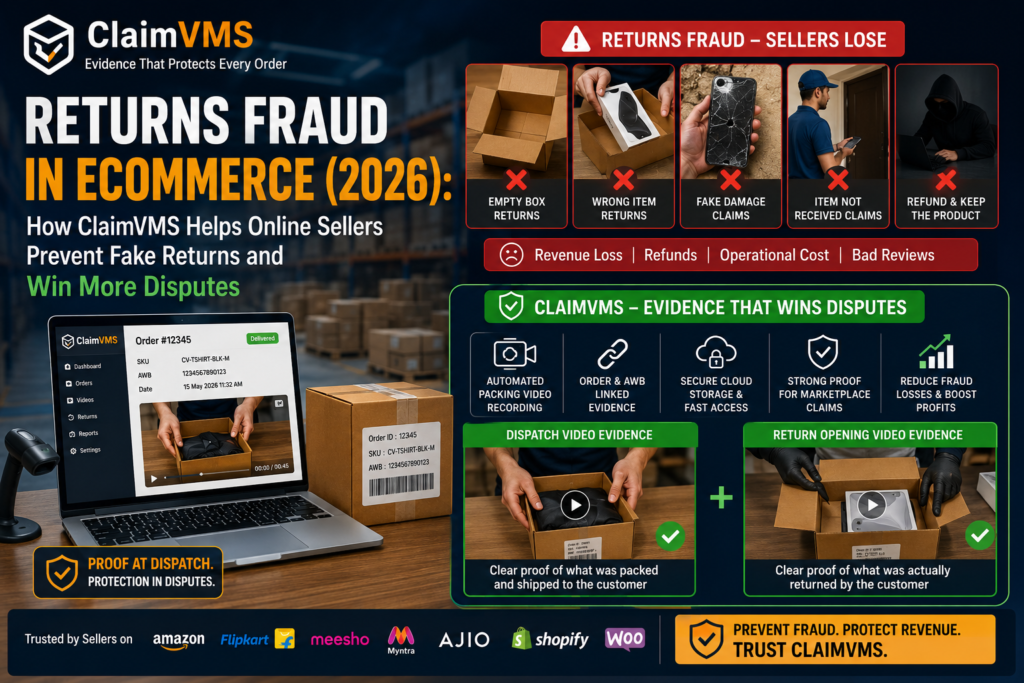
Returns Fraud Is No Longer Just a Cost of Doing Business
Product returns are an unavoidable part of ecommerce. Genuine customers may return products because they ordered the wrong size, changed their mind, or received a damaged item. These situations are expected and can usually be handled through a well-defined return policy.
However, a different challenge has emerged over the past few years—returns fraud.
Today, many ecommerce sellers are losing significant revenue not because of legitimate returns, but because dishonest buyers intentionally exploit return policies to obtain refunds while keeping the original product or returning something entirely different.
This problem affects sellers across every major marketplace, including Amazon, Flipkart, Meesho, Myntra, AJIO, Shopify, WooCommerce, and D2C ecommerce stores.
The biggest issue isn’t identifying suspicious returns.
The real problem is proving what actually happened.
Without clear evidence showing what was packed and dispatched, sellers often lose disputes even when they have done nothing wrong.
This is why leading ecommerce businesses are shifting from traditional warehouse CCTV to ClaimVMS, an AI-powered Packing Video Management System that records every shipment and creates order-linked visual evidence.
What Is Returns Fraud in Ecommerce?
Returns fraud is the deliberate misuse of a seller’s return or refund policy to gain an unfair financial advantage.
Instead of returning the product honestly, fraudsters manipulate the return process by submitting false claims, returning different products, or providing misleading information to obtain refunds.
Unlike accidental customer mistakes, return fraud is intentional.
The buyer knowingly attempts to exploit marketplace policies while the seller absorbs the financial loss.
Common objectives include:
- Receiving a refund while keeping the original product.
- Returning damaged or counterfeit items instead of the purchased product.
- Claiming the parcel arrived empty.
- Submitting fake damage evidence.
- Reporting products as undelivered despite successful delivery.
- Exploiting flexible return policies for personal gain.
As online shopping grows, so do the methods used to commit return fraud.
Why Returns Fraud Is Increasing in 2026
Ecommerce continues to expand rapidly, bringing more orders, more customers, and unfortunately, more opportunities for fraud.
Several factors are contributing to this growing problem.
Easy Return Policies
Marketplaces encourage customer confidence by offering quick and convenient returns.
While these policies improve the shopping experience, they also create opportunities for dishonest buyers to abuse the system.
Artificial Intelligence
AI has transformed ecommerce operations—but it has also given fraudsters powerful new tools.
Today, buyers can generate:
- Fake damage photographs
- AI-edited product images
- Professional dispute letters
- Convincing refund requests
These AI-generated materials often appear authentic, making manual verification increasingly difficult.
Organized Fraud Communities
Return fraud is no longer limited to isolated individuals.
Online communities now openly discuss:
- Marketplace loopholes
- Refund strategies
- Fake return methods
- Chargeback techniques
- AI tools for creating false evidence
These organized groups continuously refine new ways to exploit ecommerce sellers.
High-Value Products Attract More Fraud
Products with higher resale value naturally become bigger targets.
Examples include:
- Smartphones
- Laptops
- Smartwatches
- Fashion apparel
- Luxury accessories
- Consumer electronics
- Gaming devices
The greater the product value, the greater the incentive for fraud.
The Six Most Common Types of Returns Fraud
Understanding how fraud occurs helps businesses build stronger warehouse verification processes.
Wrong Item Return Fraud
The customer purchases a genuine product but returns something else instead.
This may include:
- Older models
- Broken products
- Counterfeit items
- Different brands
- Low-value substitutes
The fraudster keeps the original item while receiving a refund.
Without dispatch evidence, proving the product swap becomes extremely difficult.
Empty Box Fraud
In this scam, the customer returns:
- An empty carton
- Packaging filled with paper
- Stones
- Scrap materials
- Other low-value fillers
Sometimes the parcel weight is intentionally adjusted to resemble the original shipment, making the fraud harder to detect.
Unless the seller has proof showing what was packed before dispatch, disputes become challenging.
False Damage Claims
Customers falsely claim that the product arrived damaged.
Increasingly, these claims are supported using:
- Edited photographs
- AI-generated damage images
- Misleading descriptions
In many cases, the returned product is completely undamaged—or never returned at all.
Wardrobing
Wardrobing occurs when customers purchase products with the intention of using them temporarily before returning them.
This is common for:
- Clothing
- Shoes
- Handbags
- Electronics
- Event accessories
Although the item has been used, the customer claims it is unused to obtain a full refund.
False “Item Not Received” Claims
Tracking confirms successful delivery.
The courier marks the parcel as delivered.
Yet the customer reports:
“My order never arrived.”
Without dispatch evidence and delivery records, resolving these disputes becomes difficult.
Serial Number & Product Swap Fraud
Premium products often include unique identifiers such as:
- IMEI numbers
- Serial numbers
- QR codes
- Manufacturer IDs
Fraudsters replace the genuine product with another unit carrying a different serial number while requesting a refund.
Unless these identifiers are recorded during packing, proving the substitution becomes difficult.
A Real-World Scenario
Imagine an ecommerce seller processing hundreds of daily orders across Amazon, Flipkart, and Shopify.
Every month, the warehouse begins noticing patterns:
- Customers returning the wrong products.
- Empty parcels arriving at the warehouse.
- False damage claims increasing.
- Buyers claiming deliveries never arrived.
The warehouse has CCTV cameras installed.
However, retrieving footage requires manually searching hours of recordings.
Even after locating the correct timestamp, the footage rarely shows:
- Product condition
- SKU verification
- Serial numbers
- Order ID
- The complete packing process
As a result, the seller struggles to prove what was actually dispatched.
After implementing ClaimVMS, every packing station automatically records each order.
Each video is linked directly to:
- Order ID
- AWB Number
- SKU
- Packing timestamp
Now, when a dispute arises, the seller can retrieve the exact packing video within seconds and submit it as supporting evidence.
The result is faster investigations, stronger claims, and significantly improved protection against fraudulent returns.
Why Traditional Return Fraud Prevention Doesn’t Always Work
Many businesses attempt to reduce fraud by introducing stricter return policies.
Common approaches include:
- Charging return fees
- Shortening return windows
- Displaying fraud warnings
- Tightening refund approval processes
While these measures may discourage casual misuse, they rarely stop organized fraud.
A fraudster attempting to obtain a ₹40,000 smartphone is unlikely to be deterred by a ₹100 return fee.
Similarly, shortening the return window does not prevent false damage claims submitted immediately after delivery.
Policies can influence behavior.
Evidence wins disputes.
The Missing Piece: Independent Visual Proof
Most disputes come down to two conflicting statements.
The customer claims:
“The product arrived damaged.”
The seller responds:
“The product left our warehouse in perfect condition.”
Without independent proof, both are simply claims.
This is why more ecommerce businesses are adopting ClaimVMS.
By automatically recording every packing process and linking each video to the corresponding Order ID and AWB, ClaimVMS creates reliable evidence before the shipment leaves the warehouse.
When a dispute arises, sellers no longer rely on assumptions—they rely on facts backed by visual proof.
Why an Evidence-First Strategy Works Better Than Strict Return Policies
Many ecommerce businesses believe that stricter return policies will automatically reduce fraudulent returns.
Common approaches include:
- Charging return fees
- Reducing the return period
- Displaying anti-fraud warnings
- Increasing manual verification
- Tightening refund approval rules
Although these measures may discourage some opportunistic fraud, they rarely stop organized fraudsters.
A customer attempting to fraudulently claim a ₹50,000 smartphone or a premium branded product is unlikely to abandon the attempt because of a small return fee or a shorter return window.
The real issue is not the return policy.
The real issue is whether the seller can prove what actually happened.
An evidence-first approach focuses on creating verifiable proof before the parcel leaves the warehouse, making disputes easier to resolve.
The ClaimVMS Two-Video Evidence System
The strongest protection against returns fraud is maintaining evidence at two critical stages of the order lifecycle.
Stage 1: Dispatch Video Evidence
The first layer begins before shipment.
ClaimVMS automatically records the complete packing process for every order.
The recording captures:
- Product selection
- Product condition
- SKU verification
- Quantity verification
- Accessories included
- Serial number or IMEI (where applicable)
- Order ID
- AWB label
- Final sealed package
Each recording is securely linked with the order, creating independent evidence of exactly what left the warehouse.
Stage 2: Return Opening Evidence
The second layer begins when a returned parcel reaches the warehouse.
Instead of opening returns immediately, warehouse teams should follow a standardized process.
The process should include:
- Inspecting the sealed parcel
- Recording the return label
- Photographing the parcel
- Measuring parcel weight
- Recording the complete unboxing in one continuous video
- Showing every item removed from the package
This creates reliable evidence of exactly what the customer returned.
Why Two Videos Are Better Than One
Most disputes involve two important questions:
What was shipped?
and
What was returned?
A dispatch video answers the first question.
A return-opening video answers the second.
Together, these videos create a complete evidence chain that is difficult to challenge during marketplace investigations.
Why ClaimVMS Is Better Than Traditional Warehouse CCTV
Many warehouses already have CCTV cameras.
However, standard surveillance footage is rarely sufficient during ecommerce disputes.
Traditional CCTV usually cannot clearly capture:
- Product details
- Serial numbers
- SKU labels
- Order IDs
- Packing accuracy
- Accessories inside the parcel
ClaimVMS is designed specifically for ecommerce fulfillment.
Each packing station records close-up, order-specific videos that clearly document the entire packing process.
This produces evidence that is far more useful than general surveillance footage.
Amazon SAFE-T Claims
Amazon sellers frequently encounter disputes involving:
- Wrong item returns
- Empty box returns
- Fake damage claims
- Product swap fraud
- Missing accessories
ClaimVMS enables sellers to quickly retrieve:
- Packing videos
- Order details
- AWB information
- Product verification
- Return-opening videos
Submitting this evidence strengthens SAFE-T claim responses and improves dispute outcomes.
Flipkart Seller Protection
Flipkart sellers often face buyer abuse and fraudulent return claims.
ClaimVMS provides order-linked visual evidence showing:
- Correct product packed
- Correct quantity
- Product condition
- Shipping label verification
Combined with return-opening documentation, sellers have stronger evidence during investigations.
AJIO Return Claims
AJIO frequently requests warehouse packing evidence during return investigations.
Because every ClaimVMS recording is linked with the corresponding order, sellers can retrieve the required video quickly instead of manually searching CCTV footage.
This helps businesses respond within claim deadlines while reducing the risk of rejected claims due to missing evidence.
Shopify & WooCommerce Chargebacks
Independent ecommerce stores also experience fraudulent refund requests and payment disputes.
When customers claim:
- Wrong item received
- Damaged product
- Missing accessories
- Empty parcel
ClaimVMS provides visual proof of what was actually packed before shipment.
This evidence strengthens chargeback responses submitted through payment gateways.
Best Practices for Reducing Returns Fraud
Technology is most effective when combined with disciplined warehouse operations.
Every ecommerce warehouse should:
- Record every packing process.
- Verify SKU before packing.
- Record serial numbers for premium products.
- Capture high-value shipments.
- Verify parcel weight before dispatch.
- Record suspicious return openings.
- Train warehouse staff on fraud detection.
- Maintain a standardized inspection process.
- Store evidence securely.
- Retrieve evidence immediately when disputes arise.
Consistency creates credibility.
Why More Ecommerce Brands Are Choosing ClaimVMS
As return fraud continues to evolve, businesses require more than traditional warehouse cameras.
ClaimVMS is built specifically for ecommerce fulfillment operations.
Key benefits include:
- Automatic packing video recording
- Order ID linking
- AWB integration
- AI-powered video search
- Multi-camera support
- Cloud and local storage
- Secure evidence management
- Fast dispute response
- Marketplace-ready documentation
- Warehouse accountability
Whether your business processes 100 orders or 100,000 orders every day, ClaimVMS helps ensure every shipment is backed by reliable visual proof.
Final Thoughts
Returns fraud has become one of the most significant operational risks facing ecommerce businesses.
As fraud techniques become increasingly sophisticated, relying solely on invoices, courier tracking, or warehouse CCTV is no longer enough.
The most successful sellers focus on creating evidence before disputes occur.
By combining automated packing videos, structured return verification, and organized evidence management, businesses can significantly reduce fraudulent losses and respond to marketplace disputes with confidence.
With ClaimVMS, every shipment is supported by verifiable visual proof, helping sellers protect their products, reduce financial losses, and build greater trust throughout the fulfillment process.
Frequently Asked Questions (FAQs)
What is returns fraud in ecommerce?
Returns fraud occurs when a customer intentionally misuses the return or refund process by providing false information, returning incorrect products, or submitting fraudulent claims to obtain money or products unfairly.
How can sellers reduce return fraud?
The most effective approach is to create independent visual evidence before shipment using automated packing videos, combined with documented return inspection procedures.
Why are packing videos better than warehouse CCTV?
Packing videos focus specifically on each order and clearly show the product, SKU, Order ID, AWB label, and packaging process, making them much stronger evidence during disputes.
Can ClaimVMS help with Amazon SAFE-T Claims?
Yes. ClaimVMS allows sellers to quickly retrieve order-linked packing videos and supporting documentation that strengthen SAFE-T claim submissions.
Which ecommerce platforms can use ClaimVMS?
ClaimVMS is suitable for sellers operating on Amazon, Flipkart, AJIO, Myntra, Meesho, Shopify, WooCommerce, and other D2C ecommerce platforms.