
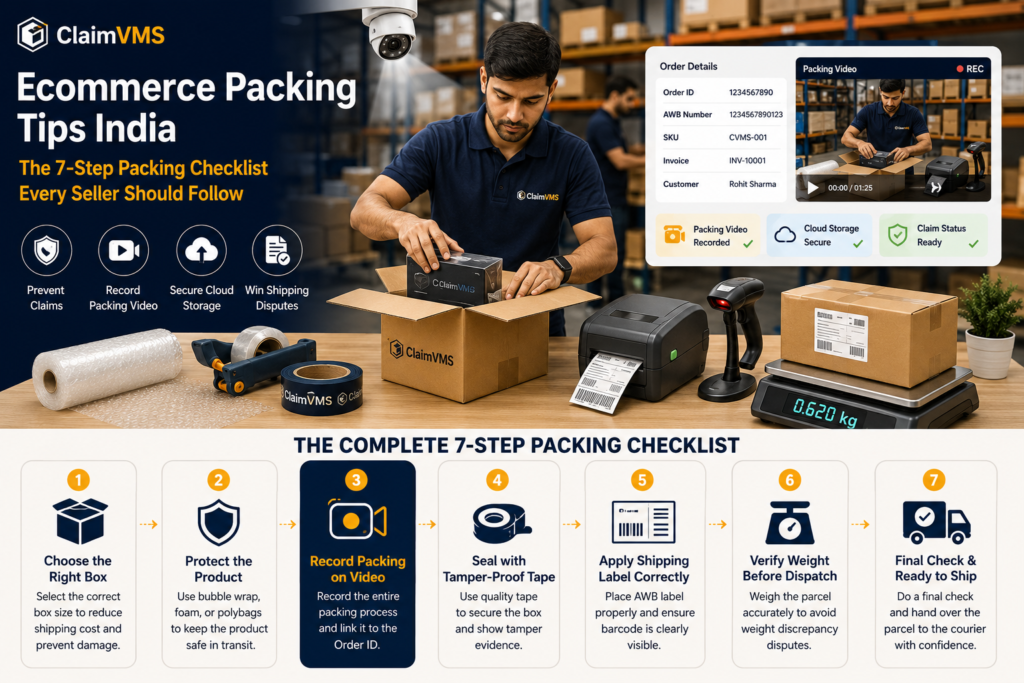
Packing is often viewed as the final operational step before an order leaves the warehouse. However, for modern ecommerce businesses, it’s much more than simply placing a product inside a box.
Every package you ship represents your brand, customer experience, and most importantly, your ability to defend yourself against return fraud, false claims, courier disputes, and marketplace investigations.
Most ecommerce packing guides focus on choosing the right box, using bubble wrap, sealing packages properly, and printing shipping labels correctly.
Those steps are important—but they’re no longer enough.
Today’s marketplace sellers on Amazon, Flipkart, Meesho, AJIO, Myntra, Shopify, and WooCommerce face increasing challenges from:
- Empty box return scams
- Wrong product claims
- Fake return requests
- Damaged product allegations
- Missing item complaints
- Courier disputes
- Weight discrepancy investigations
The biggest mistake many sellers make is failing to document the packing process itself.
This is where ClaimVMS becomes an essential part of your warehouse workflow.
ClaimVMS records every packing operation, links the recording with the Order ID, AWB number, invoice, and shipment details, and creates searchable evidence that supports claim investigations and dispute management.
Let’s explore the seven essential packing steps every ecommerce business should implement in 2026.
Why Proper Ecommerce Packing Matters More Than Ever
The ecommerce industry has become increasingly competitive, but so have fraudulent activities.
Marketplace policies are designed to protect buyers, which means sellers often need substantial documentation whenever disputes arise.
Poor packing processes can result in:
- Product damage
- Return fraud
- Customer complaints
- Marketplace penalties
- Courier disputes
- Additional shipping charges
- Claim rejections
- Loss of seller ratings
A structured packing workflow not only protects products but also creates accountability throughout warehouse operations.
Step 1: Choose the Right Packaging for Every Product
Selecting the correct packaging is the foundation of a safe shipment.
Oversized cartons increase shipping costs through volumetric weight calculations, while undersized packaging increases the risk of damage.
Consider using standardized packaging sizes for different product categories.
Examples include:
- Small accessories
- Apparel
- Electronics
- Home décor
- Combo orders
- Fragile products
Using consistent packaging also improves warehouse efficiency and inventory management.
Step 2: Record Every Packing Session
This is the step most ecommerce businesses overlook.
Recording the packing process creates visual evidence showing:
- Product condition before dispatch
- Quantity packed
- Accessories included
- Packaging quality
- Shipping label application
- Final parcel condition
Instead of relying solely on written records, businesses maintain visual documentation linked to each shipment.
ClaimVMS automates this process by connecting packing videos directly with:
- Order ID
- AWB Number
- Invoice
- SKU
- Dispatch Timestamp
- Warehouse Operator
Whenever a dispute occurs, the correct evidence can be located within minutes.
Step 3: Protect Products Internally
Internal protection should match the product type.
Examples include:
Electronics
- Bubble wrap
- Foam protection
- Anti-static packaging
Glass Items
- Double bubble wrap
- Corner protectors
- Cushion filling
Clothing
- Polybags
- Moisture protection
Cosmetics
- Leak-proof sealing
- Bubble wrap
- Cushion packaging
Proper internal protection significantly reduces transit damage.
Step 4: Seal Packages Securely
Package sealing is often underestimated.
Using tamper-evident security tape offers several benefits:
- Prevents unauthorized opening
- Improves shipment integrity
- Creates visible tampering signs
- Supports investigation during disputes
Branded security tape also strengthens customer trust while improving brand recognition.
Step 5: Apply Shipping Labels Correctly
Incorrect label placement can cause:
- Delivery delays
- Routing errors
- Failed barcode scanning
- Wrong deliveries
Best practices include:
- Apply labels on flat surfaces
- Keep barcodes unobstructed
- Avoid covering labels with tape
- Remove previous labels before reusing cartons
- Ensure AWB details remain visible
Clear labeling improves courier handling and shipment tracking.
Step 6: Verify Weight Before Dispatch
Incorrect shipment weights can result in:
- Courier overcharges
- Weight discrepancy disputes
- Shipping delays
- Additional logistics costs
Warehouse teams should:
- Use calibrated digital weighing scales
- Verify parcel dimensions
- Record actual shipment weight
- Avoid manual estimation
- Cross-check weight before dispatch
When integrated with ClaimVMS, packing videos can also include visible weight verification during the packing process.
Step 7: Document the Final Dispatch Condition
Before handing over the shipment to the courier, document the completed parcel.
The final shipment record should include:
- Sealed package
- Shipping label
- AWB Number
- Order ID
- Final packaging condition
- Weight confirmation
- Courier-ready parcel
Maintaining complete dispatch documentation provides valuable operational records whenever claim investigations occur.
Why Traditional CCTV Is No Longer Enough
Many businesses assume existing CCTV cameras provide sufficient proof.
Unfortunately, traditional CCTV footage often presents several challenges:
- Difficult to search
- Time-based recordings
- No Order ID mapping
- No AWB association
- Hours of footage to review
- Limited retrieval efficiency
Searching manually through CCTV archives during marketplace investigations can consume significant time.
How ClaimVMS Improves Packing Documentation
ClaimVMS transforms ordinary warehouse recordings into structured shipment evidence.
Instead of storing generic CCTV footage, every packing video becomes linked with:
- Order ID
- Invoice
- AWB Number
- SKU
- Dispatch Time
- Packing Operator
- Shipment History
Everything is indexed and searchable from one dashboard.
Operations teams can retrieve the correct shipment within minutes instead of reviewing hours of recordings.
Example Scenario Without ClaimVMS
A customer claims:
“The parcel arrived without the charger.”
The seller submits:
- Invoice
- Courier tracking
- Dispatch confirmation
Unfortunately, these documents cannot verify whether the charger was actually packed.
The investigation becomes difficult.
The Same Situation Using ClaimVMS
Now imagine the warehouse recorded the packing process.
The seller retrieves:
- Packing video
- Charger placement
- Product packaging
- Order verification
- AWB label
- Final sealed parcel
The complete shipment documentation provides a much clearer record for internal review and marketplace claim investigations.
Benefits of Implementing a Structured Packing Process
A standardized packing workflow offers several operational advantages.
These include:
- Reduced packing errors
- Better shipment consistency
- Faster claim investigations
- Improved warehouse accountability
- Better documentation
- Easier order verification
- Organized shipment history
- Improved operational transparency
- Reduced manual searching
- Better customer confidence
Who Should Use ClaimVMS?
ClaimVMS is suitable for businesses that regularly ship products through ecommerce platforms.
Ideal users include:
- Amazon Sellers
- Flipkart Sellers
- Myntra Sellers
- Meesho Sellers
- AJIO Sellers
- Shopify Stores
- WooCommerce Stores
- D2C Brands
- Warehouse Operators
- Fulfillment Centers
- Third-Party Logistics Providers (3PL)
Whether shipping hundreds or thousands of orders each month, maintaining structured shipment documentation helps improve operational efficiency.
Best Practices for Ecommerce Packing
Successful ecommerce businesses follow standardized packing procedures.
Recommended practices include:
- Standardize carton sizes.
- Train warehouse staff regularly.
- Use quality packing materials.
- Verify product quantity before sealing.
- Double-check shipping labels.
- Record packing operations.
- Verify shipment weight.
- Organize shipment records.
- Archive packing evidence securely.
- Review packing SOPs periodically.
Small improvements in packing operations often lead to significant reductions in claims and operational issues.
Conclusion
Packing is no longer just a logistics task—it has become a critical part of ecommerce risk management.
As marketplaces continue to strengthen documentation requirements, businesses need more than invoices and courier tracking numbers.
They need reliable, searchable shipment evidence.
ClaimVMS helps ecommerce businesses build that evidence by recording packing operations, linking videos with Order IDs and AWB numbers, and organizing shipment documentation in one centralized platform.
By integrating structured packing documentation into everyday warehouse operations, businesses can improve transparency, strengthen claim investigations, and simplify dispute management while maintaining greater confidence in every shipment they dispatch.
Frequently Asked Questions (FAQs)
1. What are the most important ecommerce packing tips?
Choosing the correct packaging, protecting products internally, verifying shipment weight, applying labels correctly, sealing parcels securely, and documenting the packing process are among the most important ecommerce packing practices.
2. Why should sellers record packing videos?
Packing videos provide visual documentation of the shipment before dispatch, helping businesses maintain accurate records for internal verification and claim investigations.
3. How does ClaimVMS improve warehouse operations?
ClaimVMS records packing videos, links them with Order IDs, AWB numbers, invoices, and shipment details, making evidence retrieval faster and more organized.
4. Does ClaimVMS work with existing warehouse cameras?
Yes. ClaimVMS is designed to integrate with most existing CCTV and warehouse camera systems.
5. Can ClaimVMS help during marketplace investigations?
ClaimVMS provides organized shipment documentation that businesses can retrieve quickly when responding to marketplace claim investigations.
6. Which ecommerce businesses can use ClaimVMS?
ClaimVMS is suitable for Amazon, Flipkart, Myntra, AJIO, Meesho, Shopify, WooCommerce, D2C brands, fulfillment centers, and warehouse operations.
7. Why is shipment documentation important?
Proper documentation helps businesses maintain accurate shipment records, improve operational transparency, and streamline claim management whenever disputes arise.
8. What is the biggest mistake sellers make while packing orders?
One of the biggest mistakes is failing to document the packing process. Without structured shipment evidence, investigating disputes and verifying dispatched orders becomes significantly more challenging.