
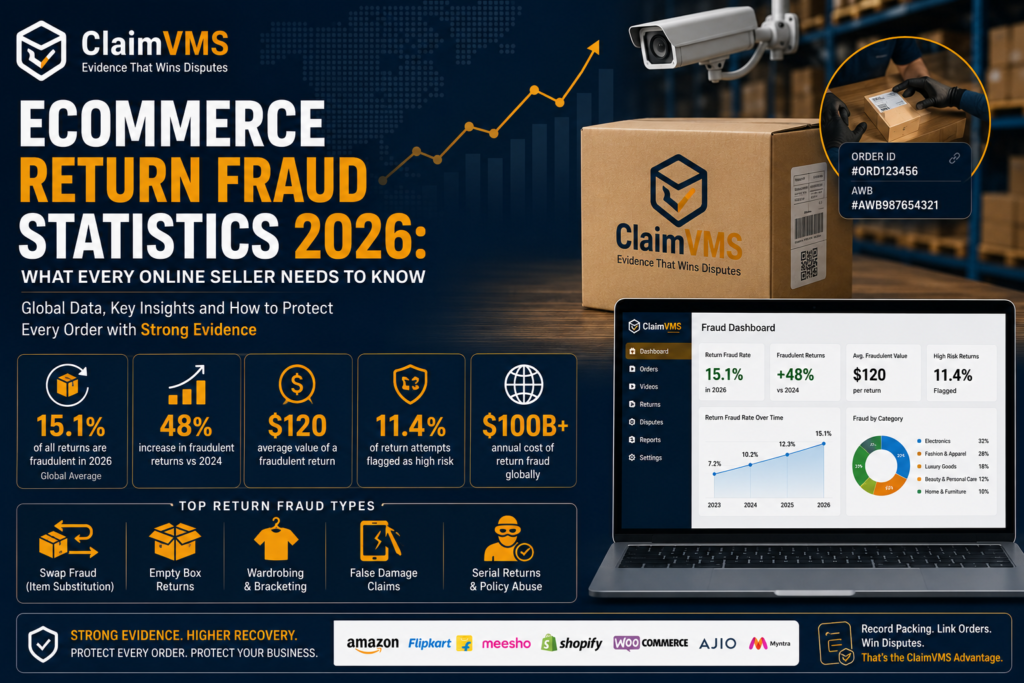
Ecommerce Return Fraud Has Become a Multi-Billion-Dollar Problem
Returns are an unavoidable part of ecommerce.
Whether customers order the wrong size, receive a damaged product, or simply change their minds, legitimate returns are a normal operating expense.
However, return fraud has evolved into one of the biggest financial threats facing ecommerce businesses.
Today, sellers are not only dealing with genuine returns—they’re also facing:
- Wrong item returns
- Empty box returns
- Fake damage claims
- Friendly fraud
- Product swap scams
- Wardrobing
- Refund abuse
As marketplaces continue to simplify return policies, fraudsters have become increasingly sophisticated in exploiting them.
For sellers on Amazon, Flipkart, Meesho, Myntra, AJIO, Shopify, WooCommerce, and D2C websites, protecting every shipment has become just as important as generating new sales.
The biggest challenge isn’t stopping every fraudulent return.
The biggest challenge is proving that fraud actually occurred.
This is exactly why modern ecommerce businesses are implementing ClaimVMS, an AI-powered Packing Video Management System that creates order-linked evidence before disputes even begin.
What the Latest Return Fraud Statistics Tell Us
Industry reports indicate that ecommerce return fraud continues to rise year after year.
While exact figures vary across research organizations and industries, the overall trend is clear:
- Return fraud is increasing.
- Refund abuse is becoming more organized.
- High-value products remain primary targets.
- Sellers are losing substantial revenue through fraudulent claims.
These statistics are not just industry headlines.
They represent real financial losses for businesses processing hundreds or thousands of online orders every month.
For many ecommerce companies, return fraud has quietly become one of the largest hidden operational costs.
Why These Numbers Matter to Your Business
Many sellers assume fraud only affects large enterprises.
Unfortunately, that isn’t true.
Consider a business shipping 300 orders every day.
If approximately 20% of those orders are returned, the warehouse processes around 60 returns daily.
Even if only a portion of those returns are fraudulent, the monthly financial exposure can quickly become significant once product value, shipping costs, warehouse handling, and operational expenses are considered.
The impact goes beyond the product itself.
Fraud also affects:
- Customer support resources
- Warehouse productivity
- Inventory accuracy
- Cash flow
- Marketplace performance metrics
- Business profitability
For growing ecommerce brands, reducing return fraud can often improve margins more effectively than increasing sales.
Which Product Categories Face the Highest Fraud Risk?
Not every ecommerce category experiences the same level of return fraud.
Certain products naturally attract more abuse because of their value or resale potential.
Electronics
Electronics remain one of the highest-risk categories.
Common fraud includes:
- Product swaps
- Counterfeit replacements
- Serial number fraud
- Fake damage claims
High-value devices such as smartphones, laptops, tablets, and smartwatches are frequent targets.
Fashion & Apparel
Fashion experiences one of the highest return volumes.
Common fraud includes:
- Wardrobing
- Returning worn clothing
- Buying multiple sizes and returning heavily used items
- Missing accessories
- Brand switching
Luxury fashion brands are especially vulnerable.
Luxury Products
Luxury watches, handbags, jewellery, and premium accessories face increased risk from counterfeit substitution.
Fraudsters often return fake products while keeping the genuine items.
Without proper verification, identifying the swap becomes difficult.
Beauty & Personal Care
Beauty products frequently experience:
- False damage claims
- Product replacement
- Claims of allergic reactions
- Opened or partially used returns
Because many beauty products cannot legally be resold after opening, even fraudulent returns can result in complete inventory loss.
Furniture & Home Products
Although return volumes may be lower, each fraudulent claim can have a much greater financial impact.
Common claims include:
- Product not as described
- Wrong colour
- Incorrect size
- Transit damage
These disputes often involve expensive shipping and handling costs.
The Most Common Types of Return Fraud
Understanding how return fraud occurs helps sellers build better warehouse processes.
Wrong Item Return Fraud
The customer purchases one product but returns something entirely different.
Examples include:
- Older models
- Broken products
- Counterfeit replacements
- Different brands
- Low-value substitutes
Without packing evidence, proving the original shipment becomes difficult.
Empty Box Returns
Customers return:
- Empty packaging
- Boxes filled with paper
- Scrap material
- Objects added to match parcel weight
The fraud often goes unnoticed until the package is opened at the warehouse.
Wardrobing
Customers intentionally purchase products for temporary use before returning them.
Examples include:
- Event clothing
- Shoes
- Watches
- Fashion accessories
- Consumer electronics
The returned item may no longer be in resale condition.
False Damage Claims
A customer claims the product arrived damaged despite receiving it in perfect condition.
Increasingly, these claims include:
- Edited product images
- AI-generated damage photographs
- Misleading descriptions
Without evidence from dispatch, defending these claims becomes much harder.
Serial Number & Product Swap Fraud
High-value electronics frequently include:
- IMEI numbers
- Serial numbers
- Manufacturer labels
Fraudsters replace the original product with another device before requesting a refund.
Recording serial numbers during packing helps identify these substitutions.
A Real Seller Example
Imagine an ecommerce business fulfilling 500 orders every day across Amazon, Flipkart, Shopify, and its own website.
Over several months, the warehouse notices a growing pattern of suspicious returns.
These include:
- Wrong products
- Empty cartons
- Fake damage complaints
- Counterfeit replacements
- Used items returned as new
Although the warehouse has CCTV cameras installed, retrieving footage requires manually searching through hours of recordings.
Even after locating the correct video, it often fails to clearly show:
- Product condition
- SKU verification
- Serial numbers
- Order ID
- The complete packing process
As a result, many disputes are rejected due to insufficient evidence.
After implementing ClaimVMS, every packing station automatically records the complete packing process.
Each recording is linked with:
- Order ID
- AWB Number
- Product SKU
- Marketplace
- Packing Timestamp
Now, whenever a dispute arises, warehouse staff retrieve the exact packing video within seconds.
Instead of relying on assumptions, the business responds with independently verifiable evidence.
The Biggest Lesson from the 2026 Return Fraud Trend
The latest return fraud statistics highlight one important reality:
Fraud is increasing across every major ecommerce platform.
While sellers cannot completely eliminate fraudulent behavior, they can significantly improve their ability to detect, document, and recover losses.
Businesses that rely only on invoices, courier tracking, or traditional CCTV often struggle to prove their case.
Businesses that create order-specific evidence before shipment are much better prepared when disputes occur.
That is where ClaimVMS provides a measurable advantage.
The Hidden Cost of Return Fraud Goes Beyond the Product Value
Many ecommerce sellers measure fraud by looking only at the refund amount.
In reality, every fraudulent return creates multiple layers of financial loss.
When a fraudulent return reaches your warehouse, your business may lose:
- Product value
- Outbound shipping charges
- Return shipping costs
- Warehouse handling expenses
- Inspection costs
- Repackaging expenses
- Customer support time
- Marketplace penalties
- Inventory value
- Profit margin
For premium products, the total operational cost can easily exceed the original selling price.
This is why return fraud should be viewed as an operational risk—not just a refund issue.
Your Recovery Rate Is More Important Than Your Fraud Rate
Most ecommerce businesses focus on one question:
“How much return fraud do we have?”
A better question is:
“How much fraudulent revenue are we recovering?”
Every ecommerce business experiences some level of return fraud.
The difference between successful sellers and struggling sellers is their ability to recover losses through strong evidence.
Imagine two businesses with identical fraud rates.
Business A
- Detects fraud.
- Has limited evidence.
- Submits weak dispute responses.
- Recovers very little.
Business B
- Detects fraud.
- Retrieves order-linked packing videos.
- Provides structured evidence.
- Wins significantly more claims.
The fraud exposure may be similar.
The recovery outcome is completely different.
Why Traditional Return Management Isn’t Enough
Many warehouses still depend on:
- Warehouse CCTV
- Order invoices
- Courier tracking
- Product catalogue images
- Internal warehouse notes
Although useful, these records rarely answer the most important dispute question:
“What exactly was packed for this order?”
Courier tracking confirms delivery.
Invoices confirm a purchase.
Warehouse notes describe the packing process.
None of them independently prove:
- Product condition
- SKU verification
- Quantity packed
- Accessories included
- Serial numbers
- Final sealed parcel
This evidence gap is one of the main reasons many legitimate seller claims are unsuccessful.
The ClaimVMS Evidence-First Strategy
ClaimVMS is designed to solve this evidence gap.
Instead of relying on documentation created after a dispute, ClaimVMS automatically records evidence during the packing process.
Every order receives its own visual record before it leaves the warehouse.
Each recording is linked directly with:
- Order ID
- AWB Number
- Marketplace
- SKU
- Packing Date & Time
- Warehouse Operator
Because the evidence is created before any dispute exists, it carries much greater credibility during investigations.
The Two-Layer ClaimVMS Protection System
Winning return disputes requires evidence from both ends of the order lifecycle.
Layer 1 – Dispatch Evidence
Before shipment, ClaimVMS records:
- Product selection
- Product condition
- SKU verification
- Quantity verification
- Accessories included
- Serial numbers (where applicable)
- Order ID
- AWB label
- Final sealed package
This creates visual proof of exactly what left the warehouse.
Layer 2 – Return Inspection Evidence
When a returned parcel arrives, warehouse staff should follow a standardized inspection process.
Recommended steps include:
- Inspect the unopened parcel
- Verify the return label
- Photograph the parcel
- Record parcel weight
- Capture a continuous return-opening video
- Document every item removed from the parcel
This creates evidence showing exactly what the customer returned.
Together, dispatch and return-opening videos create a complete evidence chain that is extremely valuable during marketplace investigations.
How ClaimVMS Improves Claim Recovery
Recovering fraudulent losses depends on how quickly and accurately evidence can be produced.
ClaimVMS dramatically simplifies this process.
Instead of manually reviewing warehouse CCTV, sellers simply search using:
- Order ID
- AWB Number
- SKU
- Marketplace
- Packing Date
The required video appears within seconds.
This allows businesses to respond faster to:
- Amazon SAFE-T Claims
- Marketplace investigations
- Payment chargebacks
- Wrong item disputes
- Empty box claims
- Friendly fraud
- Product swap investigations
Fast access to reliable evidence improves operational efficiency while strengthening every dispute response.
Best Practices for Reducing Return Fraud
Technology is only one part of a successful fraud prevention strategy.
Every ecommerce warehouse should also implement strong operational procedures.
Recommended best practices include:
- Record every packing process.
- Verify SKU before sealing.
- Capture serial numbers for premium products.
- Weigh high-value parcels.
- Record suspicious return openings.
- Train warehouse staff regularly.
- Maintain standardized inspection SOPs.
- Store evidence securely.
- Respond to disputes immediately.
- Review fraud trends every month.
Consistency creates stronger evidence.
Why More Ecommerce Businesses Are Choosing ClaimVMS
ClaimVMS is purpose-built for ecommerce fulfillment and dispute management.
Key capabilities include:
- Automatic Packing Video Recording
- AI-Powered Video Search
- Order ID & AWB Linking
- SKU Verification
- Multi-Camera Support
- Cloud & Local Storage
- Secure Evidence Management
- Fast Video Retrieval
- Marketplace-Ready Documentation
- Warehouse Transparency
Whether your business ships 100 orders or 100,000 orders every day, ClaimVMS scales with your operations while protecting every shipment with independently verifiable evidence.
Final Thoughts
The latest ecommerce return fraud statistics confirm one important reality:
Return fraud is no longer an occasional business risk.
It is a growing operational challenge affecting sellers across every major ecommerce platform.
While businesses cannot eliminate every fraudulent return, they can dramatically improve how they respond.
The most successful sellers are not necessarily the ones experiencing less fraud.
They are the ones with stronger evidence.
By combining automated packing videos, structured return inspections, and intelligent evidence management, ClaimVMS helps ecommerce businesses recover more losses, reduce manual investigations, and build greater confidence in every dispute response.
In modern ecommerce, the goal is not simply to detect fraud.
The goal is to prove it.
Frequently Asked Questions (FAQs)
What is the ecommerce return fraud rate in 2026?
Industry research shows that return fraud continues to rise across ecommerce, with estimates indicating that a significant percentage of all returns involve fraudulent or abusive behavior. The trend highlights the growing need for stronger evidence and fraud prevention systems.
Why is return fraud increasing?
Factors contributing to the increase include easier return policies, higher online shopping volumes, AI-generated fake damage claims, organized fraud networks, and the growing resale value of many ecommerce products.
What is the best way to reduce return fraud?
The most effective approach combines operational controls—such as SKU verification and return inspections—with automated packing videos that provide independent evidence before shipment.
How does ClaimVMS help recover fraudulent losses?
ClaimVMS automatically records order-specific packing videos, links them with the Order ID and AWB, and allows sellers to retrieve evidence within seconds when responding to disputes.
Which ecommerce platforms can use ClaimVMS?
ClaimVMS supports sellers operating on Amazon, Flipkart, Meesho, Myntra, AJIO, Shopify, WooCommerce, Magento, and other D2C ecommerce platforms.