
Why Most Ecommerce Sellers Lose Disputes Even When They’re Right
Every day, ecommerce sellers lose disputes despite shipping the correct product in perfect condition.
The problem usually isn’t that the seller made a mistake.
The problem is that they cannot prove what actually happened.
Whether the dispute involves:
- Wrong Item Received
- Empty Box Return
- Product Not as Described
- Friendly Fraud
- Fake Damage Claims
- Chargebacks
- Item Not Received (INR)
the final decision depends almost entirely on the quality of the evidence submitted.
Many sellers believe invoices, courier tracking, and warehouse CCTV are enough.
Unfortunately, they aren’t.
Modern dispute resolution is driven by evidence quality, not assumptions.
That is why leading ecommerce businesses are investing in structured evidence systems like ClaimVMS, which automatically create order-linked proof before disputes even occur.
Not All Evidence Carries the Same Weight
One of the biggest misconceptions among ecommerce sellers is believing that every document has equal value.
In reality, banks, payment gateways, marketplaces, and dispute teams evaluate different types of evidence differently.
Consider these examples:
Seller A submits:
- Invoice
- Courier Tracking
- Order Confirmation
Seller B submits:
- Order-linked packing video
- Product condition before dispatch
- Order ID verification
- AWB label
- Delivery confirmation
- Return opening video
- Serial number verification
Both sellers respond to the same dispute.
Only one provides direct proof.
Naturally, the second seller has a much stronger case.
This demonstrates an important principle:
Evidence is ranked by how easily it can independently verify what actually happened.
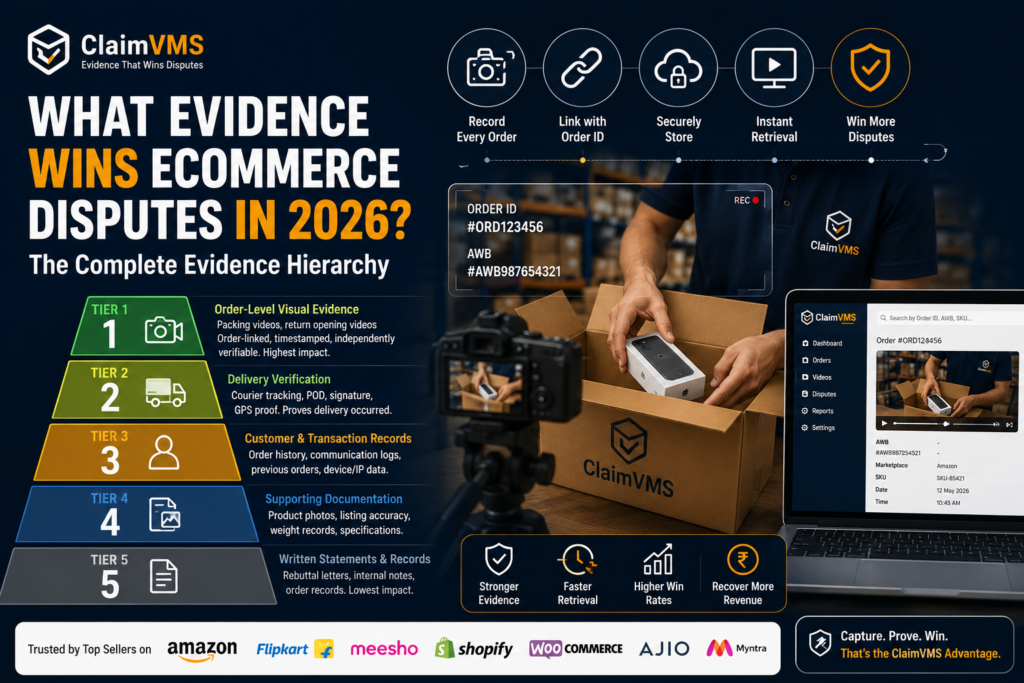
Understanding the Ecommerce Evidence Hierarchy
Think of dispute evidence as a pyramid.
The higher the evidence sits in the hierarchy, the greater its value during investigations.
ClaimVMS follows a five-level evidence hierarchy that helps sellers understand which documentation has the greatest impact during disputes.
Tier 1 – Order-Level Visual Evidence (Highest Value)
This is the strongest evidence available during ecommerce disputes.
Tier 1 evidence includes:
- Packing videos
- Return opening videos
- Order-linked video proof
- Timestamped dispatch recordings
Why is it so powerful?
Because it directly shows:
- The product being packed
- Product condition
- Quantity
- SKU
- Accessories
- Order ID
- AWB label
- Final sealed parcel
Unlike written statements, these recordings provide visual proof created before the dispute exists.
For disputes involving:
- Wrong item received
- Product swaps
- Fake damage claims
- Empty box returns
Tier 1 evidence provides the strongest foundation.
Why ClaimVMS Focuses on Tier 1 Evidence
Traditional warehouse CCTV records everything.
ClaimVMS records the right things.
Instead of monitoring general warehouse activity, ClaimVMS creates evidence specifically designed for ecommerce disputes.
Every packing video is automatically linked with:
- Order ID
- AWB Number
- SKU
- Marketplace
- Packing Timestamp
This makes retrieving evidence simple and fast.
Tier 2 – Delivery Verification
The second level of evidence focuses on proving that the shipment reached the customer.
Examples include:
- Courier tracking
- Delivery confirmation
- Signature confirmation
- GPS delivery proof
- Courier POD (Proof of Delivery)
Tier 2 evidence answers one important question:
“Was the parcel delivered?”
However, it cannot answer another critical question:
“What was actually inside the parcel?”
This limitation is why delivery confirmation alone often fails during product-related disputes.
When Delivery Proof Is Enough
Delivery confirmation works well for disputes involving:
- Item Not Received
- Failed Delivery Claims
- Shipment Tracking Issues
But if the customer claims:
- Wrong item received
- Product damaged
- Missing accessories
- Empty parcel
Delivery tracking alone becomes insufficient.
Additional product-level evidence is required.
Tier 3 – Customer & Transaction Records
The next level includes supporting documentation showing the customer’s interaction with the order.
Examples include:
- Customer emails
- Live chat history
- Previous successful purchases
- Order history
- Customer acknowledgements
These records provide useful context.
For example:
A customer who confirmed receiving the parcel before filing a chargeback creates an inconsistency that may strengthen the seller’s response.
However, these records still do not prove what was physically packed.
Why Tier 3 Cannot Replace Visual Evidence
Customer communication can be edited, misunderstood, or interpreted differently.
Visual documentation remains much stronger because it records actual warehouse activity rather than conversations.
This is why Tier 3 should support Tier 1—not replace it.
Tier 4 – Supporting Product Documentation
Many ecommerce businesses submit:
- Product photographs
- Product catalogue images
- Listing screenshots
- Weight reports
- Product specifications
Although useful, these documents only support the primary evidence.
For example:
A product image shows how the product should look.
It does not prove that the same product was packed for a specific customer.
Similarly, a weight record may indicate a discrepancy, but without a packing video it rarely explains why the difference occurred.
Tier 5 – Written Statements & Business Records
The lowest level of evidence includes:
- Written explanations
- Internal notes
- Order processing records
- Warehouse logs
- Fulfillment reports
These documents rely heavily on trust.
They tell investigators what the seller believes happened rather than proving it independently.
While they remain useful as supporting information, they should never be the primary evidence during a dispute.
A Real Business Example
Imagine an Amazon seller processing nearly 500 orders every day.
A customer claims they received the wrong product.
The seller responds using:
- Invoice
- Courier tracking
- Internal warehouse notes
Unfortunately, none of these prove what was inside the parcel.
After implementing ClaimVMS, every shipment is automatically recorded during packing.
The video clearly shows:
- Correct product
- Correct SKU
- Correct accessories
- Order ID
- AWB label
- Final sealed package
Instead of submitting assumptions, the seller now submits independent visual proof.
This significantly strengthens the dispute response while reducing investigation time.
The Biggest Mistake Most Sellers Make
Many ecommerce businesses collect evidence after receiving a dispute notification.
By that time:
- CCTV footage may have been overwritten.
- Warehouse staff may not remember the order.
- Product photographs may not exist.
- Evidence becomes difficult to reconstruct.
The strongest evidence is always created before the parcel leaves the warehouse.
That is exactly what ClaimVMS automates.
Why Tier 1 Evidence Wins More Ecommerce Disputes
The biggest difference between sellers who consistently win disputes and those who frequently lose is not the quality of their products—it’s the quality of their evidence.
Most disputes are decided by answering one simple question:
“Can the seller independently prove what happened?”
If the answer is yes, the seller has a much stronger chance of recovering their money.
If the answer is no, the investigation often relies on customer statements and limited documentation.
That is why Tier 1 evidence consistently delivers the best results.
It provides visual proof that exists before any dispute begins.
The ClaimVMS Tier 1 Evidence System
ClaimVMS was built specifically to create Tier 1 ecommerce dispute evidence automatically.
Instead of relying on manual documentation, the platform records every packing process and securely links each recording to the corresponding order.
Every packing video includes:
- Product verification
- Product condition
- SKU confirmation
- Quantity verification
- Accessories packed
- Order ID
- AWB Number
- Final sealed package
- Date & Time stamp
This creates independently verifiable evidence that can be retrieved within seconds whenever a dispute occurs.
Completing the Evidence Chain with Return Opening Videos
Winning disputes doesn’t end with dispatch.
When a returned parcel reaches the warehouse, businesses should document the return-opening process using a continuous video.
A standardized return inspection should include:
- Recording the unopened parcel
- Showing the return label
- Checking for tampering
- Recording parcel weight
- Opening the package without interruption
- Displaying every item removed
Combined with the original packing video, this creates a complete before-and-after evidence chain.
This approach is especially effective for:
- Wrong item returns
- Empty box fraud
- Product swap fraud
- Missing accessory claims
- Counterfeit product returns
Why ClaimVMS Is Better Than Traditional Warehouse CCTV
Many warehouses already use CCTV cameras for security.
However, CCTV footage is rarely designed for ecommerce dispute resolution.
Traditional CCTV often struggles to capture:
- Product details
- Serial numbers
- SKU labels
- Order IDs
- Product condition
- Complete packing workflow
Another major challenge is retrieval.
Searching several hours of footage for one specific order wastes valuable time, especially when dispute deadlines are approaching.
ClaimVMS solves these problems by creating order-specific videos instead of general surveillance recordings.
Every video is searchable using:
- Order ID
- AWB Number
- SKU
- Date
- Marketplace
The result is faster investigations and significantly less manual effort.
Matching the Right Evidence to the Right Dispute
Different disputes require different types of evidence.
Submitting irrelevant documents weakens your response.
For example:
Item Not Received (INR)
Most effective evidence:
- Delivery confirmation
- Courier tracking
- GPS delivery proof
- Signature confirmation (for eligible shipments)
Wrong Item Received
Most effective evidence:
- Packing video
- SKU verification
- Order ID confirmation
- Return-opening video
Product Not as Described
Most effective evidence:
- Packing video showing product condition
- Product listing
- Product specifications
- Customer communication (if relevant)
Empty Box Return
Most effective evidence:
- Dispatch packing video
- Return-opening video
- Weight comparison
- Courier records
Choosing evidence that directly addresses the customer’s claim significantly improves the quality of the dispute response.
Marketplace-Specific Applications
ClaimVMS supports evidence requirements across major ecommerce platforms.
Amazon SAFE-T Claims
Amazon sellers frequently handle disputes involving:
- Wrong item returns
- Product swaps
- Empty box claims
- Missing accessories
- Friendly fraud
ClaimVMS allows sellers to retrieve:
- Packing videos
- Order details
- AWB information
- Return-opening videos
This creates a comprehensive evidence package for SAFE-T claim submissions.
Shopify & WooCommerce Chargebacks
Independent ecommerce businesses often receive chargebacks for:
- Item Not Received
- Product Not as Described
- Unauthorized Transaction
- Missing Items
ClaimVMS strengthens chargeback responses by providing order-specific visual evidence that complements invoices and delivery records.
Flipkart, Meesho, Myntra & AJIO Seller Protection
Marketplace sellers regularly face:
- Wrong item disputes
- Fake damage claims
- Product swaps
- Empty parcel complaints
- Refund abuse
Order-linked packing videos help demonstrate exactly what was shipped, improving transparency during investigations.
Five Evidence Mistakes That Cost Sellers Money
Many disputes are lost because of simple but avoidable mistakes.
The most common include:
Relying Only on Invoices
Invoices confirm a purchase but do not prove the contents or condition of the parcel.
Submitting Tracking for Product Disputes
Tracking confirms delivery.
It does not prove which product was packed.
Searching CCTV After the Dispute
By the time a dispute is raised, CCTV footage may be difficult to locate or may no longer be available.
Failing to Record High-Value Orders
Premium products should always include additional evidence such as serial numbers and packing videos.
Missing Response Deadlines
Even strong evidence may not help if it is submitted after the dispute deadline.
Fast retrieval is just as important as good documentation.
Best Practices for Building a Strong Evidence System
Every ecommerce warehouse should adopt consistent evidence management procedures.
Recommended best practices include:
- Record every packing process.
- Link videos with Order IDs and AWBs.
- Verify SKU before dispatch.
- Record serial numbers for premium products.
- Capture return-opening videos.
- Measure parcel weight when appropriate.
- Store evidence securely.
- Train warehouse teams regularly.
- Maintain documented SOPs.
- Respond to disputes immediately.
A consistent process produces consistent evidence.
Why More Ecommerce Businesses Are Choosing ClaimVMS
ClaimVMS is designed specifically for ecommerce fulfilment and dispute management.
Core capabilities include:
- Automated Packing Video Recording
- AI-Powered Video Search
- Order ID & AWB Linking
- SKU Verification
- Multi-Camera Support
- Cloud & Local Storage
- Secure Evidence Management
- Fast Video Retrieval
- Marketplace-Ready Documentation
- Warehouse Transparency
Whether your business ships 100 or 100,000 orders every day, ClaimVMS scales with your operations while ensuring every shipment is backed by reliable visual proof.
Final Thoughts
Winning ecommerce disputes is no longer about writing better explanations.
It is about submitting stronger evidence.
Businesses that rely only on invoices, tracking numbers, or warehouse notes often struggle to prove what happened.
Businesses that create order-linked visual evidence before shipment are in a much stronger position.
By combining automated packing videos, structured return inspections, and intelligent evidence management, ClaimVMS helps sellers protect revenue, reduce fraud-related losses, and respond confidently to disputes across Amazon, Flipkart, Shopify, WooCommerce, AJIO, Myntra, Meesho, and D2C ecommerce platforms.
In ecommerce disputes, the strongest argument is not what you say—it is what you can prove.
Frequently Asked Questions (FAQs)
What is Tier 1 evidence in ecommerce disputes?
Tier 1 evidence is independently verifiable evidence, such as order-linked packing videos and return-opening videos, that directly proves what was shipped or returned for a specific order.
Why is a packing video more valuable than an invoice?
An invoice confirms that an order exists, while a packing video visually proves the product, condition, quantity, SKU, and packaging for that specific shipment.
Does courier tracking help with all disputes?
No. Courier tracking is most effective for “Item Not Received” disputes. It does not prove the contents or condition of the parcel in product-related disputes.
Can ClaimVMS improve Amazon SAFE-T and chargeback claims?
Yes. ClaimVMS enables sellers to retrieve order-linked packing videos and related evidence quickly, helping build stronger responses for marketplace disputes and payment chargebacks.
Which ecommerce platforms can use ClaimVMS?
ClaimVMS supports Amazon, Flipkart, Meesho, Myntra, AJIO, Shopify, WooCommerce, Magento, and most D2C ecommerce businesses.