
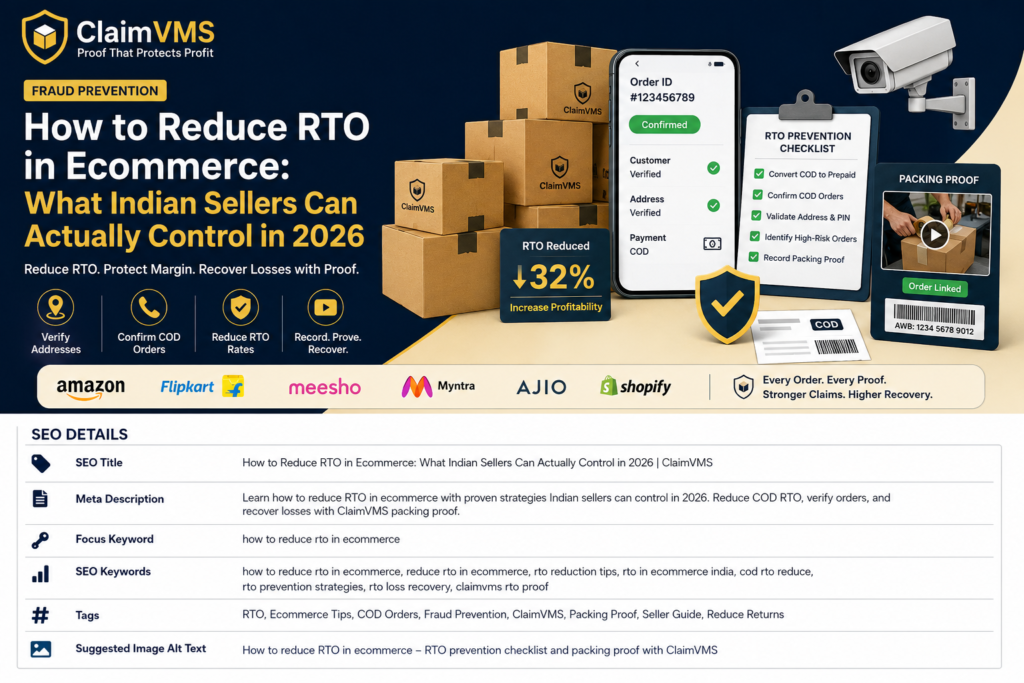
How to Reduce RTO in Ecommerce: What Indian Sellers Can Actually Control in 2026
For Amazon, Flipkart, Myntra, AJIO, Meesho, Shopify, and D2C sellers. Updated for 2026.
Return to Origin (RTO) continues to be one of the biggest profit killers for Indian ecommerce sellers. Every unsuccessful delivery doesn’t just mean a lost sale—it also brings additional shipping charges, inventory delays, and increased operational costs.
Many sellers believe RTO is simply part of doing business. In reality, a large percentage of RTO losses can be reduced by improving order verification, customer validation, and operational processes. Even when an RTO cannot be prevented, proper documentation can help recover losses through marketplace claims.
This guide explains the factors you can actually control and how ClaimVMS helps sellers reduce financial losses caused by RTO.
What Does an RTO Actually Cost?
Every RTO order creates multiple expenses:
- Forward shipping charges
- Reverse shipping charges
- Inventory blocked during transit
- Warehouse handling costs
- Lost sales opportunity
- Customer acquisition cost wasted
For Cash-on-Delivery (COD) orders, sellers receive no payment while paying both forward and reverse logistics.
An ecommerce business with a 30% COD RTO rate can lose lakhs of rupees every month purely through logistics expenses.
Why Do Ecommerce Orders Become RTO?
Although every business experiences some RTOs, most failed deliveries fall into a few common categories.
1. Cash-on-Delivery Orders
COD buyers can easily refuse delivery because no payment has been made upfront. Last-minute cancellations and impulse purchases significantly increase RTO rates.
2. Incorrect Customer Information
Common issues include:
- Invalid mobile numbers
- Wrong PIN codes
- Incomplete delivery addresses
- Customers unavailable during delivery
These problems often lead to multiple failed delivery attempts before the shipment is returned.
3. Low Purchase Intent
Many buyers place orders during promotional sales without genuine purchase intent. Duplicate orders and “order now, decide later” behavior frequently result in doorstep refusals.
4. Delivery Challenges
Remote locations, courier delays, and unsuccessful delivery attempts can also contribute to RTO, especially across Tier-2 and Tier-3 cities.
While sellers cannot control courier operations, they can significantly reduce avoidable RTOs by improving order validation before dispatch.
A Real Example: Reducing RTO Losses
Consider an apparel seller shipping hundreds of COD orders every day across multiple marketplaces.
Initially, nearly one-third of the shipments were returning as RTO.
Instead of simply blocking locations, the business introduced:
- COD order confirmation
- WhatsApp verification
- IVR confirmation
- Prepaid payment incentives
This immediately reduced unnecessary shipments.
However, some RTOs still occurred.
The business then implemented ClaimVMS to maintain complete proof of every packed order.
Whenever returned parcels arrived opened, tampered, or with missing products, the seller had timestamped packing evidence ready for marketplace claim submissions.
Instead of absorbing every loss, they were able to recover a significant portion through documented evidence.
Returns Cannot Be Eliminated—But Losses Can Be Reduced
No ecommerce seller can completely eliminate RTO.
The goal should be:
- Reduce avoidable RTOs.
- Verify high-risk orders before shipping.
- Maintain proof for every dispatched package.
- Recover losses whenever disputes arise.
Businesses that combine preventive measures with proper documentation consistently reduce overall RTO-related losses.
The Practical Steps That Actually Reduce RTO
Most successful ecommerce businesses focus on a few proven strategies instead of trying to solve everything at once.
Encourage More Prepaid Orders
Offering small prepaid discounts, cashback, or free shipping motivates customers to pay before dispatch.
Since prepaid orders are far less likely to be refused, even a modest increase in prepaid conversions can significantly lower overall RTO rates.
Verify COD Orders Before Shipping
Order confirmation through:
- IVR calls
- SMS verification
- Customer support calls
helps eliminate duplicate, fake, and impulse purchases before shipping costs are incurred.
Validate Customer Information
Checking delivery addresses, PIN codes, and phone numbers before dispatch reduces failed deliveries caused by incorrect customer details.
Identify High-Risk Orders
Past customer behavior, unusually high-value COD orders, and repeat refusals can all indicate higher RTO risk.
Applying additional verification for these orders often prevents unnecessary shipping expenses.
Maintain Packing Proof for Every Shipment
Even after taking preventive measures, some RTO shipments will still return.
In many cases, sellers receive:
- Opened packages
- Empty parcels
- Missing products
- Swapped items
- Tampered packaging
Without evidence, these losses usually become write-offs.
With complete packing proof, sellers can confidently submit claims backed by verifiable documentation.
How ClaimVMS Helps Recover RTO Losses
Reducing RTO is only one part of protecting profitability.
When disputes arise, ClaimVMS provides organized evidence linked directly to every shipment.
ClaimVMS enables sellers to:
- Record every packing process automatically
- Link videos with Order ID, SKU, and AWB
- Store videos securely in the cloud
- Retrieve any order recording within minutes
- Submit marketplace claims with strong visual evidence
Instead of depending on scattered CCTV footage or manual recordings, sellers maintain a searchable proof library for every dispatched order.
This greatly improves the chances of recovering losses from tampered or incomplete RTO shipments.
RTO Self-Assessment Checklist
Ask yourself these five questions:
1. Do you know your current RTO percentage separately for COD and prepaid orders?
Understanding where losses occur is the first step toward reducing them.
2. Are all high-risk COD orders verified before dispatch?
Order confirmation helps prevent unnecessary shipping costs.
3. Is customer address and contact information validated before shipping?
Better customer data leads to fewer delivery failures.
4. Can you prove exactly what was packed for every order?
Packing evidence strengthens marketplace dispute claims.
5. How much money was lost last month because you lacked sufficient proof?
For many sellers, this amount is far higher than expected.
Final Thoughts
RTO cannot be completely eliminated, but it can be managed.
Successful ecommerce businesses focus on two objectives:
- Prevent avoidable RTO through better order verification and customer validation.
- Recover unavoidable losses with reliable packing evidence.
ClaimVMS helps ecommerce sellers do both by creating organized, order-linked packing records that simplify dispute resolution and improve claim success across leading Indian marketplaces.