
Running a successful dropshipping business is no longer just about finding winning products and increasing sales. As online commerce grows, fraud has become one of the biggest threats to profitability.
Many sellers invest heavily in payment security but still lose thousands of rupees—or even lakhs—every month because of fraudulent refund claims, chargebacks, and post-purchase disputes.
The reality is simple:
Dropshipping fraud isn’t one problem. It’s two completely different problems that require two different protection strategies.
The first occurs before payment, where fraudsters use stolen cards or compromised accounts to place orders.
The second happens after delivery, where genuine customers—or organized refund fraud groups—claim they never received the product, received the wrong item, or received an empty package.
Most fraud prevention articles only discuss the first category.
The second category is where many ecommerce businesses lose the majority of their revenue.
ClaimVMS is designed to help businesses protect themselves against the fraud that happens after checkout, where traditional payment security solutions no longer help.
Understanding the Two Types of Dropshipping Fraud
Many ecommerce sellers think installing payment security software completely protects their business.
Unfortunately, that’s only half the picture.
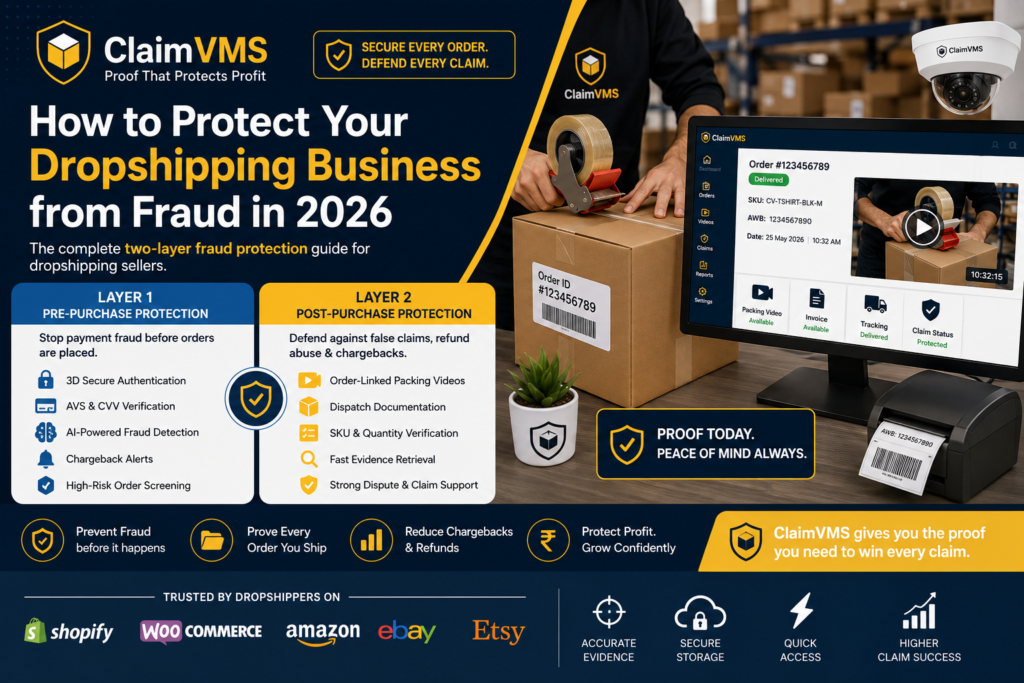
A complete fraud prevention strategy includes two independent protection layers.
Layer 1
Pre-Purchase Fraud Prevention
Protects against:
- Stolen credit cards
- Fake customer accounts
- Unauthorized transactions
- Identity theft
- Bot attacks
These risks occur before the order is approved.
Layer 2
Post-Purchase Fraud Prevention
Protects against:
- False “Item Not Received” claims
- Wrong item disputes
- Empty box scams
- Product swap fraud
- Fake damaged product claims
- Friendly fraud
- Refund abuse
These occur after the order has already been packed and shipped.
Traditional fraud tools stop working once the parcel leaves your warehouse.
This is where ClaimVMS becomes essential.
Why Fraud Is Increasing for Dropshipping Businesses
Dropshipping businesses are especially attractive targets because sellers usually never meet the customer and often rely on third-party fulfillment partners.
Fraudsters know this.
They understand that many businesses have:
- Limited warehouse documentation
- No proof of packing
- No order-specific dispatch evidence
- Weak dispute management process
Without proper evidence, many sellers simply approve refunds because fighting claims becomes difficult.
This creates an opportunity for organized refund fraud networks.
The Fraud Landscape Every Dropshipper Faces
Fraud today extends far beyond stolen credit cards.
Modern ecommerce businesses encounter several categories of fraud throughout the customer journey.
Payment Fraud
Payment fraud occurs when someone uses:
- Stolen debit cards
- Stolen credit cards
- Compromised payment credentials
- Fake customer identities
The fraudulent activity happens during checkout.
If approved, the actual cardholder later files an unauthorized transaction dispute.
These disputes usually arrive within a few weeks after purchase.
Payment fraud increases:
- Chargebacks
- Processing fees
- Fraud investigation costs
- Payment gateway risk scores
Fortunately, this category is already addressed by modern payment gateways and fraud detection tools.
Friendly Fraud
Friendly fraud is completely different.
Here, the customer is real.
The payment is genuine.
The order is delivered successfully.
Yet the customer later disputes the transaction.
Common examples include:
- “I never received my order.”
- “The wrong product arrived.”
- “The product was damaged.”
- “The box was empty.”
- “The product wasn’t as described.”
Unlike payment fraud, these disputes cannot be prevented during checkout because the transaction itself was legitimate.
The challenge begins after delivery.
Refund Abuse
Refund abuse has become one of the fastest-growing problems for ecommerce sellers.
Customers deliberately purchase products while planning to request refunds later.
Some examples include:
- Keeping the product while requesting a refund
- Returning a different item
- Returning used products
- Claiming fake damage
- Filing repeated marketplace disputes
Organized “Refund-as-a-Service” (RaaS) groups now teach buyers exactly how to exploit marketplace refund policies.
Without strong order evidence, many sellers are forced to absorb these losses.
Why Most Fraud Prevention Guides Leave Sellers Unprotected
Search online for dropshipping fraud prevention, and you’ll find advice like:
- Enable 3D Secure (3DS)
- Use AVS verification
- Verify CVV
- Install fraud detection software
- Block suspicious IP addresses
All of these are valuable.
However, they only protect the payment stage.
They cannot answer questions like:
- What product was actually packed?
- Was the parcel sealed correctly?
- Was the correct SKU shipped?
- Was the item damaged before dispatch?
- Can the seller prove the parcel contents?
These questions arise only after the order has been shipped.
Traditional fraud prevention software has no visibility into warehouse operations.
That is why many businesses continue losing disputes despite having excellent payment security.
The Missing Layer: Post-Purchase Evidence
Every post-purchase dispute eventually comes down to one simple question:
What exactly left your warehouse?
Without evidence, sellers rely on:
- Product photographs
- Order invoices
- Courier tracking
- Written explanations
Unfortunately, none of these prove what was actually placed inside the parcel.
ClaimVMS solves this challenge by automatically creating order-linked packing evidence.
Each packing session is securely connected to:
- Order ID
- SKU
- Invoice
- AWB Number
- Dispatch details
When a dispute occurs, sellers can retrieve the exact packing proof within minutes and submit strong evidence to marketplaces or payment providers.
Layer 1: Pre-Purchase Fraud Protection
The first layer of fraud prevention focuses on stopping fraudulent transactions before an order is approved and dispatched. Every dropshipping business should implement these security measures to reduce payment-related chargebacks and protect revenue.
While these tools are highly effective, it’s important to understand that they only secure the checkout process. They cannot protect sellers from disputes that occur after the order has been shipped.
Enable 3D Secure (3DS) Authentication
3D Secure (3DS2) is one of the most effective methods for preventing unauthorized card transactions.
When enabled, customers complete an additional authentication step with their issuing bank before payment is approved.
Benefits include:
- Reduces stolen card transactions
- Transfers liability for eligible transactions to the issuing bank
- Lowers payment fraud chargebacks
- Improves payment security
Every Shopify, WooCommerce, and custom ecommerce store should enable 3DS wherever supported by the payment gateway.
Use AVS and CVV Verification
Address Verification System (AVS) compares the customer’s billing address with the address registered with their bank.
CVV verification confirms that the customer possesses the physical payment card during checkout.
Together, these checks help identify suspicious transactions before payment approval.
They are particularly useful for detecting:
- Stolen card usage
- Fake customer accounts
- Credential theft
- Automated payment attacks
Although AVS and CVV improve checkout security, they cannot prevent post-delivery refund fraud.
Implement Behavioral Fraud Detection
Modern fraud detection platforms use artificial intelligence and machine learning to analyze customer behavior before approving payments.
These systems evaluate:
- Device fingerprint
- Browser behavior
- IP reputation
- Purchase history
- Multiple failed payment attempts
- High-risk geolocations
- Velocity of transactions
Orders identified as high risk can be automatically blocked or manually reviewed before shipment.
Businesses processing large order volumes should strongly consider dedicated fraud detection software alongside their payment gateway.
Enroll in Chargeback Alert Programs
Chargeback alert services notify merchants when a customer initiates a dispute with their bank.
Instead of learning about the chargeback weeks later, sellers receive an early warning and may choose to resolve the issue before it becomes an official chargeback.
Benefits include:
- Lower chargeback ratio
- Reduced dispute fees
- Better payment gateway reputation
- Improved merchant account health
For high-volume ecommerce businesses, proactive dispute management can significantly reduce financial losses.
Why Layer 1 Alone Is Not Enough
Many dropshipping businesses believe that once payment security is implemented, fraud prevention is complete.
Unfortunately, this assumption leaves a major gap.
Consider these common scenarios:
- A customer receives the parcel but claims it never arrived.
- The buyer says the wrong product was delivered.
- The customer uploads photos of an allegedly damaged item.
- A returned parcel contains a different product.
- An empty-box claim is filed after delivery.
None of these situations can be prevented by:
- 3DS Authentication
- AVS Verification
- CVV Matching
- Fraud Scoring Software
- Payment Gateways
These tools only verify who made the payment.
They cannot prove what was packed and dispatched.
The Missing Protection Layer
Once an order leaves the warehouse, the nature of fraud changes.
The challenge is no longer verifying the payment—it is proving exactly what was shipped.
Without evidence, sellers often rely on:
- Courier tracking records
- Product images
- Order invoices
- Customer communication
- Written explanations
While useful, these records rarely prove the actual contents of the package.
This is why many legitimate disputes are lost despite having secure payment systems.
Where ClaimVMS Makes the Difference
ClaimVMS complements existing payment security solutions by protecting the stage after checkout.
Instead of replacing fraud detection software, ClaimVMS strengthens your dispute defense with order-specific packing evidence.
For every dispatched order, ClaimVMS securely links:
- Order ID
- SKU
- Invoice
- AWB Number
- Packing timestamp
- Warehouse operator
- Packing video
- Dispatch proof
If a customer later raises a dispute, sellers can instantly retrieve the exact packing record associated with that order.
This evidence helps demonstrate:
- The correct product was packed.
- The parcel was properly sealed.
- The item’s condition before dispatch.
- The quantity packed.
- The shipment details linked to the specific order.
Combining Both Layers Creates Complete Fraud Protection
The strongest fraud prevention strategy combines pre-purchase security with post-purchase evidence.
Layer 1 – Prevent Payment Fraud
- 3DS Authentication
- AVS & CVV Verification
- AI Fraud Detection
- Chargeback Alerts
Layer 2 – Protect Against Post-Purchase Fraud
- Order-linked packing videos
- Dispatch verification
- SKU validation
- Packing proof
- Marketplace dispute evidence
- Claims management with ClaimVMS
Together, these two layers help ecommerce businesses reduce fraudulent transactions, defend against false claims, and recover losses that would otherwise become write-offs.
Why Dispatch Documentation Is the Missing Piece of Fraud Prevention
No matter how secure your payment process is, fraud can still happen after an order has been shipped.
When a customer raises a dispute, marketplaces and payment providers want one thing:
Evidence.
Without clear proof of what was packed and dispatched, sellers often struggle to defend themselves against false claims.
This is why dispatch documentation has become one of the most important tools for modern ecommerce businesses.
What Is Dispatch Documentation?
Dispatch documentation is a complete visual and digital record of every order packed before it leaves the warehouse.
Unlike courier tracking, which only confirms delivery, dispatch documentation proves:
- Which product was packed
- Product condition before dispatch
- Correct SKU selection
- Quantity packed
- Packaging condition
- Shipping label attached
- Parcel sealed before dispatch
This evidence creates a trustworthy record that can be used whenever disputes arise.
Why Order-Linked Packing Evidence Matters
Generic CCTV footage is rarely enough during marketplace investigations.
Searching through hours of recordings is time-consuming, and without linking footage to a specific order, proving what happened becomes difficult.
ClaimVMS automatically associates every packing session with:
- Order ID
- SKU
- AWB Number
- Invoice
- Dispatch Date
- Packing Timestamp
- Warehouse Operator
Instead of manually reviewing CCTV recordings, sellers can locate the exact packing evidence within minutes.
Real-World Example
Imagine a Shopify seller processing 250 orders every day.
A customer files a dispute claiming:
“The parcel contained the wrong product.”
Without packing evidence, the seller can only provide:
- Invoice
- Product listing
- Courier tracking
- Customer communication
Unfortunately, none of these prove what was inside the parcel.
Now imagine the same seller using ClaimVMS.
The dispute team retrieves the packing video using the Order ID.
The recording clearly shows:
- Correct SKU picked
- Product condition verified
- Correct quantity packed
- Shipping label attached
- Parcel sealed
The seller submits this evidence with the claim, significantly improving the chances of a successful resolution.
The Complete Two-Layer Fraud Protection Strategy
Successful ecommerce businesses don’t rely on a single fraud prevention tool.
Instead, they combine prevention with evidence.
Layer 1 – Prevent Fraud Before Payment
Use:
- 3DS Authentication
- AVS Verification
- CVV Matching
- AI Fraud Detection
- Risk Scoring
- Chargeback Alerts
These tools reduce unauthorized transactions.
Layer 2 – Protect Orders After Dispatch
Use ClaimVMS to:
- Record every packing session
- Capture order-linked video evidence
- Store searchable dispatch records
- Retrieve proof instantly
- Support dispute submissions
- Strengthen marketplace claims
Together, these layers provide end-to-end fraud protection.
A Practical Fraud Prevention Checklist
Every dropshipping business should review its current process.
Ask yourself:
Do you verify high-risk payments before dispatch?
Fraud detection should begin at checkout.
Can you identify suspicious customer behavior?
Monitor repeat refund requests, unusually large orders, and high-risk locations.
Is every order supported with packing proof?
Without order-level evidence, defending disputes becomes significantly harder.
Can your team retrieve evidence within minutes?
Fast access to documentation helps meet marketplace claim deadlines.
Are fraud incidents tracked and analyzed?
Reviewing dispute trends helps identify recurring fraud patterns and operational gaps.
How ClaimVMS Helps Ecommerce Businesses
ClaimVMS is built to simplify dispute management through structured packing documentation.
Key capabilities include:
- Automatic packing video recording
- Order ID and SKU linking
- AWB integration
- Secure cloud storage
- Quick video search
- Timestamp verification
- Marketplace-ready evidence
- Centralized claim management
Whether you’re fulfilling orders in-house or through a warehouse partner, ClaimVMS helps maintain organized records that are easy to retrieve when needed.
Benefits of Using ClaimVMS
Businesses using structured packing documentation can expect:
- Faster claim preparation
- Improved operational transparency
- Better warehouse accountability
- Reduced documentation effort
- Stronger evidence for disputes
- Lower financial losses from fraudulent claims
- More confidence during marketplace investigations
Instead of relying on scattered CCTV footage, every order is supported by organized, searchable proof.
Frequently Asked Questions
How can dropshipping businesses reduce fraud?
Use a two-layer strategy: implement payment fraud prevention tools before checkout and maintain order-linked packing evidence after dispatch. This combination addresses both unauthorized transactions and post-purchase disputes.
Does payment fraud software stop refund fraud?
No.
Payment security tools help prevent fraudulent transactions but cannot prove what was packed or shipped after an order is fulfilled.
Why is packing evidence important?
Packing evidence provides visual proof of the product, quantity, condition, and packaging before dispatch. It strengthens dispute responses and supports marketplace claims.
Can ClaimVMS work with existing warehouse cameras?
Yes.
ClaimVMS is designed to integrate with existing warehouse workflows, allowing businesses to organize packing evidence without replacing their current camera infrastructure.
Who should use ClaimVMS?
ClaimVMS is suitable for:
- Shopify sellers
- WooCommerce stores
- Amazon sellers
- Flipkart sellers
- Meesho sellers
- Myntra sellers
- D2C brands
- Third-party logistics providers (3PLs)
- Warehouse fulfillment businesses
Final Thoughts
Fraud prevention is no longer just about securing online payments.
Today’s ecommerce businesses must also protect themselves against false claims, refund abuse, and post-purchase disputes.
By combining Layer 1 payment security with Layer 2 dispatch documentation, sellers create a stronger defense against fraud throughout the entire order lifecycle.
ClaimVMS helps businesses build this second layer by providing organized, order-linked packing evidence that supports faster dispute resolution and improves confidence when responding to marketplace claims.
As ecommerce fraud continues to evolve, businesses with reliable documentation and structured claim management will be better positioned to protect revenue, reduce losses, and maintain long-term customer trust.