
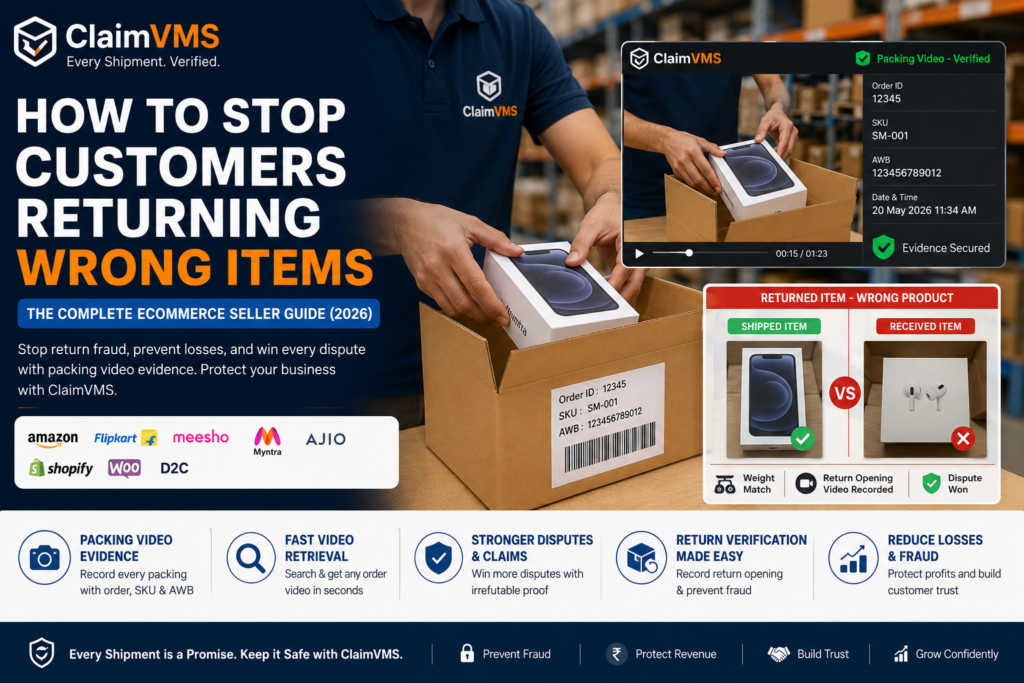
Wrong Item Returns Are Costing Ecommerce Sellers Millions Every Year
You carefully pack the correct product, verify the order details, seal the parcel, and dispatch it to your customer. A few days later, the return arrives—but instead of your original product, you find an old damaged item, a counterfeit replacement, a cheaper alternative, or even an empty box filled with paper or stones.
Unfortunately, this scenario has become increasingly common across ecommerce marketplaces.
The biggest problem isn’t simply that fraud occurred.
The real challenge is proving it.
Without reliable evidence showing exactly what was packed and what was returned, sellers often lose disputes, refunds, SAFE-T claims, and chargebacks—even when they are completely right.
According to industry studies, nearly one in four shoppers admits to returning a different product than the one originally purchased. As online shopping continues to grow, return fraud has become one of the largest hidden expenses for ecommerce businesses worldwide.
For Indian sellers operating on Amazon, Flipkart, Meesho, AJIO, Myntra, Shopify, and WooCommerce stores, protecting every shipment is no longer optional—it is becoming a necessity.
This guide explains:
- How wrong item return fraud works
- Different types of return scams
- How to detect fraudulent returns
- How to collect strong evidence
- How ClaimVMS helps sellers protect every order with automated packing video proof
Understanding Wrong Item Return Fraud
The phrase “customer returned the wrong item” actually covers several different situations.
Some are genuine mistakes.
Others are carefully planned fraud.
Knowing the difference helps you build a stronger return verification process.
1. Product Swap Fraud
This is the most common form of return fraud.
The customer receives the original product, keeps it, and sends back:
- An older version
- A broken item
- A cheaper alternative
- Another brand’s product
- A similar-looking counterfeit
- An empty box with added weight
The goal is simple:
Keep the original product while receiving a full refund.
Without proof of what was originally packed, the marketplace often cannot determine who is telling the truth.
2. Counterfeit Replacement
High-value electronics, branded products, cosmetics, watches, shoes, handbags, and accessories are common targets.
Instead of returning the genuine product, the buyer replaces it with a fake version that appears almost identical.
Unless your warehouse checks serial numbers, IMEI numbers, or unique identifiers, the counterfeit may initially go unnoticed.
3. Accidental Wrong Returns
Not every wrong return is fraudulent.
Customers managing multiple orders sometimes accidentally send the wrong parcel using the incorrect return label.
These situations are usually resolved through communication and proper documentation.
Accurate packing records help identify genuine mistakes without creating unnecessary disputes.
4. Organized Return Fraud
Some fraud is highly organized.
Groups operating online share detailed methods explaining:
- Which marketplaces are easiest to exploit
- Which sellers have weak verification processes
- How to avoid detection
- How to maximize refund approval
These fraud networks deliberately target businesses that cannot prove what they originally shipped.
For them, weak evidence equals easy money.
Why Sellers Continue Losing Return Disputes
Many ecommerce businesses believe they lose because marketplaces favor buyers.
In reality, the biggest issue is usually a lack of evidence.
Imagine two claims.
The buyer says:
“I received the wrong product.”
The seller says:
“We shipped the correct product.”
Without independent proof, both are simply statements.
Marketplace investigators cannot verify either side.
As a result, disputes frequently end in favor of the customer.
Strong evidence changes everything.
How Wrong Item Return Fraud Actually Happens
Understanding the complete fraud process helps sellers build stronger defenses.
A typical wrong item return follows these steps:
Step 1
The customer purchases a high-value product.
Examples include:
- Smartphones
- Headphones
- Fashion products
- Watches
- Electronics
- Home appliances
Step 2
The buyer receives the genuine item in perfect condition.
Step 3
Instead of keeping the original packaging untouched, the buyer prepares a substitute.
This substitute could be:
- An old version
- A damaged unit
- A counterfeit
- A similar-looking product
- An empty parcel adjusted to match the expected weight
Step 4
The customer raises a return request using a believable reason.
Common examples include:
- Wrong item received
- Defective product
- Doesn’t match description
- Quality issue
- Changed my mind
Step 5
The replacement item is packed and returned.
From the outside, the parcel often appears completely normal.
Step 6
The warehouse receives the return.
If employees simply open the package without documenting the process, critical evidence is permanently lost.
Step 7
The seller files a dispute.
Unfortunately, without proof showing exactly what was packed before dispatch, the marketplace cannot independently verify the seller’s claim.
The refund is approved.
The seller loses both the product and the money.
A Real Example of How Better Evidence Changed Everything
Consider an ecommerce seller shipping over 150 orders every day across Amazon and Shopify.
The business noticed increasing losses despite maintaining a normal return rate.
After reviewing hundreds of returns, the team identified a pattern:
Many returned parcels did not contain the products originally shipped.
Although the warehouse knew fraud had occurred, disputes were consistently rejected because there was no independent evidence.
The seller introduced three simple improvements:
- Automated packing video recording
- Return opening videos
- Weight verification before opening every returned parcel
Within the next few months, the business dramatically improved its dispute success rate because every suspicious return now included complete visual evidence from dispatch to return.
The fraud attempts did not disappear.
They simply stopped being successful.
The Two-Stage Evidence System Every Seller Should Follow
Many guides focus only on inspecting returned parcels.
While this is important, it tells only half the story.
To successfully defend a dispute, sellers must prove two things:
- What was originally shipped
- What was actually returned
Without both pieces of evidence, proving fraud becomes extremely difficult.
This is why ClaimVMS recommends a Two-Stage Evidence System for every ecommerce warehouse.
The first stage begins before the parcel ever leaves your warehouse.
Stage 1: Capture Evidence Before the Parcel Leaves Your Warehouse
The strongest evidence in any return dispute is proof of what actually left your warehouse.
Unfortunately, many sellers rely only on invoices, order confirmations, or shipping labels. While these documents confirm an order was processed, they do not prove what was inside the parcel.
ClaimVMS solves this problem by automatically recording every packing process.
During packing, the system captures:
- The correct product being picked
- SKU verification
- Product condition before packing
- Quantity verification
- Serial number or IMEI (where applicable)
- Order ID
- AWB (Air Waybill) label
- Final sealed package
Because the entire process is recorded in one continuous video, sellers have indisputable proof of exactly what was dispatched.
Every recording is securely linked with:
- Order ID
- AWB Number
- Marketplace
- Product SKU
- Packing Date & Time
Whenever a dispute arises, the required video can be retrieved within seconds instead of manually searching through hours of CCTV footage.
Why Dispatch Videos Are More Powerful Than CCTV
Traditional warehouse CCTV records everything from a distance.
It usually cannot clearly show:
- Product details
- SKU labels
- Serial numbers
- Packaging contents
- Order information
Even after locating the correct timestamp, the footage often lacks the clarity required to support a dispute.
ClaimVMS is different.
Each packing station records close-up, order-specific videos that clearly capture every important step in the packing process.
This creates evidence that marketplaces can easily verify.
Stage 2: Record What Comes Back
The second half of the evidence chain begins when a returned parcel arrives at your warehouse.
Many sellers immediately open returned packages without documenting the condition of the parcel.
This removes valuable evidence before it can be preserved.
Instead, every suspicious return should follow a structured verification process.
Recommended Return Inspection Process
Before opening the parcel:
- Check the shipping label
- Verify the Order ID
- Inspect the package for damage
- Look for resealed tape
- Check for signs of tampering
Next:
- Weigh the sealed parcel
- Photograph the weight reading
- Compare the weight with dispatch records
Finally:
- Record the complete unboxing in one continuous video
- Do not pause or edit the recording
- Clearly show every item removed from the package
This process creates reliable proof of exactly what was returned.
Why Both Stages Matter
Many sellers only record return-opening videos.
Others only record dispatch videos.
Neither is enough on its own.
Winning a dispute requires proving both sides of the transaction.
Dispatch Evidence
Shows:
- What was packed
- Product condition
- Correct SKU
- Correct quantity
- Correct Order ID
- Correct shipping label
Return Evidence
Shows:
- What actually arrived
- Parcel condition
- Weight discrepancy
- Wrong product
- Missing product
- Counterfeit item
- Empty box
Together, these two stages create a complete evidence chain that is difficult to challenge.
Common Warning Signs of Wrong Item Returns
Warehouse teams should learn to identify suspicious returns before opening them.
Some common warning signs include:
Unexpected Weight Difference
If the parcel weighs significantly less or more than expected, it should immediately be flagged for detailed inspection.
Tampered Packaging
Look for:
- Different tape
- Broken seals
- Repacked boxes
- Damaged labels
- Torn packaging
These can indicate that the original contents have been replaced.
Suspicious Return Reasons
Some return reasons do not match the product.
Examples include:
- “Wrong colour” for a single-colour product
- “Mechanical failure” for a product with no moving parts
- “Wrong item” despite matching shipment records
These returns deserve additional verification.
High-Risk Customer History
Repeated high-value returns from the same customer may indicate fraudulent behavior.
Maintaining historical return records helps identify recurring patterns.
Serial Number Mismatch
For electronics and premium products, always compare the returned serial number or IMEI with the one recorded during dispatch.
If they differ, the returned product is not the original item.
Building a Standard Operating Procedure (SOP)
Every warehouse should have a documented return verification process.
A good SOP should include:
- Parcel inspection before opening
- Weight verification
- Video recording guidelines
- Serial number verification
- Product condition checklist
- Documentation requirements
- Escalation process for suspicious returns
When every employee follows the same process, evidence remains consistent across all disputes.
How ClaimVMS Automates the Entire Evidence Process
ClaimVMS is designed specifically for ecommerce sellers who need fast, reliable, and searchable packing evidence.
The platform automatically records every packing operation and links each video with the corresponding order.
Key features include:
- Automatic packing video recording
- Order ID linking
- AWB linking
- SKU verification
- Marketplace integration
- Fast video search
- Cloud and local storage options
- Secure evidence management
- Quick retrieval for dispute responses
- Support for multiple packing stations
Instead of manually searching CCTV recordings, sellers can simply search using the Order ID or AWB number and retrieve the required evidence within seconds.
This significantly reduces response time for marketplace disputes while improving the chances of successful claim resolution.
Why More Indian Ecommerce Sellers Are Choosing ClaimVMS
As return fraud continues to increase across Amazon, Flipkart, Meesho, Myntra, AJIO, Shopify, and D2C stores, sellers need more than traditional warehouse cameras.
They need an evidence management system built specifically for ecommerce operations.
ClaimVMS helps businesses:
- Reduce losses from fake returns
- Strengthen dispute submissions
- Improve operational transparency
- Increase warehouse accountability
- Protect high-value shipments
- Respond to marketplace claims faster
With every shipment backed by visual proof, sellers gain greater confidence in handling returns and defending legitimate claims.
How to Win Wrong Item Return Disputes on Every Marketplace
Every ecommerce platform has its own dispute process, but the evidence required is largely the same.
Whether you sell on Amazon, Flipkart, Meesho, Myntra, AJIO, Shopify, WooCommerce, or your own D2C website, success depends on your ability to prove two facts:
- The correct product was dispatched.
- A different product (or no product) was returned.
With a complete evidence package, sellers can respond confidently and improve their dispute success rate.
Amazon SAFE-T Claims
Amazon sellers frequently encounter:
- Wrong item returns
- Empty box returns
- Used product returns
- Damaged product swaps
- Counterfeit replacements
When filing a SAFE-T claim, include:
- ClaimVMS packing video
- AWB details
- Order ID
- Product images
- Return opening video
- Weight comparison (if available)
- Serial number verification (where applicable)
The stronger the evidence, the easier it becomes to demonstrate that the original shipment was correct.
Flipkart Return Disputes
Flipkart sellers should document every high-value shipment before dispatch.
If a customer returns the wrong item:
- Retrieve the ClaimVMS packing video.
- Record the complete return opening.
- Photograph the returned item.
- Compare the SKU, serial number, or product condition.
- Submit all supporting evidence through the seller portal.
Having visual proof significantly strengthens the dispute.
Shopify Chargebacks
Chargebacks can be even more expensive than standard returns.
Banks require independent evidence—not assumptions.
An effective evidence package should include:
- Original packing video
- Order confirmation
- Courier tracking
- Return opening video
- Product photographs
- Delivery confirmation
ClaimVMS helps sellers prepare this evidence within minutes instead of spending hours searching CCTV footage.
WooCommerce & D2C Stores
Independent ecommerce businesses often have greater flexibility in handling disputes.
When customers claim they received:
- The wrong product
- An empty parcel
- A damaged item
- Missing accessories
Sellers can immediately retrieve the packing video and compare it with the returned parcel.
This improves internal investigations while also supporting payment gateway disputes.
AJIO, Myntra & Meesho Sellers
Fashion and lifestyle marketplaces frequently experience:
- Product swapping
- Used clothing returns
- Missing accessories
- Fake branded products
- Size-switch fraud
Recording every packing process provides clear evidence of:
- Product condition
- Size
- Colour
- Quantity
- Brand
- Packaging
This reduces uncertainty during claim reviews.
Best Practices for Preventing Wrong Item Return Fraud
Technology alone cannot eliminate fraud.
A combination of strong warehouse processes and reliable evidence offers the best protection.
Consider implementing the following practices:
- Record every packing process.
- Verify SKU before sealing.
- Scan AWB before dispatch.
- Capture serial numbers for premium products.
- Photograph expensive items before packing.
- Weigh high-value parcels.
- Record every suspicious return opening.
- Train warehouse staff on fraud detection.
- Maintain detailed return inspection records.
- Store evidence securely for future disputes.
These practices create a more transparent and accountable fulfilment process.
Common Mistakes Sellers Should Avoid
Many disputes are lost because of avoidable errors.
Some of the most common mistakes include:
- Depending only on warehouse CCTV.
- Opening returned parcels without recording.
- Failing to document parcel weight.
- Losing access to old footage.
- Manually searching hours of recordings.
- Not recording serial numbers.
- Delaying dispute submissions.
- Keeping evidence scattered across multiple systems.
Organized evidence management saves both time and money.
Why Video Evidence Is Becoming the Industry Standard
Ecommerce order volumes continue to grow every year.
At the same time, fraudulent return methods are becoming increasingly sophisticated.
Invoices and shipping labels no longer provide enough proof during disputes.
Visual evidence offers several advantages:
- Greater transparency
- Faster investigations
- Better warehouse accountability
- Improved customer trust
- Stronger marketplace claims
- Reduced financial losses
For high-value products, packing videos are quickly becoming a standard part of modern warehouse operations.
How ClaimVMS Helps Ecommerce Sellers
ClaimVMS is an AI-powered packing video management system designed specifically for ecommerce businesses.
It automatically records every packing process and securely links each video with:
- Order ID
- AWB Number
- Marketplace
- SKU
- Date & Time
With a simple search, sellers can retrieve the required video within seconds.
ClaimVMS helps businesses:
- Prevent fake return losses
- Reduce wrong item disputes
- Strengthen Amazon SAFE-T claims
- Respond faster to marketplace investigations
- Improve warehouse accountability
- Protect high-value shipments
- Build customer confidence through transparent fulfilment
Whether you process 50 orders a day or 50,000, ClaimVMS scales with your operations and ensures every shipment is backed by reliable visual proof.
Final Thoughts
Wrong item returns are no longer isolated incidents—they are a growing challenge for ecommerce businesses worldwide.
While it may not be possible to stop every fraudulent attempt, sellers can dramatically reduce their losses by maintaining a complete evidence chain from dispatch to return.
The combination of automated packing videos, structured return inspections, and organized evidence management gives sellers a stronger position during disputes across Amazon, Flipkart, Meesho, Myntra, AJIO, Shopify, WooCommerce, and other ecommerce platforms.
Instead of relying on assumptions, sellers can rely on facts.
And in ecommerce disputes, evidence always speaks louder than words.
Frequently Asked Questions (FAQs)
Q1. What is wrong item return fraud?
Wrong item return fraud occurs when a customer returns a different product instead of the one originally purchased, often to obtain a refund while keeping the genuine item.
Q2. How can sellers prove they shipped the correct product?
By recording the complete packing process, including the product, SKU, Order ID, and AWB label, sellers create reliable visual evidence of what was dispatched.
Q3. Why isn’t normal CCTV enough?
Traditional CCTV is designed for surveillance, not product verification. It usually cannot clearly capture product details, serial numbers, or packing accuracy.
Q4. Which marketplaces benefit from packing video evidence?
Packing video evidence is valuable for sellers on Amazon, Flipkart, Meesho, Myntra, AJIO, Shopify, WooCommerce, and most other ecommerce platforms.
Q5. How quickly can ClaimVMS retrieve a packing video?
Videos can be searched using the Order ID or AWB number and retrieved within seconds, making dispute responses much faster.