
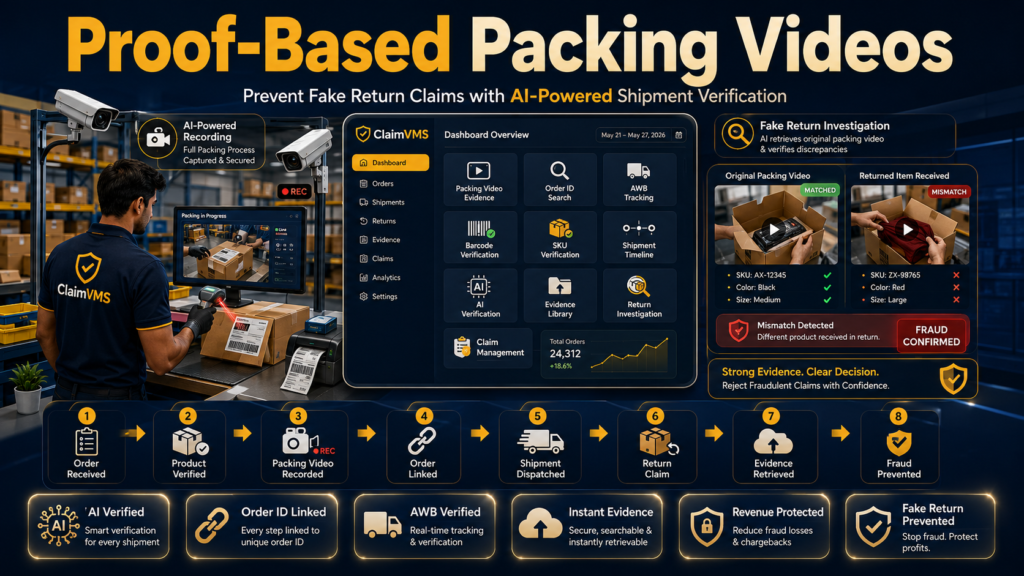
Every ecommerce business works hard to acquire customers, fulfill orders quickly, and maintain a positive marketplace reputation.
However, one fraudulent return can erase the profit from multiple successful orders.
Across India, ecommerce sellers are increasingly facing challenges such as:
- Empty box returns
- Product swap fraud
- Wrong item returned
- Missing accessories
- False “item not received” claims
- Fake damage complaints
These disputes don’t just result in refunds—they consume warehouse resources, delay investigations, increase operational costs, and affect marketplace performance.
Unfortunately, many sellers still rely on traditional CCTV footage or manual documentation to defend themselves.
In most cases, this evidence is difficult to retrieve, poorly organized, or insufficient to support a claim.
This is where proof-based packing videos become essential.
Instead of simply recording warehouse activity, ClaimVMS creates structured shipment evidence by automatically recording every packing process and linking it with the Order ID, AWB Number, SKU, Invoice, Packing Operator, Barcode Verification, and Dispatch Timestamp.
When a dispute arises, businesses can retrieve complete shipment evidence within seconds instead of searching through hours of CCTV footage.
In this guide, you’ll learn why proof-based packing videos are becoming an essential part of ecommerce operations, how they help prevent return fraud, and why ClaimVMS provides a smarter approach to shipment verification and claim management.
Why Fake Return Claims Are Increasing Across Ecommerce
As online shopping continues to grow, so does return-related fraud.
While genuine returns remain part of normal ecommerce operations, many businesses also encounter intentional misuse of return policies.
Common examples include:
- Returning a different product
- Returning damaged goods after use
- Empty parcel returns
- Missing component claims
- False delivery disputes
- Fake packaging complaints
Even a small percentage of fraudulent returns can create significant financial losses when businesses process hundreds or thousands of orders each day.
The Hidden Cost of Return Fraud
Most businesses calculate only the refunded amount when measuring return losses.
The actual financial impact is much larger.
Each fraudulent return can involve:
- Refund amount
- Reverse logistics charges
- Warehouse inspection
- Customer support time
- Inventory adjustments
- Claim preparation
- Courier investigations
- Administrative work
When combined across thousands of orders, these hidden costs significantly reduce profitability.
Revenue Loss Extends Beyond Individual Orders
A single false return may appear manageable.
However, during festive sales, promotional campaigns, and high-volume periods, fraudulent returns can quickly accumulate.
Businesses may experience:
- Reduced profit margins
- Higher operational costs
- Increased warehouse workload
- More customer disputes
- Longer investigation times
Preventing avoidable losses requires better operational visibility rather than simply processing more returns.
Inventory Accuracy Becomes More Difficult
Fraudulent returns frequently create inventory inconsistencies.
Warehouse teams must determine whether:
- The returned product is genuine.
- The correct SKU was received.
- Accessories are missing.
- The returned item is sellable.
- Inventory should be written off.
Without shipment evidence, these investigations become far more complicated.
Reverse Logistics Continues to Increase Operational Costs
Every returned shipment creates additional logistics expenses.
These may include:
- Return shipping
- Inspection costs
- Repackaging
- Restocking
- Disposal of damaged goods
- Inventory reconciliation
Reducing fraudulent returns helps businesses control these ongoing operational expenses.
Marketplace Performance Can Be Affected
Frequent customer disputes may influence important operational metrics such as:
- Return rates
- Order accuracy
- Customer satisfaction
- Seller performance indicators
- Operational efficiency
Maintaining accurate shipment documentation supports more consistent fulfillment processes.
Why Traditional CCTV Is No Longer Enough
Many warehouses already use CCTV cameras for security.
Although useful for monitoring warehouse activity, traditional surveillance systems have significant limitations during shipment investigations.
Common challenges include:
- Continuous recording
- Time-based searching
- No Order ID linkage
- No AWB mapping
- No SKU association
- Manual evidence retrieval
- Large video archives
Finding one shipment among several days of footage can consume hours of valuable warehouse time.
What Makes Proof-Based Packing Videos Different?
Proof-based packing videos are designed specifically for ecommerce fulfillment.
Instead of recording general warehouse activity, every shipment receives its own structured evidence record.
Each recording automatically includes:
- Product verification
- Barcode scan
- SKU confirmation
- Packing process
- Accessories verification
- Parcel sealing
- Shipping label
- Dispatch timestamp
The result is shipment-specific documentation rather than generic surveillance footage.
How Proof-Based Packing Videos Work
A modern shipment verification workflow typically follows these steps:
Customer Order
↓
Product Picked
↓
Barcode Verified
↓
Packing Video Recorded
↓
Order ID Linked
↓
AWB Number Mapped
↓
Parcel Sealed
↓
Shipment Dispatched
↓
Cloud Evidence Stored
Every shipment now has a complete digital history that can be retrieved whenever required.
What Evidence Should Every Shipment Include?
Strong shipment documentation should clearly capture:
- Product condition
- SKU label
- Barcode
- Quantity
- Accessories
- Packaging materials
- Parcel sealing
- Shipping label
- Order ID
- Dispatch timestamp
These details improve shipment traceability and simplify future investigations.
How ClaimVMS Automates Shipment Verification
ClaimVMS transforms traditional warehouse documentation into an intelligent shipment verification system.
Every dispatched order automatically generates:
- Packing Video
- Order ID
- AWB Number
- SKU
- Invoice
- Barcode Verification
- Dispatch Timestamp
- Packing Operator Details
- Shipment Timeline
Everything is stored securely inside a centralized cloud platform for fast retrieval whenever verification becomes necessary.
Real-World Example
Imagine an online electronics seller ships a premium Bluetooth speaker.
Several days later, the customer submits a return claiming that an inexpensive speaker was received instead.
Without structured shipment documentation, warehouse staff may spend hours reviewing CCTV footage, courier records, invoices, and warehouse logs.
Using ClaimVMS, the operations team simply searches the Order ID.
Within seconds they retrieve:
- Original Packing Video
- Barcode Verification
- Invoice
- SKU Details
- Parcel Sealing
- Dispatch Timestamp
- Shipment Timeline
Instead of relying on assumptions, the business now has organized shipment evidence available for investigation.
Proof-Based Packing Videos Improve More Than Claim Investigations
Although shipment evidence is valuable during disputes, proof-based packing videos also improve:
- Warehouse accuracy
- Packing consistency
- Employee accountability
- Operational transparency
- Internal audits
- Quality control
- Shipment traceability
- Documentation standards
Businesses gain stronger operational control across the entire fulfillment process.
How ClaimVMS Helps Prevent Fake Return Claims
Preventing fake return claims requires more than warehouse CCTV.
Businesses need a system that captures every shipment with structured, searchable evidence before the parcel leaves the warehouse.
ClaimVMS automatically records every packing process and securely links it with:
- Order ID
- AWB Number
- SKU
- Invoice
- Barcode Verification
- Packing Operator
- Dispatch Timestamp
- Shipment Timeline
Whenever a customer raises a dispute, warehouse teams can retrieve complete shipment evidence within seconds instead of manually searching through hours of video footage.
AI-Powered Shipment Verification Improves Accuracy
Modern ecommerce warehouses process hundreds or even thousands of orders every day.
Manual verification increases the risk of:
- Wrong product dispatch
- Missing accessories
- Incorrect SKU
- Wrong shipping label
- Packing errors
ClaimVMS uses AI-powered shipment verification to help standardize warehouse operations.
Every shipment follows a structured workflow, ensuring documentation is consistent and easy to retrieve whenever required.
Marketplace Claims Require Better Evidence
When return disputes occur, marketplaces often request supporting evidence.
Typical seller responses such as:
- Emails
- Internal notes
- Manual photographs
- Generic CCTV recordings
may not provide enough context for efficient investigations.
ClaimVMS organizes every shipment into a structured evidence package containing:
- Packing Video
- Product Verification
- Barcode Scan
- Shipping Label
- Invoice
- Order ID
- AWB Number
- Dispatch Timestamp
This allows operations teams to prepare documentation much faster whenever shipment verification is required.
Cloud-Based Evidence Library
One of the biggest challenges in warehouse investigations is locating historical shipment records.
ClaimVMS eliminates this problem by storing every shipment inside a centralized cloud evidence library.
Users can search using:
- Order ID
- AWB Number
- SKU
- Invoice Number
- Dispatch Date
Instead of checking multiple hard drives or DVR systems, every shipment remains organized in one secure location.
Instant Evidence Retrieval Saves Valuable Time
Imagine a customer claims that a premium smartwatch was never included in their parcel.
Without ClaimVMS:
Warehouse staff spend hours reviewing CCTV footage, checking invoices, comparing warehouse logs, and contacting multiple departments.
With ClaimVMS:
They simply enter the Order ID.
Within seconds they retrieve:
- Packing Video
- Barcode Verification
- Product SKU
- Parcel Sealing
- Dispatch Timestamp
- Shipment Timeline
- Invoice Details
The investigation begins immediately with complete shipment visibility.
Supporting Internal Warehouse Audits
Proof-based packing videos are useful for more than customer disputes.
Warehouse managers can also use them to:
- Verify packing accuracy
- Monitor operational compliance
- Review employee performance
- Identify process improvements
- Improve quality control
- Audit packing procedures
This creates greater operational consistency across all packing stations.
Reducing Internal Packing Errors
Not every shipment issue is caused by customer fraud.
Some losses occur because of:
- Wrong SKU selection
- Missing accessories
- Incorrect quantity
- Damaged packaging
- Shipping label errors
Proof-based packing videos help identify operational gaps so businesses can improve warehouse processes before they become recurring problems.
Warehouse Analytics Improve Decision Making
ClaimVMS provides valuable operational insights that extend beyond shipment recording.
Businesses can monitor:
- Packing accuracy
- Shipment verification coverage
- Investigation time
- Return trends
- Warehouse productivity
- Barcode verification rate
- Order processing efficiency
These analytics help warehouse managers optimize operations using real data rather than assumptions.
Benefits for Every Department
ClaimVMS supports multiple business teams.
Warehouse Teams
- Better packing accuracy
- Standardized workflows
- Easier shipment verification
Operations Managers
- Improved warehouse visibility
- Faster investigations
- Better operational reporting
Finance Teams
- Organized shipment documentation
- Easier reconciliation
- Better audit support
Business Owners
- Reduced operational leakage
- Improved warehouse control
- Better customer trust
- Stronger marketplace performance
Why ClaimVMS Is More Than a Packing Video System
ClaimVMS is not simply a video recording application.
It is a complete AI-powered Shipment Verification and Claim Management Platform.
The platform combines:
- Packing Video Recording
- AI Shipment Verification
- Order ID Mapping
- AWB Tracking
- Barcode Verification
- SKU Verification
- Cloud Evidence Library
- Warehouse Documentation
- Investigation Dashboard
- Warehouse Analytics
- Claim Management
Every shipment becomes a searchable operational record rather than just another CCTV recording.
Return on Investment (ROI)
Many ecommerce businesses adopt ClaimVMS to reduce return-related losses.
However, the platform also delivers long-term operational improvements.
Potential business benefits include:
- Faster investigations
- Reduced manual searching
- Better warehouse accountability
- Improved packing accuracy
- Stronger documentation
- Lower operational inefficiencies
- Better inventory visibility
- Reduced administrative workload
As businesses scale, these operational efficiencies become increasingly valuable.
Best Practices for Proof-Based Packing Videos
To maximize the effectiveness of shipment verification, ecommerce businesses should:
- Record every shipment.
- Scan every barcode before packing.
- Verify product variants.
- Display the SKU clearly.
- Show accessories before sealing.
- Capture parcel sealing completely.
- Link every shipment with the Order ID.
- Store evidence securely in the cloud.
- Review warehouse processes regularly.
- Train warehouse operators consistently.
Consistency is the foundation of reliable shipment documentation.
The Future of Ecommerce Shipment Verification
Warehouse operations are rapidly evolving.
Future-ready fulfillment centers increasingly rely on:
- AI-powered verification
- Warehouse automation
- Intelligent documentation
- Centralized evidence management
- Operational analytics
- Cloud-based shipment history
- Automated investigation tools
Businesses adopting these technologies today will be better prepared for tomorrow’s ecommerce challenges.
Conclusion
Fake return claims continue to be one of the biggest operational challenges facing ecommerce businesses.
Traditional CCTV systems provide warehouse surveillance, but they rarely deliver the structured shipment evidence needed during modern investigations.
Proof-based packing videos solve this challenge by documenting every shipment with complete operational visibility.
ClaimVMS automatically records every packing process, links each recording with the Order ID, AWB Number, SKU, Invoice, Barcode Verification, Packing Operator, and Dispatch Timestamp, and stores everything in a centralized evidence platform.
Instead of spending hours searching through warehouse footage, businesses retrieve shipment documentation within seconds, improve investigation efficiency, strengthen operational transparency, and build more reliable fulfillment processes.
As ecommerce continues expanding across India, proof-based shipment verification is becoming an essential part of protecting revenue, improving warehouse performance, and maintaining customer trust.
Frequently Asked Questions (FAQs)
1. What are proof-based packing videos?
Proof-based packing videos are order-specific recordings that document the complete packing process and are linked with Order IDs, AWB numbers, SKUs, and shipment details for future verification.
2. How do proof-based packing videos help prevent fake return claims?
They provide visual evidence of the product, packaging, barcode verification, accessories, shipping label, and parcel sealing before dispatch, helping businesses investigate disputes more efficiently.
3. How is ClaimVMS different from traditional CCTV?
Traditional CCTV records continuous surveillance footage, while ClaimVMS automatically creates searchable, order-linked shipment evidence that can be retrieved instantly using an Order ID or AWB Number.
4. Can ClaimVMS work with existing CCTV cameras?
Yes. ClaimVMS integrates with most IP cameras, CCTV systems, webcams, and compatible warehouse camera setups.
5. Which ecommerce businesses can use ClaimVMS?
ClaimVMS supports Amazon sellers, Flipkart sellers, AJIO sellers, Myntra sellers, Meesho sellers, Shopify stores, WooCommerce stores, D2C brands, fulfillment centers, and third-party logistics providers.
6. What information is linked with each packing video?
Every shipment can include the Order ID, AWB Number, SKU, Invoice, Barcode Verification, Packing Operator, Dispatch Timestamp, Shipment Timeline, and Packing Video.
7. How quickly can shipment evidence be retrieved?
Users simply search by Order ID or AWB Number, and ClaimVMS retrieves the complete shipment documentation within seconds.
8. Can ClaimVMS improve warehouse operations?
Yes. Beyond dispute investigations, ClaimVMS helps improve packing accuracy, warehouse accountability, operational transparency, documentation quality, and warehouse analytics.
9. Why is cloud-based evidence storage important?
Cloud storage centralizes shipment records, making them secure, searchable, and accessible without relying on local DVR systems or manually organized files.
10. What is the biggest advantage of ClaimVMS?
ClaimVMS transforms every shipment into a structured, searchable evidence record, helping ecommerce businesses protect revenue, streamline investigations, improve warehouse efficiency, and strengthen claim documentation through AI-powered shipment verification.