
Every ecommerce seller eventually faces an unpleasant surprise—a customer claims the item they received was different from what they ordered or says the product wasn’t as described. Whether you sell through Shopify, WooCommerce, Amazon, Flipkart, Meesho, Myntra, AJIO, or your own D2C website, these disputes can quickly become expensive.
Most sellers assume that product listings, invoices, and courier tracking are enough to defend themselves. Unfortunately, they aren’t.
Banks, marketplaces, and payment providers don’t simply ask whether your product listing was accurate. They want proof that the exact product packed for the disputed order matched what the customer purchased.
That single difference explains why thousands of genuine sellers lose perfectly valid disputes every year.
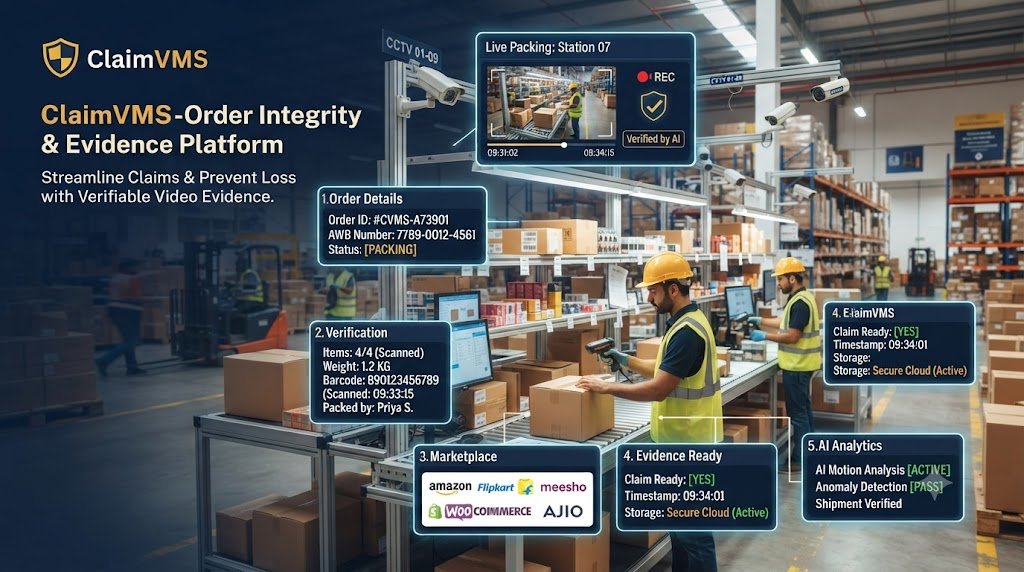
ClaimVMS helps bridge this evidence gap by automatically recording and indexing order-linked packing videos, allowing sellers to retrieve visual proof within seconds whenever a dispute arises.
Why Most Sellers Lose “Item Not as Described” Cases
One of the biggest misconceptions in ecommerce is believing that listing screenshots are enough to prove your case.
Imagine a buyer claims they ordered a Black XL T-shirt but received a Blue Medium.
Most sellers immediately submit:
Product page screenshots
Product specifications
Order invoice
Courier tracking
Purchase confirmation
While these documents prove that your store sells the correct product, they do not prove what was actually packed inside that specific parcel.
This is exactly where most dispute cases fail.
The investigation is not about your catalogue.
It is about one particular shipment.
Without evidence from the packing stage, marketplaces and banks often decide in favour of the customer.
The Question Every Marketplace Wants Answered
Whenever an “Item Not as Described” or “Wrong Item Received” dispute is raised, investigators usually ask one simple question:
What exactly was packed and dispatched for this order?
Listing images answer a completely different question:
What does your store normally sell?
Those are not the same thing.
To successfully defend a dispute, sellers need evidence created during the packing process, not after the complaint has already been filed.
This is why packing videos have become one of the strongest forms of evidence in ecommerce dispute management.
Why Order-Level Evidence Matters More Than Catalogue Evidence
Think about it this way.
Your product page represents thousands of future orders.
A dispute concerns only one specific order.
If the buyer claims they received the wrong colour, damaged product, incorrect model, or completely different item, investigators expect evidence linked directly to that order.
General product photographs cannot prove what happened during packing.
An order-linked packing video can.
ClaimVMS automatically associates every recorded packing session with the Order ID, making retrieval simple even months later.
Real Example: How One Seller Changed Their Dispute Success Rate
A growing D2C fashion brand fulfilled hundreds of orders every day through its warehouse.
The business had:
Accurate listings
Reliable suppliers
Quality control checks
Low return rates
Despite this, the company kept losing “Not as Described” disputes.
After reviewing previous cases, they discovered a common problem.
Every dispute submission included:
Listing screenshots
Product images
Courier tracking
GST invoice
Customer communication
None of these proved what actually went inside the parcel.
Once the warehouse started recording every packing process using ClaimVMS, every shipment generated searchable visual evidence linked to its Order ID.
When another dispute arrived, the team simply retrieved the packing video showing:
Correct SKU
Correct colour
Correct size
Proper packaging
Parcel sealing
Instead of relying only on paperwork, they submitted visual proof of the actual dispatch.
Their dispute success rate improved significantly because the evidence directly answered the investigator’s primary question.
The Evidence Hierarchy That Wins More Ecommerce Disputes
Not all evidence carries the same value.
Some documents support your claim.
Others directly prove it.
Understanding this hierarchy can dramatically improve your chances of winning.
Primary Evidence: Order-Linked Packing Video
This is the strongest evidence available.
An order-linked packing video records:
Product selection
SKU verification
Colour confirmation
Size confirmation
Barcode scanning
Packaging process
Parcel sealing
Since the recording is linked to the Order ID, it becomes extremely easy to retrieve whenever a marketplace requests proof.
ClaimVMS automatically indexes every video, allowing warehouse teams to search by:
Order Number
AWB Number
Customer Name
Invoice Number
Dispatch Date
Instead of spending hours reviewing CCTV footage, sellers can locate the exact recording within seconds.
Supporting Evidence: Product Listings
Your product page still plays an important role.
It confirms:
Product specifications
Images shown to buyers
Colour options
Size charts
Features
Material information
However, listings should support your evidence—not replace it.
Without dispatch proof, listing screenshots alone rarely settle “Wrong Item” disputes.
Supporting Evidence: Customer Communication
If a customer confirmed specifications before purchasing, save those conversations.
Emails, WhatsApp chats, support tickets, and marketplace messages can demonstrate that the buyer understood exactly what they ordered before payment.
Although these records are valuable, they still cannot prove what entered the parcel during packing.
That requires visual dispatch evidence.
Supporting Evidence: Courier & Shipping Records
Shipping documents remain useful because they establish the logistics timeline.
These include:
Courier manifests
AWB labels
Shipping confirmation
Delivery status
GPS delivery scans
Weight records
Combined with packing videos, they create a complete chain of evidence from warehouse to customer delivery.
This layered approach significantly strengthens dispute submissions for Amazon, Flipkart, Meesho, Shopify, WooCommerce, and other ecommerce platforms.
Why ClaimVMS Makes Evidence Collection Effortless
Traditional CCTV systems create one major challenge.
Finding a five-minute packing event inside hundreds of hours of footage is almost impossible.
ClaimVMS solves this by automatically:
Linking recordings with Order IDs
Connecting videos to AWB numbers
Indexing every shipment
Searching footage instantly
Exporting dispute-ready evidence
Maintaining secure video archives
When a customer raises a complaint weeks or even months later, your team doesn’t have to manually search CCTV footage.
The required evidence is already organised, searchable, and ready for submission.
How to Build a Winning Representment Package
Submitting evidence isn’t enough—how you organize it matters just as much.
A professional representment package should clearly explain why the customer’s claim is incorrect while making it easy for the reviewer to verify every piece of evidence.
A strong dispute response typically includes:
A concise rebuttal letter
Order-linked packing video
Product listing at the time of purchase
Invoice and order confirmation
Courier and delivery records
Customer communication (if applicable)
Return inspection photographs (when available)
Each document should be clearly labelled and referenced in your explanation. A structured submission helps marketplace investigators and payment processors review the evidence faster and reduces the chance of important files being overlooked.
Wrong Item vs. “Item Not as Described” — Understanding the Difference
Although these disputes are often grouped together, they are fundamentally different.
An Item Not as Described dispute means the customer claims the product doesn’t match the advertised specifications. This could involve differences in colour, size, material, features, or quality.
A Wrong Item Received dispute is more serious. Here, the buyer claims an entirely different product was delivered.
For example:
Ordered a Bluetooth speaker but received headphones.
Ordered a red shirt but received a blue jacket.
Ordered a 256 GB phone but received a 128 GB model.
In both cases, the investigation focuses on the same question:
What was actually packed inside the parcel?
Order-linked packing videos provide a direct answer that invoices and listing screenshots cannot.
Why These Disputes Are Increasing in 2026
Ecommerce has grown rapidly, but so has return fraud.
Today, sellers face increasingly sophisticated tactics, including:
False “Item Not as Described” claims
Wrong item allegations
Empty box fraud
Product swapping
Wardrobing and temporary product usage
Refund abuse through social media groups
Organised refund fraud networks
Some fraudulent buyers even edit photographs or use AI-powered image tools to create misleading evidence that appears convincing during dispute investigations.
Without independent proof from the packing stage, sellers often struggle to counter these claims.
That’s why proactive evidence collection is becoming a standard practice for modern ecommerce businesses.
Why Manual CCTV Systems Are No Longer Enough
Many warehouses already have CCTV cameras.
However, standard CCTV recordings create several operational problems:
Footage isn’t linked to orders.
Finding one shipment may take hours.
Multiple cameras must be reviewed manually.
Videos are difficult to export.
Important recordings may be overwritten.
Evidence preparation becomes stressful during dispute deadlines.
When marketplaces request evidence within 24–48 hours, manually searching CCTV footage can waste valuable time.
ClaimVMS transforms ordinary warehouse cameras into an intelligent evidence management system by automatically indexing videos with Order IDs and AWB numbers, allowing teams to retrieve the required recording in seconds.
How ClaimVMS Helps Ecommerce Sellers Protect Every Shipment
ClaimVMS is designed specifically for ecommerce dispute management.
Instead of relying solely on traditional CCTV recordings, it creates a complete digital record of every packed order.
Key capabilities include:
Automatic Order ID mapping
AWB-based video search
Barcode and QR code integration
AI-powered video retrieval
Secure evidence storage
Packing video exports
Marketplace-ready dispute documentation
Multi-camera warehouse support
User access controls
Long-term video archiving
Whether you’re fulfilling 50 orders a day or 50,000, every shipment can be traced back to its original packing session.
Best Practices to Reduce “Wrong Item” and “Not as Described” Disputes
Reducing disputes starts long before a customer places a complaint.
Successful ecommerce businesses typically follow these practices:
Maintain accurate product descriptions and images.
Verify SKUs before packing.
Scan barcodes during fulfillment.
Record every packing process.
Seal parcels within camera view.
Store videos securely with searchable Order IDs.
Preserve shipping and weight records.
Respond to disputes immediately.
Keep evidence organised for quick retrieval.
Train warehouse teams on standard packing procedures.
A systematic approach not only improves dispute outcomes but also reduces genuine packing mistakes.
The Future of Ecommerce Dispute Management
As online shopping continues to expand, evidence expectations will continue to evolve.
Marketplaces and payment providers increasingly favour sellers who can provide:
Clear operational records
Accurate fulfillment documentation
Transparent packing procedures
Verifiable dispatch evidence
Businesses that adopt digital evidence management today will be better prepared for future compliance requirements while protecting themselves from rising fraud.
Packing videos are no longer just an operational tool—they are becoming an essential part of ecommerce risk management.
Final Thoughts
Winning “Item Not as Described” or “Wrong Item Received” disputes is rarely about proving your product catalogue is accurate.
It’s about proving exactly what left your warehouse.
Invoices, tracking numbers, and product listings remain valuable supporting documents, but they cannot replace evidence captured during the packing process.
By recording every shipment, linking videos to Order IDs, and enabling instant retrieval, ClaimVMS gives ecommerce sellers the confidence to respond quickly and professionally whenever a dispute arises.
In today’s competitive ecommerce environment, strong operational evidence isn’t just helpful—it’s a competitive advantage.
Frequently Asked Questions
What is the best evidence for an “Item Not as Described” dispute?
The strongest evidence is an order-linked packing video showing the correct product being packed, verified, and sealed for the specific Order ID. Supporting documents such as invoices and product listings strengthen the case.
Can CCTV footage alone help win ecommerce disputes?
General CCTV footage can help, but manually locating the correct recording is difficult. A system like ClaimVMS automatically links recordings to Order IDs, making evidence retrieval much faster and more reliable.
Why are listing screenshots not enough?
Product listings show what you intended to sell, but they don’t prove what was packed inside the disputed parcel. Investigators need shipment-specific evidence.
How quickly should sellers respond to disputes?
Respond as soon as possible. Most marketplaces have strict timelines, and submitting complete evidence early improves the chances of a successful outcome.
Can ClaimVMS work with existing warehouse cameras?
Yes. ClaimVMS is designed to integrate with compatible CCTV infrastructure, allowing businesses to convert existing camera systems into searchable, order-linked evidence management platforms.
Which marketplaces can benefit from ClaimVMS?
ClaimVMS can help sellers operating on Amazon, Flipkart, Meesho, Myntra, AJIO, Shopify, WooCommerce, Magento, and other ecommerce platforms where shipment verification and dispute management are critical.