
Chargebacks Don’t Have to Mean Automatic Losses
Many ecommerce sellers assume that once a customer files a chargeback, the money is gone forever.
In reality, that’s not true.
Whether you sell on Amazon, Shopify, WooCommerce, Flipkart, AJIO, Meesho, Myntra, or your own D2C website, you have the right to dispute chargebacks by submitting supporting evidence.
Unfortunately, thousands of merchants either:
- Never challenge chargebacks.
- Miss the response deadline.
- Submit incomplete documentation.
- Fail to provide order-level proof.
As a result, genuine businesses lose products, shipping costs, payment processing fees, and valuable revenue—even when they shipped the correct order.
The good news is that every merchant has rights during the chargeback process.
The challenge is knowing how to use those rights effectively.
What Are Merchant Chargeback Rights?
Merchant chargeback rights are the protections available to sellers when a customer disputes a payment through their bank or card issuer.
These rights allow businesses to present evidence proving that the transaction was legitimate and that the customer received exactly what was ordered.
Instead of automatically accepting every chargeback, sellers can request that the payment processor or issuing bank review the facts.
When supported with strong evidence, many disputes can be resolved in the seller’s favor.
Why Chargebacks Are Increasing in Ecommerce
As ecommerce continues to grow, chargebacks are becoming more common across almost every marketplace.
Several factors contribute to this trend.
Rising Online Transactions
Higher order volumes naturally result in more disputes, refunds, and payment reversals.
As businesses grow, even a small percentage of disputed transactions can create significant financial losses.
Friendly Fraud
One of the fastest-growing causes of chargebacks is friendly fraud.
In these cases, customers:
- Receive the product.
- Keep the product.
- Contact their bank instead of the seller.
- Claim the item never arrived or was not as described.
Although the original purchase was genuine, the seller must prove what actually happened.
Easy Dispute Processes
Banks and card issuers have simplified dispute procedures for customers.
While this protects consumers, it also creates opportunities for dishonest buyers to misuse the system.
Limited Seller Evidence
Many sellers still rely only on:
- Shipping confirmation
- Courier tracking
- Order invoices
- Warehouse CCTV
Unfortunately, these documents rarely prove the actual condition or contents of the parcel at the time of dispatch.
Your Rights During a Chargeback Dispute
Every seller should understand the protections available throughout the dispute process.
Right to Receive Chargeback Notification
When a customer files a chargeback, your payment processor or marketplace should notify you.
The notification usually includes:
- Order details
- Chargeback amount
- Reason code
- Response deadline
- Required documentation
Missing this notification often results in an automatic loss.
Right to Submit Evidence
Perhaps the most valuable right merchants have is the ability to provide supporting evidence.
This may include:
- Packing videos
- Delivery confirmation
- Courier tracking
- Customer communication
- Product photographs
- Serial numbers
- Return inspection videos
The stronger your evidence, the stronger your case.
Right to Challenge the Customer’s Claim
A chargeback is not automatically the final decision.
If the customer’s claim is inaccurate or fraudulent, merchants have the right to challenge it through the formal dispute process.
Common situations include:
- False “Item Not Received” claims
- Wrong item allegations
- Fake damage complaints
- Friendly fraud
- Unauthorized refund requests
Supporting documentation plays a critical role during this stage.
Right to Appeal Certain Decisions
In some situations, sellers may have additional opportunities to appeal or escalate disputed transactions depending on the payment network, marketplace, or payment processor involved.
While every platform has different procedures, maintaining strong documentation improves the chances of success at every stage.
Why Most Merchants Still Lose Chargeback Disputes
Having rights is only part of the solution.
Many sellers lose disputes because they cannot provide sufficient evidence.
Common reasons include:
- Missing packing records.
- Poor warehouse documentation.
- CCTV footage that cannot identify the specific order.
- Missing serial number records.
- Delayed responses.
- Disorganized evidence.
Without clear proof, payment providers often rely on the customer’s version of events.
The Biggest Mistake Sellers Make
Many businesses only start collecting evidence after receiving a chargeback notification.
By then, it is often too late.
Warehouse CCTV may already have been overwritten.
Employees may not remember the packing process.
Supporting photographs may never have been taken.
Effective evidence must be created before the dispute exists.
A Real Business Scenario
Imagine a growing Shopify seller processing more than 300 orders every day.
Every month, several customers dispute transactions by claiming:
- The parcel never arrived.
- The wrong product was delivered.
- The product was damaged.
- Items were missing.
The warehouse has CCTV cameras, but locating footage requires hours of manual searching.
Even when the correct recording is found, it rarely shows:
- Product condition
- SKU verification
- Order ID
- Packaging accuracy
- Serial numbers
As a result, the seller frequently loses chargeback disputes despite shipping the correct products.
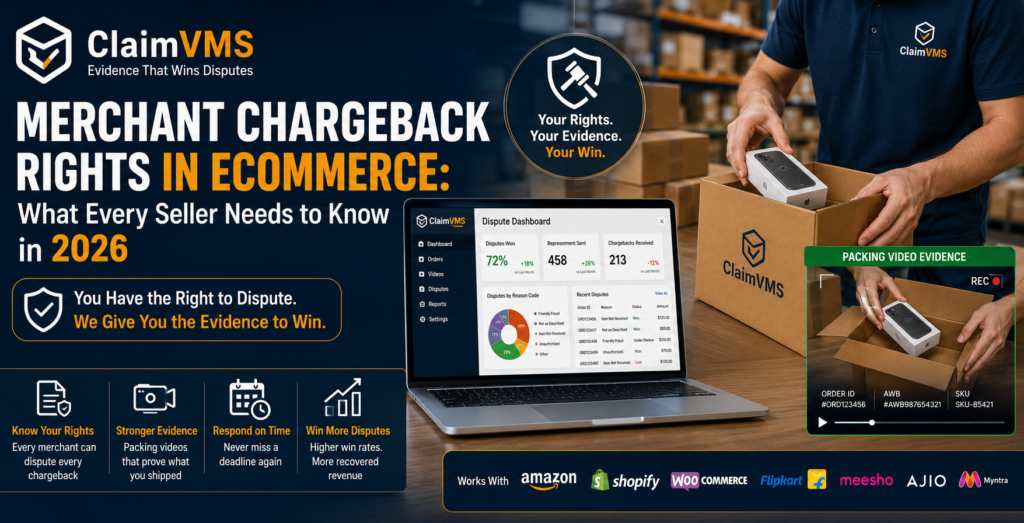
After implementing ClaimVMS, every packing station automatically records each shipment.
Every video is linked directly with:
- Order ID
- AWB Number
- SKU
- Packing Timestamp
When a chargeback arrives, warehouse staff simply search the Order ID and retrieve the required evidence within seconds.
Instead of relying on assumptions, the seller responds with verified visual proof.
Why Modern Ecommerce Sellers Need Better Evidence
Chargeback disputes are becoming more sophisticated every year.
Invoices and courier tracking are important, but they rarely answer the most important question:
“What exactly left the warehouse?”
Order-linked packing videos provide that answer.
They create independent, time-stamped evidence before any dispute begins, giving sellers a much stronger position when responding to banks, marketplaces, and payment providers.
That is exactly why more ecommerce businesses are adopting ClaimVMS as part of their fulfillment workflow.
Your Rights Mean Nothing Without Strong Evidence
Every ecommerce seller has the legal right to challenge a chargeback.
However, simply having the right to dispute a transaction doesn’t guarantee that you’ll recover your money.
Banks, payment processors, and marketplaces don’t decide cases based on opinions—they evaluate evidence.
Consider two scenarios.
Seller A submits:
- Order invoice
- Courier tracking
- Order confirmation
Seller B submits:
- Order-linked packing video
- Product condition before dispatch
- AWB verification
- Delivery confirmation
- Serial number (where applicable)
- Customer communication
- Return inspection video
Which seller is more likely to win?
The answer is obvious.
Evidence wins disputes—not arguments.
Why Traditional Warehouse CCTV Isn’t Enough
Many warehouses already have CCTV systems installed.
While these cameras are useful for general security, they were never designed for ecommerce dispute resolution.
Traditional CCTV often fails to capture:
- Product SKU
- Product condition
- Accessories packed
- Serial numbers
- Order ID
- Packing accuracy
Another challenge is retrieval.
Finding one specific order may require manually searching through several hours of recordings.
If the dispute arrives weeks later, the footage may already have been overwritten.
This makes warehouse CCTV unreliable as primary chargeback evidence.
The ClaimVMS Evidence-First Approach
ClaimVMS is built specifically for ecommerce fulfilment and dispute management.
Instead of recording general warehouse activity, ClaimVMS records every individual packing process.
Each packing video is automatically linked with:
- Order ID
- AWB Number
- SKU
- Marketplace
- Packing Date & Time
- Operator Information
When a dispute occurs, sellers simply search the Order ID and retrieve the exact evidence within seconds.
No manual searching.
No guesswork.
No missing footage.
The ClaimVMS Three-Step Evidence System
Winning more chargebacks starts with creating evidence before a dispute exists.
Step 1 – Record Every Packing Process
Every order should be documented before leaving the warehouse.
The recording should clearly capture:
- Product condition
- SKU verification
- Quantity verification
- Accessories included
- Serial number (if applicable)
- Order ID
- AWB label
- Final sealed package
This creates independent proof of what was dispatched.
Step 2 – Store Evidence Securely
Evidence should never remain scattered across multiple devices or CCTV systems.
ClaimVMS automatically indexes every recording, making it searchable by:
- Order ID
- AWB Number
- Customer Order
- SKU
- Packing Date
This dramatically reduces evidence retrieval time.
Step 3 – Respond Before Deadlines Expire
Every marketplace and payment provider operates with strict dispute deadlines.
When evidence is available instantly, businesses can respond quickly with complete documentation instead of scrambling to locate recordings.
Fast responses often improve dispute outcomes while reducing operational workload.
Amazon SAFE-T Claims
Amazon sellers frequently receive disputes involving:
- Wrong item claims
- Product not as described
- Empty box returns
- Friendly fraud
- Fake damage reports
ClaimVMS enables sellers to retrieve packing videos within seconds and include them alongside:
- Order details
- AWB information
- Courier confirmation
- Product verification
This creates a stronger evidence package for SAFE-T claim submissions.
Shopify & WooCommerce Chargebacks
Independent ecommerce brands frequently face chargebacks through payment gateways.
Typical dispute reasons include:
- Item Not Received
- Product Not As Described
- Unauthorized Transaction
- Missing Items
Order-linked packing videos provide additional evidence beyond standard invoices and tracking numbers, improving the merchant’s ability to respond effectively.
Flipkart, AJIO, Myntra & Meesho Seller Protection
Marketplace sellers often deal with:
- Fake return requests
- Product swaps
- Refund abuse
- Empty parcel claims
- Friendly fraud
Because ClaimVMS records every shipment before dispatch, businesses can retrieve visual proof that supports marketplace investigations and seller protection claims.
Five Mistakes That Cost Sellers Chargeback Disputes
Many disputes are lost because of avoidable mistakes.
The most common include:
Ignoring Small Chargebacks
Even low-value disputes contribute to chargeback ratios.
Over time, these ratios may affect payment processing costs and merchant account standing.
Missing Response Deadlines
Late submissions almost always result in automatic losses.
Businesses should establish internal processes that prioritize dispute responses.
Relying Only on Courier Tracking
Tracking confirms delivery.
It does not prove what was packed inside the parcel.
Searching CCTV Manually
Manual evidence retrieval wastes valuable time and increases the likelihood of missed deadlines.
Failing to Document High-Value Orders
Premium products should always receive additional documentation, including packing videos and serial number verification.
Best Practices for Winning More Chargebacks
Successful ecommerce businesses follow consistent evidence management procedures.
Recommended practices include:
- Record every packing process.
- Verify SKU before dispatch.
- Capture serial numbers for premium products.
- Link videos with Order IDs.
- Record suspicious returns.
- Maintain organized evidence archives.
- Respond immediately to disputes.
- Train warehouse staff regularly.
- Review recurring fraud patterns.
- Continuously improve warehouse SOPs.
Consistency builds credibility during investigations.
Why More Ecommerce Brands Are Choosing ClaimVMS
ClaimVMS helps ecommerce businesses strengthen dispute responses through automated evidence collection.
Core features include:
- Automated Packing Video Recording
- AI-Powered Video Search
- Order ID & AWB Linking
- Multi-Camera Support
- Cloud & Local Storage
- Secure Evidence Management
- Instant Video Retrieval
- Marketplace-Ready Documentation
- Warehouse Transparency
- Reduced Manual Work
Whether you process 100 orders or 100,000 orders every day, ClaimVMS scales with your business while ensuring every shipment is backed by reliable visual evidence.
Final Thoughts
Merchant chargeback rights provide ecommerce businesses with an opportunity to challenge unfair payment disputes.
However, rights alone do not recover lost revenue.
Winning disputes depends on the quality of evidence submitted.
Businesses that create order-level packing documentation before shipment are significantly better prepared than those relying only on invoices or courier tracking.
By combining automated packing videos, intelligent evidence management, and rapid retrieval, ClaimVMS helps ecommerce sellers strengthen chargeback responses, reduce financial losses, and protect every order with confidence.
When disputes arise, the strongest argument is not a written explanation—it is clear visual proof.
Frequently Asked Questions (FAQs)
Can merchants dispute every chargeback?
Yes. Merchants can respond to chargebacks by submitting evidence through the payment processor or marketplace within the applicable response deadline.
What evidence is most effective during chargeback disputes?
The strongest evidence typically includes order-linked packing videos, delivery confirmation, AWB details, serial numbers (where applicable), customer communication, and return inspection documentation.
Why aren’t invoices and courier tracking enough?
Invoices confirm a purchase, and tracking confirms delivery, but neither proves the product’s condition or the exact contents of the parcel before shipment.
Can ClaimVMS improve chargeback responses?
Yes. ClaimVMS enables sellers to retrieve order-linked packing videos and related shipment evidence within seconds, helping them prepare stronger responses to disputes.
Which ecommerce platforms benefit from ClaimVMS?
ClaimVMS supports sellers operating on Amazon, Flipkart, AJIO, Myntra, Meesho, Shopify, WooCommerce, Magento, and other D2C ecommerce platforms.