
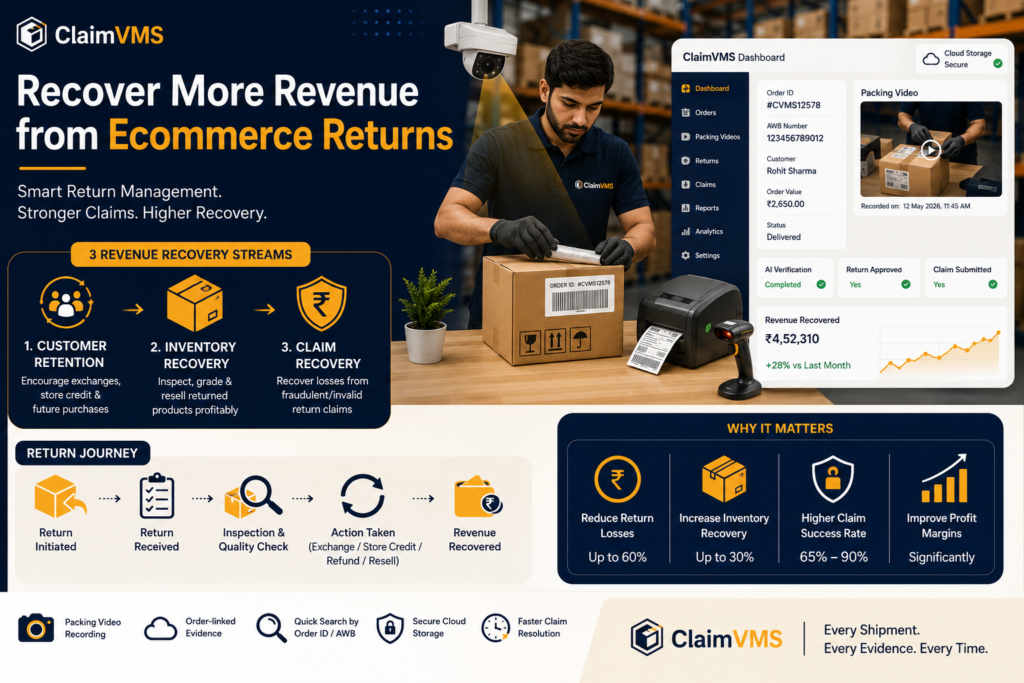
Returns are an unavoidable part of running an ecommerce business. Whether you sell on Amazon, Flipkart, Meesho, Myntra, AJIO, Shopify, or your own D2C website, every returned order impacts your revenue, operational efficiency, and profitability.
Many sellers view returns as a fixed business expense. Once a refund is issued, they assume the revenue is permanently lost. However, this approach overlooks several opportunities to recover value from returned orders.
A well-structured returns management strategy can help businesses reduce losses, retain customers, recover inventory value, and strengthen claim investigations.
One of the biggest opportunities lies in maintaining proper shipment documentation before disputes even occur.
This is where ClaimVMS helps ecommerce businesses build a reliable claim management system by recording packing operations, linking videos to Order IDs and AWB numbers, and securely storing shipment evidence for future claim investigations.
In this guide, we’ll explore how ecommerce businesses can recover more revenue from returns while improving customer satisfaction and reducing unnecessary losses.
Why Ecommerce Returns Cost More Than Most Sellers Realize
Most businesses calculate return losses based only on refunded amounts.
In reality, every returned order generates several hidden expenses.
These include:
- Reverse logistics costs
- Return shipping charges
- Warehouse handling
- Inspection costs
- Product repackaging
- Inventory depreciation
- Customer support
- Refund processing
- Marketplace penalties
- Lost resale value
When combined, these costs can significantly reduce profit margins, especially for businesses handling hundreds of returns each month.
Understanding these costs is the first step toward building an effective revenue recovery strategy.
The Three Revenue Recovery Opportunities Every Seller Should Know
Instead of viewing returns as a single problem, successful ecommerce businesses separate them into three different recovery opportunities.
These include:
Customer Revenue Retention
Keeping customers engaged through exchanges, store credits, or replacement products instead of immediate refunds.
Inventory Recovery
Restoring returned products for resale whenever possible.
Claim Recovery
Recovering losses resulting from fraudulent returns, courier issues, or marketplace disputes through proper documentation.
Together, these strategies create a more sustainable returns management process.
Recovery Strategy 1: Convert Refund Requests into Customer Retention
Refunds immediately remove revenue from your business.
Instead, businesses can encourage customers to choose alternatives that maintain long-term relationships.
Common options include:
- Product exchange
- Store credit
- Gift cards
- Alternative products
- Size replacement
- Color replacement
- Upgrade options
These approaches often improve customer satisfaction while preserving future sales opportunities.
Offer Store Credit Instead of Immediate Refunds
Many customers simply want a satisfactory resolution rather than cash back.
Providing store credit offers several advantages.
Benefits include:
- Retaining revenue within the business
- Encouraging repeat purchases
- Increasing customer lifetime value
- Reducing refund processing costs
Offering small bonus credits can further motivate customers to choose store credit instead of refunds.
Simplify the Exchange Process
Customers are far more likely to accept an exchange if the process is fast and convenient.
Businesses should:
- Offer prepaid return labels
- Minimize approval delays
- Display available replacement products immediately
- Automate exchange workflows
- Communicate shipping timelines clearly
A seamless exchange experience often turns a potentially negative interaction into a positive customer experience.
Recovery Strategy 2: Maximize the Value of Returned Inventory
Not every returned product needs to become a complete financial loss.
Proper inspection and grading allow businesses to recover significant value.
Returned products generally fall into several categories.
Like-New Products
Products that can be repackaged and resold at full price.
Open Box Items
Products with opened packaging but minimal usage.
Often suitable for discounted resale.
Refurbishable Products
Products requiring minor repairs or cleaning before resale.
Common examples include:
- Electronics
- Small appliances
- Furniture
- Premium accessories
Liquidation Inventory
Products unsuitable for standard resale but valuable through clearance channels.
Effective inventory categorization reduces unnecessary waste.
Use Return Data to Improve Future Sales
Every return contains valuable business insights.
Tracking return reasons helps businesses identify recurring operational issues.
Common patterns include:
- Incorrect sizing
- Product quality issues
- Inaccurate product descriptions
- Packaging damage
- Shipping delays
- Customer expectations
Improving listings and packaging based on return analytics helps reduce future return rates.
Recovery Strategy 3: Strengthen Claim Recovery with Better Evidence
One of the most overlooked revenue recovery opportunities involves marketplace claims.
Businesses often identify fraudulent returns but lack sufficient evidence during investigations.
Common examples include:
- Empty box returns
- Wrong product returns
- Missing accessories
- Used product returns
- Damaged product claims
- Courier handling disputes
Without proper shipment documentation, proving these cases becomes challenging.
Why Evidence Matters During Claim Investigations
Traditional documentation usually includes:
- Invoice
- Courier tracking
- Order confirmation
- Delivery confirmation
- Customer communication
Although helpful, these records rarely verify exactly what was packed before dispatch.
This creates uncertainty whenever disputes arise.
Visual shipment documentation provides an additional layer of verification.
How ClaimVMS Improves Claim Documentation
ClaimVMS creates a structured evidence system for every dispatched order.
The platform records the packing process while linking each shipment with:
- Order ID
- AWB Number
- Invoice
- SKU
- Timestamp
- Packing Operator
- Shipment History
Whenever a claim occurs, businesses can retrieve the corresponding shipment documentation quickly without manually searching through CCTV archives.
Example: Revenue Recovery Without ClaimVMS
Imagine a customer returns a parcel claiming:
“The product inside was different.”
The seller provides:
- Invoice
- Tracking details
- Dispatch confirmation
Unfortunately, none of these records demonstrate what was actually packed.
The investigation becomes difficult.
The Same Situation Using ClaimVMS
Now consider the same shipment documented using ClaimVMS.
The seller retrieves:
- Packing video
- Product verification
- Accessories packed
- Order ID
- AWB Number
- Final sealed parcel
- Dispatch timestamp
Instead of relying solely on written documentation, the business now has organized shipment records supporting the investigation.
Build a Complete Return Revenue Recovery System
Recovering revenue from ecommerce returns isn’t about a single tool or process. The most successful ecommerce businesses build a structured return recovery framework that focuses on three critical areas:
- Customer retention
- Inventory optimization
- Claim management
When these three areas work together, businesses can significantly reduce financial losses while improving customer satisfaction and operational efficiency.
Instead of viewing returns as unavoidable expenses, businesses begin treating them as opportunities for recovery and process improvement.
Reduce Refund Requests with Better Customer Communication
Many returns occur because customers receive incorrect expectations before purchasing.
Providing accurate product information helps reduce unnecessary returns.
Best practices include:
- High-quality product images
- Detailed specifications
- Accurate size charts
- Installation guides
- Product videos
- Customer FAQs
- Honest descriptions
Setting the right expectations before purchase often reduces return requests.
Create a Standard Return Inspection Process
Every returned product should follow a structured inspection workflow.
Warehouse teams should verify:
- Product condition
- Original accessories
- Packaging condition
- Serial numbers
- Product functionality
- Visible damage
- Missing components
Standard inspection procedures improve consistency while helping identify suspicious returns earlier.
Maintain Digital Documentation for Every Shipment
Modern ecommerce operations generate thousands of shipments every month.
Managing documentation manually quickly becomes difficult.
ClaimVMS creates a centralized digital repository where every shipment can be linked with:
- Packing video
- Order ID
- Invoice
- AWB Number
- Courier Information
- Dispatch Time
- SKU Details
- Warehouse Operator
Having organized documentation simplifies claim investigations and internal audits.
Why Packing Videos Are Becoming an Industry Standard
Marketplace documentation requirements continue to evolve.
Businesses increasingly rely on visual shipment records because they provide additional context that invoices and tracking numbers cannot.
Packing videos can help verify:
- Correct product packed
- Product condition before dispatch
- Accessories included
- Quantity verification
- Packaging quality
- Shipping label application
- Final sealed parcel
This documentation supports better operational transparency throughout the fulfillment process.
Respond Quickly to Marketplace Claims
Many ecommerce marketplaces require sellers to respond within specific investigation windows.
Delayed responses often reduce the opportunity to submit complete documentation.
ClaimVMS enables operations teams to retrieve shipment evidence within minutes using:
- Order ID
- AWB Number
- Invoice Number
- SKU
- Customer Order Details
Faster retrieval helps businesses respond efficiently whenever claim investigations arise.
Best Practices for Reducing Return Losses
Although returns cannot be eliminated entirely, businesses can significantly reduce unnecessary losses through consistent operational improvements.
Recommended practices include:
- Improve product listings.
- Verify inventory accuracy.
- Standardize warehouse procedures.
- Train packing staff regularly.
- Use tamper-evident packaging.
- Verify shipment weights.
- Record packing operations.
- Store shipment documentation securely.
- Review return analytics monthly.
- Investigate recurring return reasons.
Small improvements across multiple warehouse processes often generate significant long-term savings.
Benefits of Using ClaimVMS
ClaimVMS provides ecommerce businesses with an organized approach to shipment documentation and claim management.
Key advantages include:
✔ Packing video recording
✔ Order-linked shipment documentation
✔ AWB-based search
✔ Invoice mapping
✔ Centralized cloud storage
✔ Faster evidence retrieval
✔ Improved warehouse accountability
✔ Better operational transparency
✔ Reduced manual CCTV searching
✔ Organized claim documentation
✔ Supports Amazon SAFE-T documentation
✔ Supports Flipkart claim investigations
✔ Suitable for D2C and marketplace sellers
Who Should Use ClaimVMS?
ClaimVMS is ideal for businesses handling regular ecommerce shipments.
It is particularly beneficial for:
- Amazon Sellers
- Flipkart Sellers
- Myntra Sellers
- AJIO Sellers
- Meesho Sellers
- Shopify Stores
- WooCommerce Stores
- D2C Brands
- Warehouse Operators
- Third-Party Logistics Providers (3PL)
- Ecommerce Fulfillment Centers
Whether shipping hundreds or thousands of orders each month, maintaining structured shipment documentation helps improve efficiency and simplifies claim management.
The Future of Ecommerce Returns Management
As ecommerce continues to expand, marketplace documentation standards are becoming more stringent.
Businesses that invest in organized shipment documentation today will be better prepared to handle future operational challenges.
Technology-driven solutions such as ClaimVMS help warehouses move beyond traditional CCTV systems by creating searchable, order-linked shipment records that improve documentation quality and operational visibility.
Rather than reacting to disputes after they occur, businesses can proactively build evidence into every shipment from the moment it is packed.
Conclusion
Returns don’t have to be treated as unavoidable losses.
By focusing on customer retention, inventory recovery, and structured claim documentation, ecommerce businesses can recover more value from returned orders while improving operational efficiency.
ClaimVMS supports this process by recording packing operations, linking shipment videos with Order IDs and AWB numbers, and organizing all documentation in one centralized platform.
With searchable shipment records and faster evidence retrieval, businesses can respond to investigations more efficiently, strengthen internal verification processes, and build greater confidence in every shipment they dispatch.
As ecommerce grows in 2026 and beyond, proactive documentation and organized claim management will become key advantages for successful online sellers.
Frequently Asked Questions (FAQs)
1. How can ecommerce businesses recover revenue from returns?
Businesses can recover revenue by encouraging exchanges or store credit, reselling eligible returned products, improving inventory management, and maintaining proper documentation for claim investigations.
2. Why is shipment documentation important for return management?
Shipment documentation helps businesses verify packed items, maintain operational records, and retrieve evidence quickly during marketplace or courier investigations.
3. How does ClaimVMS help ecommerce sellers?
ClaimVMS records packing videos, links them with Order IDs, AWB numbers, invoices, and shipment details, making documentation organized and easily searchable.
4. Can ClaimVMS work with existing warehouse cameras?
Yes. ClaimVMS is designed to integrate with most existing CCTV and warehouse camera systems without requiring major hardware upgrades.
5. Which ecommerce platforms can benefit from ClaimVMS?
ClaimVMS is suitable for sellers operating on Amazon, Flipkart, Myntra, AJIO, Meesho, Shopify, WooCommerce, and other ecommerce platforms.
6. What types of disputes can organized shipment documentation help with?
Shipment documentation can support investigations involving missing items, damaged products, incorrect products, courier issues, and return verification.
7. Is ClaimVMS suitable for small ecommerce businesses?
Yes. Whether shipping a few hundred or several thousand orders each month, structured shipment documentation helps businesses improve operational efficiency and claim management.
8. What is the biggest mistake ecommerce sellers make while handling returns?
One of the most common mistakes is relying only on invoices and courier tracking instead of maintaining organized shipment documentation. Without structured evidence, investigating disputes and verifying dispatched orders becomes much more difficult.