
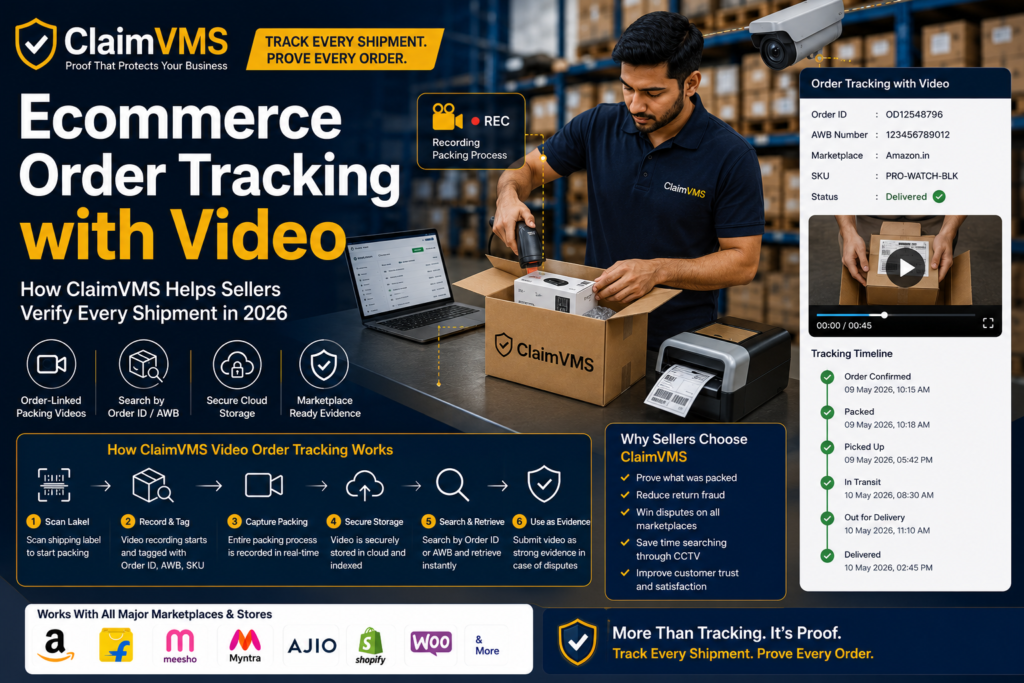
Order tracking has always been an essential part of ecommerce. It allows businesses and customers to know where a shipment is, when it was dispatched, and when it reached its destination.
However, traditional order tracking tells only where a parcel is—it does not prove what was actually packed inside the parcel.
As return fraud, empty box claims, product swapping, and false “item missing” complaints continue to increase, ecommerce sellers need more than courier tracking updates.
They need visual proof.
This is where ClaimVMS changes the way ecommerce businesses manage order tracking.
Instead of relying only on courier scans and delivery status, ClaimVMS combines order tracking with order-linked packing videos, allowing businesses to verify every shipment from the moment it leaves the warehouse.
Whether you sell on Amazon, Flipkart, Meesho, Myntra, AJIO, Shopify, WooCommerce, or your own D2C website, having searchable video evidence provides an additional layer of documentation whenever shipment-related disputes occur.
Why Traditional Order Tracking Is No Longer Enough
Every ecommerce seller uses some type of tracking system.
Typical tracking information includes:
- Order Confirmed
- Order Packed
- Courier Pickup
- In Transit
- Out for Delivery
- Delivered
While this information is useful for monitoring logistics, it does not answer the questions that matter most during a customer dispute.
For example:
- Was the correct product packed?
- Were all accessories included?
- Was the item damaged before dispatch?
- Was the parcel sealed properly?
- Which employee packed the shipment?
- Can the shipment contents be verified?
Courier tracking systems cannot answer these questions because they only record logistics events—not warehouse activities.
What Is Ecommerce Order Tracking with Video?
Video Order Tracking is an advanced fulfillment process where every shipment is recorded during packing and linked directly to its order details.
Instead of simply tracking parcel movement, businesses can also verify what was packed before dispatch.
ClaimVMS automatically associates every packing session with:
- Order ID
- AWB Number
- SKU
- Marketplace
- Customer Order
- Date & Time
- Packing Station
- Warehouse Operator
This creates an organized digital record for every shipment.
When support teams need to investigate a dispute, they can search using Order ID or AWB instead of reviewing hours of CCTV footage.
Standard Order Tracking vs Video Order Tracking
Although both systems are valuable, they solve completely different problems.
Standard order tracking focuses on delivery updates.
Video order tracking focuses on shipment verification.
Traditional tracking answers:
- Where is my parcel?
- Has it been delivered?
- Which courier handled the shipment?
- What is the current shipment status?
ClaimVMS answers:
- What product was packed?
- Was the correct SKU selected?
- Were accessories included?
- Was the parcel sealed correctly?
- Can the shipment be visually verified?
Together, these two systems provide a much more complete view of the fulfillment process.
Why Ecommerce Businesses Are Adopting Video-Based Tracking
Customer expectations continue to rise.
At the same time, return fraud is becoming increasingly sophisticated.
Businesses commonly face disputes involving:
- Empty box deliveries
- Product swapping
- Missing accessories
- Wrong item received
- Damaged product claims
- Partial return fraud
- Fake return requests
Without visual documentation, warehouse teams often rely on invoices, courier tracking, and manual explanations.
ClaimVMS helps businesses maintain organized packing records that can be quickly retrieved whenever shipment verification is required.
How ClaimVMS Video Order Tracking Works
ClaimVMS integrates video recording directly into the warehouse packing workflow.
The process remains simple for warehouse staff while automatically organizing evidence in the background.
A typical workflow includes:
Step 1
The warehouse operator selects or scans an order for packing.
Step 2
ClaimVMS links the Order ID, AWB Number, SKU, marketplace details, and shipment information to the recording.
Step 3
The complete packing process is recorded, including:
- Product verification
- Quantity confirmation
- Accessories
- Packaging
- Parcel sealing
- Shipping label placement
Step 4
The video is securely stored and indexed using the shipment information.
Step 5
Whenever required, warehouse teams simply search the Order ID or AWB to retrieve the corresponding packing video.
This eliminates the need to manually browse through continuous CCTV recordings.
Why CCTV Cannot Replace Video Order Tracking
Many sellers believe warehouse CCTV already provides enough protection.
Unfortunately, CCTV systems were designed for surveillance—not ecommerce fulfillment.
Traditional CCTV records:
- Camera Number
- Recording Time
- Date
- Warehouse Location
It does not understand:
- Order ID
- AWB
- SKU
- Customer Order
- Marketplace
- Shipment Details
As order volumes increase, manually searching warehouse recordings becomes increasingly time-consuming.
ClaimVMS organizes every recording according to order information rather than timestamps, making retrieval significantly easier.
What Makes Video Order Tracking Valuable?
A properly documented packing video captures much more than just a box being sealed.
It can document:
- Correct product selection
- Product condition
- Serial number (where applicable)
- Included accessories
- Quantity verification
- Packaging quality
- Shipping label application
- Parcel sealing
This creates a complete visual history of the dispatch process.
Search Every Shipment in Seconds
One of the biggest advantages of ClaimVMS is centralized video retrieval.
Instead of searching by:
- Camera
- Time
- Date
Warehouse teams can search using:
- Order ID
- AWB Number
- SKU
- Marketplace Order Number
- Customer Order Reference
Finding shipment evidence becomes much faster, especially for businesses processing hundreds or thousands of daily orders.
Designed for Modern Ecommerce Warehouses
ClaimVMS is built specifically for ecommerce fulfillment operations.
It supports businesses selling through:
- Amazon India
- Flipkart
- Meesho
- Myntra
- AJIO
- Shopify
- WooCommerce
- Magento
- Custom ecommerce stores
Whether your warehouse handles 100 shipments or 10,000 shipments daily, organized video order tracking helps simplify shipment verification and evidence management.
Benefits of Video Order Tracking for Ecommerce Sellers
As ecommerce businesses continue to grow across multiple marketplaces, managing shipment evidence manually becomes increasingly difficult.
Traditional tracking systems only confirm that a parcel moved through the logistics network. They do not provide visibility into what happened during the packing process.
ClaimVMS bridges this gap by combining shipment tracking with order-linked packing videos.
Some of the key benefits include:
- Faster shipment verification
- Centralized packing video management
- Organized order records
- Simplified warehouse investigations
- Better customer support documentation
- Reduced manual video searching
- Improved warehouse accountability
- Stronger evidence for marketplace disputes
Instead of relying solely on courier updates, businesses gain a complete visual history of every dispatched order.
ClaimVMS vs Traditional Order Tracking
Traditional shipment tracking is designed for logistics.
ClaimVMS is designed for ecommerce fulfillment and shipment verification.
| Feature | Traditional Order Tracking | ClaimVMS Video Order Tracking |
|---|---|---|
| Courier Status Updates | ✓ | ✓ |
| Delivery Tracking | ✓ | ✓ |
| Order ID Search | Limited | ✓ |
| AWB Search | Limited | ✓ |
| Packing Video Recording | ✗ | ✓ |
| Product Verification | ✗ | ✓ |
| SKU Verification | ✗ | ✓ |
| Parcel Sealing Evidence | ✗ | ✓ |
| Centralized Video Dashboard | ✗ | ✓ |
| Shipment Evidence Management | ✗ | ✓ |
By combining logistics information with visual documentation, ClaimVMS creates a more complete fulfillment record.
Building a Video-Based Fulfillment Process
Implementing video order tracking does not require major changes to warehouse operations.
Most businesses can continue using their existing packing workflow.
A recommended process includes:
Step 1
Receive the customer order.
Step 2
Generate the shipping label and AWB.
Step 3
Begin the packing process.
Step 4
ClaimVMS automatically records the packing session.
Step 5
The system links:
- Order ID
- AWB
- SKU
- Marketplace
- Date & Time
- Warehouse Operator
Step 6
The video is securely stored and indexed.
Step 7
Whenever needed, the warehouse team retrieves the recording using the Order ID or AWB.
This process reduces manual effort while maintaining organized shipment records.
Supporting Marketplace Dispute Management
Disputes often require businesses to verify exactly what was shipped to a customer.
Common scenarios include:
- Empty box complaints
- Wrong product claims
- Missing accessories
- Damaged item allegations
- Partial shipment disputes
- Package tampering concerns
Instead of relying only on written explanations, ClaimVMS allows support teams to quickly access the corresponding packing video and shipment details.
Having organized visual documentation can significantly improve internal investigations and customer communication.
Best Practices for Warehouse Teams
Technology alone is not enough.
Consistent warehouse procedures are equally important.
To improve shipment documentation, warehouse teams should:
- Ensure the product is fully visible before packing.
- Verify SKU and quantity.
- Show all included accessories.
- Record the complete packing process without interruptions.
- Clearly capture the shipping label.
- Avoid camera blind spots.
- Maintain proper lighting at packing stations.
- Regularly inspect camera positioning.
- Store recordings securely.
- Follow the same packing process for every order.
Consistency helps create reliable shipment records across the entire warehouse.
Why Businesses Are Moving Beyond CCTV
Warehouse CCTV remains useful for monitoring security and employee safety.
However, ecommerce businesses require much more than surveillance.
Modern fulfillment centers need systems capable of:
- Organizing packing videos
- Linking videos to Order IDs
- Retrieving recordings instantly
- Supporting warehouse investigations
- Maintaining searchable shipment records
- Managing evidence across multiple marketplaces
This is why many growing ecommerce brands are adopting dedicated Video Management Systems instead of relying only on traditional CCTV.
Future of Ecommerce Order Tracking
As ecommerce continues to evolve, order tracking is becoming more intelligent.
Businesses are increasingly looking for systems that combine:
- Shipment tracking
- Warehouse automation
- Packing verification
- Order-linked videos
- Evidence management
- Searchable shipment records
- Marketplace integrations
Video-based tracking is expected to become an important part of modern warehouse operations as businesses seek better visibility throughout the fulfillment process.
ClaimVMS is designed to support this shift by combining shipment documentation with video evidence in one centralized platform.
Conclusion
Traditional order tracking provides visibility into a parcel’s journey, but it does not document what was packed inside the shipment.
For ecommerce businesses managing large order volumes, visual shipment documentation has become an important part of warehouse operations.
ClaimVMS extends traditional order tracking by linking packing videos directly to Order IDs, AWBs, and shipment information.
This enables businesses to retrieve packing records quickly, improve warehouse accountability, organize evidence more efficiently, and support dispute investigations across multiple ecommerce platforms.
Whether you sell on Amazon, Flipkart, Meesho, Myntra, AJIO, Shopify, WooCommerce, or your own D2C website, implementing video order tracking can strengthen your fulfillment process while improving shipment transparency and operational efficiency.
Frequently Asked Questions
Q1. What is Video Order Tracking in ecommerce?
Video Order Tracking is a system that records the packing process for every shipment and links the video with Order IDs, AWBs, and shipment details, making warehouse records easier to retrieve.
Q2. How is Video Order Tracking different from normal order tracking?
Traditional tracking shows logistics events such as dispatch and delivery. Video Order Tracking adds visual documentation of the packing process, allowing businesses to verify what was shipped.
Q3. Can ClaimVMS work with existing warehouse cameras?
Yes. ClaimVMS is designed to integrate with compatible warehouse camera systems, allowing businesses to create organized packing records without replacing existing hardware.
Q4. Which ecommerce platforms are supported?
ClaimVMS supports Amazon, Flipkart, Meesho, Myntra, AJIO, Shopify, WooCommerce, Magento, and custom ecommerce platforms.
Q5. How are packing videos retrieved?
Users can search videos using Order ID, AWB Number, SKU, or shipment information through the centralized ClaimVMS dashboard.
Q6. Who should use ClaimVMS?
ClaimVMS is suitable for ecommerce brands, D2C businesses, warehouse operators, fulfillment centers, 3PL providers, and marketplace sellers who want better shipment documentation and streamlined dispute management.