
Return fraud has become one of the biggest financial challenges for ecommerce businesses. Every day, sellers lose money due to empty box returns, product swapping, damaged item claims, missing accessory complaints, and false “item not received” reports.
Whether you sell on Amazon, Flipkart, Meesho, Myntra, AJIO, Shopify, WooCommerce, or your own D2C website, winning a dispute is no longer about explaining your side of the story.
It is about presenting strong, order-specific evidence.
Many businesses only begin collecting proof after a customer files a complaint. By then, it is often too late. Videos are difficult to locate, warehouse staff struggle to remember packing details, and supporting evidence is incomplete.
A proper ecommerce return dispute proof system works differently.
Instead of creating evidence after a dispute occurs, it automatically creates and stores evidence while every order is being packed. When a dispute arrives, the proof is already available and can be retrieved within seconds.
This proactive approach helps businesses respond faster, improve operational efficiency, and strengthen documentation for marketplace investigations.
Why Traditional Order Records Are Not Enough
Almost every ecommerce business maintains records such as:
- Order invoices
- Shipping labels
- Courier tracking
- Warehouse inventory logs
- Dispatch confirmations
- Payment records
While these documents are important, they do not actually prove what was packed inside a parcel.
For example:
An invoice confirms the customer purchased a product.
A courier tracking number confirms a shipment was delivered.
A warehouse management system confirms the order was processed.
However, none of these records visually demonstrate that the correct product, accessories, manuals, or components were placed inside the package before dispatch.
This missing layer of proof often becomes a challenge during return investigations.
That is where ClaimVMS provides additional value.
What Is an Ecommerce Return Dispute Proof System?
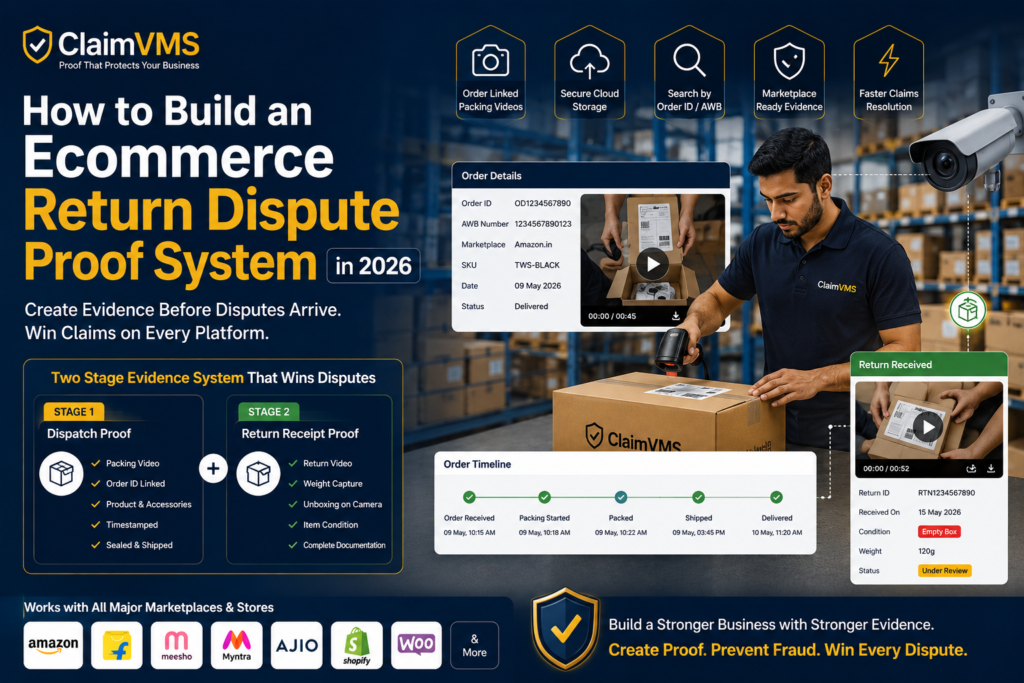
An Ecommerce Return Dispute Proof System is a structured process that creates, stores, and organizes visual evidence throughout the order fulfillment journey.
Rather than depending solely on invoices and courier records, the system captures packing videos linked directly to each shipment.
ClaimVMS helps businesses organize evidence by connecting every packing session with:
- Order ID
- AWB Number
- SKU
- Marketplace
- Date & Time
- Packing Station
- Warehouse Operator
This creates searchable records that can be quickly retrieved whenever required.
The Two Stages of an Effective Evidence System
A strong dispute management process consists of two separate evidence stages.
Both stages are equally important.
Stage 1 – Dispatch Proof
Dispatch proof documents exactly what leaves your warehouse.
This includes:
- Product condition before packing
- Correct SKU verification
- Included accessories
- Quantity verification
- Packaging process
- Parcel sealing
- Shipping label attachment
ClaimVMS records this process while linking the Order ID and shipment details to the video, making future retrieval simple and organized.
Stage 2 – Return Receipt Proof
The second stage begins when the returned parcel arrives back at your warehouse.
Instead of immediately opening the package, businesses should first document the return.
A recommended workflow includes:
- Recording the unopened parcel
- Capturing courier labels
- Measuring package weight
- Recording the complete unboxing process
- Photographing returned contents
- Documenting missing or damaged items
Combining dispatch proof with return receipt documentation creates a complete record of the shipment lifecycle.
Why Many Sellers Lose Return Disputes
Many ecommerce businesses already have warehouse CCTV.
However, CCTV alone rarely provides an organized dispute management process.
Common challenges include:
- Videos stored only by date and time
- No Order ID linkage
- Difficult video retrieval
- Manual searching through hours of recordings
- Missing packing sessions
- No centralized evidence dashboard
As order volumes increase, these issues become even more difficult to manage.
ClaimVMS addresses these operational challenges by organizing videos around shipment information rather than camera timelines.
What Makes Dispatch Evidence Strong?
Not every packing video provides useful evidence.
An effective dispatch recording should include several important elements.
1. Order-Specific Recording
Every video should correspond to a single customer order.
ClaimVMS associates the recording with:
- Order ID
- AWB
- SKU
- Marketplace details
This makes searching and retrieval much faster compared to traditional CCTV systems.
2. Recording During the Actual Packing Process
Evidence is strongest when it is created while the order is being packed.
The recording should clearly show:
- Product selection
- Product condition
- Quantity verification
- Accessories included
- Packaging materials
- Box sealing
- Shipping label placement
This creates a visual history of the dispatch process.
3. Clear Product Visibility
The camera should clearly capture:
- Product model
- Product appearance
- Serial number (where applicable)
- Accessories
- Packaging condition
A clear recording provides better documentation than footage where the product is partially visible or outside the camera frame.
4. Fast Retrieval During Investigations
Marketplace investigations often require businesses to respond within limited timeframes.
Searching through continuous CCTV recordings wastes valuable time.
ClaimVMS enables warehouse teams to retrieve videos using:
- Order ID
- AWB Number
- SKU
- Customer Order Number
This significantly improves evidence management during dispute handling.
Why ClaimVMS Is Built for Ecommerce Sellers
Unlike general-purpose CCTV software, ClaimVMS focuses specifically on ecommerce warehouse operations.
It helps businesses:
- Record packing videos
- Organize evidence
- Search by Order ID
- Manage shipment records
- Retrieve videos quickly
- Improve warehouse documentation
- Support dispute investigations
- Reduce manual effort during evidence collection
Whether your business processes 100 orders or 10,000 orders per day, maintaining organized evidence becomes increasingly important as order volume grows.
Building Return Receipt Proof That Strengthens Your Evidence
Creating packing videos is only half of an effective ecommerce dispute management process.
The second half begins when a returned parcel reaches your warehouse.
Many sellers immediately open returned packages without documenting their condition. If the parcel contains the wrong product, missing accessories, or an empty box, there is no reliable record showing exactly what was received.
A structured return documentation process helps create visual evidence before the package is inspected.
A recommended workflow includes:
- Record the sealed parcel before opening.
- Capture the courier label and AWB.
- Measure and record the parcel weight.
- Record the entire unboxing process without interruption.
- Photograph the returned items.
- Document any missing components, wrong products, or damaged packaging.
This process creates a complete record of the returned shipment.
Connecting Dispatch and Return Evidence
The strongest dispute documentation combines evidence from dispatch and return.
Dispatch evidence answers:
- What product was packed?
- Was every accessory included?
- Was the parcel sealed correctly?
- Which Order ID was dispatched?
Return evidence answers:
- What was actually returned?
- Was the parcel damaged?
- Were accessories missing?
- Was the wrong item sent back?
When both records are available, warehouse teams can compare the original shipment with the returned parcel much more efficiently.
ClaimVMS stores these records in a centralized dashboard, allowing businesses to locate related evidence using the same Order ID or AWB.
The Five Essential Components of a Return Dispute Proof System
An effective dispute proof system is more than just recording videos.
It combines technology with standardized warehouse processes.
1. Automated Packing Video Recording
Every dispatched order should have its own packing video.
Instead of relying on employees to manually start recordings, ClaimVMS helps automate the documentation process, reducing the possibility of missed recordings.
2. Order-Based Video Organization
Traditional CCTV stores videos according to:
- Camera Number
- Date
- Time
ClaimVMS organizes recordings using:
- Order ID
- AWB Number
- SKU
- Marketplace
- Customer Order Details
This structure allows warehouse teams to retrieve evidence much more efficiently.
3. Standardized Return Documentation
Every returned shipment should follow the same inspection process.
A standardized workflow ensures consistency across warehouse teams and reduces missing documentation during return investigations.
4. Centralized Evidence Management
As businesses grow, evidence becomes scattered across multiple devices and storage systems.
ClaimVMS centralizes:
- Packing Videos
- Return Videos
- Order Details
- Shipment Information
- Search History
- Warehouse Records
Everything remains connected to the original order.
5. Faster Evidence Retrieval
Marketplace response windows are often limited.
Searching manually through CCTV footage can consume valuable time.
With ClaimVMS, warehouse teams can locate videos using Order ID, AWB, or shipment details instead of reviewing hours of continuous recordings.
How ClaimVMS Simplifies the Entire Workflow
A typical ClaimVMS workflow looks like this:
Step 1
The warehouse operator begins packing an order.
Step 2
ClaimVMS links the Order ID, SKU, AWB, and marketplace information to the recording.
Step 3
The complete packing process is documented.
Step 4
The recording is securely stored and indexed.
Step 5
If a customer raises a dispute, the support team searches the Order ID.
Step 6
The packing video is instantly available for review and evidence preparation.
This organized workflow significantly reduces manual effort during investigations.
ClaimVMS vs Traditional Evidence Collection
| Feature | Traditional CCTV | ClaimVMS |
|---|---|---|
| Continuous Recording | ✓ | ✓ |
| Search by Order ID | ✗ | ✓ |
| Search by AWB | ✗ | ✓ |
| Shipment-Based Organization | ✗ | ✓ |
| Packing Video Management | Limited | ✓ |
| Evidence Dashboard | ✗ | ✓ |
| Warehouse-Friendly Search | ✗ | ✓ |
| Ecommerce-Focused Workflow | ✗ | ✓ |
| Multi-Marketplace Support | Limited | ✓ |
| Centralized Video Records | ✗ | ✓ |
Benefits for Amazon, Flipkart, Meesho, Shopify and D2C Sellers
As ecommerce businesses expand across multiple marketplaces, managing evidence manually becomes increasingly difficult.
ClaimVMS helps businesses:
- Organize warehouse operations
- Reduce manual video searching
- Improve dispute documentation
- Retrieve evidence quickly
- Maintain consistent warehouse processes
- Support customer service investigations
- Build stronger shipment records
- Improve operational efficiency
Whether processing 50 orders or several thousand orders daily, maintaining organized visual documentation becomes easier with a structured system.
Best Practices for Warehouse Teams
To build a reliable dispute-proof process, every warehouse should follow consistent operating procedures.
Recommended practices include:
- Keep the product visible throughout packing.
- Show accessories before sealing the parcel.
- Ensure shipping labels are clearly visible.
- Avoid camera blind spots.
- Use adequate lighting at packing stations.
- Follow the same recording process for every shipment.
- Document returned parcels before opening them.
- Store all evidence securely.
- Review recordings periodically for quality.
- Train warehouse staff on standardized documentation procedures.
Consistency is one of the most important factors in maintaining reliable shipment records.
Conclusion
Winning ecommerce disputes begins long before a customer raises a complaint.
Businesses that rely only on invoices, courier tracking, or warehouse CCTV often struggle to provide organized visual evidence during investigations.
A structured return dispute proof system creates documentation throughout the entire fulfillment lifecycle—from dispatch to return receipt.
ClaimVMS helps ecommerce businesses organize packing videos, shipment information, and return documentation into a centralized system that simplifies evidence management.
Whether you sell on Amazon, Flipkart, Meesho, Myntra, AJIO, Shopify, WooCommerce, or your own ecommerce website, implementing a structured proof system can improve warehouse efficiency, strengthen shipment documentation, and support faster dispute handling.
Frequently Asked Questions
Q1. What is an Ecommerce Return Dispute Proof System?
An Ecommerce Return Dispute Proof System is a structured process that records, stores, and organizes dispatch and return evidence for every shipment, making documentation easier to retrieve during customer disputes.
Q2. Why are packing videos important?
Packing videos provide visual documentation of the product, accessories, packaging, and parcel sealing before dispatch, helping businesses maintain better shipment records.
Q3. Can ClaimVMS work with existing warehouse cameras?
Yes. ClaimVMS is designed to work with compatible warehouse camera setups, allowing businesses to organize packing evidence without replacing existing infrastructure.
Q4. Which ecommerce platforms can use ClaimVMS?
ClaimVMS supports sellers operating on Amazon, Flipkart, Meesho, Myntra, AJIO, Shopify, WooCommerce, Magento, and custom ecommerce platforms.
Q5. How are videos searched in ClaimVMS?
Users can quickly locate recordings using Order ID, AWB Number, SKU, or shipment information through the centralized dashboard.
Q6. Who should use ClaimVMS?
ClaimVMS is ideal for ecommerce brands, D2C businesses, warehouses, fulfillment centers, third-party logistics (3PL) providers, and marketplace sellers looking to improve shipment documentation and return dispute management.