
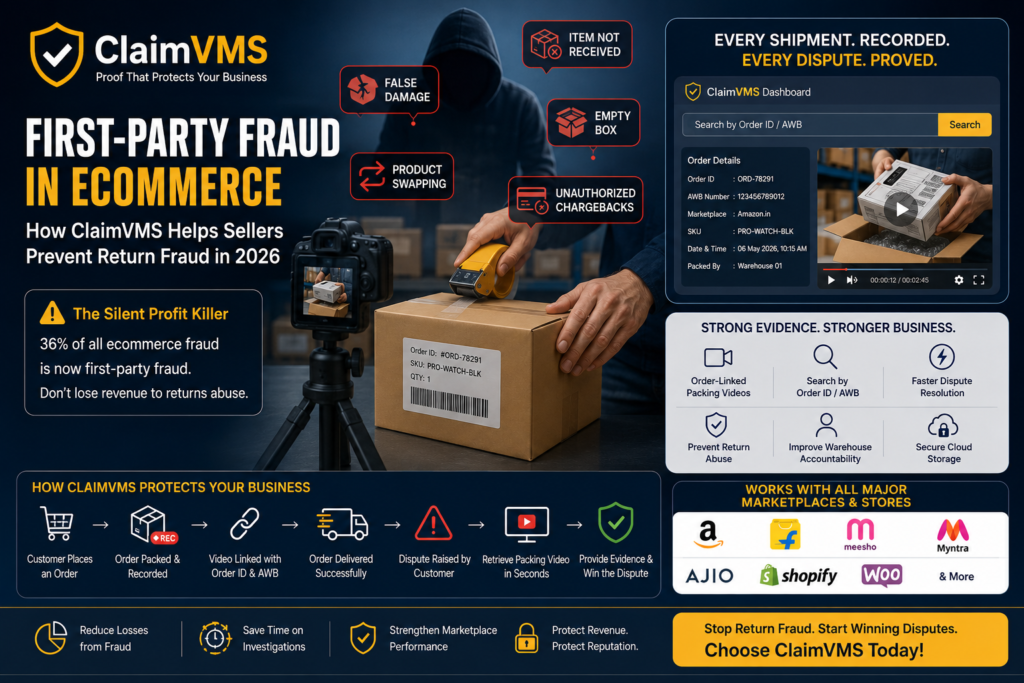
First-party fraud has become one of the fastest-growing challenges for ecommerce businesses worldwide. Unlike traditional payment fraud, first-party fraud is committed by genuine customers who complete legitimate purchases and later misuse return policies, chargebacks, or marketplace dispute systems to obtain refunds while keeping the product.
For sellers on Amazon, Flipkart, Meesho, Myntra, AJIO, Shopify, WooCommerce, and D2C websites, this type of fraud can result in significant financial losses, operational inefficiencies, and increased dispute management costs.
The biggest challenge is that first-party fraud does not occur during checkout—it happens after the product has been delivered.
By the time the dispute is raised, payment verification has already been completed, the order has been fulfilled, and the warehouse team has moved on to processing new shipments.
This is why traditional fraud prevention tools are often unable to protect sellers from post-purchase abuse.
ClaimVMS addresses this problem by creating structured, order-linked packing video evidence during fulfillment, enabling sellers to verify exactly what was packed and shipped before any dispute arises.
What Is First-Party Fraud in Ecommerce?
First-party fraud occurs when a genuine customer intentionally misuses the ecommerce return or dispute process for financial gain.
Unlike stolen credit card fraud, the customer places a legitimate order using their own payment method.
The fraudulent activity begins only after the product has been delivered.
Common examples include:
- Claiming the parcel never arrived
- Returning a different product
- Sending back an empty box
- Reporting false product damage
- Returning used products as new
- Filing unnecessary chargebacks
- Claiming missing accessories
- Submitting misleading return requests
Because the customer is legitimate, these transactions usually pass every payment verification system.
The fraud happens during the post-purchase stage rather than at checkout.
Why First-Party Fraud Is Increasing
Several factors have contributed to the rapid growth of first-party fraud.
These include:
- Growth of ecommerce marketplaces
- Simplified online return policies
- Instant refund expectations
- Social media refund tutorials
- AI-generated complaint messages
- Fake product damage images
- Abuse of customer-friendly policies
- Increased online shopping volumes
As return processes become more convenient, some customers exploit these systems to obtain refunds unfairly.
Businesses therefore require stronger verification methods throughout the fulfillment process.
Why Traditional Fraud Prevention Is Not Enough
Most ecommerce businesses already use fraud detection tools.
These systems analyze:
- Payment behavior
- Device fingerprints
- IP addresses
- Customer history
- Billing information
- Transaction patterns
- Geographic risk
- Purchase frequency
These technologies work well before an order is shipped.
However, they cannot answer fulfillment-related questions such as:
- Was the correct product packed?
- Were all accessories included?
- Was the product damaged before dispatch?
- Was the parcel sealed correctly?
- Which warehouse operator packed the shipment?
This information is only available if the fulfillment process itself has been documented.
Where ClaimVMS Makes the Difference
ClaimVMS focuses on the stage where first-party fraud actually occurs.
Instead of analyzing only payment risks, ClaimVMS creates visual shipment evidence during warehouse packing.
Every packing session can be associated with:
- Order ID
- AWB Number
- SKU
- Marketplace
- Date & Time
- Warehouse Operator
- Packing Station
This creates structured shipment records that can be searched quickly whenever a dispute is received.
Common Types of First-Party Fraud
Although first-party fraud appears in many forms, several patterns occur repeatedly across ecommerce businesses.
1. Item Not Received (INR) Claims
The customer claims the shipment was never delivered despite courier confirmation.
Support teams must investigate delivery records and shipment documentation before responding.
2. Item Not as Described (INAD)
Customers state that the received product differs from the listing even when the correct item was dispatched.
Without fulfillment-stage documentation, resolving these disputes becomes more challenging.
3. Product Swapping
The customer returns a different product while keeping the original item.
This is particularly common with electronics, branded accessories, and premium consumer products.
4. Empty Box Returns
Instead of returning the purchased item, the customer ships an empty parcel or replaces the contents with low-value objects.
Warehouse teams require accurate documentation during return inspection to identify such cases.
5. Used Product Returns
Products are used temporarily and later returned as unused.
Fashion products, consumer electronics, tools, and occasion-based purchases frequently experience this type of abuse.
Why Fulfillment Evidence Has Become Essential
Invoices, courier tracking, payment confirmations, and warehouse management systems all provide valuable operational information.
However, they do not visually verify:
- Which product entered the parcel
- Whether accessories were included
- Product condition before dispatch
- Packaging quality
- Parcel sealing process
ClaimVMS records the packing workflow to create searchable shipment evidence that supports warehouse investigations and dispute management.
How ClaimVMS Builds Order-Level Evidence
Rather than relying solely on warehouse CCTV, ClaimVMS organizes every packing session using shipment information.
During fulfillment, the system links each recording with:
- Order ID
- AWB Number
- SKU
- Marketplace
- Packing Date
- Warehouse Operator
Instead of manually searching hours of CCTV footage, warehouse teams simply search using the Order ID or AWB.
The corresponding packing video becomes available within seconds.
Why Video Evidence Matters More Than Ever
As ecommerce order volumes continue to grow, manual investigations become increasingly time-consuming.
Having organized shipment documentation helps businesses:
- Verify dispatched products
- Review packing quality
- Investigate customer complaints
- Improve warehouse accountability
- Reduce manual evidence collection
- Support marketplace dispute responses
- Maintain centralized shipment records
By creating evidence before disputes occur, businesses can manage investigations more efficiently while improving operational transparency.
Why Checkout Fraud Detection Cannot Stop First-Party Fraud
Most ecommerce businesses invest heavily in fraud prevention at the checkout stage.
Modern fraud detection systems evaluate:
- Credit card verification
- Device fingerprinting
- IP reputation
- Customer purchase history
- Payment authentication
- Billing and shipping address validation
- Transaction risk scores
These technologies are excellent for preventing stolen card fraud and suspicious transactions.
However, first-party fraud begins after the payment has been successfully completed.
The customer is genuine.
The payment is legitimate.
The order is dispatched correctly.
The dispute arises days or even weeks later.
This means checkout security alone cannot prevent customers from raising false claims such as:
- Item not received
- Wrong product delivered
- Missing accessories
- Empty box complaints
- Product swapping
- False damage claims
To address these situations, businesses need fulfillment-stage evidence rather than additional payment verification.
Building a Strong Fulfillment Evidence System
An effective fraud prevention strategy extends beyond payment security.
Every dispatched shipment should include structured documentation that verifies what actually left the warehouse.
A reliable fulfillment evidence system should include:
- Order-linked packing videos
- Product verification
- SKU confirmation
- Parcel sealing documentation
- Shipping label verification
- Timestamped recordings
- AWB linkage
- Centralized video storage
- Fast evidence retrieval
ClaimVMS helps businesses build this evidence layer without disrupting existing warehouse operations.
How ClaimVMS Works
ClaimVMS integrates seamlessly into the warehouse packing workflow.
The process is designed to be simple for warehouse teams while automatically organizing shipment records.
A typical workflow includes:
Step 1
The warehouse operator selects or scans the order.
Step 2
ClaimVMS links the shipment information, including:
- Order ID
- AWB Number
- SKU
- Marketplace
- Date & Time
- Warehouse Operator
Step 3
The complete packing process is recorded, including:
- Product verification
- Quantity confirmation
- Accessories
- Packaging materials
- Parcel sealing
- Shipping label placement
Step 4
The recording is securely stored and indexed.
Step 5
If a customer raises a dispute, the warehouse or support team searches the Order ID or AWB.
The corresponding packing video becomes instantly available.
This significantly reduces manual effort compared to searching through continuous CCTV footage.
ClaimVMS vs Traditional Fraud Prevention
| Feature | Traditional Fraud Detection | ClaimVMS |
|---|---|---|
| Payment Risk Analysis | ✓ | ✗ |
| Device Fingerprinting | ✓ | ✗ |
| Customer Behavior Analysis | ✓ | ✗ |
| AI Transaction Monitoring | ✓ | ✗ |
| Packing Video Recording | ✗ | ✓ |
| Order ID Linked Evidence | ✗ | ✓ |
| AWB Search | ✗ | ✓ |
| SKU Verification | ✗ | ✓ |
| Shipment Verification | ✗ | ✓ |
| Marketplace Evidence Management | Limited | ✓ |
| Warehouse Video Dashboard | ✗ | ✓ |
Rather than replacing fraud detection tools, ClaimVMS strengthens the fulfillment stage by creating structured shipment evidence.
Benefits for Amazon, Flipkart, Meesho, Shopify and D2C Sellers
Modern ecommerce businesses often sell across multiple marketplaces simultaneously.
Managing shipment evidence separately for every platform becomes increasingly difficult as order volumes grow.
ClaimVMS provides a centralized system that helps businesses:
- Organize packing videos
- Retrieve shipment evidence quickly
- Improve warehouse accountability
- Reduce manual investigations
- Maintain consistent shipment documentation
- Support customer service teams
- Improve operational efficiency
- Strengthen marketplace dispute management
Whether processing 100 orders or 20,000 shipments every month, structured fulfillment evidence improves warehouse visibility.
Best Practices for Marketplace Sellers
To minimize first-party fraud and improve shipment verification, warehouses should adopt standardized procedures.
Recommended practices include:
- Record every packing session.
- Keep the product fully visible.
- Show accessories before sealing.
- Verify SKU and quantity.
- Clearly capture shipping labels.
- Maintain proper camera positioning.
- Avoid blind spots.
- Use adequate warehouse lighting.
- Store all recordings securely.
- Standardize packing procedures across all operators.
Consistency ensures that every shipment follows the same documentation process.
The Future of First-Party Fraud Prevention
As ecommerce continues to grow, fraud prevention will increasingly rely on a combination of:
- Artificial Intelligence
- Warehouse automation
- Video Management Systems
- Order-linked packing videos
- Shipment verification
- Automated evidence management
- Marketplace integrations
- Data analytics
Businesses that document fulfillment rather than relying solely on payment verification will be better prepared to handle future fraud trends.
ClaimVMS is built to support this evolution by combining warehouse video management with structured shipment records.
Conclusion
First-party fraud is no longer an occasional issue—it has become one of the most significant operational challenges facing ecommerce sellers.
Traditional fraud detection systems are designed to stop suspicious transactions before payment, but they cannot verify what happened during fulfillment.
ClaimVMS closes this gap by creating searchable, order-linked packing videos that document every shipment before it leaves the warehouse.
By combining fulfillment-stage evidence with existing fraud prevention technologies, businesses can improve warehouse accountability, simplify investigations, and manage marketplace disputes more efficiently.
Whether you sell on Amazon, Flipkart, Meesho, Myntra, AJIO, Shopify, WooCommerce, or your own ecommerce website, building a structured proof system is an important step toward reducing first-party fraud and protecting your business.
Frequently Asked Questions
Q1. What is first-party fraud in ecommerce?
First-party fraud occurs when a genuine customer intentionally misuses the return or dispute process after receiving a legitimately purchased product, often attempting to obtain a refund while keeping the item.
Q2. Why is first-party fraud increasing?
Growing ecommerce adoption, easier return policies, AI-generated complaint content, social media refund tutorials, and marketplace-friendly refund processes have contributed to increased first-party fraud.
Q3. How does ClaimVMS help reduce first-party fraud?
ClaimVMS automatically records order-linked packing videos, allowing businesses to verify shipped products through searchable fulfillment evidence whenever disputes arise.
Q4. Can ClaimVMS work with existing warehouse cameras?
Yes. ClaimVMS is designed to integrate with compatible warehouse camera systems, allowing businesses to organize packing videos without replacing existing hardware.
Q5. Which ecommerce platforms does ClaimVMS support?
ClaimVMS supports Amazon, Flipkart, Meesho, Myntra, AJIO, Shopify, WooCommerce, Magento, and custom ecommerce websites.
Q6. Who should use ClaimVMS?
ClaimVMS is ideal for ecommerce brands, D2C businesses, warehouse operators, fulfillment centers, third-party logistics (3PL) providers, and marketplace sellers looking to improve shipment documentation, reduce first-party fraud, and strengthen dispute management.