
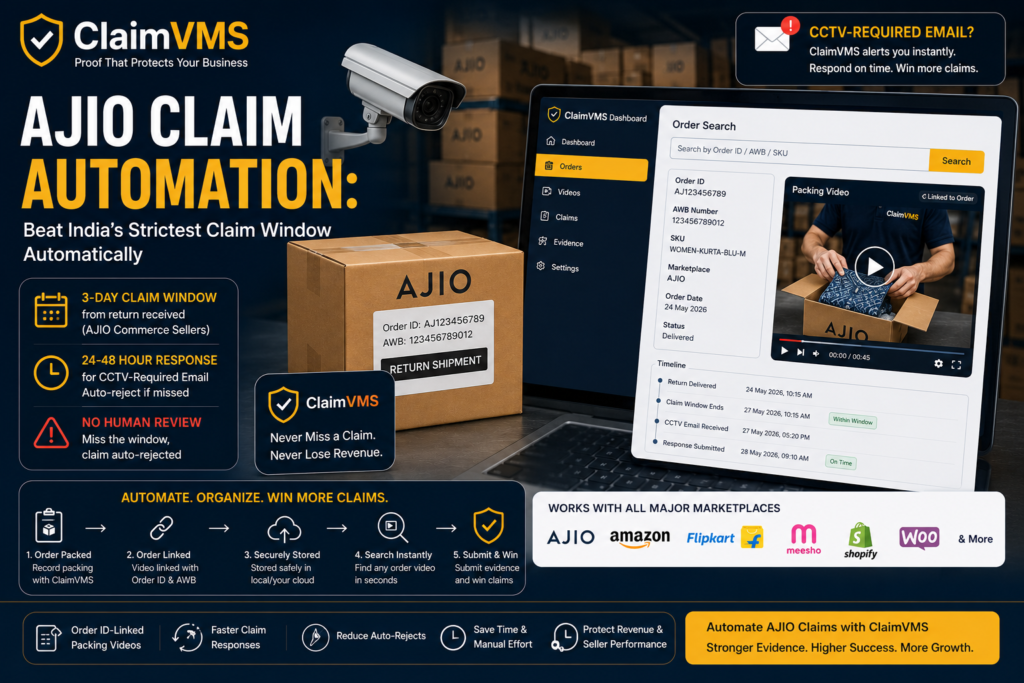
Selling on AJIO offers tremendous growth opportunities for fashion, lifestyle, electronics, and consumer goods brands. However, many sellers quickly discover that managing disputes on AJIO requires a completely different approach compared to other marketplaces.
Unlike marketplaces with longer claim timelines, AJIO operates one of the shortest response windows for seller claims. Missing a deadline—even by a few hours—can result in an automatic rejection before the evidence is reviewed.
For businesses processing hundreds of daily orders, manually tracking every return, locating warehouse videos, and preparing supporting documents becomes increasingly difficult.
This is where ClaimVMS transforms the entire process.
Instead of relying on manual follow-ups, ClaimVMS automates packing video management, organizes shipment evidence using Order IDs and AWB numbers, and helps sellers retrieve the required proof within seconds whenever an AJIO dispute is raised.
Whether you sell on AJIO, Amazon, Flipkart, Myntra, Meesho, Shopify, WooCommerce, or your own D2C website, having an automated evidence management system significantly improves operational efficiency and dispute readiness.
Why AJIO Claims Are Different
Every ecommerce marketplace has its own dispute process.
AJIO stands out because sellers must respond within limited timelines while submitting clear and organized shipment evidence.
A typical claim often requires businesses to:
- Verify the disputed order
- Retrieve packing records
- Locate shipment details
- Prepare supporting documents
- Submit evidence within the required timeframe
When these tasks depend entirely on manual processes, delays become unavoidable.
As order volumes grow, maintaining consistent response times becomes even more challenging.
Why Manual Claim Management Creates Problems
Many warehouse teams still manage disputes manually.
Their typical workflow looks like this:
- Receive dispute notification
- Inform warehouse team
- Search CCTV recordings
- Match recording timestamps
- Locate shipping information
- Download video
- Trim footage
- Upload evidence
- Submit claim
This process consumes valuable time and increases the possibility of missing important deadlines.
During sales events, weekends, or festive seasons, these delays become even more noticeable.
Why Traditional CCTV Is Not Enough
Most ecommerce warehouses already have CCTV systems.
However, CCTV was designed for warehouse surveillance—not marketplace dispute management.
Traditional CCTV stores footage using:
- Camera Number
- Recording Date
- Recording Time
It does not organize recordings using:
- Order ID
- AWB Number
- SKU
- Marketplace
- Customer Order
When AJIO requests evidence for a specific order, manually searching through continuous recordings can take hours.
ClaimVMS solves this problem by automatically organizing packing videos around shipment information rather than timestamps.
What Is AJIO Claim Automation?
AJIO Claim Automation is the process of organizing fulfillment evidence and claim documentation so warehouse teams can respond quickly whenever disputes occur.
Instead of manually searching videos and shipment records, ClaimVMS automatically links every packing video with:
- Order ID
- AWB Number
- SKU
- Marketplace
- Date & Time
- Warehouse Operator
- Packing Station
This creates searchable shipment records that are available whenever needed.
The Three Most Important Stages of Claim Management
An efficient claim management process consists of three connected stages.
Stage 1 – Shipment Documentation
The first stage begins during warehouse packing.
Every shipment should include documentation showing:
- Correct product
- Quantity verification
- Accessories
- Packaging
- Parcel sealing
- Shipping label placement
ClaimVMS records this process automatically while associating the shipment details with the recording.
Stage 2 – Organized Evidence Storage
Recording videos alone is not enough.
Businesses must also organize evidence so it can be retrieved quickly.
ClaimVMS indexes recordings using:
- Order ID
- AWB
- SKU
- Marketplace
- Customer Order Details
Instead of searching by time, warehouse teams simply search by shipment information.
Stage 3 – Faster Evidence Retrieval
When a dispute is received, speed becomes critical.
Rather than reviewing hours of CCTV footage, ClaimVMS allows warehouse teams to retrieve the required packing video within seconds using the Order ID or AWB.
This significantly reduces manual effort during investigations.
Common Reasons Sellers Struggle with AJIO Claims
Many businesses experience similar operational challenges.
These include:
- Manual video searching
- Disorganized warehouse recordings
- Missing shipment documentation
- Difficulty locating older videos
- High order volumes
- Weekend claim notifications
- Multiple marketplaces
- Lack of centralized evidence management
As businesses scale, these challenges become increasingly difficult to manage without automation.
How ClaimVMS Simplifies AJIO Claim Management
ClaimVMS is designed specifically for ecommerce fulfillment operations.
Instead of functioning as general CCTV software, it focuses on creating structured shipment evidence.
During every packing session, ClaimVMS records:
- Product verification
- SKU confirmation
- Quantity checks
- Accessories
- Packaging process
- Parcel sealing
- Shipping label attachment
Each recording is linked directly with shipment information, making future retrieval fast and reliable.
Why Order-Linked Packing Videos Matter
Marketplace disputes often require businesses to verify exactly what was packed.
General CCTV footage may show warehouse activity, but it rarely identifies a specific shipment.
ClaimVMS organizes videos using:
- Order ID
- AWB Number
- SKU
- Marketplace
- Date & Time
This makes locating the correct evidence significantly easier than manually searching CCTV timelines.
How ClaimVMS Works
ClaimVMS is designed to simplify the entire evidence management process for ecommerce sellers.
Instead of relying on manual CCTV searches, the platform automatically creates searchable packing records while orders are being fulfilled.
A typical workflow looks like this:
Step 1
A warehouse operator scans or selects an order for packing.
Step 2
ClaimVMS automatically associates the shipment with:
- Order ID
- AWB Number
- SKU
- Marketplace
- Date & Time
- Warehouse Operator
- Packing Station
Step 3
The complete packing process is recorded, including:
- Product verification
- Quantity confirmation
- Accessories
- Packaging materials
- Parcel sealing
- Shipping label attachment
Step 4
The recording is securely stored and indexed.
Step 5
If AJIO requests evidence, the support team simply searches using the Order ID or AWB.
The corresponding packing video is available within seconds, eliminating the need to manually search CCTV footage.
ClaimVMS vs Traditional CCTV
Traditional CCTV systems are designed for warehouse surveillance.
ClaimVMS is built specifically for ecommerce fulfillment and marketplace dispute management.
| Feature | Traditional CCTV | ClaimVMS |
|---|---|---|
| Continuous Recording | ✓ | ✓ |
| Search by Order ID | ✗ | ✓ |
| Search by AWB | ✗ | ✓ |
| SKU-Based Search | ✗ | ✓ |
| Marketplace-Based Search | ✗ | ✓ |
| Packing Video Management | Limited | ✓ |
| Centralized Evidence Dashboard | ✗ | ✓ |
| Shipment Verification | ✗ | ✓ |
| Warehouse Investigation Tools | ✗ | ✓ |
| Marketplace Claim Support | Limited | ✓ |
Instead of reviewing hours of recordings, warehouse teams can instantly retrieve shipment-specific evidence.
Benefits of ClaimVMS for AJIO Sellers
Managing claims manually becomes increasingly difficult as daily order volumes increase.
ClaimVMS helps sellers by:
- Organizing packing videos automatically
- Reducing manual video searches
- Simplifying evidence retrieval
- Improving warehouse accountability
- Supporting customer service teams
- Maintaining searchable shipment records
- Standardizing warehouse documentation
- Improving operational efficiency
Whether processing 50 or 5,000 orders daily, having centralized shipment evidence significantly reduces administrative workload.
Supporting Multiple Ecommerce Marketplaces
Many businesses sell on several marketplaces simultaneously.
Managing separate evidence systems for each platform creates unnecessary complexity.
ClaimVMS supports businesses selling through:
- AJIO
- Amazon India
- Flipkart
- Meesho
- Myntra
- Shopify
- WooCommerce
- Magento
- Custom ecommerce websites
A single dashboard allows warehouse teams to organize evidence across all supported sales channels.
Best Practices for Warehouse Teams
Automation is most effective when supported by consistent warehouse processes.
Recommended best practices include:
- Record every packing session.
- Verify products before sealing parcels.
- Show all included accessories.
- Capture shipping labels clearly.
- Keep products visible throughout the recording.
- Avoid camera blind spots.
- Maintain proper warehouse lighting.
- Securely store shipment records.
- Train warehouse operators regularly.
- Follow standardized packing procedures.
These practices improve the quality and consistency of fulfillment documentation.
Why Automation Improves Claim Success
Manual claim handling often introduces delays.
Warehouse teams may need to:
- Search CCTV recordings
- Verify shipment details
- Download videos
- Rename files
- Match Order IDs
- Prepare supporting documents
Automation reduces these repetitive tasks by organizing evidence from the moment an order is packed.
With ClaimVMS, businesses can:
- Retrieve shipment records faster
- Respond to disputes more efficiently
- Reduce manual workload
- Improve warehouse productivity
- Maintain organized evidence for future investigations
The Future of Marketplace Claim Management
As ecommerce continues to grow, dispute handling is becoming increasingly data-driven.
Future warehouse operations will depend on:
- Order-linked packing videos
- AI-assisted evidence retrieval
- Warehouse automation
- Centralized video management
- Intelligent search
- Marketplace integrations
- Automated documentation
- Analytics-driven operations
Businesses that adopt structured evidence management today will be better prepared for the evolving requirements of ecommerce marketplaces.
ClaimVMS is designed to support this transformation by providing organized, searchable, and scalable fulfillment evidence.
Conclusion
Managing marketplace disputes manually becomes increasingly difficult as ecommerce businesses scale.
Traditional CCTV systems provide warehouse surveillance but are not designed to manage shipment-specific evidence.
ClaimVMS bridges this gap by automatically recording packing videos, linking them with Order IDs and AWB numbers, and organizing them into a searchable evidence management system.
Whether you sell on AJIO, Amazon, Flipkart, Meesho, Myntra, Shopify, WooCommerce, or your own ecommerce website, ClaimVMS helps improve warehouse documentation, streamline evidence retrieval, and simplify marketplace claim management.
By replacing manual workflows with structured automation, businesses can respond to disputes faster while maintaining organized shipment records for every order.
Frequently Asked Questions
Q1. What is AJIO Claim Automation?
AJIO Claim Automation is the process of organizing shipment documentation and packing evidence so sellers can retrieve the required records quickly whenever a marketplace dispute occurs.
Q2. Why is Order ID-linked packing video important?
Order ID-linked packing videos allow businesses to retrieve evidence using a specific shipment instead of manually searching CCTV footage by date and time.
Q3. Can ClaimVMS work with existing warehouse cameras?
Yes. ClaimVMS integrates with compatible warehouse camera systems, allowing businesses to organize packing videos without replacing their existing hardware.
Q4. Which ecommerce platforms does ClaimVMS support?
ClaimVMS supports AJIO, Amazon, Flipkart, Meesho, Myntra, Shopify, WooCommerce, Magento, and custom ecommerce websites.
Q5. How are packing videos retrieved?
Users can search recordings using Order ID, AWB Number, SKU, or shipment information through the centralized ClaimVMS dashboard.
Q6. Who should use ClaimVMS?
ClaimVMS is suitable for ecommerce brands, D2C businesses, warehouse operators, fulfillment centers, third-party logistics (3PL) providers, and marketplace sellers looking to improve fulfillment documentation and streamline dispute management.