
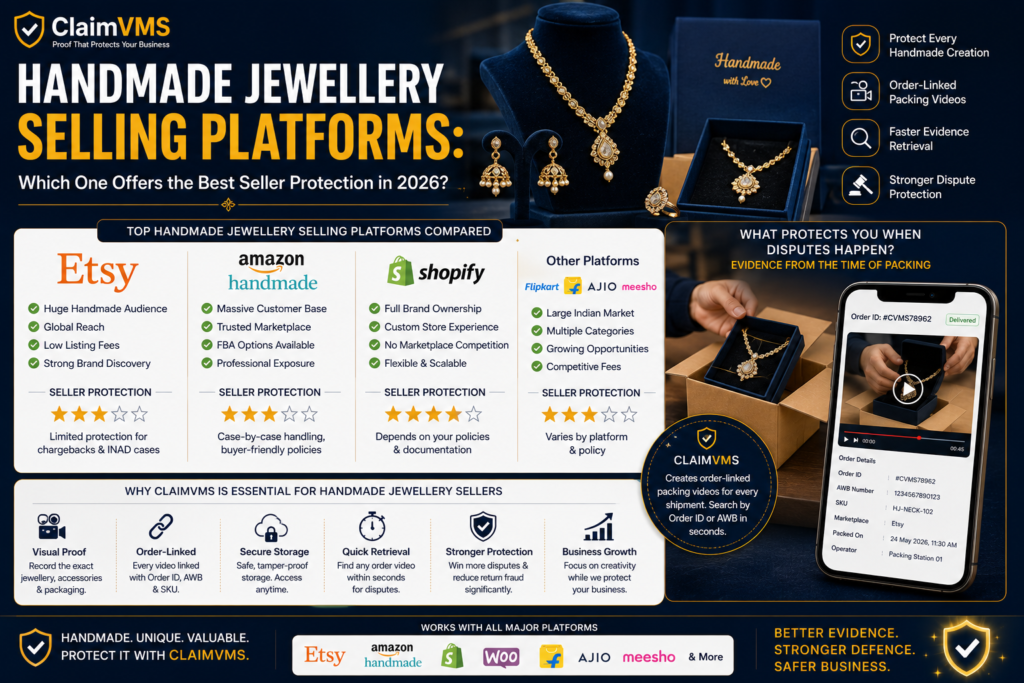
Selling handmade jewellery online has never been easier. Today, independent jewellery makers can reach customers worldwide through marketplaces such as Etsy, Amazon Handmade, Shopify, Flipkart, AJIO, Meesho, and their own ecommerce websites.
Most comparison guides focus on marketplace fees, customer reach, marketing opportunities, and ease of listing products.
While these factors are important, they overlook one critical question:
What happens when a customer files a false return or dispute?
For handmade jewellery sellers, every product is unique.
Unlike mass-produced items, a handcrafted necklace, bracelet, ring, or pendant cannot always be replaced with an identical piece. Every design represents hours of craftsmanship, expensive materials, and creative effort.
When a fraudulent return succeeds, sellers lose far more than a single sale.
They lose their product, their time, their craftsmanship, and often their profit.
This is where ClaimVMS provides an additional layer of protection.
Instead of depending solely on invoices, courier tracking, or marketplace policies, ClaimVMS creates order-linked packing videos that provide visual documentation for every dispatched order.
Whether you sell on Etsy, Amazon Handmade, Shopify, Flipkart, AJIO, Meesho, WooCommerce, or your own D2C website, organized shipment evidence helps businesses investigate disputes more efficiently.
Why Handmade Jewellery Disputes Are Different
Selling handmade jewellery is fundamentally different from selling factory-manufactured products.
Mass-produced products are identical.
Handmade products are not.
Even when using the same materials and design, slight variations naturally occur because every item is individually crafted.
This creates unique challenges during customer disputes.
For example:
- Every gemstone has different characteristics.
- Metal finishes may vary slightly.
- Hand engraving creates natural variations.
- Customized jewellery cannot be reproduced exactly.
- Bespoke orders are unique to one customer.
When customers claim the product received is “different” from the listing, sellers need documentation that verifies exactly what was shipped.
Why Seller Protection Matters More Than Marketplace Fees
Many new jewellery businesses compare marketplaces using:
- Listing fees
- Transaction charges
- Commission percentages
- Monthly subscriptions
- Customer traffic
- Marketing features
While these comparisons are useful, they rarely discuss dispute management.
Questions sellers should also consider include:
- How are return disputes handled?
- What evidence is accepted?
- How long can buyers raise disputes?
- How are chargebacks managed?
- How quickly must sellers respond?
- What documentation is required?
These factors directly affect long-term profitability.
Common Disputes Faced by Handmade Jewellery Sellers
Handmade jewellery businesses commonly receive disputes involving:
- Item Not As Described (INAD)
- Wrong Item Received
- Empty Parcel Claims
- Missing Jewellery Pieces
- Missing Accessories
- Product Swapping
- Damaged Product Claims
- Chargebacks
- Fake Return Requests
Without fulfillment-stage evidence, resolving these disputes becomes significantly more difficult.
Why Traditional Documentation Is Often Insufficient
Most jewellery businesses maintain records such as:
- Product photographs
- Customer invoices
- Courier tracking
- Shipping labels
- Payment receipts
- Inventory records
While these records are essential, they do not visually verify:
- Which jewellery piece was packed
- Product condition before dispatch
- Included accessories
- Packaging quality
- Parcel sealing process
ClaimVMS adds this missing layer by recording the packing process and linking it to the corresponding order.
Comparing Popular Handmade Jewellery Selling Platforms
Every ecommerce platform offers different strengths.
The best choice depends on your business goals, customer base, and preferred selling model.
Etsy
Etsy remains one of the world’s most popular marketplaces for handmade products.
It is particularly suitable for:
- Handmade jewellery
- Personalized gifts
- Artisan products
- Custom-made accessories
- Vintage collections
Advantages include:
- Strong handmade-focused customer base
- Global marketplace
- Easy product listings
- Established buyer trust
- Large artisan community
However, sellers still need strong shipment documentation when customer disputes arise.
Amazon Handmade
Amazon Handmade allows verified artisans to sell handcrafted products within Amazon’s marketplace.
Ideal for:
- Established jewellery brands
- Higher-volume businesses
- Premium handcrafted products
- Businesses expanding internationally
Benefits include:
- Large customer reach
- Amazon trust
- Professional marketplace
- Fulfillment options
- Strong logistics network
As order volumes increase, maintaining organized shipment evidence becomes increasingly important.
Shopify
Shopify offers complete control over branding and customer experience.
It is suitable for:
- D2C jewellery brands
- Luxury jewellery stores
- Custom collections
- Social media businesses
- Premium handmade brands
Benefits include:
- Complete store ownership
- Custom branding
- Flexible marketing
- Customer relationship management
- No marketplace competition
Since Shopify stores manage their own customer disputes, maintaining fulfillment documentation is particularly valuable.
Selling Across Multiple Platforms
Many successful jewellery brands sell simultaneously on:
- Etsy
- Amazon Handmade
- Shopify
- WooCommerce
- Flipkart
- AJIO
- Meesho
While this expands customer reach, it also increases operational complexity.
Businesses must manage:
- Multiple order sources
- Different return policies
- Different dispute timelines
- Separate customer communications
- Various evidence requirements
Managing this manually becomes increasingly difficult as order volumes grow.
Why Order-Level Evidence Has Become Essential
The biggest challenge is not creating beautiful product listings.
The challenge is proving exactly what was shipped.
ClaimVMS automatically records packing videos and links every shipment with:
- Order ID
- AWB Number
- SKU
- Marketplace
- Date & Time
- Warehouse Operator
Instead of manually searching warehouse recordings, businesses can retrieve shipment evidence within seconds using the Order ID.
This organized approach simplifies dispute investigations across multiple ecommerce platforms.
How ClaimVMS Works for Handmade Jewellery Sellers
Handmade jewellery sellers face unique challenges because every order is different. Unlike factory-made products, handcrafted jewellery often includes natural variations, custom engravings, unique gemstones, and personalized designs.
ClaimVMS simplifies evidence management by creating Order ID-linked packing videos for every shipment.
A typical workflow includes:
Step 1
The jewellery order is prepared for dispatch.
Step 2
ClaimVMS automatically associates the shipment with:
- Order ID
- AWB Number
- SKU
- Marketplace
- Customer Order
- Date & Time
- Warehouse Operator
Step 3
The complete packing process is recorded, including:
- Finished jewellery piece
- Product quality inspection
- Gemstone verification
- Accessories
- Jewellery box
- Warranty card
- Certificate of Authenticity (if applicable)
- Invoice placement
- Parcel sealing
- Shipping label attachment
Step 4
The packing video is securely stored and indexed.
Step 5
If a customer raises a dispute weeks or months later, the seller simply searches the Order ID or AWB to retrieve the corresponding packing video.
This eliminates the need to manually search CCTV footage or rely only on product photos.
Why Product Photos Alone Are Not Enough
Many handmade jewellery businesses believe professional product photography is sufficient evidence.
Unfortunately, listing photos only show the sample product—not the exact piece shipped to the customer.
For example, listing photos cannot confirm:
- Which gemstone was packed
- Which ring was dispatched
- Which engraving was completed
- Which necklace was sealed
- Which earrings were included
- What accessories accompanied the order
ClaimVMS fills this gap by documenting the actual dispatched product.
ClaimVMS vs Traditional Documentation
| Feature | Traditional Documentation | ClaimVMS |
|---|---|---|
| Product Photos | ✓ | ✓ |
| Invoice Records | ✓ | ✓ |
| Courier Tracking | ✓ | ✓ |
| Packing Video | ✗ | ✓ |
| Order ID Linked Evidence | ✗ | ✓ |
| AWB Search | ✗ | ✓ |
| SKU Verification | ✗ | ✓ |
| Jewellery Verification | ✗ | ✓ |
| Marketplace Evidence Management | Limited | ✓ |
| Centralized Dashboard | ✗ | ✓ |
Instead of scattered documents, ClaimVMS creates a single searchable evidence system for every shipment.
Benefits for Multi-Platform Jewellery Businesses
Many jewellery brands sell across multiple channels simultaneously.
Typical sales channels include:
- Etsy
- Amazon Handmade
- Shopify
- WooCommerce
- Flipkart
- AJIO
- Meesho
- Instagram Shop
- Facebook Shop
- Independent websites
Managing evidence separately for each platform becomes increasingly difficult as orders grow.
ClaimVMS provides one centralized platform that works across all supported marketplaces.
Benefits include:
- Unified evidence management
- Faster shipment verification
- Instant video retrieval
- Reduced manual searching
- Better warehouse accountability
- Improved customer support
- Organized order history
- Simplified dispute investigations
Protecting High-Value Handmade Jewellery
Premium handmade jewellery often includes:
- Gold jewellery
- Sterling silver collections
- Diamond jewellery
- Gemstone jewellery
- Bridal jewellery
- Customized engagement rings
- Personalized pendants
- Luxury handcrafted collections
For these products, a single fraudulent return can represent thousands of rupees—or even lakhs—in losses.
Creating fulfillment-stage evidence helps businesses maintain better shipment records and investigate disputes more effectively.
Best Practices for Handmade Jewellery Shipping
To improve documentation quality, jewellery businesses should follow standardized packing procedures.
Recommended practices include:
- Inspect every jewellery piece before packing.
- Record close-up views of gemstones and finishes.
- Show serial numbers where applicable.
- Display certificates of authenticity.
- Include warranty cards in the recording.
- Capture all accessories before sealing.
- Clearly record shipping labels.
- Avoid camera blind spots.
- Maintain consistent lighting.
- Securely store all packing videos.
Following a consistent process improves the quality and reliability of shipment documentation.
Future of Handmade Jewellery Seller Protection
As ecommerce continues to evolve, seller protection will rely increasingly on:
- AI-powered fraud detection
- Order-linked packing videos
- Warehouse automation
- Centralized evidence management
- Intelligent video search
- Marketplace integrations
- Cloud-based video storage
- Data-driven dispute management
Businesses that invest in structured evidence systems today will be better prepared for future marketplace requirements.
ClaimVMS is designed to support this evolution by combining warehouse video management with organized shipment records.
Conclusion
Choosing the right handmade jewellery selling platform involves much more than comparing fees or customer traffic.
Long-term success also depends on how effectively sellers can protect themselves when disputes arise.
Whether you sell on Etsy, Amazon Handmade, Shopify, Flipkart, AJIO, Meesho, WooCommerce, or your own ecommerce website, maintaining organized fulfillment evidence has become an essential part of modern ecommerce operations.
ClaimVMS helps handmade jewellery businesses create Order ID-linked packing videos, organize shipment records, and retrieve evidence within seconds whenever disputes occur.
By combining structured warehouse documentation with centralized video management, jewellery sellers can improve operational efficiency, strengthen dispute investigations, and better protect the value of every handcrafted creation.
Frequently Asked Questions
Q1. Which platform is best for selling handmade jewellery?
The ideal platform depends on your business goals. Etsy is popular for artisan products, Amazon Handmade offers broad customer reach, and Shopify provides complete brand ownership. Many successful businesses sell across multiple platforms simultaneously.
Q2. Why are handmade jewellery disputes different from other products?
Every handmade jewellery piece is unique. Unlike mass-produced products, slight variations in gemstones, finishes, engravings, and craftsmanship make order-specific documentation especially important during dispute investigations.
Q3. How does ClaimVMS help handmade jewellery sellers?
ClaimVMS automatically records Order ID-linked packing videos, allowing sellers to retrieve shipment evidence quickly whenever customer disputes arise.
Q4. Can ClaimVMS work with existing warehouse cameras?
Yes. ClaimVMS is designed to integrate with compatible warehouse camera systems without requiring businesses to replace their existing hardware.
Q5. Which ecommerce platforms are supported?
ClaimVMS supports Etsy, Amazon Handmade, Shopify, WooCommerce, Flipkart, AJIO, Meesho, Magento, and custom ecommerce websites.
Q6. Who should use ClaimVMS?
ClaimVMS is ideal for handmade jewellery makers, artisan brands, D2C businesses, luxury jewellery retailers, fulfillment centers, warehouse operators, and marketplace sellers looking to improve shipment documentation and dispute management.
This conversion is based on your uploaded TrackVid article and rewritten specifically for ClaimVMS.